

TL;DR:
- DNA testing helps individuals confirm biological relationships and explore genetic health traits through analysis of DNA samples. Different test types vary in purpose, accuracy, and what they can reveal, with paternity tests reaching up to 99.99% certainty and kinship tests reporting a Combined Relationship Index (CRI). Results are most reliable when from accredited labs and when appropriate tests are matched to specific questions, with clinical follow-up recommended for health-related findings.
A DNA test for personal knowledge is a scientific analysis of your genetic material used to uncover information about biological relationships and potential health traits. Known in the industry as direct-to-consumer (DTC) genetic testing, this practice has grown from a niche curiosity into a mainstream tool for self-discovery. Whether you want to confirm a family relationship or learn about inherited traits, personal genetic testing offers a concrete starting point. This article explains the main test types, how the process works, what you can realistically expect from your results, and where the limits of consumer testing begin.
What is a DNA test for personal knowledge, and what types exist?
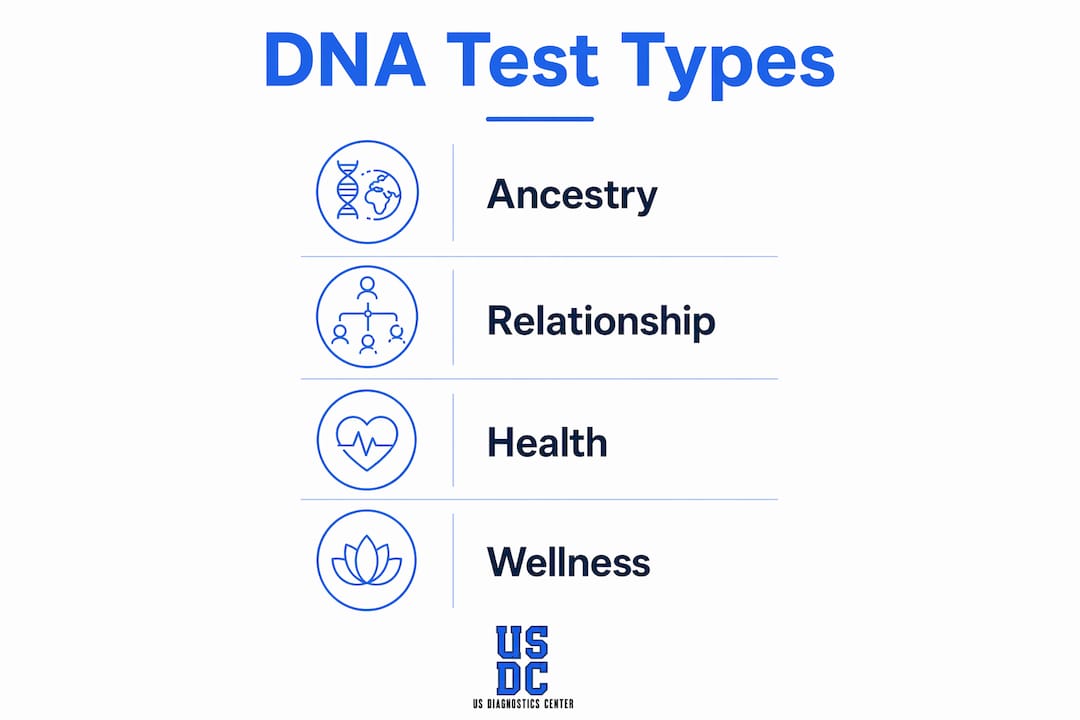
Personal DNA tests fall into distinct categories, each designed for a different purpose. The main categories cover health and wellness and relationship testing. Understanding which category fits your goal prevents wasted money and misread results.
Relationship tests
Relationship testing, including paternity and kinship DNA testing, confirms or rules out biological connections between individuals. These tests analyze specific genetic markers shared between relatives and calculate a Combined Relationship Index (CRI) for kinship tests, or a probability of paternity for parentage tests. Paternity tests are the most common, but sibling, grandparent, and avuncular tests follow the same core logic.
Health and wellness tests
Health-focused DTC tests screen for carrier status, pharmacogenomic responses, and polygenic risk scores. Carrier screening tells you whether you carry a gene variant associated with a heritable condition. Pharmacogenomics indicates how your body may metabolize certain medications. Polygenic risk scores estimate your statistical likelihood of developing conditions like heart disease or type 2 diabetes.
| Test type | Primary purpose | DNA analyzed | Typical sample |
|---|---|---|---|
| Paternity/kinship | Biological relationship | Autosomal markers | Cheek swab |
| Health and wellness | Carrier status, trait tendencies | Selected SNP variants | Saliva |
Pro Tip: If your primary goal is confirming a biological relationship for personal peace of mind, a relationship test analyzing up to 28 genetic markers gives you the clearest answer.
How does DNA testing work from sample to result?
Most consumer personal DNA tests use a painless at-home collection method, either a saliva tube or a cheek swab. At-home collection is straightforward and does not require a clinic visit or medical professional. You collect the sample, seal it in the provided packaging, and mail it to the lab using the prepaid return envelope included with your kit.

Once the sample arrives at the laboratory, technicians extract DNA from the cells in your saliva or cheek cells. The lab then runs the sample through a microarray or sequencing process to read specific points in your genome called single nucleotide polymorphisms (SNPs). Consumer tests typically analyze about 0.02% of the genome via microarray chips. That fraction is enough for trait tendencies, but it is not sufficient for rare variant detection or clinical diagnosis.
Turnaround times vary by test type and lab. Relationship tests from specialized labs like US Diagnostics Center process samples in 2–3 business days in the lab, with standard order-to-results delivery in 7–10 business days. Expedited options are available when timing is critical.
The distinction between DTC and clinician-ordered genetic tests matters significantly for how results can be used. Clinical tests use more comprehensive sequencing with strict chain-of-custody protocols, making them valid for medical decisions and legal proceedings. Consumer tests lack that chain-of-custody, which is why they cannot serve as legal evidence on their own.
Pro Tip: Before swabbing, avoid eating, drinking, or chewing gum for at least 30 minutes. Food residue and bacteria in your mouth can degrade the DNA sample and affect result quality.
Key steps in the process:
- Order your kit and receive it with a prepaid return envelope
- Collect your saliva or cheek swab sample following the included instructions
- Seal and mail the sample to the lab
- The lab extracts DNA and runs microarray or sequencing analysis
- Results are delivered digitally, typically with an interpretation guide
What benefits and insights can you gain from personal DNA testing?
The most concrete benefit of DNA testing for personal insight is confirmed biological knowledge. A paternity test removes doubt about a parent-child relationship with a result that reaches 99.99% accuracy for inclusions. That certainty has real emotional and practical value for families navigating complex situations. For kinship questions — such as whether two individuals are siblings, or whether a child shares a biological grandparent — tests report a Combined Relationship Index (CRI); a CRI above 10 supports the claimed relationship, while a CRI below 0.1 does not support it.
Health and trait insights are the most nuanced category of benefits. Genetic trait prediction covers tendencies like caffeine sensitivity, lactose intolerance, and muscle fiber composition. These results reflect probabilistic tendencies, not certainties. Environmental and lifestyle factors often carry more weight than genetics alone for many traits.
Common motivations and outcomes from personal DNA testing include:
- Confirming or ruling out a biological parent-child relationship
- Connecting with previously unknown relatives through shared DNA databases
- Identifying carrier status for heritable conditions before family planning
- Understanding how your genetics may influence medication responses
- Satisfying personal curiosity about inherited physical or behavioral traits
For a deeper look at how to read your results once they arrive, the DNA results interpretation guide from US Diagnostics Center walks through the key numbers and what they mean in plain language.
What limitations and risks should you know before testing?
DTC genetic tests are wellness tools, not diagnostic instruments. Health experts at Johns Hopkins caution that consumer health tests can return false negatives because they screen only common genetic variants. A negative result on a DTC health test does not rule out a condition. Clinical genomic sequencing covers far more of the genome and is the appropriate tool for medical decisions.
Unexpected results carry real emotional weight. Discovering non-paternity or unknown relatives through a DNA test can cause significant distress for individuals and entire families. Experts advise thinking through the possible outcomes before testing, particularly when sensitive family dynamics are involved.
Lab quality and accreditation also affect how much you can trust your results. Accredited labs and healthcare provider involvement are critical factors in the clinical validity of genetic test results. Tests ordered through healthcare providers undergo rigorous validation that most consumer services do not replicate.
Data privacy is a separate but equally serious concern. When you submit a DNA sample to a consumer testing service, you are also sharing data about your biological relatives who never consented to testing. Reading the privacy policy and data-sharing terms of any service before submitting your sample is a necessary step, not an optional one.
Key precautions before and after testing:
- Define your goal clearly before choosing a test type. Relationship confirmation and health screening require different tests.
- Read the privacy and data-sharing policy of any service you use.
- Prepare emotionally for unexpected results, especially in family relationship testing.
- Treat DTC health results as preliminary information, not a diagnosis.
- Consult a genetic counselor if your results indicate significant health risks or carrier status.
- Confirm any health-related finding through a clinician-ordered test before making medical decisions.
Key Takeaways
A DNA test for personal knowledge delivers meaningful insight into biological relationships and genetic traits, but its value depends entirely on choosing the right test type and understanding what the results can and cannot confirm.
| Point | Details |
|---|---|
| Two main test categories exist | Relationship and health tests each serve a different purpose and analyze different DNA. |
| Consumer tests analyze a small fraction | DTC microarray tests cover about 0.02% of the genome, enough for trait tendencies but not clinical diagnosis. |
| Paternity tests reach high accuracy; kinship tests use CRI | Paternity tests confirm a parent-child relationship with up to 99.99% accuracy. Kinship tests (sibling, grandparent, avuncular) report a Combined Relationship Index (CRI) — a CRI above 10 supports the claimed relationship, below 0.1 does not. |
| Health results are probabilistic | Trait and health risk results reflect tendencies, not certainties, and require clinical follow-up. |
| Lab accreditation matters | Tests from accredited labs with chain-of-custody protocols produce results valid for legal and medical use. |
What I've learned after years of watching people test
Most people approach a DNA test expecting a simple answer. What they get is a probability, a percentage, or an index value. That gap between expectation and result is where confusion and disappointment tend to live.
The most grounded advice I can offer is this: decide what question you are actually trying to answer before you order anything. If you want to know whether someone is your biological father, a relationship test is the right tool. Ordering the wrong test and then trying to interpret it for a purpose it was not designed for is one of the most common mistakes I see.
I am also cautious about the health and wellness category. The science behind polygenic risk scores is real, but the consumer-grade versions of these tests are genuinely limited. A negative result on a DTC health screen is not reassuring in the way most people assume. If a health question matters enough to test for, it matters enough to discuss with a physician and pursue through a clinical lab.
The emotional dimension of relationship testing is consistently underestimated. Families that test for paternity or kinship are often already in a stressful situation. A result that confirms what everyone hoped is a relief. A result that contradicts long-held assumptions can reshape relationships permanently. That is not a reason to avoid testing. It is a reason to go in with clear eyes and, if needed, a counselor available.
DNA testing for personal knowledge is genuinely useful when the right test is matched to the right question. The technology is reliable. The challenge is human.
— Todd
US Diagnostics Center's home DNA testing options
US Diagnostics Center offers relationship DNA tests designed for individuals who need clear, accurate answers about biological connections. Each kit includes a cheek swab collection method and a prepaid return envelope, making the process straightforward from home.
Results from US Diagnostics Center's lab are processed in 2–3 business days, with standard order-to-results delivery in 7–10 business days. Expedited processing is available for urgent situations. The lab analyzes up to 28 genetic markers and reports paternity results at 99.99% accuracy for positive relationship findings, backed by rigorous lab quality and chain-of-custody practices. For individuals who need results that hold up in court, the legal DNA tests collection covers court-admissible options. For personal knowledge without a legal requirement, the home DNA tests catalog lists available relationship testing kits with pricing starting at $79.
FAQ
What does a DNA test for personal knowledge actually tell you?
A personal DNA test can reveal biological relationships, carrier status for certain genetic conditions, and probabilistic trait tendencies. Results vary by test type and are not equivalent to a clinical diagnosis.
How accurate are home DNA relationship tests?
Paternity tests that confirm a biological parent-child connection can reach 99.99% accuracy. Tests that exclude a parent-child relationship report a 0% probability of paternity. Kinship tests — sibling, grandparent, and avuncular — report a Combined Relationship Index (CRI) rather than a probability percentage; a CRI above 10 supports the claimed relationship, while a CRI below 0.1 does not support it.
Can a consumer DNA test diagnose a medical condition?
No. DTC health tests analyze a limited subset of genetic variants and are not validated for diagnostic use. Any significant health finding from a consumer test requires confirmation through a clinician-ordered clinical test.
What is the difference between autosomal DNA markers used in relationship testing versus other DNA types?
Relationship tests — including paternity, sibling, grandparent, and avuncular tests — analyze autosomal DNA markers inherited from both parents. Comparing these markers between two individuals determines whether a biological relationship exists. The number of markers tested affects result confidence; labs like US Diagnostics Center analyze up to 28 genetic markers for relationship tests.
How long does it take to get DNA test results?
Relationship tests from specialized labs like US Diagnostics Center deliver results in 7–10 business days for standard orders, with expedited options available for faster turnaround.
Recommended
- DNA Evidence in Paternity and Family Law Cases (2026) | USDC
- Facts About DNA: What to Know Before a DNA Test | USDC
- Top 5 DNA Testing Misconceptions — Myths vs. Facts | USDC
This article is part of our Understanding DNA Testing: How It Works and What to Expect guide.


0 comments