

Home DNA test turnaround time is defined by the test type, with paternity results typically arriving in 1 to 3 business days after lab receipt and immigration DNA tests taking 3 to 8 weeks due to strict chain-of-custody protocols. The clock starts when the lab receives and processes your sample, not when you mail the kit. Understanding this distinction prevents the most common source of frustration for people waiting on results for paternity, immigration, or relationship verification. Modern at-home paternity testing typically delivers results within 2 to 3 business days of lab receipt, with expedited options available at checkout for urgent cases.
How fast home DNA test results arrive: the core timeline
The speed of home DNA testing depends almost entirely on what the test is designed to prove. Paternity and relationship tests analyze a focused set of genetic markers, which allows labs to process samples quickly. Immigration DNA testing involves different chemistry and workflows on top of federal coordination steps, which produces different timelines. Immigration tests add a third layer: bureaucratic coordination between labs, embassies, and federal immigration authorities.
Here is a practical breakdown of typical timelines by test category:
- Paternity and relationship tests: 1 to 3 business days after lab receipt for non-legal tests; 5 to 10 business days for court-required testing when the workflow includes witnessed collection and chain of custody requiring chain-of-custody documentation
- Immigration DNA tests: 3 to 8 weeks total, with some cases extending to 10 weeks or longer
One fact most people miss: turnaround time begins only when the lab receives and accessions your sample. Shipping transit time, which can add 3 to 10 days, is entirely separate from lab processing time. Planning your timeline without accounting for shipping is the single most common reason people are caught off guard by the DNA test results waiting period.
What factors influence the speed of home DNA test results?
Several variables determine how quickly results reach you, and most are within your control once you understand them.
- Test type and purpose: Paternity and sibling tests examine fewer genetic markers than ancestry or clinical health tests. Fewer markers mean faster analysis and a shorter home DNA test processing speed.
- Legal vs. non-legal testing: Legal and court-admissible tests require verified sample collection, documented chain of custody, and administrative review. This adds days to the process compared to at-home, non-legal kits.
- Shipping time: Transit to the lab adds 3 to 10 days before processing even begins. Using overnight or two-day shipping directly reduces total wait time.
- Lab capacity and backlogs: High-volume periods, such as holidays or post-holiday surges, create intake backlogs that delay accessioning. This is separate from actual lab processing time.
- Sample quality: Degraded or insufficient samples require recollection, which restarts the entire timeline. Proper swabbing technique on the first attempt eliminates this risk.
- Rush processing availability: Expedited options exist for at-home paternity tests but require the lab's rush workflow, which not every provider offers.
Pro Tip: Choose a lab that offers rush processing before you order your kit, not after. Confirming expedited availability upfront saves you from discovering it is unavailable when you need results quickly.
How fast do paternity and relationship DNA tests deliver results?
Paternity testing is the fastest category in home DNA testing. Lab analysis takes 1 to 3 business days after sample receipt, with some labs offering 24 to 48 hour rush processing for urgent situations. Results at this speed can still achieve very high statistical confidence when the lab examines a robust marker panel — USDC's home paternity test can analyze up to 28 genetic markers, well above the general reliability threshold. For most families seeking clarity on paternity or close biological relationships, the non-legal at-home test is the fastest path to an answer.

Legal paternity tests, also called court-admissible or chain-of-custody tests, follow a different process. Court-admissible paternity tests typically take 5 to 10 business days because sample collection must be witnessed and documented by a neutral third party, and paperwork must be verified before results are released. This additional time is not a flaw in the process. It is the mechanism that makes results defensible in a court proceeding or paternity affidavit.
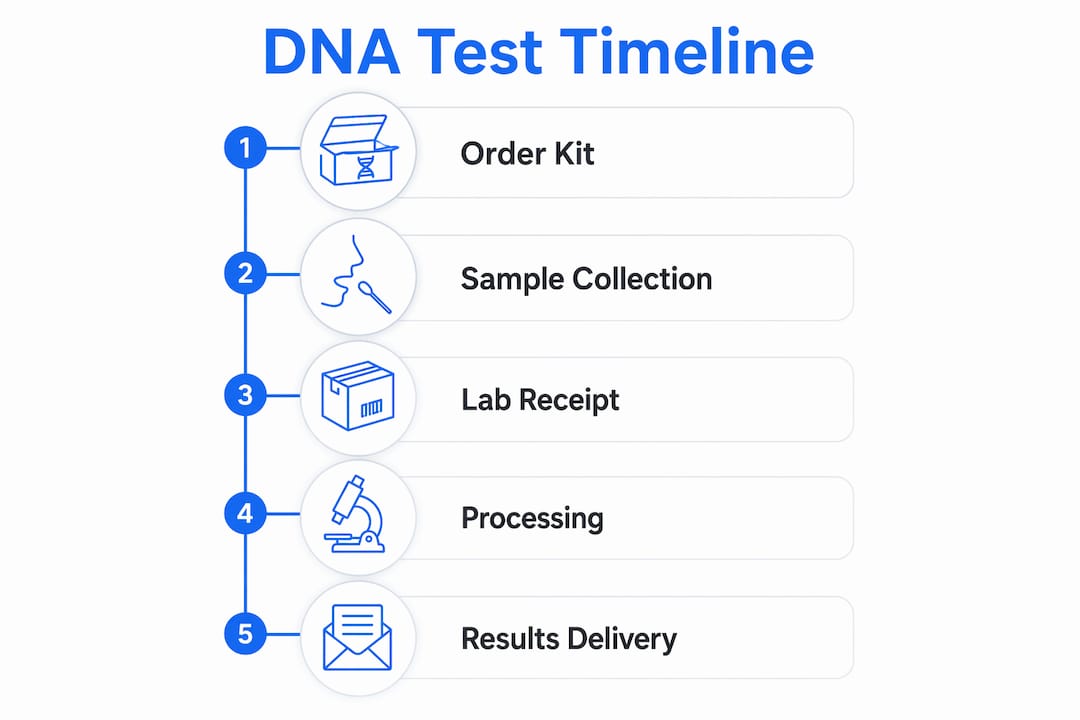
Here is a step-by-step view of the paternity test timeline from kit to results:
- Order and receive the kit: Standard delivery takes 2 to 5 business days; expedited shipping reduces this to 1 to 2 days.
- Collect samples: Buccal swabs from all parties are collected at home (non-legal) or at a designated collection site (legal).
- Return samples to the lab: Use overnight or two-day shipping to minimize transit time.
- Lab accessioning: The lab logs and prepares your sample, typically within 24 hours of receipt.
- Analysis: Non-legal tests complete analysis in 1 to 3 business days; legal tests take 5 to 10 business days.
- Results delivery: Digital results are sent by email or through a secure portal; physical reports follow by mail.
Relationship tests, including grandparentage, sibling, and aunt or uncle testing, follow a similar timeline to paternity tests. Relationship DNA tests focus on fewer markers than ancestry tests, which keeps processing time short and makes expedited options more feasible.
Pro Tip: When multiple parties need to submit samples, coordinate collection on the same day and ship all samples together. Labs process complete sample sets faster than partial submissions waiting on additional parties.
Why do immigration DNA test results take longer and what to expect?
Immigration DNA testing operates under a fundamentally different framework than consumer or legal paternity testing. The process involves coordination between the petitioner in the United States, the beneficiary abroad, a U.S. embassy or consulate, and an AABB-accredited laboratory. Each handoff adds time, and none of it can be rushed without risking the integrity of the entire case.
The table below outlines the standard immigration DNA test timeline:
| Stage | Typical Duration | Notes |
|---|---|---|
| Authorization and case setup | 1 to 2 weeks | USCIS or embassy approval required before testing begins |
| Sample collection coordination | 3 to 7 days | Petitioner and beneficiary collect samples at separate authorized sites |
| Lab analysis | 3 to 5 business days | AABB-accredited lab processes samples after receiving both submissions |
| Result transmission to authorities | 1 to 2 weeks | Results go directly to USCIS or the embassy, not to the client |
| Total estimated timeline | 3 to 8 weeks | Some cases extend to 10 weeks or longer depending on embassy delays |
Immigration DNA test results are sent directly to immigration officials, not to the individual being tested. This is a legal requirement, not a policy choice. The client receives confirmation that results were transmitted, but the actual report goes to the relevant authority. Embassy and consular coordination is the most unpredictable variable in the entire process, with scheduling delays alone sometimes adding one to two weeks.
One critical point: attempting to accelerate immigration DNA testing through unauthorized channels causes permanent delays. Unauthorized testing methods result in evidence rejection by immigration authorities, forcing the entire process to restart from the authorization stage. The only way to get results accepted is to follow the prescribed chain-of-custody process from the beginning.
How do other DNA test categories compare in timing?
| Test Category | Typical Turnaround After Lab Receipt | Rush Option Available? |
|---|---|---|
| Paternity (non-legal) | 1 to 3 business days | Yes, 24 to 48 hours |
| Paternity (legal/court-admissible) | 5 to 10 business days | Limited |
| Relationship (sibling, grandparent) | 2 to 5 business days | Sometimes |
| Health DNA | 2 to 6 weeks | No |
| Immigration | 3 to 8 weeks (total process) | No |
The reason ancestry and health tests cannot be expedited comes down to how labs process them. Consumer DNA tests are batch processed, meaning hundreds or thousands of samples are analyzed together using complex computational workflows. Pulling a single sample out of a batch for priority processing disrupts the entire workflow and is not operationally practical for most labs. This is a structural feature of how genetic data analysis works at scale, not a service limitation that providers choose to impose.
Health DNA tests carry an additional layer of complexity. Results must be cross-referenced against clinical databases and, in some cases, reviewed by genetic counselors before delivery. This review process adds days to the timeline but also adds clinical reliability to the results.
What practical tips can help speed up your home DNA test result timeline?
Reducing your total wait time requires action at multiple points in the process, not just choosing a lab with fast processing.
- Use expedited shipping to the lab. Overnight or two-day shipping eliminates the 3 to 10 day transit window that adds to the total wait. This single step has the largest impact on overall timeline for paternity and relationship tests.
- Collect samples correctly on the first attempt. Degraded or insufficient samples require recollection and resubmission, adding one to two weeks to your timeline. Follow kit instructions precisely, avoid eating or drinking 30 minutes before swabbing, and use all swabs provided.
- Choose a lab with confirmed rush processing. Expedited lab processing can reduce analysis time to 1 to 2 days, but it does not affect shipping or accessioning delays. Confirm rush availability before ordering.
- For immigration tests, use only a lab that meets USCIS chain-of-custody requirements. Improperly collected samples are rejected outright by USCIS and embassies. Using a provider that follows chain-of-custody protocols from the start prevents the most costly delay of all: starting over.
- Coordinate multi-party sample collection in advance. For tests requiring samples from two or more individuals, schedule collection on the same day and ship together. Labs process complete sample sets without waiting for additional submissions.
Pro Tip: If you need results for a legal proceeding or immigration case, plan for a separate testing workflow with witnessed collection. Upgrading from a non-legal test after the fact is not possible. You would need to retest entirely, doubling your wait time.
Key takeaways
Home paternity and kinship DNA test turnaround time ranges from 1 to 3 business days once samples reach the lab. Immigration testing operates on an entirely different workflow with a much longer timeline of 3 to 8 weeks, with the clock starting at lab receipt rather than at the time of mailing.
| Point | Details |
|---|---|
| Paternity tests are fastest | Non-legal paternity results arrive in 1 to 3 business days; legal tests take 5 to 10 business days. |
| Immigration tests take the longest | The full process spans 3 to 8 weeks due to embassy coordination and mandatory result transmission to authorities. |
| Shipping time is separate from lab time | Transit adds 3 to 10 days before lab processing begins; use expedited shipping to reduce total wait. |
| Rush options are limited by test type | Expedited processing is available for at-home paternity and kinship tests. Immigration testing does not offer meaningful rush options because of the federal coordination steps involved. |
| Chain-of-custody protocols prevent costly restarts | Labs meeting industry chain-of-custody standards reduce rejection risk for legal and immigration cases, protecting your timeline. |
What I have learned about DNA test timing after years in this field
People consistently underestimate how much of the total wait time happens outside the lab. The lab analysis itself, for a paternity test, takes one to three days. The rest of the timeline is shipping, accessioning, and in the case of immigration tests, bureaucratic transmission. Focusing only on lab speed misses the larger picture.
The other pattern I see repeatedly is people choosing non-legal tests when they actually need court-admissible results. A non-legal test is faster and cheaper, but it cannot be used in a custody proceeding, a paternity affidavit, or an immigration case. Discovering this after the fact means retesting from scratch. Matching the test type to the actual use case before ordering is the most time-saving decision you can make.
For immigration cases specifically, the instinct to find shortcuts is understandable given the emotional weight of the situation. But unauthorized testing does not just delay results. It invalidates them entirely. The chain-of-custody requirement exists because immigration authorities need to verify that the samples were collected from the correct individuals under controlled conditions. There is no workaround that preserves result validity.
Working with a lab that meets USCIS chain-of-custody requirements and understanding the full process timeline from authorization to result transmission gives you realistic expectations and eliminates the most preventable delays.
— Todd
Get fast home DNA test results from US Diagnostics Center
US Diagnostics Center provides at-home DNA test kits with lab processing typically completed in 2 to 3 business days for paternity and relationship tests. Standard order-to-results turnaround is 7 to 10 business days, with expedited options available at checkout for urgent cases. USDC's guided selection tool matches you to the right home kit across paternity, grandparent, sibling, and aunt/uncle testing.
For families who need biological answers quickly, at-home paternity and kinship testing delivers clear timelines from ordering through results. USDC's home DNA test collection is available at the link below. You can browse the full home-kit catalog at usdiagnosticscenter.com/collections/home-dna-tests.
FAQ
How long does a home DNA test take from start to finish?
Total time from ordering a kit to receiving results ranges from 5 to 14 days for paternity tests. Immigration DNA testing operates on a separate workflow and can run 4 to 10 weeks including federal review, accounting for shipping, lab processing, and result delivery.
Does the DNA test results waiting period start when I mail the kit?
No. The waiting period for DNA test results begins when the lab receives and accessions your sample, not when you mail it. Shipping transit time of 3 to 10 days is separate from lab processing time.
Can I get same-day or next-day DNA test results?
Same-day results are not available for home DNA tests. The fastest option is a rush paternity test, which can return results in 24 to 48 hours after lab receipt, but shipping time still applies before processing begins.
Why do immigration DNA tests take so much longer than paternity tests?
Immigration DNA tests require authorization from USCIS or a U.S. embassy, coordinated sample collection at two separate locations, and mandatory transmission of results directly to immigration authorities rather than to the client. This process adds 3 to 8 weeks to the total timeline beyond standard lab analysis.
Does the type of accreditation a lab holds affect how fast I get results?
AABB accreditation does not speed up lab processing, but it is a common requirement for results submitted to courts or immigration authorities. Submitting results that do not meet those specific credential requirements can force a complete restart, which is the most significant delay risk in legal and immigration DNA testing.
Recommended
- Understanding DNA Testing: How It Works and What to Expect | USDC
- USDCTest | DNA Paternity Testing for Peace of Mind
- At-Home Paternity Test: Cost & Accuracy | USDC
Article generated by BabyLoveGrowth
This article is part of our Understanding DNA Testing: How It Works and What to Expect guide.


0 comments