

TL;DR:
- Kinship DNA testing compares specific DNA markers to confirm biological relationships, such as paternity or siblingship. It produces definitive inclusion or exclusion results, using STR analysis to achieve high accuracy, especially with multiple relatives involved. Proper test selection and sample collection are essential for reliable, legally valid, and conclusive outcomes.
Kinship DNA testing is the scientific process of comparing specific DNA markers between two or more people to confirm a biological relationship. The standard industry term is relationship DNA testing, and it relies on autosomal STR markers — short tandem repeats that vary between individuals and are inherited from both parents. Labs typically examine 20 or more STR markers to build a DNA profile for each person tested. Kinship DNA testing examples span paternity, grandparentage, siblinghood, maternity, and even twin zygosity, each serving distinct legal or personal verification needs.
1. What are the most common kinship DNA testing examples?
Relationship DNA testing covers a wider range of family scenarios than most people realize. Kinship tests serve paternity, inheritance disputes, family reunification, maternity questions, twin zygosity, and identification of deceased individuals. Each test type uses the same STR foundation but applies it to a different relationship question.
The most frequently requested DNA relationship testing examples include:
- Paternity test. A child's STR profile is compared against the alleged father's profile. A confirmed biological father shares one allele at each marker with the child. Results commonly exceed 99.99% inclusion for paternity, making this the most statistically certain of all kinship tests.
- Maternity test. The same STR comparison is applied between a mother and child. Maternity tests are used in adoption cases, hospital mix-up disputes, and surrogacy verification.
- Grandparent test. When a father is unavailable for direct testing, one or both paternal grandparents are tested instead. The child inherits half of the father's DNA, and the grandparents each contributed half of the father's profile, so the indirect link is still statistically meaningful. Testing both grandparents typically produces a Combined Relationship Index (CRI) well above 10, which per AABB standards is supportive of the claimed biological relationship.
- Sibling test. Two individuals are compared to determine whether they share both parents (full siblings), one parent (half siblings), or neither. Full siblings share roughly 50% of their DNA; half siblings share roughly 25%. The Combined Relationship Index (CRI) reflects which scenario is more probable: a CRI greater than 10 is supportive of the claimed relationship, a CRI between 0.1 and 10 is inconclusive, and a CRI less than 0.1 is not supportive.
- Aunt/uncle test (avuncular). An aunt or uncle shares approximately 25% of their DNA with a niece or nephew. This test is used when neither parent is available and a grandparent is also unavailable.
- Twin zygosity test. Identical twins share 100% of their STR profile; fraternal twins share roughly 50%. A zygosity test resolves the question definitively using the same marker comparison, and results are reported using a Combined Relationship Index (CRI).
Each of these examples of kinship DNA tests produces a clear inclusion or exclusion result, not a probability range like ancestry kits provide.
2. How does kinship DNA testing work scientifically?

The scientific foundation of all kinship tests is STR analysis, which examines repeating DNA sequences that vary widely between unrelated individuals. Because STR markers are inherited from both parents, they create a unique genetic fingerprint that labs can compare across family members. This is fundamentally different from the SNP markers used by commercial ancestry kits, which scan broad population-level patterns and cannot produce legal or forensic certainty.
Labs calculate a statistical measure called the Likelihood Ratio (LR), also called the Combined Relationship Index (CRI) for kinship tests or Combined Paternity Index (CPI) for parentage tests. This ratio compares two hypotheses: that the tested individuals are related as claimed, versus that they are unrelated. Extremely high CPI values — such as 2.78 × 10²¹ — indicate absolute biological confirmation even in cases where rare mutations caused minor marker inconsistencies.
The table below summarizes how statistical thresholds translate into interpretive conclusions:
| Statistical measure | Threshold | Interpretation |
|---|---|---|
| Combined Paternity Index (CPI) | Greater than 100 | Strong support for biological parentage |
| Combined Relationship Index (CRI) | Greater than 10 | Supportive of the claimed biological relationship |
| Combined Relationship Index (CRI) | 0.1 – 10 | Inconclusive |
| Combined Relationship Index (CRI) | Less than 0.1 | Not supportive (evidence against the claimed relationship) |
| Probability of inclusion | 99.99% or higher | Standard for confirmed paternity |
| Exclusion result | Zero shared alleles at multiple loci | Biological relationship excluded |
| Mutation-adjusted CPI | Recalculated after MPS review | Resolves rare inconsistencies without false exclusion |
Mutations at some STR loci can cause minor inconsistencies. Advanced sequencing methods such as Massively Parallel Sequencing (MPS) analyze a larger number of markers simultaneously to resolve these rare cases and prevent false exclusions.
Pro Tip: If your result shows one or two marker mismatches, do not assume exclusion. Ask the lab whether MPS-based analysis was applied before drawing any conclusions.
Clinical relationship testing is intentionally limited to highly informative markers that produce definitive answers. This distinguishes it clearly from exploratory ancestry testing, which is designed for population comparisons, not legal verification.
3. What are examples of complex or extended kinship DNA tests?
Extended kinship testing covers relationships beyond the immediate parent-child pair. These tests are more statistically challenging because the shared DNA percentage decreases with each degree of separation. Accuracy remains near 100% for first- and second-degree relatives, but drops to approximately 83–91% for third-degree relatives such as first cousins, and declines further beyond fourth-degree relationships. That drop in accuracy is the primary reason labs recommend adding more family members to complex cases.
Common examples of extended kinship tests include:
- Avuncular test. An aunt or uncle shares on average 25% of their DNA with a niece or nephew. The avuncular DNA test is most useful when both parents are unavailable and a grandparent is also inaccessible.
- First cousin test. First cousins share roughly 12.5% of their DNA. At this level, the Combined Relationship Index (CRI) is less decisive on its own, and labs strongly recommend including additional relatives to raise the statistical weight.
- Multiple relative testing. Adding a known biological relative, such as a confirmed sibling or grandparent, to the comparison significantly raises the Combined Relationship Index (CRI). Testing multiple family members moves results from inconclusive to definitive, especially when the alleged parent is unavailable.
- Deceased individual identification. STR profiles from biological children, parents, or siblings of a deceased person can be compared to remains to establish identity. This application is used in legal, military, and humanitarian contexts.
A practical scenario illustrates how adding relatives changes outcomes. Suppose a child needs to confirm a paternal link but the alleged father is deceased. Testing only the paternal grandmother produces a moderate Combined Relationship Index (CRI). Adding the paternal grandfather and a confirmed paternal sibling raises the combined statistical weight substantially, often moving the result from inconclusive (CRI between 0.1 and 10) to supportive of the claimed relationship (CRI greater than 10).
Pro Tip: Before ordering an extended kinship test, list every available biological relative on the relevant side of the family. Labs can advise which combination of relatives produces the strongest statistical result for your specific question.
Massively Parallel Sequencing is particularly valuable in extended kinship cases where mutation effects or low shared-DNA percentages create ambiguous marker comparisons. MPS examines a far larger set of markers than standard STR panels, providing additional data points to resolve borderline results.
4. What should you consider when choosing a kinship DNA test?
Selecting the right test depends on three factors: the specific relationship question, the legal or personal purpose, and the availability of family members for sampling. Getting these three factors right before ordering prevents wasted time and inconclusive results.
Legal versus personal use. A legal DNA test requires strict chain-of-custody collection, meaning a neutral third party collects and seals the samples. A home DNA test uses self-collected buccal swabs and provides personal confirmation but is not court-admissible. If you need results for child support, custody, inheritance, or immigration proceedings, order a legal test from the start.
Marker count. More markers produce more statistical certainty. Labs using 20 or more STR markers provide stronger Combined Relationship Index (CRI) values than labs using fewer. When comparing test options, confirm the marker count before ordering.
Relative availability. Direct testing always produces the strongest result. If the alleged parent is unavailable, the next best option is both biological grandparents on that side. If only one grandparent is available, adding a confirmed sibling of the alleged parent improves the result further.
Lab accreditation status. For legal matters, confirm whether the lab holds or is actively pursuing recognized accreditation. which is the standard quality benchmark for relationship DNA testing in the United States. Accreditation status directly affects whether results are accepted in court.
Common pitfalls to avoid:
- Ordering a home test when a legal test is required for court proceedings
- Testing only one grandparent when both are available, which reduces statistical power
- Confusing an ancestry SNP kit result with a clinical kinship test result; they are not interchangeable
- Failing to disclose known adoptions or prior paternity findings to the lab, which can affect result interpretation
The kinship DNA test glossary at US Diagnostics Center explains each test type and its specific requirements in plain language, which is a useful reference before placing an order.
Key takeaways
Kinship DNA testing uses targeted STR marker analysis to confirm biological relationships, and selecting the correct test type, marker count, and collection method determines whether results are accurate, legally valid, and conclusive.
| Point | Details |
|---|---|
| STR markers are the foundation | All kinship tests compare short tandem repeats, not the SNP markers used by ancestry kits. |
| Test type must match the question | Paternity, grandparent, sibling, and avuncular tests each apply to a specific relationship scenario. |
| More relatives improve accuracy | Adding confirmed biological relatives raises the Combined Relationship Index (CRI) in complex or indirect cases. |
| Legal tests require chain of custody | Court-admissible results need third-party sample collection, not home self-collection. |
| Marker count affects certainty | Labs using 20 or more STR markers produce stronger statistical conclusions than those using fewer. |
What I've learned from watching families navigate kinship testing
The most common mistake I see is people ordering the wrong test for their actual question. A family will spend weeks waiting for a sibling test result when what they really needed was a grandparent test, because the alleged father was unavailable and no one told them that option existed. The test type has to match the relationship question precisely, not just the relationship category.
The second pattern I notice is the gap between emotional expectations and clinical results. Many families start with a consumer ancestry kit, see a vague percentage match, and treat it as confirmation. Ancestry kits versus clinical STR tests are not comparable tools. One is designed for population-level curiosity; the other is designed to answer a specific legal or personal question with a definitive yes or no. Mixing them up creates confusion that a proper kinship test would have avoided entirely.
The third thing I've observed is that people underestimate how much adding one more relative changes the outcome. I've seen cases where a single grandparent test produced an inconclusive result, and adding the second grandparent moved the Combined Relationship Index (CRI) well past the confirmation threshold of 10. Labs can tell you in advance which combination of relatives gives the strongest result for your situation. Ask that question before you order, not after.
The science here is genuinely reliable when applied correctly. The failures I've seen are almost always procedural: wrong test type, wrong collection method, or too few participants. Get those three things right and the result will be clear.
— Todd
How US Diagnostics Center supports your kinship DNA testing needs
US Diagnostics Center offers home kinship DNA tests covering paternity, maternity, sibling, grandparent, and aunt/uncle relationships. Every test analyzes up to 28 STR markers, and results are delivered within 2–3 business days of lab receipt, with standard order-to-results time of 7–10 business days. Each kit includes a prepaid return shipping envelope.
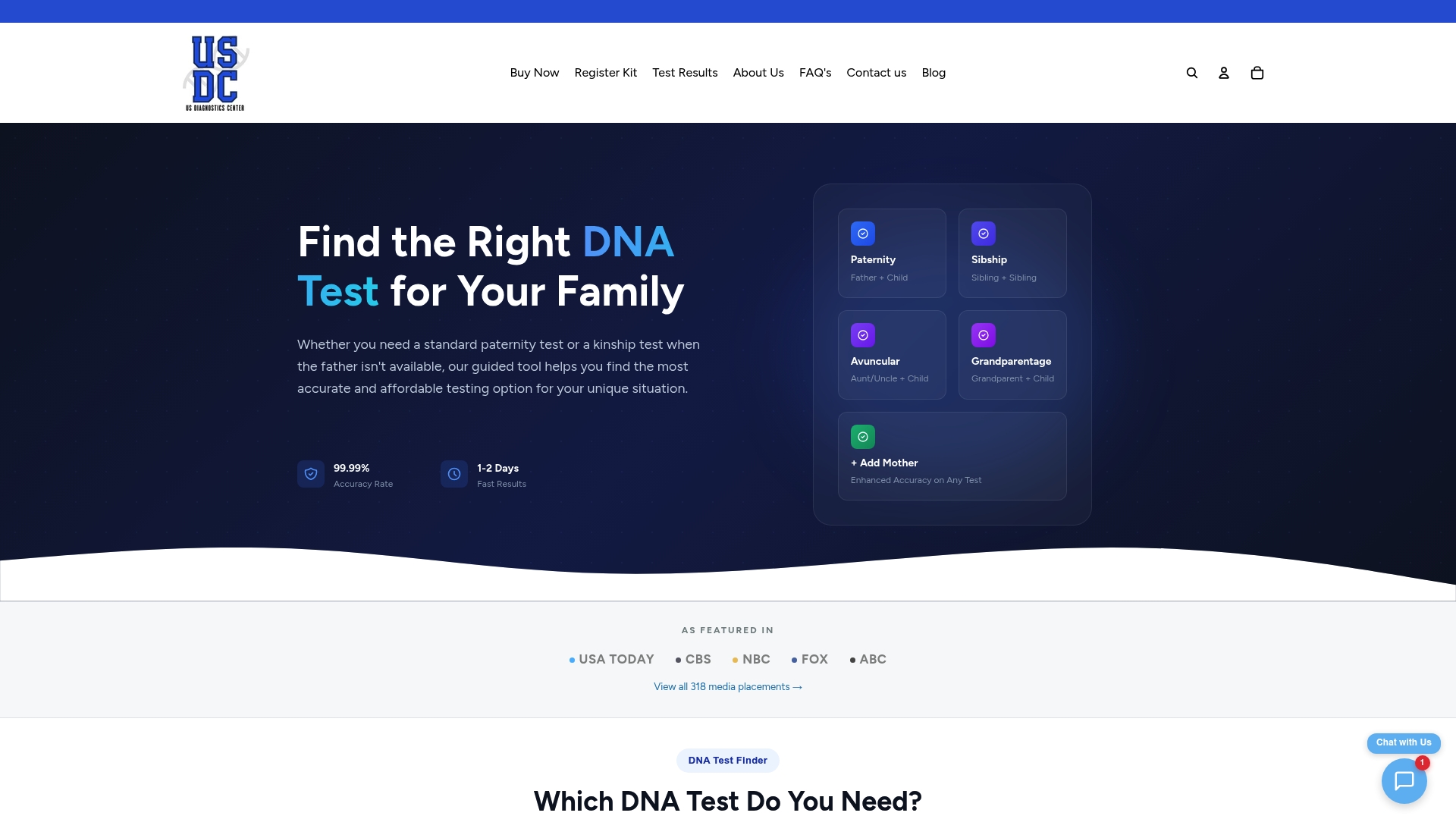
Home paternity testing starts at $79. Maternity testing is $129. Sibling, grandparent, and aunt/uncle tests are $139. Legal DNA tests — which require chain-of-custody sample collection to produce court-admissible results — are coming soon as If you are unsure which test fits your situation, the guided tool at US Diagnostics Center recommends the most accurate and affordable option based on your specific family scenario.
FAQ
What is kinship DNA testing?
Kinship DNA testing is the scientific comparison of STR markers between two or more people to confirm a specific biological relationship. It produces a definitive inclusion or exclusion result, unlike ancestry kits, which provide population-level estimates.
What are the most common examples of kinship DNA tests?
The most common types are paternity, maternity, grandparent, sibling, and avuncular (aunt/uncle) tests. Each targets a specific relationship and uses STR marker comparison to calculate a Combined Relationship Index (CRI) or Combined Paternity Index.
How accurate is a grandparent or sibling kinship test?
Accuracy is near 100% for first- and second-degree relatives such as grandparents and siblings. Adding both grandparents or a confirmed sibling to the test significantly strengthens the statistical result, typically producing a Combined Relationship Index (CRI) well above 10, which per AABB standards is supportive of the claimed biological relationship.
Can I use a home DNA test for court proceedings?
A home DNA test is not court-admissible because it lacks chain-of-custody documentation. For legal matters such as child support or inheritance, a legal DNA test with third-party sample collection is required.
What is the difference between a kinship test and an ancestry test?
A kinship test uses targeted STR analysis to answer a specific relationship question with legal certainty. An ancestry test uses broader SNP markers to estimate population origins and cannot confirm or exclude a specific biological relationship.
Recommended
- Kinship DNA Tests: Sibling, Grandparent & More | USDC
- Kinship DNA Test | DNA Testing Glossary | USDC
This article is part of our Kinship DNA Testing: Sibling, Grandparent, and Family Relationship Tests guide.


0 comments