

TL;DR:
- A legal paternity test follows strict procedures and documents chain of custody to produce court-admissible evidence.
- Home tests lack the chain of custody and are not accepted by courts for legal proof of paternity.
A legal paternity test is a DNA test performed under controlled conditions that produces court-admissible evidence of biological fatherhood. Unlike a home test purchased at a pharmacy, a court-admissible DNA test follows strict procedural rules that allow judges, attorneys, and government agencies to rely on the results as valid legal proof. The core standard is a probability of paternity at or above 99%, established through analysis of 20 or more genetic markers. Two elements determine whether results hold up in court: scientific accuracy and documented chain of custody. Both are required. Neither alone is sufficient.
What is a legal paternity test and how does chain of custody work?
A legal paternity test collects DNA through a buccal swab, a simple cheek swab that gathers cells from inside the mouth. The swab itself is identical to what a home test uses. The difference is everything that happens before and after the swab touches the cheek.

Chain of custody is the documented record proving that a specific sample came from a specific person and was handled without tampering from collection to lab analysis. Courts require this record because without it, there is no way to verify that the DNA tested actually belongs to the person named in the case.
The chain of custody process follows a defined sequence:
- Identity verification: A neutral third party checks each participant's government-issued photo ID before any sample is collected.
- Witnessed collection: The collector observes the swabbing directly. No participant handles their own swab unsupervised.
- Tamper-evident packaging: Samples go into sealed containers with security tape. Any breach of the seal is visible and documented.
- Documented handling: Every transfer of the sample, from collector to courier to lab, is logged with signatures and timestamps.
- Lab receipt confirmation: The receiving laboratory signs for the samples and records their condition upon arrival.
Even minor documentation gaps, such as a missing signature or an undated photo, can cause a court to reject results entirely. That rejection happens regardless of how accurate the underlying science is.
Pro Tip: Always request a copy of the chain-of-custody documentation from your collection site before leaving. Confirm every field is completed. A blank line discovered weeks later can delay your case by months.
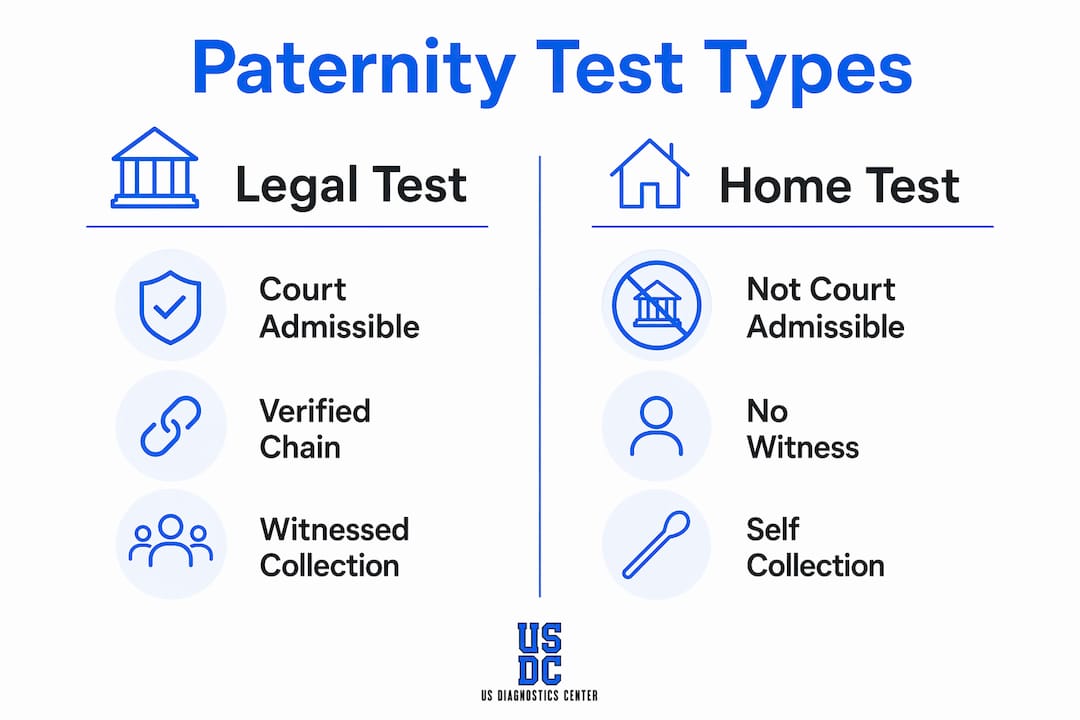
Home tests skip every step listed above. The participant collects their own sample, seals it themselves, and mails it without any third-party verification. Home tests are not admissible in court for this reason. If you need legal proof, a home test creates a false sense of security.
What is the legal process to obtain a court-admissible paternity test?
Obtaining a DNA test that a family court will accept requires following a formal legal process. The steps below apply in most U.S. jurisdictions, though specific requirements vary by state.
- File a petition. The requesting party submits a sworn statement to family court citing a reasonable possibility of paternity. The petition identifies the child, the alleged father, and the legal basis for the request.
- Serve notice. All parties named in the petition must receive formal legal notice. This step protects due process rights and gives each party the opportunity to respond or object.
- Attend the court hearing. A judge reviews the petition and any objections. If the court finds sufficient grounds, it issues a testing order directing all parties to submit samples.
- Schedule sample collection. Testing occurs at a court-approved collection site. A trained collector verifies identity, witnesses the swabbing, and seals the samples following chain-of-custody protocol.
- Receive and submit results. The lab delivers results directly to the court or the requesting attorney. Results showing a probability of paternity at or above 99% establish a legal presumption of fatherhood in most states.
The full process from filing to results typically takes 2–4 months, depending on court scheduling and whether any party contests the order. That timeline is not a flaw in the system. It reflects the due process protections that make the results legally defensible.
Most state laws set filing deadlines for paternity actions, commonly until the child turns 18, with some states extending to age 21 or beyond. Missing that deadline can bar court-ordered testing regardless of what biological evidence exists. If you are unsure of the deadline in your state, consult a family law attorney before taking any other step.
Legal tests typically include samples from the mother, the child, and the alleged father. Testing the mother improves accuracy by allowing the lab to isolate the child's paternal DNA more precisely, though her participation is not always mandatory. Labs analyze 20 or more genetic markers to reach a definitive determination.
When and why are court-admissible paternity tests required?
A DNA test accepted by family court becomes necessary in several distinct legal situations. Understanding which scenario applies to your case determines the type of test you need and the process you must follow.
Common situations requiring a court-admissible result include:
- Custody and visitation disputes. A father seeking parental rights, or a mother seeking to establish the legal father for custody purposes, needs a result the court will recognize. If you are working with a child custody attorney, they will typically require court-admissible documentation before filing.
- Child support establishment or modification. Courts will not order child support based on a home test. A paternity test for child support must meet the same admissibility standards as any other legal evidence.
- Challenging a Voluntary Acknowledgment of Paternity. A man who signed a Voluntary Acknowledgment of Paternity can challenge it through court-ordered DNA testing within statutory time limits. DNA testing provides definitive biological evidence to support or contest that acknowledgment.
- Benefits and inheritance claims. Social Security survivor benefits, life insurance claims, and estate disputes may all require documented proof of biological fatherhood.
- International cases. An international paternity test follows the same chain-of-custody requirements as a domestic test but may involve additional coordination with foreign collection sites and embassy-approved laboratories.
An informal or home test result carries no legal weight in any of these situations. Courts prioritize procedural fairness over convenience, and a result without verified chain of custody gives the opposing party grounds to challenge the entire submission.
What are the costs and accuracy of legal vs. home paternity tests?
Both legal and home paternity tests achieve high scientific accuracy. The distinction is not in the biology. It is in the documentation.
Legal paternity testing carries additional costs compared to a home test, reflecting the identity verification, witnessed collection, tamper-evident packaging, and administrative documentation that courts require. Turnaround after sample collection is generally 1–2 weeks for legal tests, accounting for the additional verification steps.
Home tests cost significantly less. US Diagnostics Center offers home paternity testing at $79, which includes a prepaid return shipping envelope. The scientific accuracy of a home test reaches 99.99%, identical to a legal test at the DNA analysis level. The results, however, cannot be submitted as evidence in any legal proceeding.
| Feature | Legal paternity test | Home paternity test |
|---|---|---|
| Court admissible | Yes | No |
| Chain of custody | Required and documented | Not applicable |
| Sample collection | Witnessed by neutral third party | Self-collected |
| Typical cost | See provider for current pricing | $79 |
| DNA accuracy | 99.99% | 99.99% |
| Turnaround post-collection | 1–2 weeks | 2–3 business days lab processing |
DNA evidence with 99.99% probability can still be excluded if due process or chain of custody is broken. Courts treat procedural fairness as equally important as scientific accuracy. That principle protects all parties, including the alleged father, from evidence that cannot be independently verified.
Pro Tip: If you are unsure whether you need a legal or home test, review the key differences between test types before ordering. Ordering the wrong test wastes time and money, and a home test result cannot be upgraded to legal status after the fact.
Common delays in legal testing come from scheduling conflicts at collection sites, parties who fail to appear, and incomplete paperwork at the lab intake stage. Addressing all three proactively, by confirming appointments, verifying ID requirements in advance, and double-checking documentation, keeps the process on schedule.
Key Takeaways
A legal paternity test requires both scientific accuracy and documented chain of custody to produce results that courts will accept as valid evidence.
| Point | Details |
|---|---|
| Chain of custody is non-negotiable | Missing signatures or undocumented transfers can invalidate results regardless of DNA accuracy. |
| Court process takes 2–4 months | Filing, service of process, a hearing, and collection all add time before results reach the court. |
| Home tests cannot become legal tests | Self-collected samples lack witnessed collection and cannot be retroactively certified for court use. |
| Legal test costs vary by provider | Collection fees are separate; home tests cost less but carry no legal admissibility. |
| Filing deadlines are real | Most states bar paternity actions after the child turns 18, making early action critical. |
What I've learned about the gap between accurate and admissible
The most common mistake I see is people conflating scientific accuracy with legal admissibility. They run a home test, get a 99.99% result, and assume the hard part is done. Then they walk into a family court proceeding and learn that the judge cannot accept the result because no neutral party witnessed the collection.
Courts prioritize due process as highly as biological truth. That is not a bureaucratic obstacle. It is a protection. Without chain-of-custody requirements, any party could submit a manipulated or mislabeled sample and claim it as evidence. The procedural rules exist to prevent that.
The second mistake is waiting. Paternity actions have statutory deadlines, and I have seen cases where a family delayed testing for years, assuming they could address it later. By the time they sought legal proof, the filing window had closed. The biology was clear. The legal remedy was gone.
My advice is straightforward: if there is any possibility you will need court-admissible results, start with a legal test. You can always use a home test for personal knowledge afterward. You cannot reverse the process. Consult a family law attorney early, use a certified collection site, and verify every piece of documentation before the sample leaves the room.
— Todd
How US Diagnostics Center Supports Your Legal Paternity Testing Needs
US Diagnostics Center currently offers a full range of home DNA testing options, including home paternity testing at $79, sibling testing at $139, grandparent testing at $139, and aunt/uncle (avuncular) testing at $139. Legal and immigration testing options are coming soon.
You can learn more about our legal paternity test kit on its product page, which includes current availability information. In the meantime, US Diagnostics Center home paternity tests analyze up to 28 genetic markers and deliver 99.99% accuracy, with standard order-to-results turnaround of 7–10 business days and lab processing completed in 2–3 business days after sample receipt. Each kit ships with a prepaid return shipping envelope.
FAQ
What does paternity mean in a legal context?
Paternity is the legal recognition of a man as the biological father of a child. Legal paternity establishes rights and obligations including custody, visitation, child support, and inheritance.
What are the court-admissible DNA test requirements?
A court-admissible DNA test requires witnessed sample collection by a neutral third party, verified photo ID for all participants, tamper-evident packaging, and fully documented chain of custody from collection through lab receipt.
How long does the legal paternity test process take?
The process from filing a petition to receiving results typically takes 2–4 months, depending on court scheduling, whether parties contest the order, and collection site availability.
Can a home DNA test be used for custody cases?
No. Home paternity tests are not admissible in court because they lack witnessed collection and verified chain of custody. Custody cases require a legal test conducted at an approved collection site.
What are the paternity test chain of custody steps?
Chain of custody requires photo ID verification, witnessed buccal swab collection, tamper-evident sample sealing, documented transfer at every handoff, and a signed lab receipt confirming sample condition upon arrival.
Recommended
- Paternity Test for Child Support: What Courts Require (2026) | USDC
- Paternity Test California: Laws, Process & At-Home Options | USDC
- At-Home Paternity Testing in Colorado: Laws & Options (2026) | USDC
- At-Home Paternity Testing in Nevada: Laws & Options (2026) | USDC
This article is part of our Paternity Testing: The Complete Guide guide.


0 comments