

Home DNA kits are direct-to-consumer (DTC) genetic testing products that allow couples to collect biological samples at home and receive results through a secure online portal, without visiting a clinic. The reasons couples use home DNA kits span from confirming biological relationships discreetly to exploring shared ancestry and informing reproductive health decisions. Brands like 23andMe and AncestryDNA have made genetic testing accessible to millions, but a growing number of couples turn to specialized relationship testing providers for paternity, sibling, and kinship confirmation. Privacy, convenience, and the ability to act on personal questions without public exposure are the defining advantages that make these kits a preferred choice.
Why couples use home DNA kits: the main motivations
Couples choose at-home genetic testing for several distinct reasons, and understanding those reasons helps clarify which type of kit is appropriate. The motivations range from personal curiosity to legally significant questions about biological parentage.
According to a YouGov 2026 survey, ancestry and heritage is the top reason Americans take DNA tests, cited by 59% of respondents. That figure reflects a genuine desire to understand ethnic origins and family migration history, not just idle curiosity.
The most common motivations among couples include:
- Paternity and maternity confirmation: Resolving questions about biological parentage without confrontation or court involvement
- Ancestry exploration: Tracing shared or individual ethnic backgrounds and discovering unknown relatives
- Health risk awareness: Identifying genetic variants linked to inherited conditions before or during pregnancy
- Carrier screening: Determining whether one or both partners carry recessive gene mutations that could affect a child
- Curiosity about kinship: Confirming or ruling out biological connections between suspected siblings, half-siblings, or other relatives
Survey data also shows rising willingness among Americans to test for biological sibling status, adoption confirmation, and health risk likelihood when personal questions are at stake. This reflects a broader cultural shift toward using genetic data as a tool for personal decision-making rather than purely medical diagnosis.
Pro Tip: If you are unsure which test addresses your specific situation, use a guided selection tool like the one offered by Usdiagnosticscenter to identify the most accurate and cost-effective option before purchasing.
How home DNA kits protect privacy for couples
Privacy is both the primary attraction and the most significant concern surrounding home DNA testing. Privacy concerns cause 42% of people to avoid DNA tests entirely, with 30% describing privacy as “very much” a concern. That statistic reveals a real tension: the same discretion that draws couples to home kits is also the reason many hesitate to use them.
Reputable home DNA kit providers address this tension through several structural safeguards:
- At-home sample collection: Cheek swabs are collected privately, with no clinic visit or third-party observation required
- Secure online portals: Results are delivered through password-protected accounts, not mailed in identifiable packaging
- Opt-in database sharing: Ancestry platforms like 23andMe and AncestryDNA do not share genetic data with public databases unless the user explicitly consents
- Encryption and data policies: Leading providers publish clear data retention and deletion policies, giving users control over their genetic information
- Mobile specimen collectors: For cases requiring witnessed sample collection, certified collectors visit homes or private locations using unmarked vehicles, maintaining confidentiality while following strict chain-of-custody protocols
The distinction between personal-use and legal-use kits matters here. Personal-use kits offer maximum privacy because no third party witnesses the collection. Legal kits require witnessed collection to be court-admissible, but reputable providers conduct that process discreetly and professionally.
Pro Tip: Before ordering, review the provider's data retention policy. Choose providers that allow you to delete your genetic data after results are delivered, particularly if you are not interested in ancestry database matching.
What types of relationship tests do couples use at home?
Home DNA kits cover a broader range of kinship questions than most couples realize. Cheek swabs take less than a minute per person and produce DNA profiles accurate enough for paternity, maternity, and extended kinship testing. The table below summarizes the most common test types couples use.

| Test type | Purpose | Typical accuracy |
|---|---|---|
| Paternity test | Confirms biological father-child relationship | 99.99% inclusion or exclusion |
| Maternity test | Confirms biological mother-child relationship | 99.99% inclusion or exclusion |
| Sibling DNA test | Determines full or half-sibling relationship | Probability-based, varies by shared DNA |
| Grandparentage test | Confirms grandparent-grandchild biological link | High accuracy, recommended with both grandparents |
| Avuncular test | Confirms aunt/uncle and niece/nephew relationship | Probability-based |
Each test type serves a specific purpose, and choosing the wrong test produces inconclusive results. For example, a sibling test between two individuals with no alleged parent available produces a probability estimate rather than a definitive answer. A kinship DNA test that includes a known parent dramatically improves the statistical confidence of the result.
The legal versus non-legal distinction is critical for couples who may need results in a court proceeding. Non-legal home kits provide personal peace of mind but are not admissible as evidence in custody, inheritance, or immigration cases. Legal DNA tests require witnessed collection with a documented chain of custody to meet court standards. Usdiagnosticscenter offers both options, with rigorous laboratory standards backing the accuracy of results in either format.
How couples use home DNA kits for ancestry and health planning
Ancestry testing and health-related genetic screening represent two distinct but often overlapping reasons for home DNA testing. Understanding the difference between them prevents couples from misinterpreting results or making uninformed decisions.
Ancestry and family discovery
Ancestry tests analyze hundreds of thousands of genetic markers to estimate ethnic composition and geographic origins. Couples use these results to understand shared heritage, trace migration patterns, and identify previously unknown relatives through DNA matching features. Home DNA testing can surface unexpected family connections, including unknown half-siblings or biological relatives who were adopted. These discoveries can be deeply informative but also emotionally complex, which is worth preparing for before testing.
Genetic health risk and carrier screening
Health-focused DTC tests identify variants associated with conditions like BRCA1/BRCA2 mutations, hereditary hemochromatosis, and cystic fibrosis carrier status. Couples planning a pregnancy find carrier screening particularly relevant. If both partners carry a recessive mutation for the same condition, their child has a 25% chance of inheriting that condition. Platforms like Sapyen offer carrier screening resources that explain how couples can use home kit results to inform reproductive planning.
However, DTC genetic tests are accessible and noninvasive but carry real limitations on predictive power. A negative result does not rule out all genetic risks, and a positive result does not confirm a diagnosis. The American College of Obstetricians and Gynecologists (ACOG) states that genetic counseling is required for interpreting carrier status and making informed reproductive decisions. Home kit results are a starting point, not a clinical conclusion.
Pro Tip: Treat home DNA health results as a reason to schedule a conversation with a genetic counselor, not as a final answer. Healthcare professionals at services like Sapyen can help you interpret carrier status in the context of your full medical history.
The following table outlines the key differences between ancestry and health-focused home DNA tests:
| Feature | Ancestry test | Health and carrier screening test |
|---|---|---|
| Primary use | Ethnic origins, relative matching | Inherited condition risk, carrier status |
| Clinical validation needed | No | Yes, for major decisions |
| Emotional complexity | Moderate to high | Moderate to high |
| Counseling recommended | Optional | Strongly recommended |
| Legal admissibility | Not applicable | Not applicable |
Key takeaways
Couples use home DNA kits because they provide private, accurate, and convenient access to genetic information that addresses relationship clarity, ancestry, and health planning without requiring a clinic visit.
| Point | Details |
|---|---|
| Privacy drives adoption | 42% of Americans cite privacy concerns as a barrier, making discreet home collection a decisive advantage. |
| Ancestry is the top motivation | 59% of Americans who test do so to learn about heritage and ethnic origins. |
| Multiple test types available | Paternity, maternity, sibling, grandparentage, and avuncular tests each serve distinct kinship questions. |
| Health results need clinical follow-up | ACOG and MedlinePlus confirm that home kit health findings require counseling and confirmatory testing. |
| Legal vs. non-legal kits differ | Court-admissible results require witnessed collection with a documented chain of custody. |
What I've learned from couples navigating home DNA testing
The couples who get the most value from home DNA testing are the ones who go in with a clear question and a plan for handling the answer. That sounds obvious, but it is the step most people skip.
The privacy appeal is real. Collecting a cheek swab at home, receiving results through a secure portal, and never having to explain yourself to a receptionist or a lab technician addresses a genuine need. But privacy as a feature only works if the provider behind the kit is genuinely trustworthy. Encryption policies, opt-in database sharing, and AABB accreditation are not marketing language. They are the structural details that determine whether your genetic data stays yours.
What I find underappreciated is the emotional preparation side. Ancestry tests regularly surface unexpected relatives, and relationship tests sometimes confirm what a couple feared rather than hoped. Neither outcome is a reason to avoid testing. Both are reasons to discuss, before ordering, what you will do with a result that surprises you. Couples who have that conversation first tend to handle unexpected findings far more constructively.
For health-related testing, the guidance is straightforward: use home kit results as a prompt, not a verdict. A carrier screening result that shows both partners carry a cystic fibrosis mutation is significant information. It is not a diagnosis, and it is not a reason to panic. It is a reason to book an appointment with a genetic counselor who can put that result in proper clinical context.
Choosing a provider with transparent accreditation, clear data policies, and both legal and non-legal options gives couples the flexibility to start with a personal-use test and escalate to a court-admissible test if circumstances change. That flexibility matters more than most couples realize when they first order a kit.
— Todd
How Usdiagnosticscenter supports couples with home DNA testing
Usdiagnosticscenter provides a full range of home DNA tests designed for couples seeking relationship clarity or confidential kinship confirmation. Their guided selection tool identifies the most accurate and affordable test for your specific situation, whether that involves paternity, grandparentage, or sibling testing.
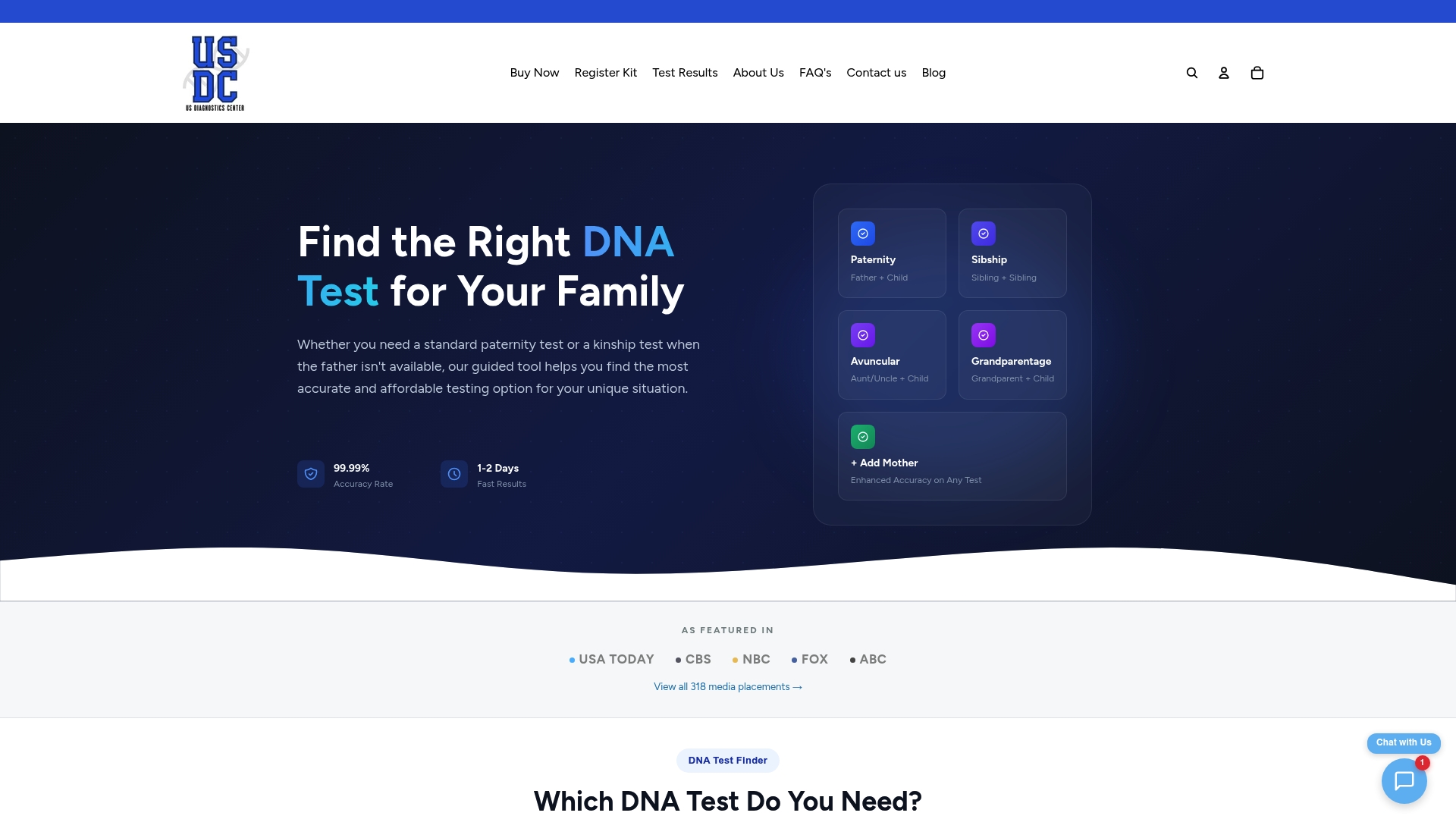
Results are delivered within 2 to 3 business days through a secure online portal, with expedited options available for urgent cases. All testing produces results that are 99.99% accurate. Both personal-use and court-admissible legal test options are available, giving couples the choice between maximum privacy and legally defensible documentation. Usdiagnosticscenter's team provides expert support throughout the process, from test selection to result interpretation.
FAQ
Why do couples choose home DNA kits over clinic testing?
Home DNA kits offer private sample collection, secure online results, and no clinic visit, which removes the social and logistical barriers that prevent many couples from testing. Discreet cheek swab collection at home with secure online result access is the defining advantage for privacy-sensitive cases.
Are home DNA kit results accurate enough for relationship confirmation?
Yes, for paternity and maternity testing, accredited laboratories following AABB, ISO 17025:2017, and CAP protocols produce results with 99.99% accuracy. Sibling and avuncular tests are probability-based and may benefit from including a known parent sample to strengthen the result.
Can couples use home DNA kits for health planning?
Home DNA kits provide carrier screening and genetic risk information, but clinical counseling is required before making reproductive or medical decisions based on those results. Treat home kit health findings as a starting point that warrants a conversation with a genetic counselor.
What is the difference between a legal and a non-legal home DNA test?
A non-legal test uses self-collected samples and provides personal-use results that are not admissible in court. A legal DNA test requires witnessed sample collection with a documented chain of custody, making results court-admissible for custody, inheritance, or immigration proceedings.
How long does it take to get results from a home DNA kit?
Most reputable providers, including Usdiagnosticscenter, deliver results within 2 to 3 business days through a secure online portal. Expedited processing is available for time-sensitive cases.
Recommended
- USDCTest | DNA Paternity Testing for Peace of Mind
- Understanding DNA Testing: How It Works and What to Expect | USDC
- Kinship DNA Tests: Sibling, Grandparent & More | USDC
Related resources
- Paternity testing overview
- Home paternity test kit
- Understanding DNA testing
- How to establish paternity
This article is part of our Understanding DNA Testing: How It Works and What to Expect guide.


0 comments