


Paternity confirmation is the legal and biological process that formally identifies a man as the father of a child, establishing his parental rights and obligations under law. For fathers seeking custody, visitation, or simply the certainty of a biological connection, understanding why fathers need paternity confirmation is the first step toward protecting both themselves and their children. This process relies on two primary tools: voluntary acknowledgment of paternity (VAP) and DNA testing, each carrying distinct legal weight. Getting it right from the start prevents costly disputes and secures rights that courts will otherwise not automatically grant.
Why fathers need paternity confirmation
Paternity confirmation does more than settle a biological question. It creates a legal relationship between father and child that courts recognize for custody, support, inheritance, and medical decision-making. Without formal confirmation, a father has no enforceable parental rights, regardless of his involvement in the child's life.
Establishing paternity early affords children the best chance for financial support, medical care, and emotional security while enabling fathers to assert rights before legal deadlines close. That timeline matters. Many states impose strict windows for contesting or establishing paternity, and missing them can permanently limit a father's legal standing.

The importance of paternity testing extends beyond the courtroom. A confirmed biological connection provides psychological stability and a clear identity for the child, which experts say is better than prolonged uncertainty. For fathers, confirmation removes ambiguity and creates the foundation for a legally protected relationship.
How is paternity legally established?
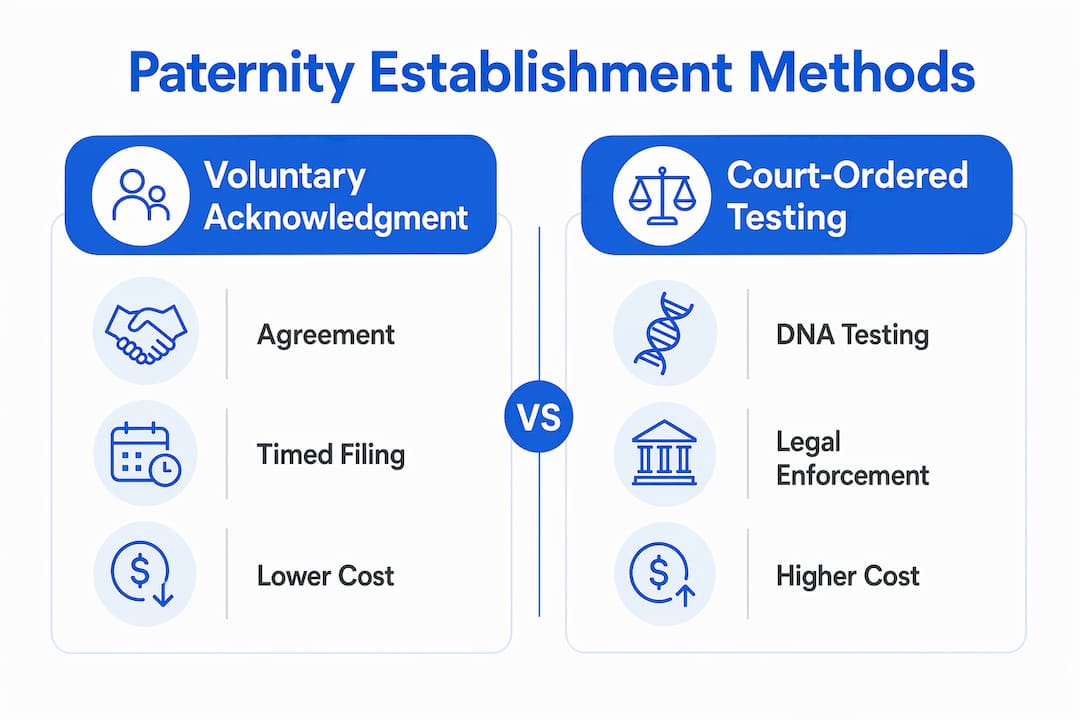
Two main pathways exist for establishing legal fatherhood: voluntary acknowledgment and court-ordered DNA testing.
Voluntary acknowledgment of paternity
A Voluntary Acknowledgment of Paternity (VAP) is a signed, notarized document that both parents complete to formally recognize the father. Voluntary acknowledgment must be notarized and filed with vital records, and most hospitals facilitate this process at birth. Once filed, the VAP carries the same legal weight as a court order for purposes of child support. However, it does not automatically grant full parental rights such as custody or visitation. Those require a separate legitimation proceeding in most states.
Court-ordered DNA testing
When paternity is disputed, family court can order DNA testing. The process follows standardized procedures including sworn testimony and chain of custody protocols to produce evidence that is admissible in court. Court-ordered DNA tests typically take 2–4 months and cost approximately $500, with courts often splitting costs between parties based on income and conduct.
The legal standard is clear. Genetic testing at 99% probability establishes a legal presumption of paternity. That threshold is the benchmark family courts use to resolve parentage disputes definitively.
| Method | Timeline | Cost | Legal Weight |
|---|---|---|---|
| Voluntary Acknowledgment | At birth or shortly after | Minimal or free | Equal to court order for support |
| Court-Ordered DNA Test | 2–4 months | Approx. $500 | Full legal admissibility |
| Home DNA Kit | Days | $100–$200 | Not court-admissible |
Pro Tip: If you sign a VAP and later have doubts, most states allow a rescission period of 60 days to withdraw it without court involvement. After that window closes, you must prove fraud, duress, or material mistake to challenge it.
What are the key benefits of confirming paternity?
The benefits of paternity confirmation span legal rights, financial protections, and long-term emotional well-being for both father and child.
Legal and financial rights
Parent-child relationship rights are protected by establishing paternity, enabling a father to seek custody and visitation through the courts. Without confirmed paternity, a father cannot petition for custody or enforce visitation, even if he has been the child's primary caregiver.
Financial protections are equally significant. Paternity confirmation provides access to inheritance rights, insurance benefits, Social Security survivor benefits, and veterans' benefits for the child. These are not minor considerations. A child whose paternity is unconfirmed may be legally barred from claiming benefits that could support them for life.
Medical and emotional benefits
Paternity confirmation helps clarify medical history vital for the child's health care. Accurate biological data informs decisions about genetic conditions, hereditary diseases, and treatment options that a physician cannot fully assess without a complete family history.
"A confirmed biological connection provides psychological stability and a clear identity for the child, which experts say is better than prolonged uncertainty." — American SPCC
The emotional benefits for fathers are equally real. Confirmation removes doubt, strengthens the father-child bond, and gives a father the legal standing to be present and involved. Fatherhood and paternity tests are connected not just legally but psychologically. Fathers who confirm paternity early report greater confidence in pursuing custody arrangements and more stable co-parenting relationships.
What are the common challenges in paternity confirmation?
Fathers face several practical and legal obstacles when pursuing paternity confirmation. Understanding them in advance prevents costly mistakes.
- Voluntary acknowledgment is not full parental rights. A VAP grants rights for support but custody rights require a separate legitimation process. Many fathers assume signing the birth certificate settles everything. It does not.
- Legal deadlines are strict. Challenging paternity after legal deadlines is difficult and requires proving fraud or material mistake. Deadlines range from 60 days to 2 years depending on the jurisdiction.
- Home DNA kits are not court-admissible. A paternity test for court use requires an accredited lab and verified sample collection. Home kits lack the chain of custody documentation that courts require, making them useful for personal knowledge but legally worthless in a proceeding.
- Costs can be a barrier. Court-ordered testing costs approximately $500, though courts may apportion fees. Legal representation adds to that figure.
- Emotional difficulty is real. Seeking confirmation can feel adversarial, particularly when the other parent is uncooperative. Many fathers delay the process for this reason, which only compounds legal risk.
Pro Tip: If you want personal clarity before pursuing legal action, US Diagnostics Center offers rush paternity test results for home DNA tests. For court-admissible results, a legal DNA test with witnessed collection and documented chain of custody is required.
What practical steps should fathers take to confirm paternity?
A clear, step-by-step approach reduces confusion and protects your rights throughout the process.
- Determine which pathway applies. If both parents agree, a VAP filed at the hospital or vital records office is the fastest route. If paternity is disputed, you will need to file a petition in family court to request DNA testing.
- File the correct paperwork. For a court-ordered test, file a petition to establish paternity with your local family court. The court will schedule a hearing and issue an order for testing at an accredited laboratory.
- Complete the DNA test properly. Testing involves a buccal swab collected under supervised conditions to maintain chain of custody. DNA evidence is the gold standard in courts for custody and support, and judges prioritize it to resolve disputes objectively.
- Prepare for a possible hearing. If results confirm paternity, the court issues a paternity order. You may then need to file a separate legitimation petition to obtain custody and visitation rights.
- Consult a family law attorney. Legal counsel helps you understand state-specific deadlines, file correctly, and respond to any challenges from the other party.
The table below compares the two primary routes based on key decision factors.
| Factor | Voluntary Acknowledgment | Court-Ordered Testing |
|---|---|---|
| Both parents agree | Yes | Not required |
| Legal admissibility | Yes, for support | Full, for all proceedings |
| Grants custody rights | No | Requires legitimation |
| Timeline | Days | 2–4 months |
| Cost | Minimal | Approx. $500 |
For fathers who want to understand the science behind the results, US Diagnostics Center provides a clear explanation of probability of paternity and what DNA match percentages mean in a legal context.
Key takeaways
Paternity confirmation is the single most important legal step a father can take to protect his rights and his child's future, and acting early prevents complications that become exponentially harder to resolve later.
| Point | Details |
|---|---|
| Voluntary acknowledgment has limits | A VAP establishes support obligations but does not grant custody or visitation rights. |
| DNA testing is the legal standard | Courts require accredited lab testing with chain of custody; home kits are not admissible. |
| Deadlines are strict | Most jurisdictions allow only 60 days to 2 years to contest or establish paternity. |
| Children gain concrete benefits | Confirmed paternity unlocks inheritance, Social Security, insurance, and medical history access. |
| Early action protects everyone | Establishing paternity early secures a father's rights and gives the child legal and emotional stability. |
The case for acting before you have to
I have spoken with a lot of fathers over the years who waited. They waited because the situation felt complicated, because they did not want to create conflict, or because they assumed their involvement in the child's life would speak for itself in court. It rarely does.
Many fathers delay seeking confirmation and risk legal barriers or complicated disputes later. That is not a hypothetical. I have seen fathers lose the ability to contest paternity entirely because a deadline passed while they were weighing their options. The law does not pause for hesitation.
What I find most striking is how often fathers conflate emotional certainty with legal standing. A man can be absolutely certain he is a child's father and still have no enforceable rights without a court order or a properly filed VAP. The legal system does not recognize certainty. It recognizes documentation.
The good news is that the process is straightforward when you start it early. A buccal swab, a properly accredited lab, and the right paperwork are all it takes to establish something that protects both you and your child for life. The clarity that comes from confirmed paternity is not just legal. Fathers consistently describe it as a turning point in how they show up for their children. That is worth acting on now, not later.
— Todd
Start with a home paternity test from US Diagnostics Center
For many fathers, the first step is gaining personal clarity before pursuing formal legal action. A home DNA test can provide that clarity quickly and affordably.
US Diagnostics Center currently offers home DNA test options for personal knowledge. Home DNA tests are for personal knowledge only and are not court-admissible. For court-admissible results, a legal DNA test with witnessed sample collection and documented chain of custody is required. Whether you are seeking personal certainty or want to understand your options before taking legal steps, US Diagnostics Center can help you find the right starting point.
FAQ
What is paternity confirmation?
Paternity confirmation is the legal and biological process of formally identifying a man as a child's father, establishing enforceable parental rights and obligations. It is accomplished through a Voluntary Acknowledgment of Paternity or court-ordered DNA testing.
How long does court-ordered paternity testing take?
Court-ordered DNA testing typically takes 2–4 months from filing to result, with costs of approximately $500 that courts often divide between parties based on income.
Does signing a birth certificate establish full parental rights?
Signing a birth certificate or filing a VAP establishes paternity for child support purposes but does not automatically grant custody or visitation rights. A separate legitimation proceeding is required in most states to obtain those rights.
Can a home DNA test be used in court?
A home DNA test is not court-admissible because it lacks verified sample collection and chain of custody documentation. Legal proceedings require testing through an accredited laboratory with supervised collection protocols.
What happens if a father misses the deadline to establish paternity?
Challenging or establishing paternity after the legal deadline requires proving fraud, duress, or material mistake, which is a high legal bar. Deadlines range from 60 days to 2 years depending on the jurisdiction, making early action critical.

0 comments