

TL;DR:
- Paternity testing confirms biological fatherhood by analyzing inherited STR markers with over 99.9% confidence. Advanced sequencing can resolve complex cases, but sample collection quality is critical for accuracy. Including the mother's DNA reduces ambiguity, and legal tests require a documented chain of custody for court use.
Paternity testing is defined as a DNA comparison method that determines biological fatherhood by analyzing inherited genetic markers between a child and an alleged father. The process relies on short tandem repeat (STR) analysis, a forensic standard that produces probability scores exceeding 99.9% when a match is confirmed. That level of statistical confidence is why courts, families, and medical professionals treat these results as definitive. Understanding why paternity testing is conclusive requires looking at the science, the technology, and the procedural safeguards that make it reliable.
Why does DNA analysis establish paternity conclusively?
DNA paternity testing works because every person inherits exactly half of their DNA from each biological parent. STR markers are highly variable sequences that repeat at specific locations in the genome. Each locus is compared between the child and the alleged father to detect matches or exclusions. When the child carries an STR allele that cannot have come from the alleged father, that locus is flagged as a mismatch.

The statistical engine behind a conclusive result is the Combined Paternity Index, or CPI. The CPI multiplies the likelihood ratios across all tested loci to produce a single probability score. Usdiagnosticscenter tests up to 28 markers, which gives the CPI calculation a wide base of evidence. A probability of paternity above 99.9% is the accepted threshold for inclusion in both personal and legal contexts.
The process follows these steps:
- Buccal swabs collect DNA from the child and the alleged father.
- The laboratory extracts and amplifies DNA at each STR locus.
- Each locus is compared between the two profiles.
- The CPI is calculated using population frequency data for each allele.
- The final probability score is reported as either inclusion or exclusion.
Including the mother's DNA in the process refines the result further. Adding the mother's sample clarifies which markers the child inherited maternally, isolating the paternal contribution and reducing any residual ambiguity. This step is optional but recommended in cases where absolute clarity is needed.
What advanced technologies help resolve complex paternity cases?
Standard STR analysis covers the vast majority of cases with high confidence. However, rare biological events such as mutations at a single locus can create apparent mismatches that do not reflect a true exclusion. Massively parallel sequencing (MPS) addresses these situations by analyzing a far larger set of markers simultaneously.
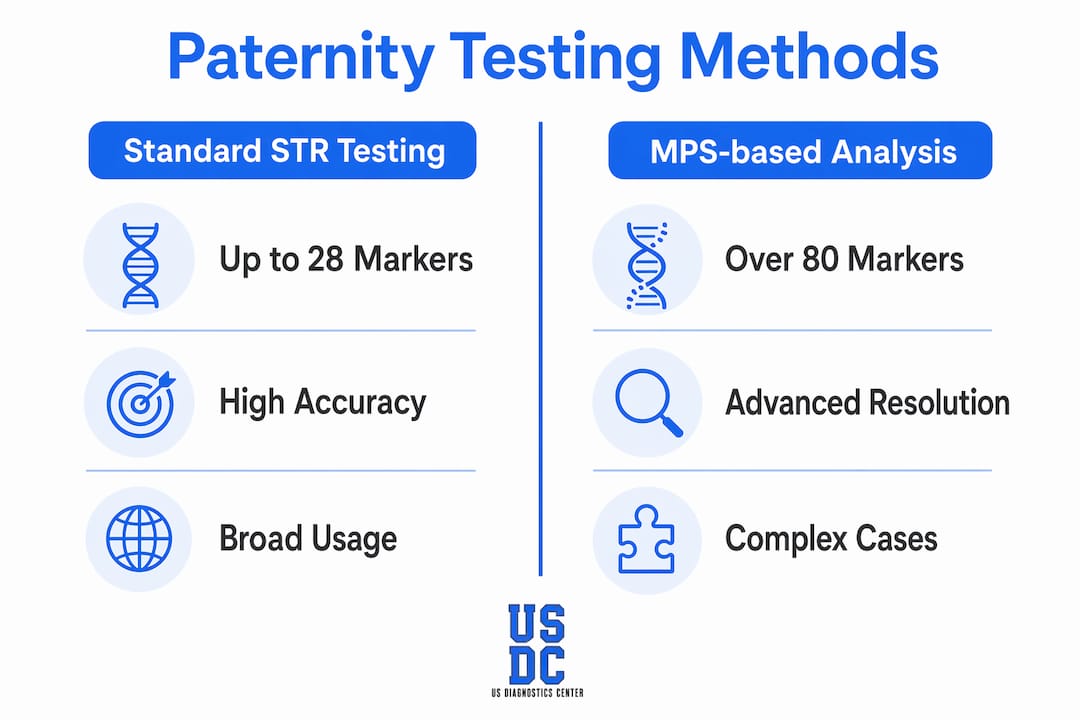
A 2026 case study published in Scientific Reports illustrates the power of MPS. Researchers used 54 autosomal STRs, 27 X-STRs, 48 Y-STRs, and 132 identity-informative SNPs to reinvestigate a paternity case that had shown three CODIS core STR inconsistencies. The combined paternity index reached 2.78 × 10²¹. That number is not just large; it means the probability of paternity was so high that the result was effectively certain beyond any statistical doubt.
The table below compares standard STR testing with MPS-based analysis across key performance dimensions.
| Feature | Standard STR testing | MPS-based analysis |
|---|---|---|
| Markers analyzed | Up to 28 STR loci | Hundreds of STRs and SNPs |
| Best use case | Routine paternity determination | Complex or ambiguous cases |
| Handles mutations | Limited | Yes, with multi-marker context |
| CPI range | Typically above 99.9% | Can reach astronomically high values |
| Turnaround | Standard lab timelines | May require specialized labs |
Pro Tip: If a standard test returns an inconclusive result or flags a single locus mismatch, request MPS-based analysis before drawing any conclusions. One mismatched locus does not equal exclusion when a mutation is possible.
MPS is not the default for every test, and most families will never need it. However, knowing it exists is reassuring. The science has a reliable fallback for the rare cases where standard methods leave any uncertainty.
What factors can affect the conclusiveness of a paternity test?
DNA paternity testing is among the most accurate forensic tools available, but reliability depends on responsible application and awareness of its limits. The laboratory analysis itself is mathematically sound. The vulnerabilities lie in the steps before the sample reaches the lab.
The most common factors that reduce conclusiveness include:
- Sample contamination. Eating, drinking, or chewing gum within 30 minutes of swabbing degrades the DNA sample. Labs identify contaminated samples and request recollection, which delays results.
- Improper swab drying. Sealing a wet swab in its envelope promotes bacterial growth that breaks down DNA. Swabs must air-dry for at least 30 minutes before packaging.
- Omitting the mother's DNA. Tests without the mother's sample rely on inference for the maternal contribution. Omitting the mother's sample increases the chance of ambiguous results, particularly when the alleged father is a close relative of the biological father.
- Testing a close relative instead of the alleged father. Brothers or other close relatives share a high proportion of STR alleles. Testing the wrong person can produce a false inclusion or an ambiguous result that requires advanced methods to resolve.
- Broken chain of custody. For legal tests, every sample must be collected by a neutral third party, sealed, and documented. A broken chain of custody renders results inadmissible in court, regardless of the biological accuracy.
Human errors during collection are the leading source of test inaccuracies, not laboratory failures. Choosing a lab that follows accredited procedures and provides clear collection instructions eliminates most of these risks before they occur.
Pro Tip: Follow the step-by-step preparation guide for DNA testing before you swab. Proper preparation takes less than an hour and protects the integrity of your sample.
How are paternity test results interpreted?
Paternity test results fall into two categories: inclusion and exclusion. Exclusion confirms that the alleged man is not the biological father, based on multiple mismatches across tested loci. Inclusion reports a very high probability of paternity, typically above 99.9%, which courts and families accept as conclusive.
Results are expressed as probabilities, not absolute certainties, because of the statistical nature of the calculation. A 99.9% probability means there is a 0.1% chance the conclusion is incorrect. That residual uncertainty reflects real-world biological variability, not a flaw in the method. No forensic test in any field claims 100% certainty; the 99.9% threshold is the accepted standard for legal and personal purposes.
The legal and personal implications of a conclusive result are significant:
- Legal standing. Court-admissible results require accredited collection procedures and documented chain of custody. A legal DNA test follows these protocols from the moment of collection.
- Child support and custody. Established paternity creates enforceable legal obligations for financial support and parental rights.
- Inheritance and benefits. Confirmed biological parentage affects eligibility for Social Security benefits, inheritance rights, and insurance coverage.
- Medical history. Knowing the biological father gives the child access to accurate family medical history, which informs future healthcare decisions.
Paternity testing serves not only biological clarification but also the emotional, financial, and legal foundations of family relationships. A conclusive result, whether inclusion or exclusion, gives everyone involved a factual basis for decisions that affect the child's entire life.
Key takeaways
Paternity testing is conclusive because STR marker analysis, rigorous chain of custody procedures, and accredited laboratory processing combine to produce probability scores that exceed the 99.9% legal threshold.
| Point | Details |
|---|---|
| STR analysis drives accuracy | Comparing up to 28 inherited markers between child and alleged father produces a statistically definitive result. |
| CPI quantifies confidence | The Combined Paternity Index multiplies likelihood ratios across all loci to generate a single probability score. |
| Sample handling is critical | Contamination before lab receipt is the leading cause of inconclusive results, not laboratory error. |
| Mother's DNA reduces ambiguity | Including the maternal sample isolates paternal markers and lowers the chance of an inconclusive outcome. |
| MPS resolves complex cases | Advanced sequencing analyzes hundreds of markers and can resolve cases where standard STR testing shows ambiguity. |
The part most people overlook when they order a test
After working with DNA testing processes for years, the pattern I see most often is this: people focus entirely on the science and ignore the procedure. They read about 99.9% accuracy, feel reassured, and then swab right after breakfast without a second thought. That is where results go wrong.
The laboratory analysis is genuinely reliable. The STR method is a forensic standard used in criminal investigations worldwide. The math behind the CPI is not in dispute. What is in dispute, when results come back inconclusive, is almost always what happened before the sample reached the lab.
The second thing I would emphasize is the difference between a home test and a legal test. A home paternity test uses the same DNA technology and delivers the same biological answer. However, it cannot be used in court because the collection was not witnessed and documented. If there is any chance the result will be needed for child support, custody, or inheritance proceedings, understanding the difference between home and legal tests early can save significant time and cost. You can learn about legal paternity tests and what to expect when that level of documentation is required. Redoing a test under legal protocols after the fact is a common and avoidable expense.
The science behind paternity testing is settled. The execution is where attention is required.
— Todd
Usdiagnosticscenter's approach to conclusive paternity results
Families who need a definitive answer deserve a process they can trust from start to finish. Usdiagnosticscenter offers home DNA tests for personal knowledge and peace of mind. Lab processing is completed in 2–3 business days with standard order-to-results delivery in 7–10 business days. Each kit includes a prepaid return shipping envelope, and expedited processing is available as an add-on during checkout for urgent situations.

Usdiagnosticscenter analyzes up to 28 STR markers per test Home paternity tests start at $79, and if you are unsure which test fits your situation, Usdiagnosticscenter's guided tool recommends the right option based on your specific family scenario. Visit Usdiagnosticscenter to review available tests and place an order with confidence.
FAQ
Why is paternity testing considered conclusive?
Paternity testing compares inherited STR markers between a child and alleged father to calculate a probability of paternity. A result above 99.9% is the accepted legal and scientific threshold for a conclusive inclusion.
How accurate are DNA paternity tests?
Standard paternity tests produce probability scores above 99.9% for inclusion results. Exclusion results are definitive when multiple loci show mismatches that cannot be explained by mutation.
Does including the mother's DNA improve accuracy?
Yes. Including the mother's sample clarifies which markers the child inherited maternally, isolating the paternal contribution and reducing the chance of an ambiguous result.
What causes an inconclusive paternity test result?
Sample contamination before lab receipt is the most common cause, including eating or drinking within 30 minutes of swabbing. Labs typically request recollection when a sample is degraded.
Can a paternity test be used in court?
A paternity test is admissible in court only when collected under a documented chain of custody by a neutral third party. Home tests use the same science but do not meet legal admissibility requirements.
Recommended
- Paternity Testing: The Complete Guide | USDC
- Probability of Paternity | DNA Testing Glossary | USDC
- At-Home Paternity Test: Cost & Accuracy | USDC
- Rush Paternity Test Results: Fast, Legal, and Accurate | USDC
This article is part of our Paternity Testing: The Complete Guide guide.


0 comments