

A true false positive from a well-performed trio paternity test, with both parents and the child sampled correctly, is extraordinarily rare, occurring at roughly one in ten million. Nearly every wrong result traced back to real cases stems from something else entirely: a duo test run without the mother, a close relative of the true father in the pool of possibilities, a sample mix-up, or a chain-of-custody failure. Genuine biological false positives from mutation or chimerism exist, but they sit far down the list of likely causes.
TL;DR:
- The chances of a true biological false positive from a well-performed trio test are about one in ten million, with most errors stemming from sample mix-ups or inadequate collection procedures.
- Including the mother’s sample in testing reduces false inclusion risk from approximately 19% to about 0.56%, especially when testing close relatives and using expanded marker panels.
- Duo tests without the mother have a false exclusion rate of around 1 in 770, increasing significantly if close relatives of the alleged father share recent ancestry.
- Chain-of-custody documentation and witnessed collection greatly decrease errors caused by sample tampering, mislabeling, or contamination before reaching the lab.
- Confirming or challenging a result involves verifying laboratory paperwork and potentially adding the mother or other relatives for more accurate, legally reliable conclusions.
Table of Contents
- What Causes a False Positive Paternity Test Result?
- What Nonbiological Errors Produce a Wrong Result?
- How Common Are False Inclusions and False Exclusions?
- Why Does Adding the Mother’s Sample Cut False Positives So Much?
- Can Related Men Cause a False Paternity Match?
- What Rare Biological Causes Can Skew a Result?
- What Should You Do If a Result Looks Wrong?
- How Do Labs Investigate a Confusing Result?
- Verifying Results Without Losing Your Head
- Choosing the Right Test to Confirm or Rule Out a Result
- Sources
- FAQ
What Causes a False Positive Paternity Test Result?
Standard paternity testing compares short tandem repeat (STR) markers, specific stretches of DNA that repeat in patterns unique enough to distinguish one person’s genetic profile from another’s. Each child inherits one copy of every marker from each biological parent, so a lab checks whether the alleged father’s DNA supplies a matching copy at enough locations to support biological parentage.
The difference between duo and trio testing determines how much room for error exists in that comparison. A duo test looks only at the father and child, forcing the lab to infer which of the child’s two alleles at each marker came from the mother versus the father. A trio test includes the mother’s sample directly, which lets analysts subtract her contribution and isolate exactly what the child inherited from the biological father. That isolation is the single biggest factor separating a rock-solid result from one with more uncertainty built in.
Labs express their conclusion as a combined paternity index (CPI), a statistical score built from the likelihood ratios at every tested marker. That CPI converts into a probability of paternity, and most accredited labs will not report a positive result below 99.9% probability. A handful of markers showing a match means very little on their own.
- STR markers: multiple loci tested simultaneously, each adding statistical weight to the result
- Duo testing: father and child only, weaker discrimination when a relative is involved
- Trio testing: mother, child, and father, the gold standard for isolating paternal alleles
- CPI and probability of paternity: the statistical backbone behind every reported conclusion
What Nonbiological Errors Produce a Wrong Result?
Most results that turn out wrong have nothing to do with the genetic testing itself. The DNA analysis is often flawless. The problem happened before the sample ever reached the sequencer.
Labeling mix-ups are the classic example: swabs from two different people get labeled incorrectly during collection or intake, and the lab produces a technically accurate result for the wrong pair of people. Contamination is another frequent culprit. Eating, drinking, smoking, or touching the swab tip before collection can introduce foreign DNA, and a damp or improperly sealed collection envelope can degrade a sample enough to compromise the read. How Often Are Home Paternity Tests Wrong and Why points out that home paternity kits use the same laboratory analysis as court-ordered tests, but the collection step itself carries more risk because nobody is watching to confirm the swab went in the right envelope.
Here’s the sequence most disputed results actually follow:
- Sample collected at home, unsupervised, with no third-party witness confirming identity or technique.
- Swabs mislabeled, contaminated, or degraded in transit.
- Lab runs a clean genetic analysis on a compromised or misidentified sample.
- Result comes back technically accurate for the sample received, but wrong for the people involved.
Witnessed collection, where a neutral third party confirms identity and observes the swabbing, closes most of that gap. Chain-of-custody documentation that tracks a sample from collection to lab intake makes it far harder for a swap or tampering incident to go unnoticed.
Pro Tip: Before you assume a lab made a genetic error, ask for the collection date, the technician’s initials, and photos of the sealed envelope. Most disputed results resolve at that paperwork stage, not in the lab.
How Common Are False Inclusions and False Exclusions?
The numbers vary enormously depending on which test type you’re looking at, and conflating them is where a lot of confusion starts.
Well-performed trio testing, with both parents and the child sampled and enough markers analyzed, produces a false-inclusion rate on the order of one in ten million, according to research on familial relationship testing accuracy. That number reflects the mathematics of testing enough independent markers at once. The odds of a random unrelated man matching by chance at fifteen, twenty, or more loci simultaneously are astronomically small.
Duo testing without the mother tells a different story. The same research found false exclusion rates as high as roughly 1-in-770 for certain marker sets when the mother’s DNA isn’t available to isolate the paternal contribution. False inclusions in duo testing stay comparatively rare among unrelated men, but the risk climbs sharply the moment a close relative of the true father enters the picture.
Three variables drive nearly all of the difference between a near-perfect result and a shakier one: whether the mother’s sample is included, how many markers get tested, and whether any of the men involved share recent ancestry.
- Trio testing false inclusion: roughly 1 in 10,000,000 for standard cases
- Duo testing false exclusion: as high as roughly 1 in 770 for some marker panels
- Both rates shift substantially when population structure or shared ancestry enters the equation
The AABB Relationship Testing Technical Report cautions against reading an exclusion rate as a direct measure of how many tested men are nonbiological fathers. Exclusion statistics reflect case mix, testing purpose, and reporting conventions as much as they reflect biology. A lab that handles a lot of court-referred cases involving known disputes will report different numbers than one processing routine home kits.
Why Does Adding the Mother’s Sample Cut False Positives So Much?
Including the mother’s DNA lets the lab subtract her known contribution from the child’s genetic profile at every marker, leaving only the alleles that had to come from the biological father. Without that subtraction, the lab has to guess which allele belongs to which parent, and that guess introduces uncertainty that compounds across every locus tested.
The improvement isn’t marginal. Research on false inclusion risk in relative parentage testing found that adding the mother’s sample can drop relative false-inclusion rates from around 19% in a motherless duo scenario down to roughly 0.56% for some relationship types. That’s not a small statistical nudge. It’s the difference between a result you can trust and one that needs a second look.
Adding a mother’s sample after the fact is usually straightforward:
- Contact the lab that ran the original test and ask about supplemental trio testing.
- Collect the mother’s swab using the same collection kit and instructions as the original test.
- Expect the lab to rerun the comparison using all three profiles rather than issuing a patch to the old report.
- Ask specifically how the updated report will present the paternity index once the maternal profile is factored in.
If you originally tested with just father and child, switching to trio testing is the single most effective thing you can do to tighten the result.
Can Related Men Cause a False Paternity Match?
Close relatives are the largest biological blind spot in standard paternity testing, and it isn’t close. Brothers share roughly half their DNA. Uncles, grandfathers, and cousins share smaller but still meaningful fractions. That shared inheritance means a standard STR panel, built to distinguish unrelated people, doesn’t have nearly as much power to distinguish two brothers.
| Scenario | Approximate false-inclusion risk | What reduces it |
|---|---|---|
| Duo test, brother of true father | Up to ~19% | Adding mother’s sample, expanded marker panel |
| Trio test, brother of true father | ~0.56% for some relationship types | Already substantially reduced by maternal subtraction |
| Duo test, unrelated alleged father | Extremely low | Standard STR panel is generally sufficient |
| Trio test, unrelated alleged father | Roughly 1 in 10 million | Already at maximum available confidence |
When a case involves the possibility of a related alleged father, testing multiple related men side by side gives the lab something to compare directly rather than evaluating one man in isolation. Expanding the marker panel adds more independent comparison points, and some labs turn to high-density SNP panels when STR markers alone can’t separate close relatives with confidence. Research on rectifying ambiguous STR results has shown that larger SNP panels can resolve cases that a standard marker count leaves genuinely unclear. The number of markers tested matters more here than almost anywhere else in the process, which is worth understanding before you order a test with limited marker coverage.
What Rare Biological Causes Can Skew a Result?
Two genuine biological phenomena occasionally produce a confusing result, and both are far rarer than the causes covered so far.
STR markers mutate at a low, well-documented rate from one generation to the next. When a single marker shows a mismatch while every other tested locus matches cleanly, labs generally treat that as a possible mutation rather than grounds for exclusion. The AABB technical report confirms that mutation rates are already built into how CPI calculations handle single-locus inconsistencies, so one mismatched marker among fifteen or twenty typically doesn’t overturn an otherwise strong result.
Chimerism, where a person carries two genetically distinct cell lines, usually from absorbing a twin in early development, is far rarer and can genuinely confuse a standard test if the tissue sampled doesn’t reflect the person’s reproductive cells. Suspected chimerism calls for tissue-specific retesting, sampling a different cell type than the original cheek swab, and this is a scenario worth bringing to a genetic counselor rather than resolving through repeat standard testing alone.
What Should You Do If a Result Looks Wrong?
Work through verification in order rather than jumping straight to a legal fight or an emotional conclusion.
- Request the chain-of-custody documentation and the raw allele table from the lab, not just the summary report.
- Ask whether the original test was duo or trio, and if it was duo, arrange to add the mother’s sample.
- If a relative of the alleged father could plausibly be the biological father, disclose that to the lab and ask about testing that man directly or expanding the marker panel.
- Consider an independent second lab for a cross-check if the stakes are high enough to warrant it.
- For custody, support, or inheritance disputes, ask what testing standard the relevant court requires before you rely on a home kit result in that proceeding.
Pro Tip: Always ask for the raw allele table, not just the pass/fail summary. A single-locus discrepancy surrounded by fifteen clean matches tells a very different story than a scattered pattern across multiple markers, and you want to see that distinction yourself.
If mutation or chimerism genuinely seems to be in play, a genetic counselor can help interpret the pattern and recommend which specialized test actually answers the question you’re asking.
How Do Labs Investigate a Confusing Result?
Lab staff work through ambiguous results in a fairly consistent order. First, they check sample integrity: was the collection witnessed, was the packaging intact, does the paperwork match the profiles run? Second, they check whether the mother’s sample was included, and if not, that becomes the first thing they’ll recommend adding. Third, if a relative could be the true father, they’ll suggest testing that man directly rather than trying to infer an answer from one profile alone. Only after those steps do specialized panels come into play.
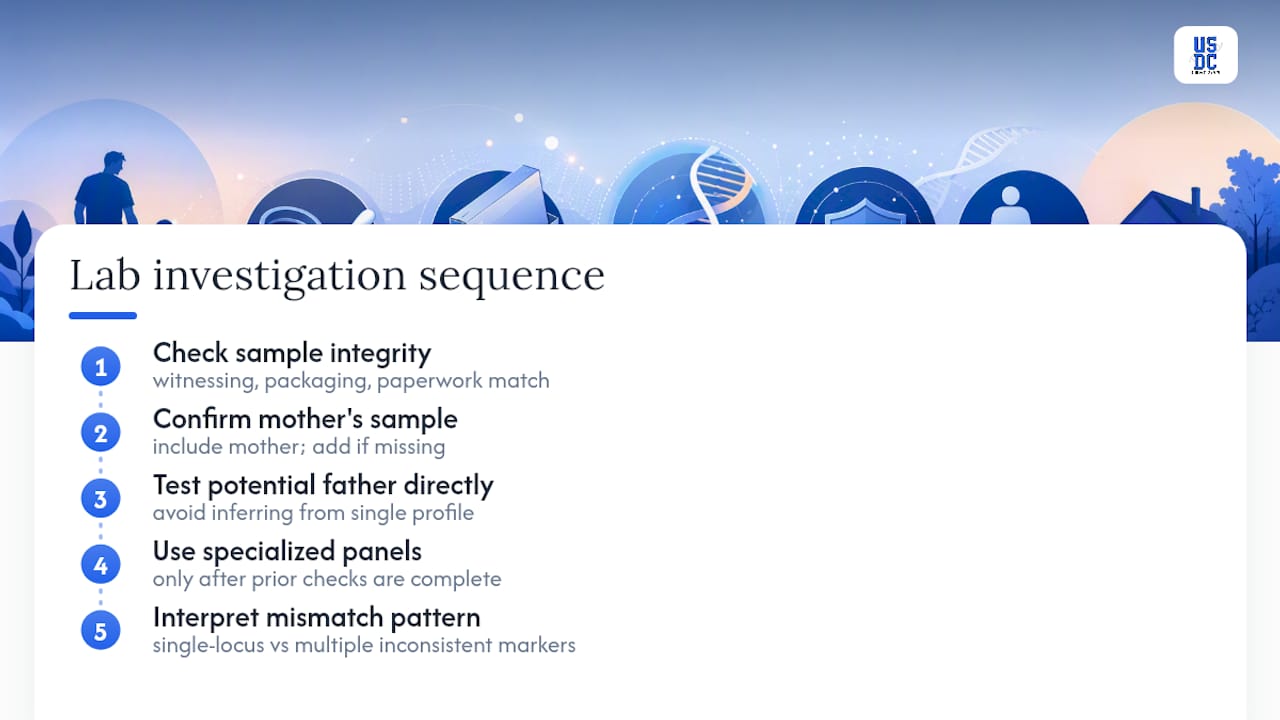
Deciding whether a mismatch reflects a mutation, a processing error, or genuine nonpaternity comes down to pattern: one clean single-locus discrepancy among many matches reads very differently than several inconsistent markers scattered across the panel. A guided test selection tool can help customers choose the testing configuration—duo, trio, or extended kinship—that fits their specific situation before a sample is collected.
Verifying Results Without Losing Your Head
A wrong or ambiguous paternity result touches something deeply personal, and it’s normal to feel destabilized before you’ve even opened the report fully. That reaction doesn’t mean the result is actually wrong. Most genuine false positives trace back to fixable, identifiable causes: a missing maternal sample, an untested relative, a collection error. Work through verification step by step rather than reacting to the headline number, and bring in a genetic counselor or an accredited lab when the outcome carries real legal or financial weight.
— Dr. Todd Lewis
Choosing the Right Test to Confirm or Rule Out a Result
If your original test raised more questions than it answered, the fix is usually a better-configured test rather than a repeat of the same one. US Diagnostics Center’s test finder tool walks you through duo, trio, and extended kinship options based on your specific situation, including whether a relative of the alleged father needs to be part of the comparison.
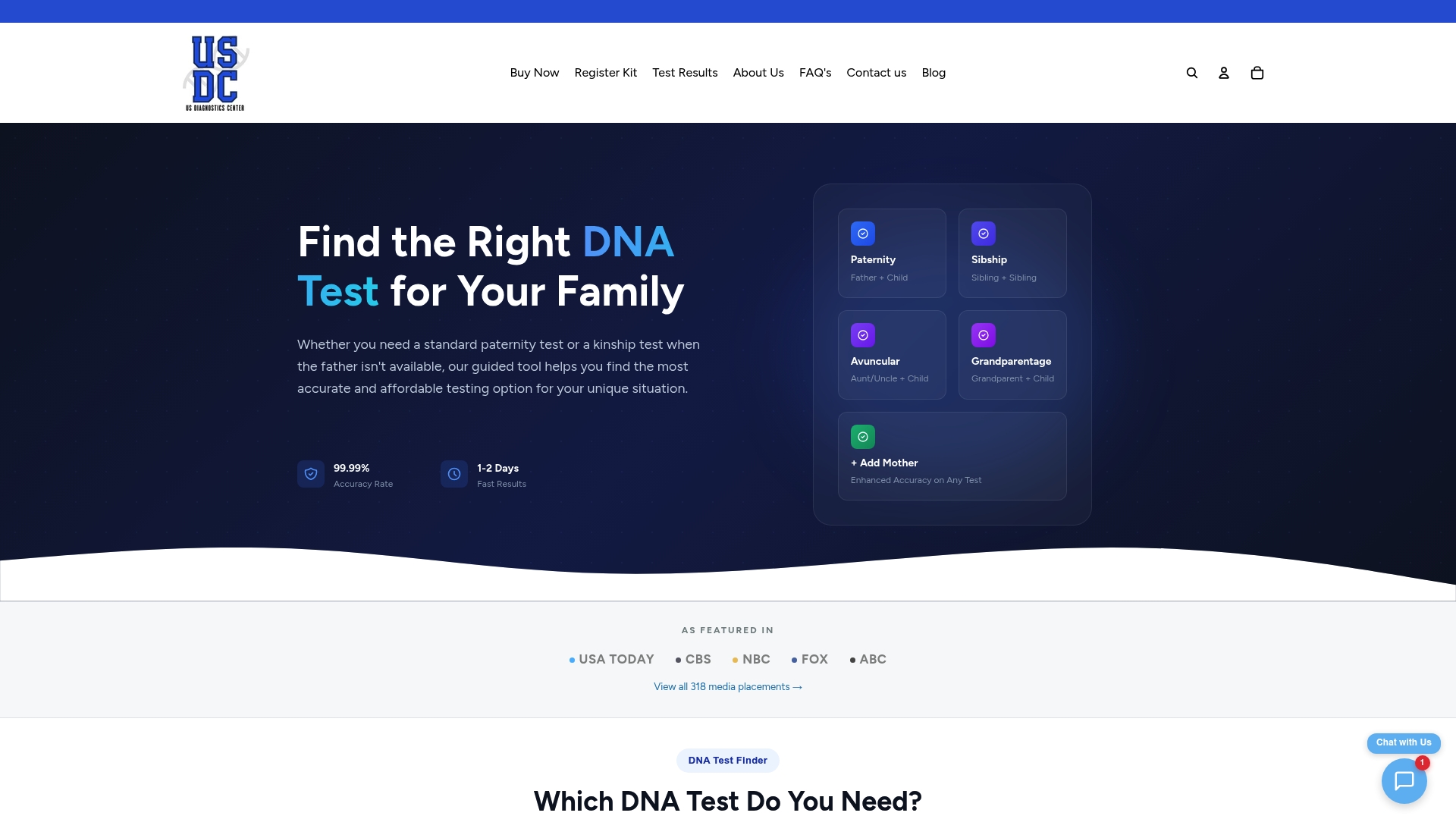
The Home Paternity Test Kit runs $79 and analyzes up to 28 markers, giving you more comparison points than a bare-minimum panel offers. Lab processing typically takes 2 to 3 business days once your sample arrives, with standard turnaround running 7 to 10 business days from order to results, and every kit ships with a prepaid return envelope so you’re not tracking down packaging on your own. If you’re adding a mother’s sample to convert a duo result into a trio result, or you need to bring in a sibling or grandparent for a kinship comparison, those collection kits work the same way.
If your situation requires a court-admissible result or industry-standard chain-of-custody documentation, confirm those specific requirements with the relevant court or agency before you order.
Sources
- How many familial relationship testing results could be wrong?
- How Often Are Home Paternity Tests Wrong and Why
FAQ
Can a 99.9% DNA Test Result Still Be Wrong?
Yes, though it’s uncommon. A 99.9% probability of paternity reflects the statistical strength of the marker comparison, but it can’t correct for a mislabeled sample, an untested relative, or a duo test run without the mother’s DNA.
How Common Are False Negative Paternity Tests?
Genuine false negatives, where a real biological father is incorrectly excluded, are rare in trio testing but climb in duo testing, with some studies reporting exclusion rates as high as roughly 1 in 770 for certain marker sets when the mother’s sample isn’t available.
What Can Throw Off a Paternity Test?
The most common causes are pre-lab issues: contaminated or mislabeled samples, unwitnessed home collection, and testing without the mother’s DNA when a close relative of the alleged father could plausibly be the true father.
Can You Face Legal Consequences for Lying About Paternity?
Knowingly submitting a fraudulent sample or misrepresenting identity during a court-ordered or legal paternity case can carry serious legal consequences, including perjury or fraud charges, depending on the jurisdiction and circumstances involved. Anyone facing a legal paternity dispute should consult an attorney about the specific requirements in their case.
Recommended
- Positive Paternity Test Results: What They Mean & Next Steps
- Paternity Test 0% Probability: 7 Steps to Take Next
- Paternity Test When Possible Fathers Are Related (2026)
- How to Read Paternity Test Results: DNA Report Explained
This article is part of our Paternity Testing: The Complete Guide guide.


0 comments