

Yes. At-home kinship DNA kits can resolve most personal paternity, sibling, grandparent, aunt/uncle, and twin zygosity questions even when a relative lives in another country. What they cannot do is stand in for immigration or court chain-of-custody testing, which requires witnessed collection and an accredited lab process. The distinction matters because the two use cases get confused constantly online.
For personal answers, here's what at-home kits typically cover:
- Paternity and maternity — confirming a parent-child relationship
- Sibling testing — full or half siblings
- Grandparent testing — used when a parent isn't available
- Aunt/uncle (avuncular) testing — another workaround when direct parents can't test
- Twin zygosity — determining if twins are identical or fraternal
US Diagnostics Center sells these as consumer kits and prices home paternity at $79, with results typically in 7 to 10 business days from order to report.
Key Takeaways
At-home kinship DNA tests reliably answer personal paternity, sibling, grandparent, avuncular, and twin questions, but they cannot substitute for legal or immigration testing.
| Point | Details |
|---|---|
| Match test to relationship | Choose paternity, sibling, grandparent, avuncular, or twin zygosity based on who's available to test. |
| More markers, more confidence | Kits testing up to 28 markers generally produce stronger relationship index scores than lower-marker tests. |
| Add relatives for weak results | Including a parent, sibling, or grandparent improves conclusiveness, especially for sibling comparisons. |
| Not for legal or immigration use | At-home results aren't admissible in court and can't support immigration petitions. |
| US Diagnostics Center for personal testing | Offers home paternity ($79), maternity ($129), and sibling/grandparent/aunt-uncle kits ($139) with 7 to 10 business day turnaround and prepaid return shipping. |
Table of Contents
- Does Immigration DNA Overseas Testing Apply to Personal Kinship Kits?
- What At-Home Kinship Tests Cover and When to Pick Each
- How Accurate Are At-Home DNA Tests With Relatives Abroad?
- How Do You Choose the Right Kit for Relatives Overseas?
- Ordering, Collecting, and Shipping Samples From Overseas Relatives
- When You Need a Legal Test Instead of an At-Home Kit
- Interpreting Results When Relatives Come From Different Regions
- Keeping Samples Intact During International Shipping
- What to Expect From Customer Support When Ordering for Overseas Relatives
- Customs Rules and International Shipping for DNA Samples
- What Actually Matters When You're Testing Across Borders
- Ordering an At-Home Kit for a Relative Overseas
- Sources
- FAQ
Does Immigration DNA Overseas Testing Apply to Personal Kinship Kits?
Searches for "immigration DNA overseas" often land people in the wrong lane entirely. Immigration and court-admissible DNA testing is a separate, regulated process involving witnessed collection at approved facilities and a documented chain of custody that satisfies USCIS petition standards. That process is not what this guide covers, and it's not what a $79 at-home kit is built to deliver.
What this guide covers is simpler: a mother in Ohio wants to know if the man in Manila is her child's father. A woman in Texas wants to confirm whether her half-sister in Germany shares the same father. These are personal questions, not legal ones, and at-home kits answer them well. If you eventually need documentation for a visa or court filing, that's a different product entirely, and one USCIS uses specific DNA evidence standards to evaluate.
What At-Home Kinship Tests Cover and When to Pick Each
The right test depends on who's available to swab, not just who you're trying to identify.
- Paternity/maternity tests work when the alleged parent can provide a sample. This is the most direct and conclusive test type, and it's why it's usually the first choice when the parent is reachable, even overseas.
- Sibling tests compare two people believed to share a parent. Full siblings share more DNA than half siblings, and results are more conclusive for full-sibling comparisons than for half-sibling ones.
- Grandparent and avuncular tests step in when a parent has died, disappeared, or simply refuses to test. A grandparent shares roughly the same genetic relationship to a grandchild as an aunt or uncle does to a niece or nephew, so both work as indirect stand-ins.
- Twin zygosity testing answers whether twins are identical (monozygotic) or fraternal (dizygotic), often ordered out of curiosity or for medical history reasons rather than a dispute.
Picking the wrong test type for your situation is the most common mistake families make, and it usually happens when someone orders a sibling test because a parent overseas won't participate, without realizing a direct paternity test might still be possible another way.
How Accurate Are At-Home DNA Tests With Relatives Abroad?
Accuracy comes down to two things: how many genetic markers the lab checks, and how many relatives you test. Most consumer kits test up to 28 markers, and more markers generally produce a stronger, more confident result.
Parent-child tests are the most straightforward. A direct comparison between an alleged father and child either strongly supports or excludes the relationship, and the math behind it is well established. Sibling tests work differently. Consumer kinship tests, including USDC's, report results as a Combined Relationship Index (CRI) rather than a probability percentage. A CRI above 10 is supportive of the claimed relationship; 0.1–10 is inconclusive; below 0.1 argues against it. USCIS's own policy guidance on DNA evidence notes that sibling DNA evidence with probability scores below 90% under USCIS's evidentiary framework are generally treated as inconclusive on their own — a threshold specific to the immigration evidentiary standard, not to how consumer lab reports are formatted, but useful context for understanding how much less certain sibling comparisons are compared to direct parent-child testing.
Sibling tests are inherently less certain than parent-child tests. Analysis from Genomes Unzipped explains that including a known parent or additional relative in the test substantially improves how confidently a lab can interpret sibling results.
This is why labs and USCIS guidance alike recommend testing additional first-degree relatives (a parent, another sibling) or second-degree relatives (a grandparent, aunt, or uncle) whenever you can. Each added relative gives the lab more data points to work with, which tightens the relationship index score.
Pro Tip: If your sibling test result comes back ambiguous, don't assume the relationship is disproven. Ask about adding a parent or grandparent to the comparison before drawing any conclusions.
How Do You Choose the Right Kit for Relatives Overseas?
- Match the test to the actual question. If you're confirming a father-child relationship and the father is willing to swab, order a direct paternity test rather than a sibling test as a workaround.
- Look for higher marker counts and optional add-on participants. A kit that supports up to 28 markers and lets you add a grandparent or second sibling gives you a stronger result if the first comparison comes back unclear.
- Confirm turnaround, prepaid return shipping, and consent requirements before you order. Every participant, including the one overseas, needs to complete a signed consent form for the lab to process the sample.
- Ask about expedited processing if timing matters. Standard order-to-results runs 7 to 10 business days, but expedited options exist for families facing time-sensitive decisions.
Pro Tip: Order one kit that ships to the U.S. address of the person managing the process, then have that person mail a swab kit internationally to the overseas relative rather than shipping two separate kits from the lab. It's simpler to track and reduces the chance of a kit getting lost in transit.
Ordering, Collecting, and Shipping Samples From Overseas Relatives
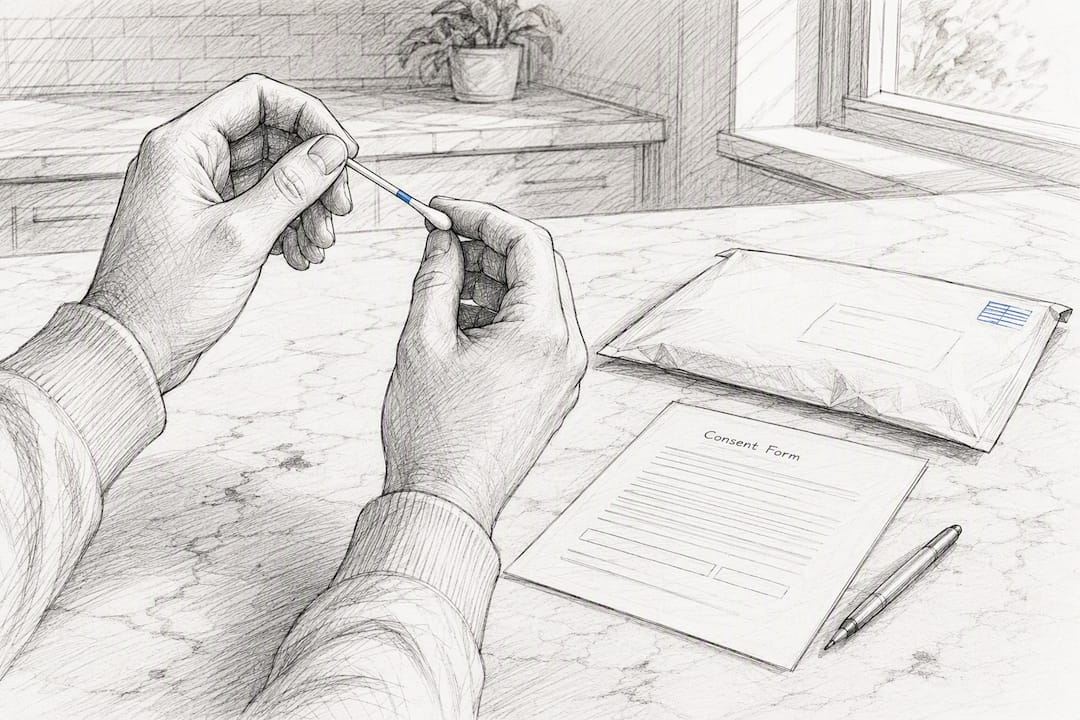
A standard kit arrives with cheek swabs, collection tubes or envelopes, consent forms, and a return mailing envelope. Collection itself is simple: swab the inside of the cheek, let it air-dry as instructed, seal it in the provided container, and sign the consent form. Cleveland Clinic's overview of at-home paternity testing confirms this cheek-swab method is standard across consumer kits and typically takes about a week or two before results are ready.
Shipping internationally adds a few wrinkles. Use plain, accurate language on any customs declaration, describing the contents as a biological sample for personal identity testing. Avoid wording that suggests medical waste or clinical specimens, since that can trigger unnecessary customs holds or special handling requirements.
Once the sample reaches the U.S. lab, processing typically takes 2 to 3 business days, with standard order-to-results timelines running 7 to 10 business days. Expedited processing is available for families who need a faster answer.
- Each participant, including the one overseas, must sign their own consent form
- Missing or incomplete consent forms are one of the most common reasons kits get delayed
- Keep a copy of the signed forms before mailing, just in case anything gets lost
When You Need a Legal Test Instead of an At-Home Kit
At-home kits are built for personal information. They are not admissible in court, and they cannot be used for immigration petitions. Cleveland Clinic notes plainly that at-home results generally don't hold up as legal evidence, because there's no witnessed collection and no documented chain of custody.
Legal and immigration-grade testing requires a very different process: a neutral third party observes the sample collection, verifies each participant's identity, and the lab documents every step from swab to result. That's a separate product from anything covered in this guide, and it typically involves specific requirements USCIS petitions call for at consulates overseas.
If there's any chance you'll need official documentation later, start with the legal route instead of an at-home kit. Here's what changes:
- Legal tests require witnessed, identity-verified collection
- Chain-of-custody paperwork tracks the sample at every step
- An accredited lab processes the sample under stricter protocols
Interpreting Results When Relatives Come From Different Regions
Population genetics can raise questions when relatives being tested come from different countries or ethnic backgrounds, but it rarely changes the bottom line for a well-designed kinship test. DNA relationship testing relies on markers that are inherited in predictable, well-understood patterns regardless of ancestry. A parent-child comparison works the same way whether both people live in Ohio or one lives in Lagos.
Where population background can matter is in how rare or common certain marker variants are within different reference populations, which labs account for when calculating relationship index scores. This is a technical adjustment handled on the lab side. It's not something you need to manage, and it's rarely a reason to doubt a clear result.
What can genuinely complicate interpretation is testing more distant relationships, like avuncular or grandparent comparisons, across populations with limited genetic diversity data on file. If your results come back with a wider confidence range than expected, that's often a sign the test would benefit from an additional relative rather than a sign something went wrong with your family's background specifically.
If a result surprises you, the most useful next step isn't to second-guess the science. It's to ask whether adding a second relative, like a sibling or grandparent, would tighten the relationship index score. That's usually a more productive path than trying to interpret an ambiguous score on your own, especially when the people involved come from different genetic backgrounds and you're not sure how much that should weigh into your read of the numbers.
Keeping Samples Intact During International Shipping
A degraded or contaminated sample is the most preventable reason a kit gets delayed. The fix is mostly about patience during collection. Let the swab air-dry fully before sealing it, exactly as the kit instructions describe. A swab packaged while still damp is far more likely to grow bacteria that can interfere with lab processing.
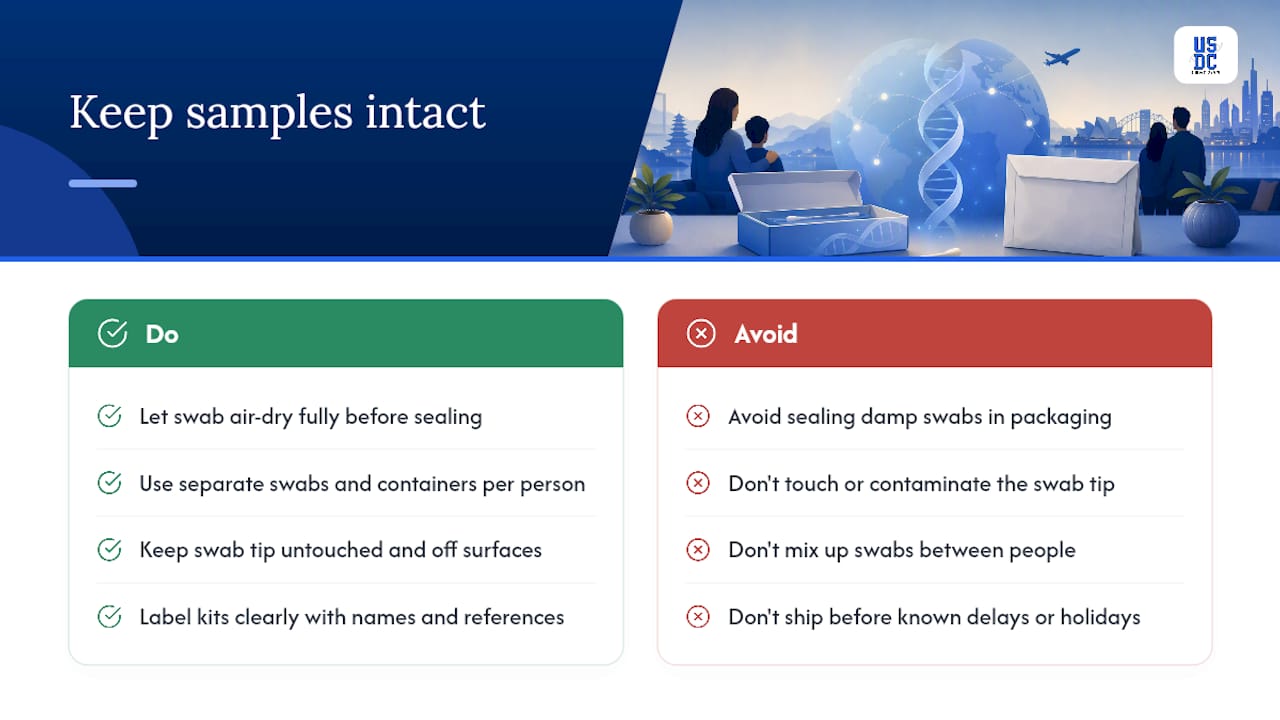
Avoid touching the swab tip with fingers, and don't let it contact other surfaces before it's sealed. If two people are swabbing for the same test, use separate swabs and separate containers. It sounds obvious, but mixing up which swab belongs to which person is a real and common error, especially when a kit is being coordinated across two households or two countries.
Temperature extremes are the other risk during international transit. A sample sitting in a hot cargo hold or a freezing customs warehouse for days isn't ideal, though most cheek-swab kits are designed to tolerate normal shipping conditions reasonably well since the sample is dried rather than liquid. Still, avoid mailing a kit right before a known customs delay or holiday shipping crunch if you can help it.
Label everything clearly. If two family members overseas are each returning a separate kit, make sure names and reference numbers are legible and match what's on file with the lab. A smudged label or an unsigned consent form is a far more common cause of delay than anything related to shipping conditions themselves.
What to Expect From Customer Support When Ordering for Overseas Relatives
Ordering a kit for someone in another country raises questions a standard FAQ page doesn't always answer. Will customs hold the package? What if the relative doesn't have reliable mail service? What happens if a form is filled out incorrectly? This is where responsive customer support earns its place.
Good support for this specific scenario means someone who can walk you through customs declaration wording, confirm what happens if a kit sample arrives outside expected condition, and clarify whether a specific country's mail system is reliable enough for return shipping. It also means being reachable before you order, not just after something goes wrong.
Ask direct questions before you buy: How does the lab handle a sample that arrives late? What's the process if a consent form is missing a signature? Can you add a second relative to an existing order without starting over? A provider that answers these clearly, in plain language, before you've spent any money, is a good sign of how they'll handle a problem later.
This matters more for overseas orders than domestic ones, simply because there are more points where something can go sideways: an address typo, an unfamiliar customs form, a mail carrier unfamiliar with the packaging. Support that understands the international piece of this, not just the domestic swab-and-mail process, is worth confirming before you commit to a kit.
Customs Rules and International Shipping for DNA Samples
Most countries don't treat a dried cheek swab as a hazardous or restricted biological material, but customs officials don't always know that on sight. The safest approach is accurate, plain-language labeling: describe the contents as a non-hazardous biological sample for personal identity testing, not as a medical specimen or diagnostic sample, which can trigger different handling rules.
Every country has its own customs form requirements, and postal reliability varies widely. Before mailing a kit internationally, check whether the destination country requires a customs declaration form (many do, even for small packages) and fill it out with a straightforward, honest description. Vague or alarming language, like anything suggesting a clinical or medical waste product, is more likely to get a package flagged for inspection or delayed.
Return shipping works the same way in reverse. When a sample travels from overseas back to the U.S. lab, the same plain labeling principle applies. Prepaid return envelopes provided in most kits are addressed and set up for standard mail service, but if the relative overseas is mailing from a country with slower or less predictable postal service, build in extra time before you're expecting results.
If you're unsure how a particular country's customs process will handle a biological sample, ask the testing provider directly before shipping. This is a common enough scenario that most established providers will have a straightforward answer rather than a runaround.
What Actually Matters When You're Testing Across Borders
The conventional advice on this topic tends to focus entirely on shipping logistics: get the right envelope, fill out the form correctly, mail it on time. That's necessary, but it's not where most families actually go wrong. The bigger mistake is choosing the wrong test type for the relationship in question, then getting an ambiguous sibling or avuncular result and assuming the test failed rather than realizing the test itself was undersized for the question being asked.
If I could get families to prioritize one thing, it's this: think about who else could reasonably be tested before you order anything. A sibling test alone is a weaker tool than a sibling test plus a shared parent or grandparent, and that's true whether everyone lives in the same zip code or across three continents. Marker count matters too, and up to 28 markers gives a meaningfully stronger result than a bare-bones test, but no marker count fixes a test design that was too indirect for the question being asked.
Overseas logistics are solvable with planning. Test selection is where good outcomes are actually won or lost.
— Dr. Todd Lewis
Ordering an At-Home Kit for a Relative Overseas
US Diagnostics Center is built for exactly this kind of personal question, without the wait times or added cost of a legal testing process you don't need. Home paternity testing runs $79, maternity testing is $129, and sibling, grandparent, and aunt/uncle kits are $139, each with lab processing in 2 to 3 business days and standard order-to-results timing of 7 to 10 business days.
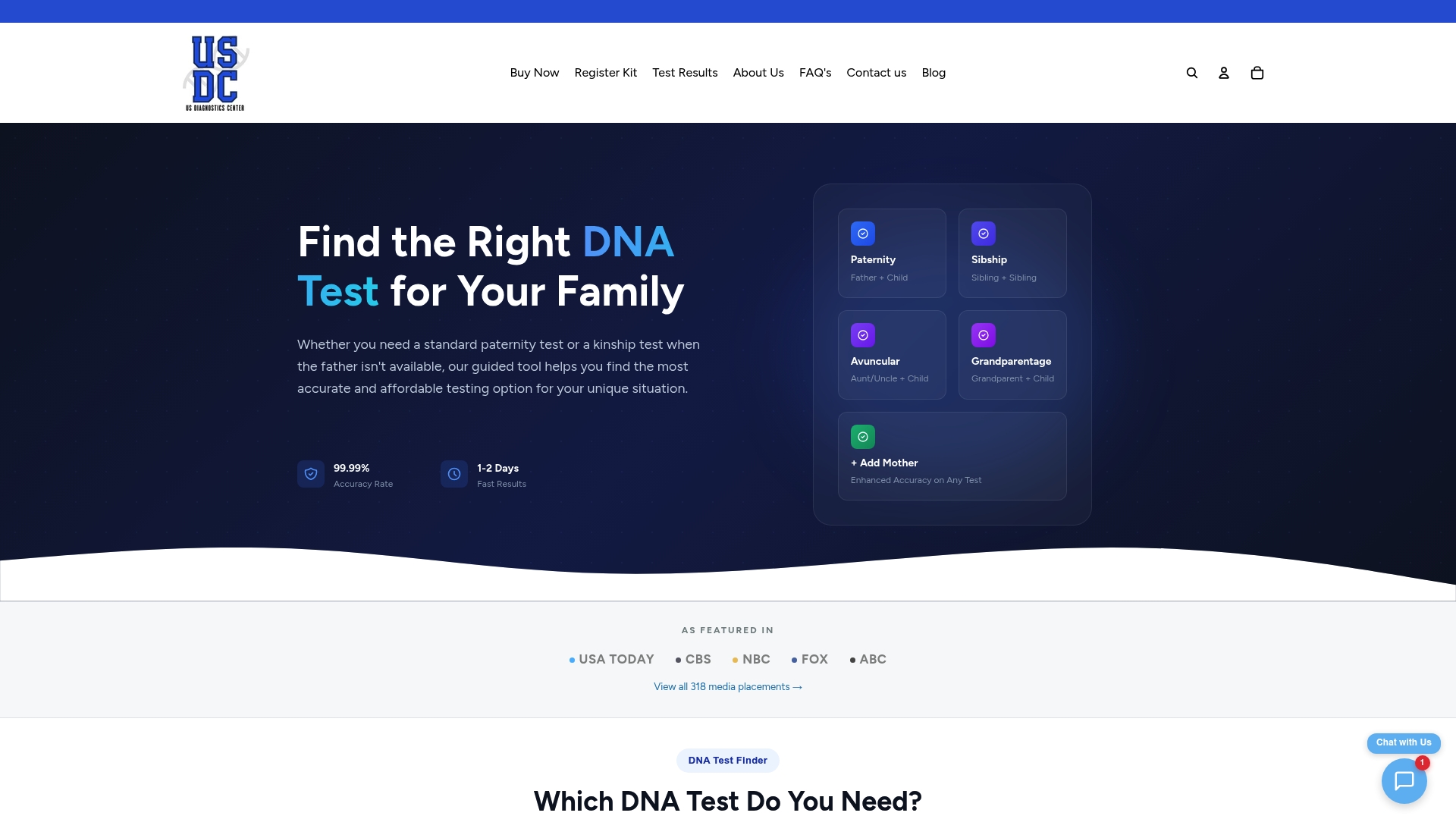
Every kit includes a prepaid return shipping envelope. Returning a sample from the U.S. side of the process is already handled once collection is done. A guided test-selection tool on the site helps you pick the right test type based on your specific family situation, whether that's a straightforward paternity question or a more complex grandparent comparison. Expedited processing is available if you're working against a deadline. US Diagnostics Center's at-home kits are for personal use only and are not admissible for legal or immigration purposes.
If you're ready to move forward, browse the home DNA test collection to compare kit options, or check the kinship testing page if you're still deciding between a sibling, grandparent, or avuncular test.
Sources
- USCIS: Policy memorandum — DNA evidence of sibling relationships
- Cleveland Clinic — DNA paternity test: procedure, accuracy & results
- Genomes Unzipped — How accurate is a sibling DNA test?
FAQ
Can I Use an At-Home DNA Kit for Immigration Purposes?
No. At-home kits are for personal information only and don't meet the witnessed collection and chain-of-custody standards immigration petitions require.
How Many Markers Should a Kinship Test Include?
Look for kits testing up to 28 markers, since more markers generally produce stronger, more reliable relationship index scores.
What If My Sibling Test Result Comes Back Inconclusive?
Add a parent, another sibling, or a grandparent to the comparison.
How Long Does It Take to Get Results From an Overseas Relative?
Once the sample reaches the lab, processing takes 2 to 3 business days, with standard order-to-results timelines of 7 to 10 business days. Expedited options are available.
What is AABB accreditation and why does it matter?
AABB accreditation is a voluntary certification that DNA testing laboratories can earn by meeting rigorous standards for chain-of-custody procedures, analyst qualifications, and quality management. Courts and immigration agencies such as USCIS require that DNA evidence be produced by an AABB-accredited lab. For personal at-home testing where legal admissibility is not required, AABB accreditation is not a prerequisite, but it remains a meaningful quality benchmark when evaluating any testing provider.
Recommended
- DNA Testing for Immigration: At-Home Kinship Tests Explained | USDC
- 8 Situations Where a Sibling DNA Test Is the Answer | USDC
This article is part of our Kinship DNA Testing: Sibling, Grandparent, and Family Relationship Tests guide.


0 comments