

TL;DR:
- At-home DNA relationship tests can verify personal relationships but are not suitable for legal or immigration purposes. Choosing a test with the appropriate marker count and understanding sample collection, privacy policies, and result interpretation are crucial. Higher marker counts improve accuracy, especially in indirect relationships, and consulting a genetic counselor may help interpret ambiguous findings.
At-home and standard relationship DNA tests can confirm biological relationships for personal peace of mind, but they are not the same as court-admissible or immigration-submission tests, which require strict chain-of-custody procedures and accredited collection. If your goal is personal verification rather than a legal filing, an at-home kit is a practical, affordable starting point.
- What these tests measure: Relationship tests compare genetic markers at specific locations in your DNA. Industry kits analyze 20 or more markers to calculate inclusion or exclusion probabilities. A conclusive paternity result typically reports near 99.99% probability of inclusion or a definitive 0% exclusion.
- At-home vs. standard lab: At-home kits suit personal curiosity and convenience. A standard lab with transparent reporting and clear marker counts is preferable when you want more reliable documentation, though neither replaces a legal chain-of-custody test for court or immigration purposes.
- Relationships you can test: Paternity, maternity, full or half siblings, grandparentage, aunt/uncle (avuncular), and twin zygosity are all testable through kinship tests, which are a distinct category from ancestry or health tests.
Table of Contents
- What you need to know before buying a kit
- A practical note on responsible personal DNA testing
- At-home relationship tests from US Diagnostics Center
- Useful sources for further reading
- Key Takeaways
- An editor's perspective on what families actually need from these tests
- FAQ
What you need to know before buying a kit
Choose a test that matches the specific relationship you need to verify, confirm the lab's marker count and turnaround time, and read the privacy policy before submitting a sample.
Relationship type: Each kinship scenario requires a different test design. Paternity and maternity tests compare parent-child DNA directly. Sibling, grandparent, and avuncular tests use statistical modeling across shared markers, which can produce ambiguous results when the biological relationship is indirect. Matching the test to the actual relationship question avoids wasted time and inconclusive reports.
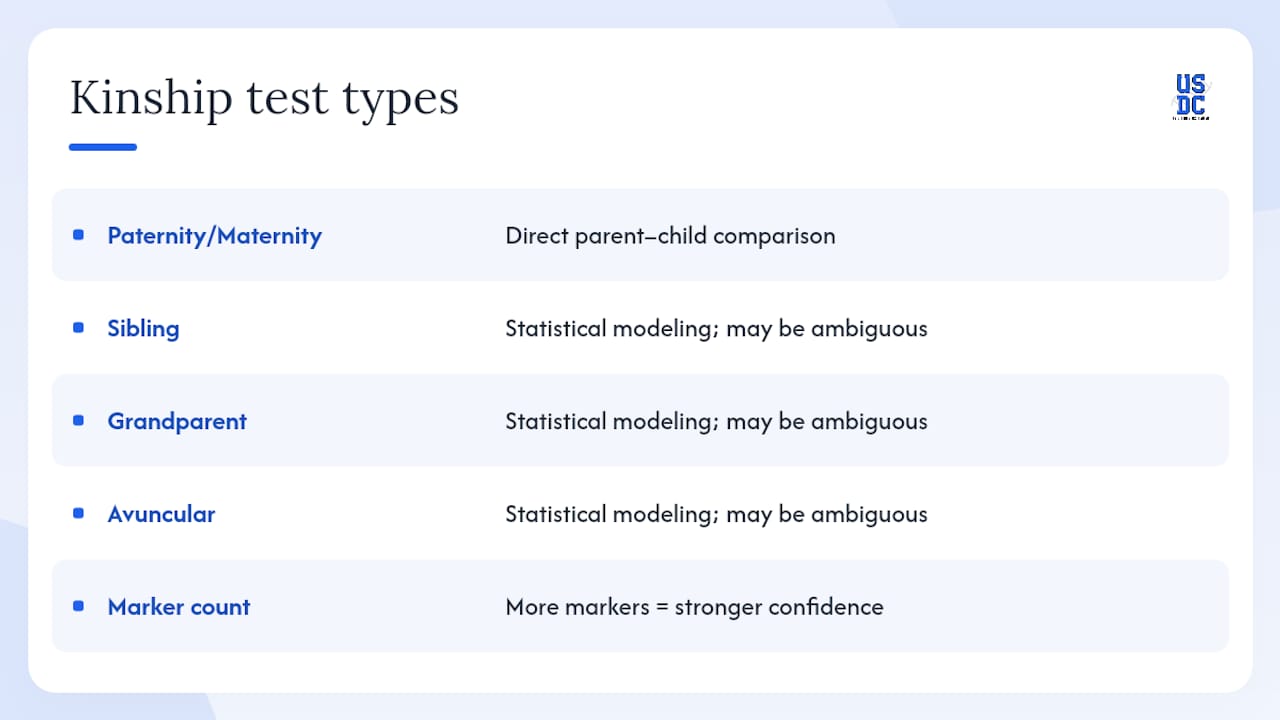
Marker count: More markers generally means greater discriminatory power. Tests using up to 28 markers provide stronger statistical confidence than those using fewer. When comparing kits, the marker count is one of the most practical specifications to check.
Sample collection: Nearly all at-home relationship tests use a simple cheek swab. Proper technique matters: swab firmly for 30 seconds per cheek, allow the swab to air-dry before sealing, and avoid eating or drinking for 30 minutes before collection. Poor handling can degrade the sample and affect accuracy.
Timeline and cost: At-home relationship tests are considerably less expensive than clinical or legal panels. Lab processing typically runs 2–3 business days after the sample arrives; order-to-results is usually 7–10 business days. Expedited options can shorten that window.
Privacy: DNA data is sensitive. Before ordering, confirm what the lab retains, whether samples are stored after analysis, and whether data is shared with third parties. A clear, specific privacy policy is a meaningful trust signal.
A practical note on responsible personal DNA testing
Personal DNA testing deserves the same careful preparation you would give any significant family decision. The recommendation here is straightforward: match the test to the relationship, verify the marker count, and read the privacy terms before you submit a sample.
Results that confirm a relationship are usually straightforward to interpret. Results that are ambiguous or unexpected are a different matter. At-home tests lack the medical context that a clinical setting provides, and a genetic counselor can help you work through findings that conflict with family history or raise new questions. If you are testing a relationship that involves other family members, consider discussing the process with them beforehand.
Pro Tip: Before collecting your sample, review the lab's result report format. A well-structured report will state the probability of relationship clearly, identify each marker tested, and explain what an inconclusive result means. If that information is not available before purchase, contact customer support and ask.
For DNA evidence used in forensic or investigative contexts, the role of DNA in cold cases illustrates how chain-of-custody and marker standards directly affect the reliability of any conclusion.
At-home relationship tests from US Diagnostics Center
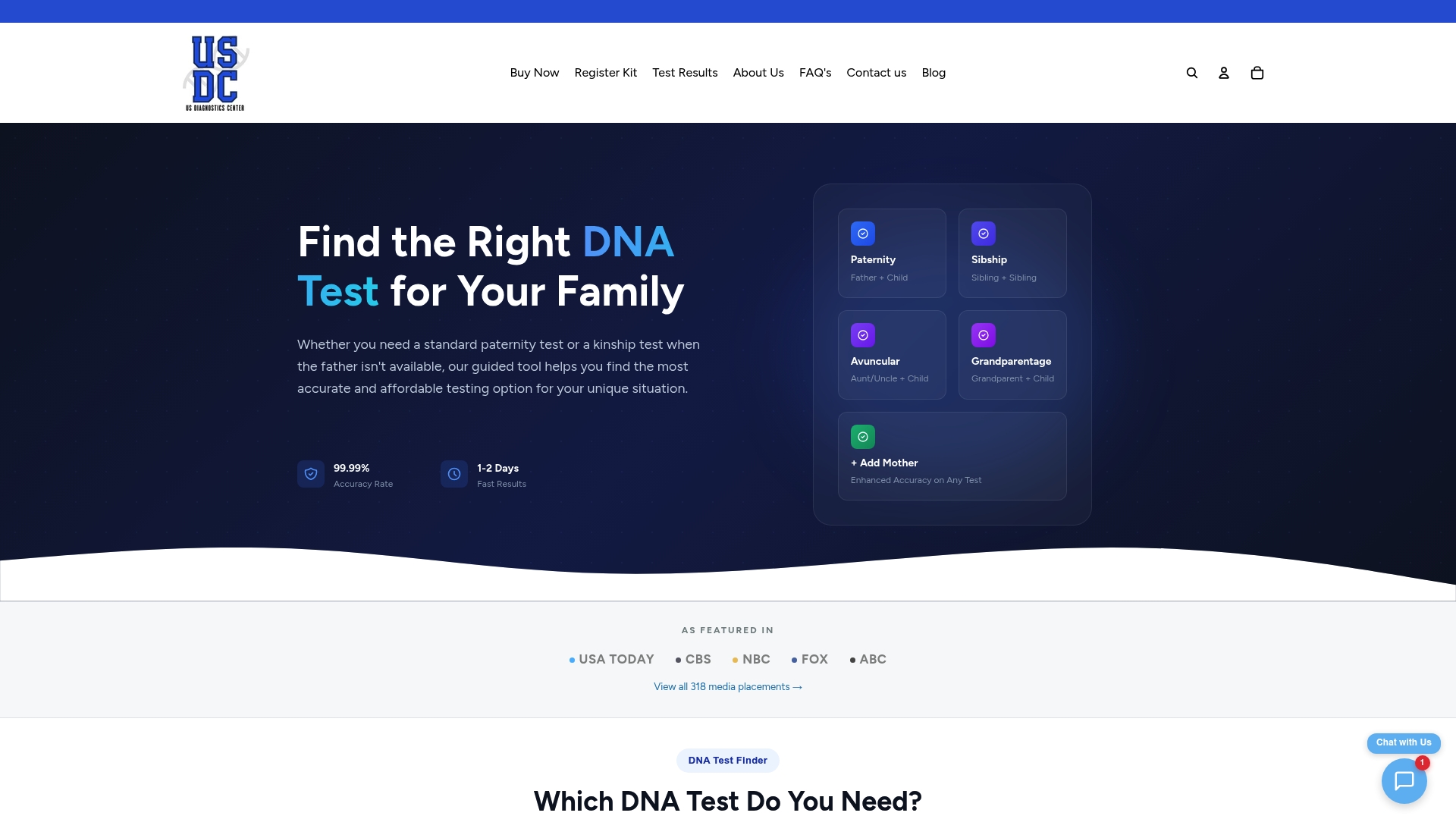
US Diagnostics Center offers at-home DNA test kits for paternity ($79), maternity ($129), and kinship relationships including sibling, grandparent, and aunt/uncle tests ($139 each). All kits use cheek swabs and include a prepaid return shipping envelope. Lab processing generally takes 2–3 business days after the sample arrives; standard order-to-results is 7–10 business days. Tests analyze up to 28 markers. US Diagnostics Center is BBB Accredited with an A- rating. These tests are for personal verification only and do not cover prenatal testing or ancestry analysis.
| Dimension | US Diagnostics Center | Typical at-home test |
|---|---|---|
| Accuracy / marker count | Multiple markers | Varies; often fewer markers |
| Lab processing turnaround | 2–3 business days | 2–3 business days |
| Order-to-results | 7–10 business days | 7–10 business days |
| Price range | $79 to $139 | — |
| Sample type | Cheek swab | Cheek swab |
| Accreditation / lab standards | BBB Accredited (A-); see lab details on site | Varies; check before ordering |
| Privacy and data policy | Stated policy; confirm at checkout | Varies widely |
| Customer support / counseling | Available; guided test selection | Varies by provider |
US Diagnostics Center's guided test selection tool helps you identify which kit fits your specific relationship question before you order. Browse the full at-home DNA test collection or review kinship testing options to find the right fit.
Useful sources for further reading
The sources below cover accuracy limits, test types, sample handling, and privacy considerations for at-home relationship DNA testing.
| Source | What it covers | Why consult it |
|---|---|---|
| Cleveland Clinic: At-Home DNA Tests | Accuracy limits and when clinical confirmation is needed | Understand what at-home tests can and cannot tell you |
| MedlinePlus: DTC Test Types | Kinship vs. ancestry vs. health tests | Clarifies which test category applies to your question |
| MedlinePlus: DTC Test Results | Probability results and unexpected findings | Prepares you for ambiguous or surprising outcomes |
| Cleveland Clinic: Paternity Test | Marker counts, cheek swab procedure, legal vs. personal use | Explains what makes a result reliable and admissible |
| JAMA Internal Medicine: At-Home Genetic Tests | Lab method variation and accuracy differences | Helps evaluate lab transparency and accreditation claims |
| MyMedicalLab: DNA Testing | Cost ranges and turnaround expectations | Sets realistic expectations before you order |
| Testing.com: Paternity Test | How probability reporting works; cheek swab as standard | Explains inclusion/exclusion results in plain terms |
Once you have identified the right test for your relationship question, confirm the lab's marker count and privacy policy, collect the sample carefully, and contact a genetic counselor if results are unexpected or ambiguous.
Key Takeaways
At-home relationship DNA tests are reliable for personal verification when you choose a kit with a clear marker count, a transparent privacy policy, and a reputable lab.
| Point | Details |
|---|---|
| Test type must match the relationship | Paternity, sibling, grandparent, and avuncular tests each use different statistical models. |
| Marker count signals accuracy | Tests using up to 28 markers provide stronger statistical confidence than lower-count alternatives. |
| Results are probabilistic | Conclusive paternity reports show near 99.99% inclusion or definitive 0% exclusion. |
| Privacy policy matters | Confirm what the lab retains and whether your DNA data is shared before submitting a sample. |
| US Diagnostics Center option | Offers at-home kits from $79 to $139, with 7–10 business day order-to-results and up to 28 markers. |
An editor's perspective on what families actually need from these tests
The conventional framing around at-home DNA testing tends to focus on accuracy percentages and accreditation logos. Those details matter, but they are not the first question most families are actually asking. The real question is usually simpler: will this answer hold up for me personally?
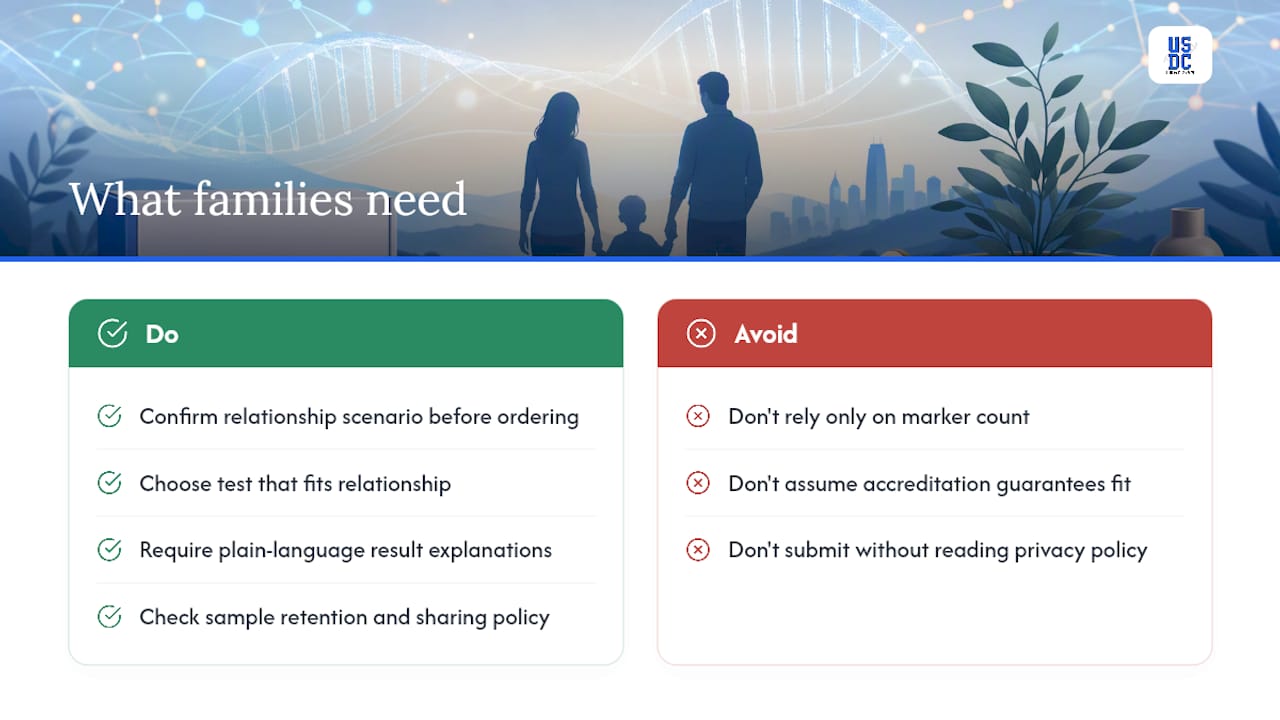
For the vast majority of people ordering a relationship test, the purpose is private. They are not preparing for a courtroom. They want clarity on a question that has been sitting unresolved, sometimes for years. In that context, the most important variables are not the ones most labs advertise. They are: does the test design actually fit the relationship being questioned, does the report explain what the numbers mean in plain language, and does the lab have a clear policy on what happens to your sample after analysis?
The marker count question is also frequently misunderstood. More markers do not automatically mean a more accurate result in every scenario. For direct parent-child paternity, even a moderate marker count produces a statistically decisive result. For indirect relationships like half-siblings or grandparentage, the statistical picture is genuinely more complex, and a higher marker count provides meaningful additional resolution. Knowing which scenario you are in before you order is the step most guides skip.
Finally, the privacy concern deserves more weight than it typically receives. DNA data is not just personal to you. It carries information about every biological relative you have. Reading a lab's data retention and sharing policy is not paranoia; it is a reasonable precaution before submitting a sample that cannot be un-submitted.
FAQ
What relationships can an at-home DNA test confirm?
At-home kinship tests can assess paternity, maternity, full or half siblings, grandparentage, avuncular (aunt/uncle), and twin zygosity. Each test type uses a different statistical model, so the kit must match the specific relationship being questioned.
How accurate are at-home relationship DNA tests?
Accuracy depends on marker count, sample quality, and lab standards. Conclusive paternity results typically report near 99.99% probability of inclusion; exclusion results are reported at 0%. Tests using up to 28 markers provide stronger statistical confidence for indirect relationships like sibling or grandparent testing.
Are at-home DNA test results admissible in court or for immigration?
No. At-home kits are for personal information only and are not court-admissible. Legal and immigration submissions require chain-of-custody collection at an approved facility. See the home vs. legal test distinction for a full explanation.
How long does it take to get results from US Diagnostics Center?
Lab processing runs 2–3 business days after the sample arrives; standard order-to-results is 7–10 business days. Expedited processing is available for faster turnaround.
What should you do if results are unexpected or ambiguous?
Contact a genetic counselor for professional interpretation. Ambiguous results, particularly in indirect kinship tests, may require confirmatory testing or additional markers to reach a statistically reliable conclusion.

0 comments