

TL;DR:
- Legally binding DNA tests follow strict chain-of-custody protocols to ensure results are court-admissible.
- They include identity verification, witnessed collection, and processing by accredited laboratories, unlike home tests.
Legally binding DNA tests are DNA analyses conducted under strict legal protocols to produce results admissible in courts and official agencies. Unlike at-home tests, these court-accepted DNA tests follow a documented chain-of-custody process that traces every specimen from collection to lab processing. The types of legally binding DNA tests available today cover paternity, maternity, sibling relationships, and grandparent verification, each with specific procedural requirements. Choosing the wrong test type, or skipping a single documentation step, can render results inadmissible and force costly retesting.

What is chain of custody and why does it matter for legal DNA tests?
Chain of custody is the documented record that tracks a DNA specimen from the moment of collection through lab analysis and final reporting. Court-admissible DNA tests require this documentation to prove that no sample was tampered with, switched, or contaminated at any point. Without it, a judge can exclude the results entirely.
Every legally binding DNA test must satisfy these chain-of-custody requirements:
- Identity verification. Each participant presents a government-issued photo ID at collection.
- Witnessed collection. A neutral third party, not a family member, observes the buccal swab process.
- Tamper-evident packaging. Samples are sealed immediately in packaging that shows visible signs of any interference.
- Documentation trail. Paperwork records every handler, transfer point, and timestamp from collection to the lab.
- Lab processing by an accredited facility. AABB accreditation sets national standards that courts in many jurisdictions require for test validity.
If any link in that chain breaks, courts may exclude or reduce the weight of the DNA evidence. Breaks in chain of custody can require full retesting and delay a case by weeks, adding both financial and emotional cost.
Pro Tip: Always ask your testing provider for a copy of the chain-of-custody documentation before your appointment. Reviewing it in advance helps you arrive prepared with the correct ID and understand exactly what the collector will do.
Common types of legally binding DNA tests for family and legal purposes
The term "legally binding DNA test" covers several distinct test categories. Each one addresses a specific relationship question and carries its own procedural requirements.
1. Legal paternity test
A legal paternity test determines whether a specific man is the biological father of a child. It is the most frequently ordered DNA test in family court, used in child support, custody, and inheritance proceedings. Legal paternity tests require identity verification, witnessed collection, and processing by an accredited lab. Testing with up to 28 genetic markers delivers the statistical power courts expect, typically producing a probability of paternity at or above 99.99%.
2. Legal maternity test
A legal maternity test confirms the biological relationship between a woman and a child. Courts order this test less frequently than paternity tests, but it appears in adoption disputes, surrogacy agreements, and cases where birth records are questioned. The collection and documentation process mirrors that of a paternity test exactly.
3. Sibling DNA test
A sibling DNA test determines whether two individuals share one or both biological parents. Courts and agencies use this test when a father is unavailable for direct testing, making it a practical alternative in custody and inheritance cases. Sibling tests analyze shared genetic markers across both individuals and report a probability of full or half siblingship. Home sibling and kinship DNA tests for personal knowledge are available through US Diagnostics Center starting at $139.
4. Grandparent DNA test
A grandparent DNA test establishes a biological link between a grandparent and a grandchild, typically when the alleged father is deceased or unavailable. Family courts accept this test as indirect evidence of paternity. Testing one grandparent produces useful results, but testing both paternal grandparents significantly increases statistical confidence.
5. Aunt or uncle DNA test
An aunt or uncle DNA test, sometimes called an avuncular test, determines whether an individual is the biological aunt or uncle of a child. Like the grandparent test, it serves as a proxy for paternity when the alleged father cannot be tested. Courts treat avuncular results as supporting evidence rather than definitive proof, so pairing this test with other documentation strengthens a legal case.
6. Deceased or absent party testing
When a key participant is deceased or unavailable, labs can sometimes test alternative biological samples such as stored tissue, hair roots with follicles, or fingernail clippings. This category requires additional documentation and chain-of-custody steps to verify sample origin. Not every lab offers this service, so confirming availability before proceeding is necessary.
7. Court-ordered versus voluntary legal testing
Court-ordered testing is mandated by a judge and must follow the court's specific instructions regarding lab selection and reporting format. Voluntary legal testing is initiated by the parties themselves but follows the same chain-of-custody protocols. Voluntary tests through accredited sites are equally valid and often faster than waiting for a court order, provided the lab meets the jurisdiction's accreditation requirements.
How legal DNA test procedures differ from home DNA tests
The core difference between a legally binding DNA test and a home DNA test is not the science. Both use buccal swabs and analyze the same genetic markers. The difference is the procedural framework that surrounds sample collection.
Home DNA tests allow self-collection without any identity verification or third-party witnessing. That flexibility makes them useful for personal knowledge, but results are for personal use only — no court will accept them. Court-admissible results require processing by an AABB-accredited laboratory and a documented chain of custody, neither of which a home test provides.
Cost reflects this difference. Legal DNA tests are generally more expensive than home tests because they include the collection infrastructure, identity verification, and accredited lab processing that legal tests require. Home tests cost considerably less because they skip those steps.
Turnaround time also differs. Legal tests generally return results in 1–2 weeks when accounting for scheduling, collection, and lab processing. US Diagnostics Center's home DNA tests are processed within 2–3 business days, with a standard order-to-results window of 7–10 business days.
Pro Tip: If you need results for an upcoming court date, confirm your legal testing provider's turnaround time before ordering. Ask specifically about the time from collection appointment to final report delivery, not just lab processing time.
For a detailed breakdown of lab verification steps involved in court-approved testing, the Labrynix genetics blog covers the paperwork and verification process clearly.
How to choose the right legally binding DNA test for your situation
Selecting the correct test requires matching your legal purpose to the appropriate test type and confirming that your provider meets the procedural standards courts require.
- Identify your legal purpose first. Child support and custody proceedings almost always require a paternity test. Inheritance disputes may call for a paternity, sibling, or grandparent test depending on who is available for testing.
- Determine who can be tested. If the alleged father is available, a direct paternity test is the most statistically powerful option. If he is not, a grandparent, sibling, or avuncular test provides indirect evidence.
- Confirm lab accreditation. AABB accreditation is the national standard courts recognize. Ask any provider directly whether their processing lab holds current AABB accreditation.
- Check whether the test is court-ordered or voluntary. If a judge has issued a specific order, follow its instructions exactly regarding lab selection and report format. Voluntary testing gives you more flexibility in provider choice.
- Prepare for your appointment. Bring a government-issued photo ID for every participant, including the child. Review the DNA test preparation checklist to avoid common errors that can delay processing.
- Ask about marker count. Tests analyzing up to 28 markers produce stronger statistical conclusions than those using fewer. Confirm this detail with your provider before booking.
Key takeaways
The most reliable legally binding DNA tests combine documented chain-of-custody protocols, identity verification, witnessed collection, and processing by an AABB-accredited lab to produce court-admissible results.
| Point | Details |
|---|---|
| Chain of custody is non-negotiable | Any break in documentation can cause courts to exclude results and require retesting. |
| Test type must match your legal need | Paternity, maternity, sibling, and grandparent tests each serve distinct legal purposes. |
| Legal tests cost more than home tests | Legal paternity tests reflect higher costs due to accreditation requirements and procedural rigor. |
| AABB accreditation is the court standard | Courts in many jurisdictions require AABB-accredited lab processing for test validity. |
| Voluntary testing is equally valid | Voluntary legal tests at accredited sites carry the same legal weight as court-ordered tests. |
Why proper protocol matters more than people expect
People often focus on the science of DNA testing and assume that any positive result will hold up in court. That assumption has cost families months of delays and thousands of dollars in retesting fees.
The single most common failure I see is a chain-of-custody break caused by something avoidable: a participant who forgot their ID, a collection witnessed by a family member instead of a neutral third party, or a sample mailed without tamper-evident packaging. Each of those errors is fixable before the test. None of them are fixable after the fact.
My strong advice is to treat the documentation as seriously as the test itself. Confirm your provider's accreditation status before you book. Ask to see the chain-of-custody form in advance. Bring every required document for every participant, including children. Courts are not forgiving of procedural shortcuts, even when the underlying science is sound.
The other thing worth saying plainly: voluntary legal testing is underused. Many people wait for a court order because they assume it carries more authority. It does not. A voluntary test performed at an accredited site with a complete chain of custody is just as admissible as a court-ordered test, and it puts you in control of the timeline.
— Todd
DNA testing options at US Diagnostics Center
US Diagnostics Center currently offers home DNA tests for personal knowledge, including paternity, maternity, sibling, and grandparent tests. Each test analyzes up to 28 genetic markers and follows rigorous lab processing standards. Court-admissible results require a separate legal DNA test with witnessed sample collection and documented chain of custody, performed through a legal testing provider.
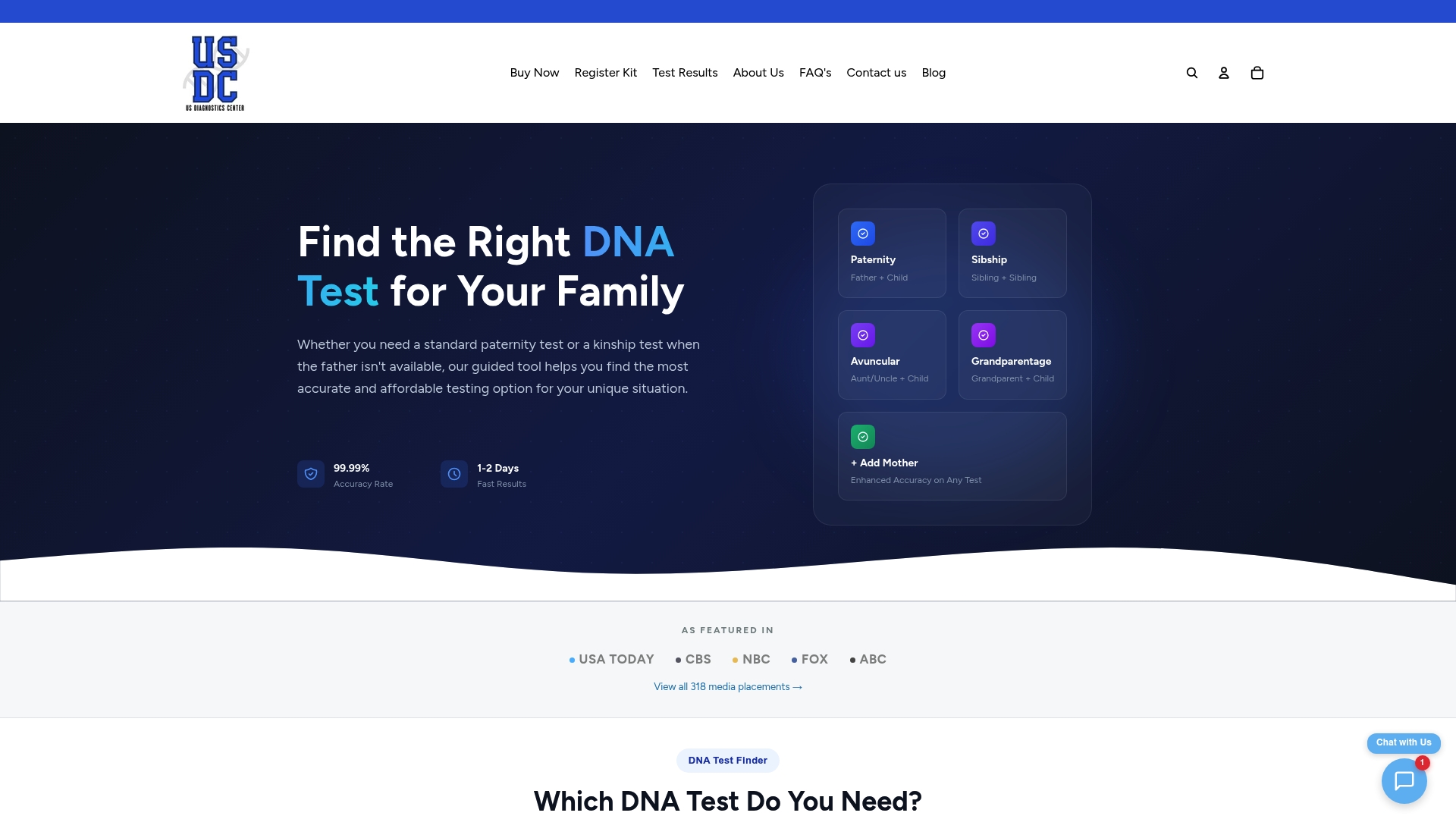
Lab processing takes 2–3 business days, with a standard order-to-results window of 7–10 business days. Every order includes a prepaid return shipping envelope. Home paternity testing starts at $79, home maternity testing starts at $129, and sibling or grandparent tests start at $139. For a full overview of relationship testing options, the paternity testing guide covers procedures, costs, and what to expect at your appointment.
FAQ
What is a legally binding DNA test?
A legally binding DNA test is a DNA analysis conducted under documented chain-of-custody protocols, with identity verification and witnessed collection, producing results admissible in court. Court-admissible tests typically achieve 99.99% accuracy when processed by an AABB-accredited laboratory.
Can a home DNA test be used in court?
Home DNA tests are not admissible in court because they lack identity verification, third-party witnessing, and documented chain of custody. U.S. courts require AABB-accredited lab processing and a complete custody record for results to be accepted.
What happens if chain of custody is broken?
If chain of custody is broken, courts may exclude the DNA evidence or assign it reduced weight. Retesting is often required, which adds weeks to a case and increases costs significantly.
How many markers does a legal DNA test analyze?
Legal DNA tests analyze up to 28 genetic markers, which provides the statistical power courts expect for relationship conclusions. Fewer markers reduce the probability calculation and may not satisfy court standards in all jurisdictions.
Is voluntary legal DNA testing as valid as court-ordered testing?
Voluntary legal testing is equally valid when performed at an AABB-accredited site with full chain-of-custody documentation. Voluntary tests often process faster than court-ordered tests because they do not depend on judicial scheduling.
Recommended
- What Is a Legal DNA Testing Site? Your 2026 Guide | USDC
- What Is Included in a DNA Test Kit: Full Guide | USDC
This article is part of our Understanding DNA Testing: How It Works and What to Expect guide.


0 comments