

A legal DNA testing site is a certified provider that collects and analyzes DNA samples under strict chain-of-custody and identity verification protocols, producing results accepted by courts and government agencies. These sites differ fundamentally from consumer ancestry services or home relationship tests ordered for personal knowledge. Choosing the wrong type of test for a paternity case, custody dispute, or immigration application can delay your legal resolution by months — and in some cases force you to start the entire process over. Understanding what separates a court-admissible DNA testing service from a direct-to-consumer product is the first step toward getting results that actually hold up in 2026.
What is a legal DNA testing site and how does it work?
A legal DNA testing site is a provider accredited by recognized bodies such as the AABB (formerly the American Association of Blood Banks) and certified under CLIA (Clinical Laboratory Improvement Amendments). These credentials are not optional. They signal that the laboratory meets federal standards for accuracy, personnel qualifications, and quality control.
The defining feature of any legal DNA testing service is the chain-of-custody process, which documents every step from sample collection through laboratory analysis. This documented trail proves that the sample tested belongs to the person identified and has not been tampered with. Courts, the USCIS, and child support agencies all require this documentation before accepting DNA evidence. In practical terms, chain-of-custody documentation means you should receive a printed or digital record that lists every person who handled your sample, every transfer point, and every seal that was applied — from the collection room to the lab bench. If a provider cannot show you what that paperwork looks like before you book, treat that as a warning sign.
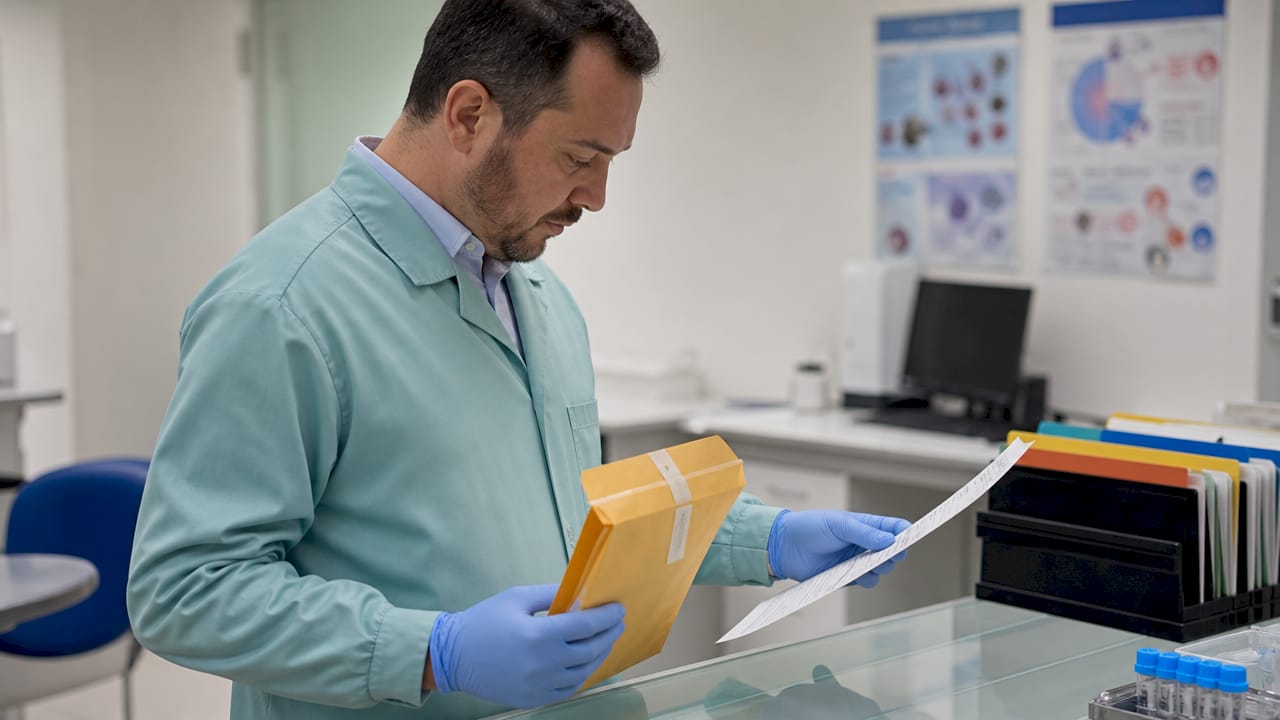
Legal DNA tests cover a range of relationship types, including paternity, grandparentage, siblingship, and immigration kinship. Each test type follows the same core protocol: verified identity, observed collection, sealed and labeled samples, and documented transfer to the laboratory. To understand how these relationship categories compare, the understanding DNA testing overview is a useful starting point before you choose a test type.
How do legal DNA testing sites ensure results are admissible in court?
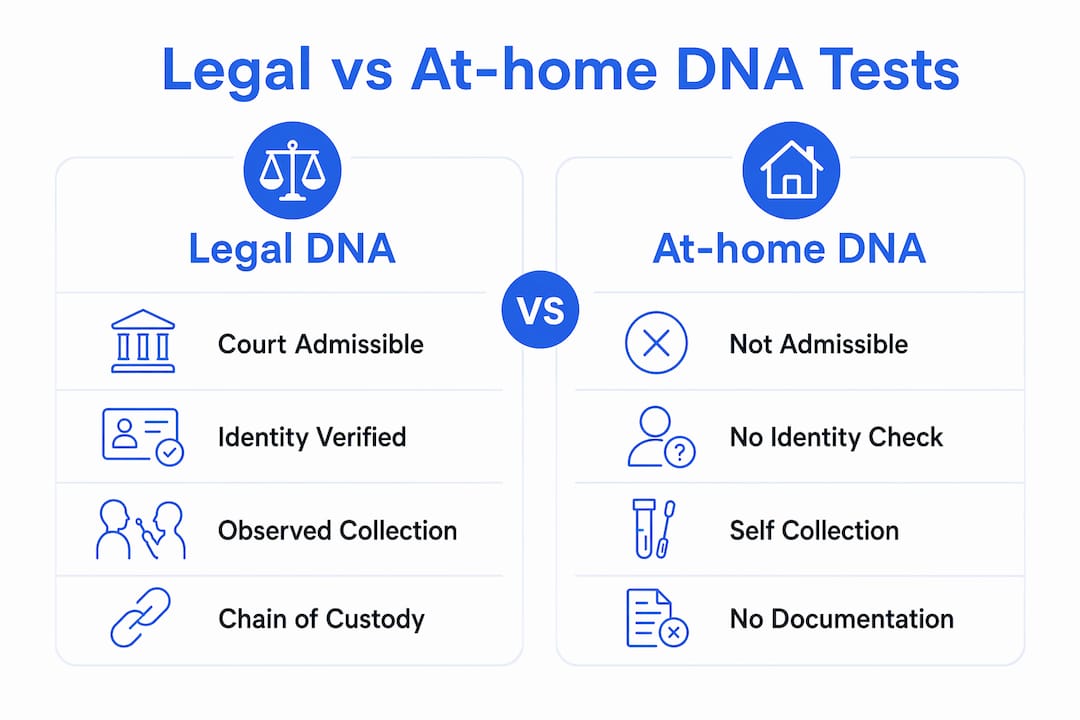
Court admissibility depends on three procedural requirements: identity verification, observed sample collection, and documented chain of custody. A legal DNA testing site satisfies all three at every appointment.
Identity verification
Certified sample collectors verify the identity of every participant using a government-issued photo ID before collecting any sample. For minors, a parent or legal guardian presents identification on their behalf. This step prevents substitution and ties each sample to a confirmed individual.
Observed sample collection
The collector witnesses the buccal swab procedure directly. Observed collection prevents tampering or substitution and ensures the sample is linked correctly to the identified individual. Self-collected samples, regardless of how carefully handled, do not satisfy this requirement.
Chain-of-custody documentation
Every sample is sealed, labeled, and accompanied by paperwork that tracks its movement from the collection site to the laboratory. Legal DNA tests conducted at AABB-accredited labs with full chain-of-custody procedures deliver a 99.99% probability of paternity, a figure courts and agencies rely on when making binding decisions. You should receive copies of all chain-of-custody documents along with your final results report — keep these on file, because attorneys and agencies may request them separately from the results letter itself. For a deeper look at what chain of custody involves at each stage, see the chain-of-custody knowledge page.
Pro Tip: Ask any legal DNA testing provider for their AABB accreditation certificate number before scheduling a collection appointment. A legitimate legal DNA testing site will provide this without hesitation. Note that US Diagnostics Center's court-admissible legal testing is currently Coming Soon — verify accreditation directly with whichever provider you use for an immediate legal need.
- Sample collection performed by a certified, neutral third party
- Government-issued photo ID required for all adult participants
- Samples sealed and labeled in the presence of the collector
- Chain-of-custody paperwork accompanies samples to the laboratory
- Accredited laboratory conducts analysis under CLIA-compliant conditions
What are the differences between legal and at-home DNA tests?
At-home consumer DNA tests are not legally admissible for paternity, custody, or immigration purposes. They lack both identity verification and chain-of-custody documentation. This is the single most important distinction you need to understand before ordering any DNA test for a legal purpose.
At-home tests serve legitimate purposes. They provide personal relationship answers, and they are convenient, private, and relatively affordable. They simply cannot be used as evidence in a court proceeding or submitted to a government agency. If you want to understand a biological relationship before committing to a legal proceeding — or simply for peace of mind — an at-home test is a reasonable first step, as long as you understand its limitations.
| Feature | Legal DNA test | At-home consumer test |
|---|---|---|
| Court admissible | Yes | No |
| Identity verification | Required | Not performed |
| Chain of custody | Documented | Not maintained |
| Observed collection | Yes | No |
| AABB accreditation | Required | Not required |
| Typical cost range | Varies by provider and test type | $79–$139 (USDC home tests) |
| Turnaround time | 2–5 business days (lab); total varies by scheduling | 2–3 business days at lab; 7–10 days order to results |
| Primary use | Legal proceedings, government agencies | Personal knowledge, relationship answers |
Legal DNA testing costs vary by provider, test type, and the specific chain-of-custody and accreditation requirements involved. At-home consumer tests are more affordable and do not include the certified collection steps that make legal validity possible.
Pro Tip: If you have already taken an at-home test and received a result, that result cannot substitute for a legal test. You will need to order a separate court-admissible test through a certified site. Ordering the correct test from the start saves both time and money.
How to choose a legal DNA testing site: key factors
Selecting the right provider for DNA testing for legal purposes requires checking specific credentials, not just reading marketing claims. The following factors separate reliable legal DNA testing services from those that may not hold up under legal scrutiny. Reviewing the understanding DNA testing guide can also help you frame the right questions before you contact a provider.
- AABB accreditation: Confirm the laboratory processing your samples holds current AABB accreditation. This is the primary quality standard for relationship DNA testing in the United States. Ask for the accreditation certificate number and verify it directly with the AABB if you have any doubt.
- CLIA certification: The laboratory must also hold a CLIA certificate issued by the Centers for Medicare & Medicaid Services, which governs clinical laboratory testing standards at the federal level. You can verify a lab's CLIA status using the CMS online provider search tool before committing to a provider.
- Certified collection sites: The provider must offer a network of certified sample collection locations staffed by trained, neutral collectors. Convenience matters less than certification. Confirm that the collector is a neutral third party — a friend or family member cannot serve in this role for a legal test.
- Chain-of-custody documentation: Ask specifically how the provider documents sample handling. You should receive copies of all chain-of-custody paperwork along with your results. A reputable provider will walk you through what those documents look like before you schedule.
- Legal documentation delivery: Confirm that results are delivered in a format accepted by the specific court, agency, or attorney involved in your case. Some proceedings require notarized reports or results on laboratory letterhead with a wet signature.
- Customer support: Choose a provider with knowledgeable support staff who can answer procedural questions and help you understand your documentation before, during, and after the collection appointment.
Consulting a lawyer or genetic professional before ordering a legal DNA test confirms that you are selecting the correct test type for your jurisdiction and purpose. Test requirements vary by state and by the specific agency involved. Professional guidance prevents ordering the wrong test and having to repeat the process.
What legal situations require a DNA test from a certified site?
Common legal cases requiring court-admissible DNA tests span family law, immigration, and estate proceedings. Each situation requires results from a certified legal DNA testing site, not a consumer product.
- Paternity and child custody cases. Courts require legally valid DNA evidence to establish or contest biological parentage. A paternity affidavit supported by a court-admissible DNA test carries significant weight in custody determinations. See the paternity testing overview for a breakdown of what the process involves and how results are reported.
- Child support establishment or modification. Child support agencies require verified biological relationship evidence before establishing or modifying support orders. At-home results are rejected at this stage.
- Immigration and citizenship applications. USCIS accepts DNA evidence to support family-based visa petitions and citizenship claims when documentary evidence is unavailable or insufficient. The agency specifies its own accreditation requirements for laboratories, which may go beyond standard AABB accreditation — confirm the exact requirements with your immigration attorney or the USCIS directly before ordering any test. For kinship test types accepted in immigration proceedings, the kinship DNA testing page outlines the relationship categories most commonly involved.
- Inheritance disputes and estate claims. Probate courts may require DNA evidence to resolve contested claims of biological relationship in inheritance cases.
- Birth certificate amendments. Amending a birth certificate to add or change a parent's name requires legally valid DNA evidence in most states.
Understanding which category your situation falls into helps you select the correct test type. A legal paternity test kit covers the most common scenario, but grandparentage, siblingship, and other kinship tests follow the same court-admissible protocols when ordered through a certified site.
Key Takeaways
A legal DNA testing site is defined by AABB accreditation, chain-of-custody documentation, and certified observed collection, all of which are required for court-admissible results.
| Point | Details |
|---|---|
| Legal vs. at-home tests | At-home tests lack identity verification and chain of custody, making them inadmissible in court. |
| AABB accreditation matters | Only labs with current AABB accreditation meet the standard courts and agencies require. |
| Cost reflects compliance | Legal test pricing varies by provider and test type, reflecting the certified collection and documented chain-of-custody requirements involved. |
| Consult before ordering | A lawyer or genetic professional confirms the correct test type for your jurisdiction and purpose. |
| Multiple legal uses | Paternity, custody, immigration, inheritance, and birth certificate cases all require court-admissible tests. |
Why getting the test type right matters more than most people realize
People often assume that any DNA test showing a biological relationship will satisfy a court or government agency. That assumption causes real problems. Families have completed at-home tests, received clear results, and then discovered those results were entirely unusable in their custody or immigration proceedings. They had to start over, pay again, and wait again.
The procedural requirements for legal DNA testing are not bureaucratic obstacles. They exist because courts need to verify that the sample tested actually came from the person named in the report. Without observed collection and documented chain of custody, there is no way to rule out substitution or contamination. A judge cannot accept evidence that lacks that foundation.
One area where people consistently underestimate complexity is immigration. USCIS has specific laboratory requirements that go beyond standard AABB accreditation. Ordering a test without confirming those requirements first can result in rejection even when the test itself was conducted correctly. The Genetic Information Nondiscrimination Act (GINA) also protects individuals from genetic discrimination in health insurance and employment, but it does not cover life insurance or long-term care insurance. Privacy considerations matter when you are deciding where and how to test.
The consistent recommendation is to contact the attorney or agency handling your case before ordering any test. Confirm the exact accreditation and documentation requirements. Then choose a provider that meets those requirements specifically. Spending fifteen minutes on that step saves weeks of delay.
— Todd
US Diagnostics Center: DNA testing for families
US Diagnostics Center currently offers home DNA relationship testing for families who need clear answers about biological relationships for personal knowledge. Available home tests include the home paternity test ($79), home maternity test ($129), and sibling, grandparent, and aunt/uncle kinship tests ($139 each). Each home kit ships with a prepaid return shipping envelope, and lab processing typically takes 2–3 business days once samples are received, with total order-to-results timing of 7–10 business days. Home kits analyze up to 28 genetic markers. These home tests are for personal knowledge only and are not court-admissible. Browse the full home DNA tests collection to compare all available options.
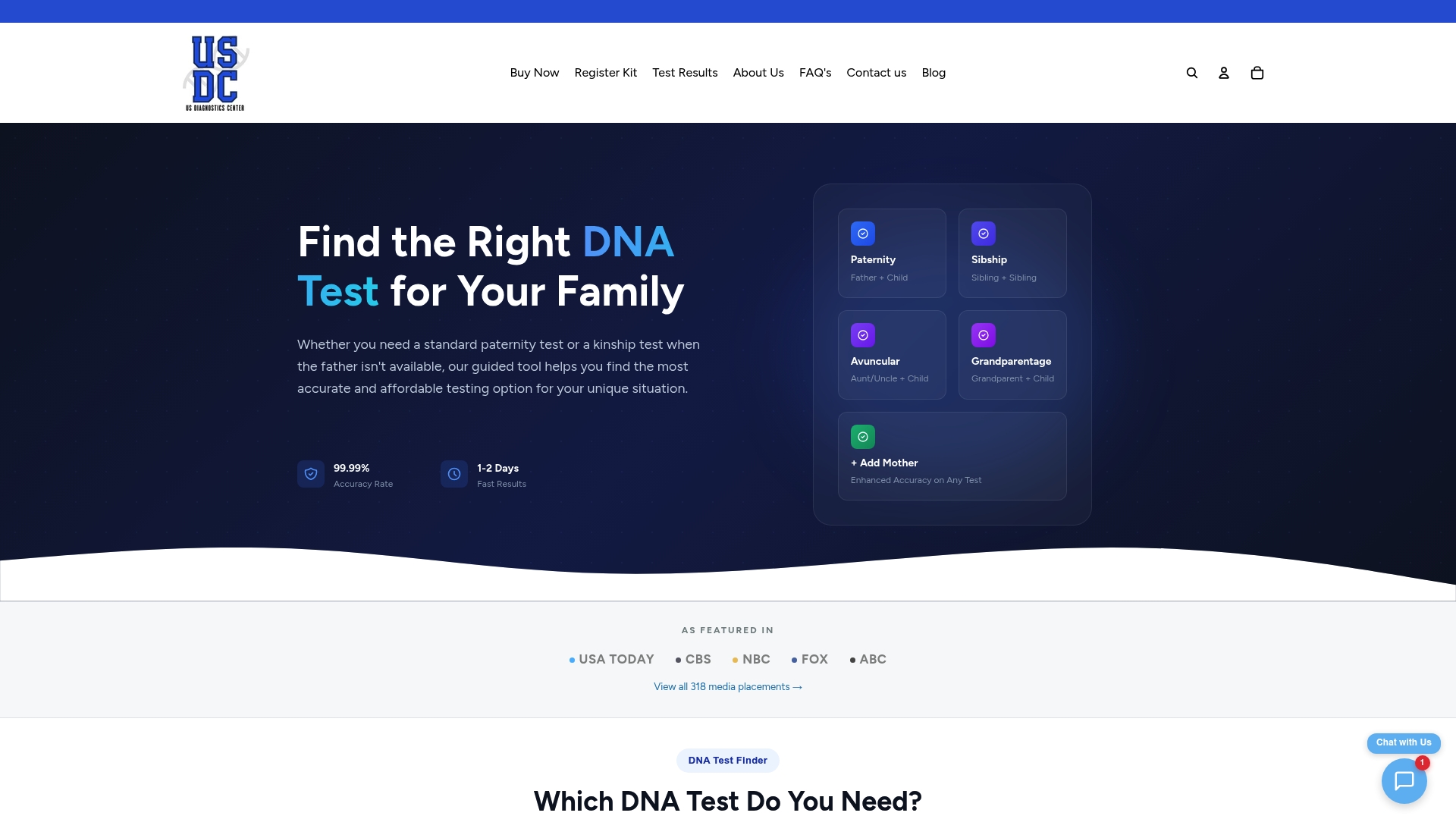
US Diagnostics Center is also expanding into court-admissible legal and immigration DNA testing, including legal paternity, legal sibling, and immigration kinship options — those product pages are currently marked Coming Soon while the service is prepared for launch. If your case cannot wait, consult your attorney or agency about their accepted providers, and check back for updates when USDC's legal offerings become available. Expedited add-ons for home testing (such as express same-day or next-day lab processing) are available during checkout for time-sensitive personal matters. Visit US Diagnostics Center to review current home DNA testing options.
FAQ
What is a legal DNA testing site?
A legal DNA testing site is a certified provider that collects DNA samples under chain-of-custody and identity verification protocols, producing results accepted by courts and government agencies. Accreditation by the AABB and CLIA certification are the primary quality standards.
How long does a legal DNA test take to get results?
Legal DNA test results typically take 2–5 business days at the lab once samples are received, with total time depending on collection scheduling and whether the provider offers expedited processing. Confirm turnaround times with your specific provider before booking, especially if a court deadline is involved.
Can I use an at-home DNA test for a custody case?
No. At-home consumer DNA tests are not legally admissible for custody, paternity, or immigration purposes because they lack identity verification and chain-of-custody documentation. If you already have at-home results, you will need to order a separate legal test through a certified site to use in any court or agency proceeding.
What accreditation should a legal DNA testing site have?
The laboratory must hold current AABB accreditation and CLIA certification. These credentials confirm the lab meets federal and industry standards for relationship DNA testing accuracy and quality control. Ask the provider for their accreditation certificate number and verify it directly if you have any doubt.
What are the DNA testing requirements for immigration?
USCIS accepts DNA evidence for family-based visa petitions and citizenship claims when documentary proof is unavailable. The agency imposes specific laboratory accreditation requirements that may go beyond standard AABB accreditation. Always confirm the exact lab requirements with your immigration attorney or directly with USCIS before ordering any test, and review the kinship DNA testing page for the relationship types most relevant to immigration proceedings.
Do I need a lawyer before ordering a legal DNA test?
Consulting a lawyer or genetic professional before ordering is strongly recommended. It confirms you are selecting the correct test type for your jurisdiction and purpose, and it prevents wasted time and expense if the wrong test is ordered. Requirements vary by state, court, and agency.
Recommended
- Legal DNA Test | DNA Testing Glossary | USDC
- Legal Single Profile DNA Test | Coming Soon | USDC
- Legal Full Sibling DNA Test | Coming Soon | USDC
This article is part of our Understanding DNA Testing: How It Works and What to Expect guide.


0 comments