

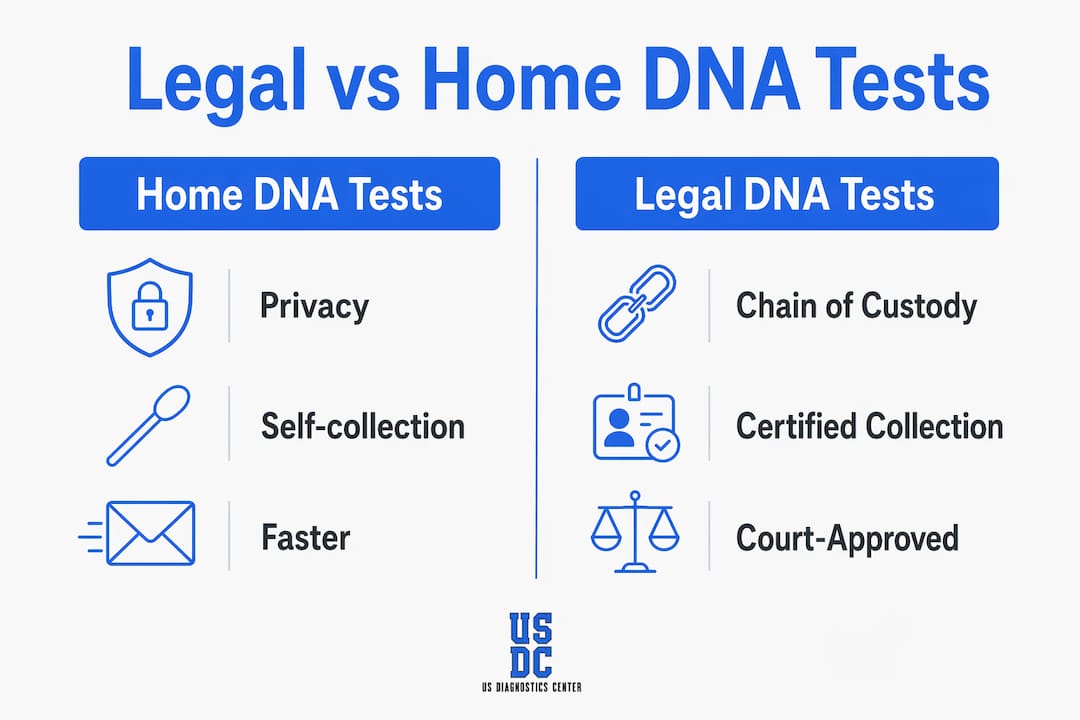
Home DNA tests and legal DNA tests are not interchangeable. The core reason why home DNA differs from legal tests comes down to one procedural requirement: chain of custody. A home kit lets you collect your own cheek swab, mail it in, and receive results privately. A legal test requires a certified, neutral third party to collect the sample, verify your identity, seal the specimen on the spot, and document every person who touches it from collection through lab analysis. Courts do not accept home test results because no verifiable chain of custody exists to confirm the sample came from the right person and was not altered.
Key distinctions at a glance:
- Legal admissibility: Legal tests are court-admissible; home tests are not.
- Sample collection: Legal tests use certified collectors; home tests are self-administered.
- Identity verification: Legal testing requires government-issued photo ID; home testing does not.
- Chain of custody: Legal tests document every handler; home tests have no such record.
- Purpose: Home tests provide personal knowledge; legal tests provide evidence.
What home DNA tests are and when people use them
A home DNA test is a privately purchased kit that lets individuals collect cheek-swab samples without visiting a clinic or testing facility. The kit arrives by mail, participants swab their own cheeks, and the samples are returned in a prepaid envelope for laboratory analysis. Results typically arrive within days and are delivered directly to the purchaser.
People choose home tests for reasons that have nothing to do with courts. Common uses include personal peace of mind about a biological relationship, informal family decisions, or satisfying curiosity before deciding whether to pursue formal legal action. The convenience and lower cost make them accessible for situations where legal proof is not the goal.
Key characteristics of home DNA tests:
- Accessibility: Ordered online or at a pharmacy, no appointment required.
- Cost: Generally lower than legal testing.
- Privacy: Results go only to the purchaser.
- Limitation: Not admissible in court due to absent third-party verification.
- Data security: Purchasers should review the provider's privacy policy before submitting samples.
What legal DNA tests are and when courts require them
A legal DNA test follows a strictly controlled process designed to produce evidence a court will accept. Samples are collected at certified facilities by trained, neutral collectors who verify each participant's identity with government-issued photo identification, photograph all parties, and seal and label every specimen on the spot. The laboratory that analyzes the samples must meet accreditation standards set by bodies such as AABB, which establishes quality and reliability requirements for forensic DNA testing.
Courts rely on legal DNA results for paternity disputes, child support orders, custody arrangements, birth certificate amendments, and government benefits claims. The Social Security Administration, for example, may require a legally valid DNA test to award survivor benefits when a deceased parent's name does not appear on a child's birth certificate.
Legal DNA testing use cases:
- Paternity and custody proceedings: Establishes or disproves biological parentage for court orders.
- Child support determinations: Provides admissible biological evidence.
- Benefits claims: Satisfies agency requirements for proof of relationship.
- Probate and inheritance disputes: Proves biological connection to a deceased individual.
- Court-ordered testing: Judges can compel testing; refusal may result in an adverse inference.
How the procedures differ between home and legal testing
The procedural gap between home and legal DNA testing is where legal vs. home DNA test differences become most consequential. Home tests rely entirely on self-collection with no independent witness, no identity verification, and no documentation of who handled the sample. Legal tests build an unbroken record from the moment the swab leaves a participant's mouth.

The National Institute of Justice describes the chain of custody as a recorded means of verifying where evidence has traveled and who handled it, specifically to prevent substitution, tampering, misidentification, or contamination. Without that record, evidence may be excluded from trial entirely.
Procedural comparison:
- Home tests: Self-collected, no witness, no identity check, no sealed documentation.
- Legal tests: Certified collector, photo ID required, samples sealed and labeled immediately.
- Documentation: Legal tests record every handler; home tests produce no such log.
- Tamper evidence: Legal specimens use tamper-evident seals; home kits do not.
- Court outcome: A broken or absent chain of custody can result in evidence exclusion.
Accuracy and reliability: what the science actually shows
The underlying DNA science in home and legal tests is often similar. Both may analyze short tandem repeat (STR) markers to determine biological relationships, and a well-run home test can produce scientifically sound results. US Diagnostics Center, for instance, tests up to 28 markers, which exceeds the industry standard of 20 or more markers.
The critical distinction is not the science itself but the procedural context around it. Home test results are personal knowledge, not legal evidence. Courts require proof that the sample came from the identified person, was handled correctly, and was analyzed under verifiable forensic conditions. A home test cannot provide any of that documentation, regardless of how accurate the underlying analysis may be.
Reliability considerations:
- Scientific accuracy: Home tests can be accurate but lack procedural verification.
- Legal weight: Only tests with documented chain of custody carry evidentiary weight.
- Marker count: More markers analyzed generally means greater accuracy.
- Forensic standards: Legal labs follow FBI quality assurance standards for forensic DNA testing.
- Interpretation: Courts evaluate process and documentation, not just the result.
How to choose the right DNA test for your situation
The decision between a home test and a legal test depends entirely on what you intend to do with the result. If the goal is personal clarity, a home test is a practical and affordable starting point. If the result may ever be presented in a legal proceeding, a court-ordered or legally administered test is the only option worth pursuing.
Consider these factors before choosing:
- Intended use: Personal knowledge only, or potential court use?
- Legal proceedings: Any active or anticipated custody, support, or benefits case requires a legal test.
- Cost tolerance: Home tests cost less; legal tests carry higher fees but produce admissible results.
- Privacy: Home tests offer more privacy; legal tests involve third-party collectors and documented records.
- Uncertainty: If unsure whether legal proceedings are likely, consult a family law attorney before testing.
Pro Tip: A home test result can give you the confidence to request court-ordered testing, but it cannot replace that testing. Think of it as preliminary information, not legal proof.
Expert insights on chain of custody and legal parentage
Chain of custody is the documented process that guarantees a sample's integrity from collection through analysis. The National Institute of Justice states that failure to establish a complete chain of custody may result in exclusion of evidence or a limiting instruction to the jury. That standard applies directly to DNA paternity evidence in family court.
Legal parentage adds another layer of complexity. Under California Courts guidance, a DNA test showing biological parentage does not automatically make someone a child's legal parent. Formal steps such as signing a Voluntary Declaration of Parentage or obtaining a court order are still required. Conversely, a negative DNA result does not automatically remove legal parental status if a prior court order already established it. The Texas Attorney General similarly notes that positive biological paternity does not confer legal parental rights without formal legal action.
Additional expert considerations:
- Jurisdictional variation: Some states require physician or attorney authorization for legal DNA testing.
- Home tests as a catalyst: A home result can motivate filing for court-ordered testing but cannot substitute for it.
- AABB accreditation: This standard, set by the AABB organization, signals laboratory quality for legal testing.
Pro Tip: Even a legally valid DNA result confirming biological parentage requires separate formal legal steps, such as a court order or voluntary declaration, before parental rights and responsibilities are established.
Cost comparison: home tests vs. legal tests
Home DNA tests are considerably less expensive than legal tests. US Diagnostics Center offers home paternity testing starting at $79, with maternity testing at $129 and sibling, grandparent, or aunt/uncle relationship tests at $139. Each kit includes a prepaid return shipping envelope. Results are delivered within 7–10 business days from order, with 2–3 business days of lab processing once the samples arrive.
Legal DNA testing carries higher costs due to professional collection, identity verification, and accredited laboratory processing; contact facilities directly for current pricing.
Timeframe: how long each type of test takes
Home DNA tests are faster from a logistics standpoint. Once a kit is ordered, samples can be collected the same day and mailed immediately. US Diagnostics Center's standard turnaround is 7–10 business days from order to results, with 2–3 business days of lab processing after the samples arrive. For families who need answers quickly without legal requirements, this timeline is practical.
Legal DNA tests take longer because the process requires scheduling a collection appointment at a certified facility, completing identity verification on-site, and then routing the sealed specimens through an accredited laboratory. Total turnaround from scheduling to results often runs two to four weeks, depending on the facility's availability and whether expedited processing is requested. Court-ordered testing may involve additional scheduling delays tied to judicial timelines.
Key Takeaways
Home DNA tests serve personal knowledge; legal DNA tests serve courts, and only the latter are built on the chain-of-custody documentation that makes results admissible as evidence.
| Point | Details |
|---|---|
| Chain of custody is the dividing line | Legal tests document every sample handler; home tests have no such record, making them inadmissible. |
| Home tests start at $79 | US Diagnostics Center home kits range from $79 to $139 depending on relationship type. |
| Legal tests generally cost significantly more than home tests, reflecting the professional collection and accreditation involved. | Contact facilities directly for current legal testing pricing. |
| Biology does not equal legal parentage | A positive DNA result requires formal legal steps, such as a court order, to establish parental rights. |
| Marker count affects accuracy | US Diagnostics Center tests up to 28 markers, exceeding the industry standard of 20 or more markers. |
FAQ
Will a home DNA test hold up in court?
No. Home DNA tests are not admissible in court because they lack a verifiable chain of custody and third-party collection protocols that courts require for DNA evidence.
What's the difference between a legal and non-legal DNA test?
A legal DNA test uses a certified collector, identity verification, and sealed documentation to create an unbroken chain of custody; a non-legal home test is self-collected with no independent verification.
How accurate is a home DNA test?
Home DNA tests can be scientifically accurate, but accuracy alone does not make results legally valid. Courts require procedural documentation, not just correct science.
Can a home DNA test be wrong?
Yes, though errors are uncommon when tests are conducted properly. Self-collection without oversight introduces risks of sample mix-up or contamination that certified collection eliminates. For personal knowledge testing, home tests are generally reliable; for legal proceedings, only court-admissible testing applies.
Recommended
- Why Court DNA Differs from Private Tests: A Clear Guide | USDC
- What Is a Legal DNA Testing Site? Your 2026 Guide | USDC
- How to Do a DNA Test: A Complete Step-by-Step Guide | USDC
- How Home DNA Kits Get Processed: A Clear Guide | USDC
This article is part of our Understanding DNA Testing: How It Works and What to Expect guide.


0 comments