

TL;DR:
- Court DNA testing involves strict procedures and accredited labs to ensure admissibility, unlike private tests. Both types use the same science, but only legal tests document sample collection and handling according to official standards. Choosing the correct test from the start saves time, money, and prevents legal rejection or delays.
Court DNA testing is defined by strict legal protocols that make results admissible as evidence, while private DNA tests are scientifically accurate but lack the procedural safeguards courts require. The core reason why court DNA differs from private tests has nothing to do with the science itself. Both test types use the same genetic analysis methods and can achieve 99.99% accuracy. The difference lies entirely in how samples are collected, documented, and verified. Understanding this distinction protects you from costly mistakes, such as submitting a home test result in a custody hearing only to have it rejected outright.

Why court DNA differs from private tests: the chain-of-custody standard
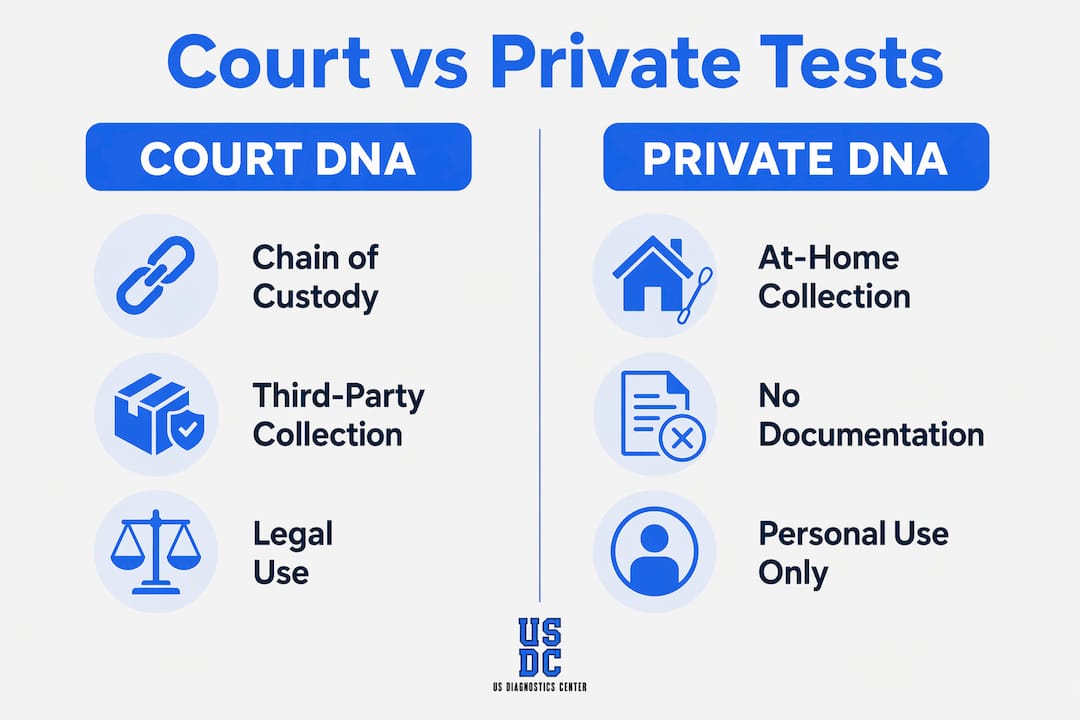
Chain of custody is the documented record that proves a DNA sample came from a specific person and was handled without tampering from collection through lab analysis. Courts require this record because a DNA result is only useful as evidence if the identity of the donor is verified and the sample's integrity is confirmed. Without it, there is no way to prove the cheek swab in the lab envelope actually came from the person named in the case.
A proper chain of custody for legal DNA testing includes several specific steps:
- A neutral, certified third party collects the sample. The collector cannot be a family member or anyone with a personal interest in the outcome.
- Government-issued photo ID is verified for every participant before collection begins.
- Photographs of participants are taken at the collection site.
- Sample envelopes are sealed and signed in the presence of the collector.
- Every transfer of the sample, from collection site to lab, is documented and dated.
Any deviation from these steps renders the test inadmissible in court. A single gap in documentation is enough for a judge to reject the result entirely. That is why legal DNA testing cannot be replicated at home, regardless of how carefully a person handles the swabs.
Private tests skip every one of these steps. Samples are self-collected at home, placed in an envelope, and mailed to the lab with no independent verification of who provided the sample. The lab processes the DNA accurately, but there is no evidentiary record connecting that DNA to a specific, verified individual.
Pro Tip: Before ordering any DNA test, ask yourself whether you may ever need the result in a legal proceeding. If there is any chance the answer is yes, order a legal test from the start. Retesting adds cost and delays.
How laboratory accreditation affects legal DNA test validity
Laboratory accreditation determines whether a court or government agency will accept a DNA result. AABB accreditation is the specific credential that U.S. courts and agencies such as USCIS require for relationship DNA testing. AABB stands for the American Association of Blood Banks, and its accreditation program audits labs for repeatable, validated, and documented processes that meet forensic standards.
The key facts about AABB accreditation in legal DNA testing:
- Courts and USCIS require DNA results from AABB-accredited laboratories for legal and immigration purposes.
- Non-accredited lab results are rejected regardless of technical accuracy.
- Other credentials such as CLIA (Clinical Laboratory Improvement Amendments) and CAP (College of American Pathologists) accreditation apply to clinical testing but do not satisfy the AABB requirement for relationship testing.
- Only about 30 laboratories in the U.S. hold the specific AABB accreditation required for relationship testing admissible in court. That limited number reflects how rigorous the standard is.
- Even within AABB-accredited labs, the accreditation scope must specifically cover relationship testing. A lab accredited for blood banking but not relationship DNA testing cannot produce court-admissible paternity results.
Industry authorities describe AABB accreditation as the gold standard that ensures labs meet the rigorous forensic and procedural standards necessary for acceptance in U.S. courts and government bodies. That language is not marketing. It reflects a legal reality that affects whether your result will be accepted or discarded.
Readers who need results for court or immigration purposes should verify the accreditation status of any lab before ordering.
Pro Tip: When evaluating a lab for legal testing, ask specifically whether its AABB accreditation scope covers relationship DNA testing. A general AABB credential is not sufficient.
Are private DNA tests less accurate than court-ordered tests?
Private DNA tests are not less accurate than court-ordered tests. Both test types use short tandem repeat (STR) analysis, the same genetic method, and both can produce results showing 99.99% probability of a biological relationship. The science is identical.
"DNA's scientific accuracy does not equal legal admissibility. Courts demand verified chain of custody to confirm the identity of the donor for evidentiary value. A result showing 99.99% probability means nothing legally if the court cannot confirm whose DNA was actually tested." — Legal experts on DNA admissibility
This distinction matters because many people assume a highly accurate result will be accepted anywhere. Courts do not evaluate DNA results purely on their numeric probability. They evaluate the entire evidentiary record: who collected the sample, how it was handled, and whether the lab meets accreditation standards. Private tests lack "probative integrity," meaning they cannot prove the sample came from the named individual. A private test result has genuine value for personal knowledge and peace of mind. It has no evidentiary weight in a legal proceeding.
What are the practical differences in process, cost, and usage?
The procedural gap between legal and private DNA testing is significant. Understanding each step helps you choose the right test for your situation.
Legal DNA testing process:
- Order a legal test from an accredited collection site or lab.
- Schedule an appointment at an authorized collection location.
- Bring government-issued photo ID for all participants.
- A certified collector photographs participants, verifies IDs, and collects buccal swabs.
- The collector seals and signs sample envelopes in your presence.
- Samples are shipped directly from the collection site to the lab with documented chain of custody.
- The lab processes results, typically within 2–3 business days of receiving samples.
- A court-admissible report is issued directly to the requesting party or court.
Private DNA testing process:
- Order a home test kit online.
- Self-collect buccal swabs at home.
- Mail samples to the lab in the provided envelope.
- Receive results, typically within a similar processing window.
The evidentiary record for a legal test includes verified government-issued IDs, participant photographs, signed sample envelopes, and documented chain of custody from collection to reporting. A private test produces none of this documentation.
| Factor | Legal DNA test | Private DNA test |
|---|---|---|
| Sample collection | Certified third-party collector | Self-collected at home |
| Chain of custody | Fully documented | None |
| Lab accreditation required | AABB for relationship testing | Not required |
| Court admissible | Yes | No |
| Typical use | Custody, child support, immigration | Personal knowledge |
Legal tests cost more than private tests because of the collection appointment, certified personnel, and documentation requirements. If a private test result is submitted in a legal dispute and rejected, the court will require a new legal test. That means paying twice and delaying the case. Choosing the right test from the start avoids that outcome.
Common misconceptions about court versus private DNA tests
Several persistent myths lead people to make the wrong testing choice. Addressing them directly prevents costly errors.
- Myth: A private home DNA test is acceptable in court. Home test samples have no independent verification and can be self-collected, so courts do not accept them as evidence. No exception exists for high-accuracy results.
- Myth: Court DNA tests use different or more advanced science. Both test types use STR analysis. The science is the same. The difference is procedural, not scientific.
- Myth: Chain of custody is just bureaucratic paperwork. Chain of custody is the legal mechanism that connects a DNA result to a verified individual. Without it, the result has no evidentiary value. It is not optional documentation.
- Myth: AABB accreditation is a marketing label. AABB accreditation is a mandatory legal requirement for relationship testing accepted by U.S. courts and USCIS. Labs without it cannot produce court-admissible results, regardless of their other credentials. Learn more about common DNA testing myths before making a testing decision.
- Fact: Refusing a court-ordered DNA test carries legal consequences. Courts may treat refusal as confirmation of the biological relationship in dispute. That outcome can directly affect custody, child support, and parental rights determinations.
Pro Tip: If you have already taken a private test and need the result for court, do not submit it. Order a legal test immediately. Submitting an inadmissible result can signal to the court that you misunderstood the process, which reflects poorly on your case.
Key Takeaways
Court DNA tests and private DNA tests use identical science, but only legal tests produce court-admissible results because they document chain of custody, use certified collectors, and require AABB-accredited laboratories.
| Point | Details |
|---|---|
| Chain of custody is the core difference | Legal tests document every step from collection to lab; private tests document nothing. |
| AABB accreditation is mandatory for courts | Only about 30 U.S. labs hold this credential for relationship testing. |
| Accuracy is equal, admissibility is not | Both test types achieve 99.99% accuracy; courts reject private tests on procedural grounds. |
| Wrong test choice costs time and money | Submitting a private test in court leads to rejection and mandatory retesting. |
| Refusing a court-ordered test has consequences | Courts may infer a positive result from refusal, affecting custody and support rulings. |
Why the process matters more than people expect
People consistently underestimate how much the collection process affects the legal value of a DNA result. I have seen situations where families spent months waiting on a custody resolution, only to discover their private test result was worthless in court. The delay was entirely avoidable.
The chain-of-custody requirement is not a technicality courts invented to complicate things. It exists because DNA evidence, like any evidence, must be traceable to a verified source. A result without that traceability is not evidence. It is data with no legal context.
The AABB accreditation requirement follows the same logic. Courts need to know the lab follows audited, repeatable processes. A lab that produces accurate results but operates without that oversight has no way to prove its processes meet legal standards. Accuracy and auditability are two different things.
My practical advice: if you are facing any legal matter involving paternity, custody, child support, or relationship verification, treat the DNA test as a legal document from the start. Read about what makes a legal DNA testing site before you order. The cost difference between a home test and a legal test is far smaller than the cost of retesting, legal delays, and missed court deadlines.
— Todd
DNA testing options at US Diagnostics Center
US Diagnostics Center offers home DNA tests for personal knowledge. Legal DNA testing options — following the full chain-of-custody process described in this article — are coming soon. Testing uses up to 28 markers for high-confidence results.
When you are ready for a legal test, learn more about what to look for in a legal DNA testing provider.
FAQ
What makes a DNA test court admissible?
A court-admissible DNA test requires a documented chain of custody, third-party sample collection with photo ID verification, and processing by an AABB-accredited laboratory. Without all three elements, courts will reject the result.
Can I use a home DNA test result in a custody case?
Private home DNA tests are not admissible in custody cases because they lack verified sample collection and chain-of-custody documentation. A new legal test would be required.
Is AABB accreditation required for all DNA tests?
AABB accreditation is required specifically for relationship DNA tests used in court proceedings and USCIS immigration cases. It is not required for private or personal-use DNA tests.
What happens if I refuse a court-ordered DNA test?
Refusing a court-ordered DNA test can lead a court to draw an adverse inference, treating the refusal as confirmation of the biological relationship in dispute, which directly affects case outcomes.
How long does a legal DNA test take?
Lab processing for a legal DNA test typically takes 2–3 business days after the lab receives the samples. Standard order-to-results turnaround, including shipping and collection scheduling, is generally 7–10 business days.
Recommended
- What Is a Legal DNA Testing Site? Your 2026 Guide | USDC
- DNA Evidence in Paternity and Family Law Cases (2026) | USDC
- What Is Included in a DNA Test Kit: Full Guide | USDC
This article is part of our Understanding DNA Testing: How It Works and What to Expect guide.


0 comments