

TL;DR:
- Biological kinship testing uses DNA analysis to determine or clarify family relationships by comparing genetic markers. The results are statistical, expressed through likelihood ratios that weigh the strength of claimed relationships, and depend on the number of relatives tested and markers analyzed. Most tests involve autosomal STR profiling, with supplemental mitochondrial or Y chromosome tests for complex lineages or inconclusive cases. At-home DNA test kits make this process accessible for personal knowledge — no clinic visit required.
Biological kinship testing is a DNA-based scientific method used to establish or clarify biological family relationships by comparing genetic markers between individuals. Known formally as DNA relationship testing or kinship analysis, it produces statistical evidence rather than a simple yes-or-no answer. Labs analyze specific inherited markers, then calculate a likelihood ratio (LR) to express how strongly the data supports a claimed relationship. Families use at-home DNA test kits to resolve questions about paternity, maternity, siblingship, grandparentage, and extended family connections for personal peace of mind. Separate legal DNA testing services — conducted under strict chain-of-custody procedures — are used when results must be presented in court.
What is biological kinship testing and how does it work?
Kinship testing determines biological relationships by comparing genetic maps between individuals using DNA analysis of specific genetic markers. Each person inherits half their DNA from each biological parent, so relatives share predictable patterns of genetic markers. A lab measures how much of that pattern two people share, then calculates the probability that the overlap is due to a true biological relationship rather than chance.

The core statistical tool is the likelihood ratio. The LR indicates whether the analysis supports the claimed kinship and with what probability weight. An LR of 1,000, for example, means the genetic data is 1,000 times more consistent with the claimed relationship than with no relationship. That number carries real weight in personal decision-making and, when generated under the appropriate testing conditions, in legal proceedings.
The number of participants tested directly affects the strength of that ratio. More participants and closer relatives increase the LR's strength. A test involving only two distant cousins will produce a weaker, less conclusive ratio than one involving a parent and child.
The role of autosomal STR profiling
Autosomal STR profiling is the primary method used for kinship testing, sometimes supplemented by mitochondrial or Y chromosome STR analyses for maternal or paternal lineage assessments. Autosomal short tandem repeats (STRs) are segments of DNA that vary in length between individuals. Labs count how many times a sequence repeats at each location across the genome, then compare those counts between the tested individuals.
Mitochondrial DNA testing traces the direct maternal line, passing unchanged from mother to child. Y-STR testing traces the direct paternal line, passing from father to son. These supplemental methods are most useful when autosomal analysis alone cannot produce a conclusive result.
Pro Tip: If the alleged parent is unavailable for testing, ask whether the lab can include that person's biological parent or full sibling. Adding a first-degree relative of the absent party significantly strengthens the likelihood ratio calculation.
Step-by-step: how a kinship test is conducted
- Order the test. Select the appropriate test type based on the relationship in question. At-home DNA test kits — like those available from USDC's home DNA tests collection — are designed for personal knowledge. If you need results for a legal matter, that requires a separate legal testing service conducted under strict chain-of-custody protocols.
- Collect samples. Most labs use buccal swabs, a simple cheek swab collected at home by each participant.
- Send samples to the lab. Samples travel in a prepaid return shipping envelope to the testing facility.
- Lab analysis. Technicians extract DNA, run STR profiling across multiple genetic markers, and calculate the likelihood ratio.
- Receive results. Results are delivered with a clear probability statement. At-home test results are for personal knowledge only; they are not formatted or certified for court use.
What are the main types of kinship tests?
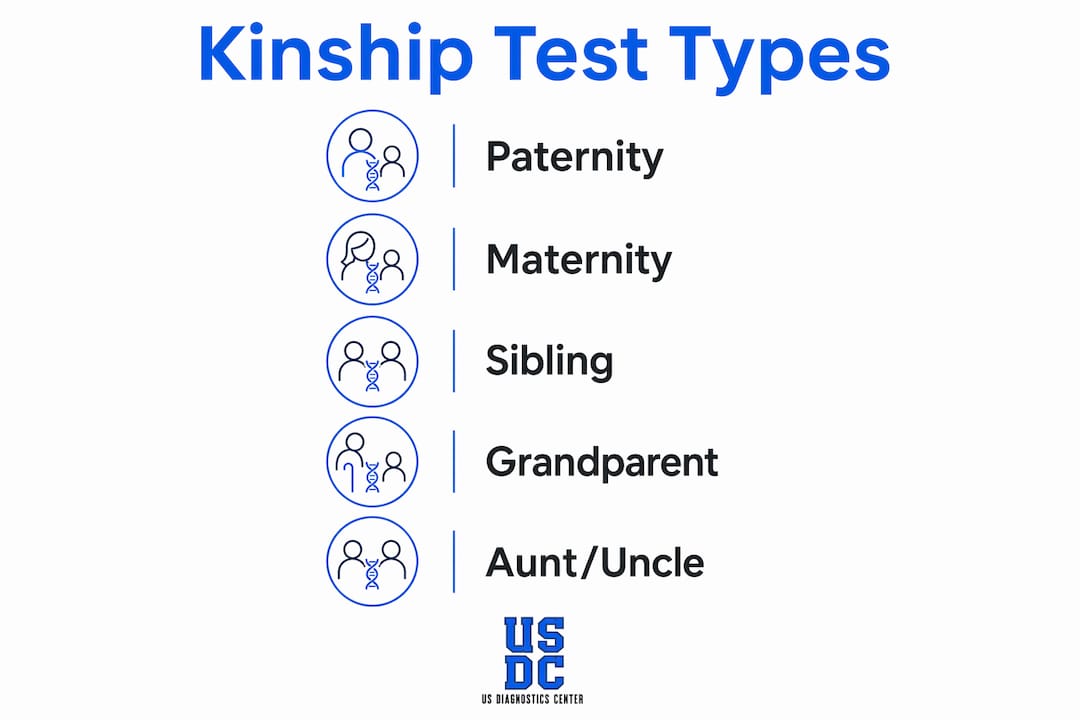
Different types of kinship tests address different relationship questions, depending on which individuals are available for sampling. Choosing the right test type from the start saves time and avoids inconclusive results.
The most common test categories are:
- Paternity testing. Compares the child's DNA to the alleged father's DNA. This is the most statistically powerful kinship test because parent-child relationships share the highest proportion of genetic markers. Learn more about how paternity testing works and when to use it.
- Maternity testing. Confirms whether a woman is the biological mother of a child. Less common than paternity testing but equally definitive when conducted properly.
- Siblingship testing. Determines whether two individuals share one or both biological parents. Full siblingship tests are more conclusive than half-siblingship tests because full siblings share more markers on average.
- Grandparentage testing. Used when a parent is unavailable. A grandparent shares roughly 25% of their DNA with a grandchild, which provides enough statistical signal for a meaningful result.
- Avuncular testing. Tests the relationship between an aunt or uncle and a niece or nephew. Like grandparentage testing, it applies when the direct parent cannot be tested.
- Y-STR and mitochondrial DNA testing. Traces direct paternal or maternal lineage across multiple generations. Useful in inheritance disputes, family reunification cases, and genealogical legal matters.
Each test type has a defined application. Paternity and maternity tests resolve direct parentage questions. Sibling, grandparent, and avuncular tests fill the gap when a parent is deceased, unavailable, or unwilling to participate. Y-STR and mitochondrial tests answer lineage questions that autosomal testing cannot address alone.
For a clearer picture of how these scenarios play out in practice, kinship testing examples illustrate the range of real-life situations families face.
What factors affect the accuracy of kinship testing?
Kinship testing accuracy declines as genetic distance increases. First-degree relationships yield stronger evidence than second or third-degree relationships because closer relatives share more genetic markers. Understanding this principle prevents misplaced expectations about what a test can and cannot confirm. For a broader foundation on how DNA tests work and what the numbers mean, reviewing the basics of understanding DNA testing is a helpful starting point.
Key factors that influence result quality include:
- Genetic distance. A parent-child test is more conclusive than a cousin test. The further apart two people are on the family tree, the fewer markers they share, and the weaker the statistical signal.
- Number of relatives tested. Including multiple first-degree relatives when the alleged parent is unavailable strengthens likelihood ratio calculations and improves conclusiveness.
- Sample quality. Degraded or contaminated buccal swabs reduce the number of readable markers, which weakens the final ratio. Following collection instructions carefully prevents this.
- Marker count. Labs that analyze up to 28 markers produce more statistically reliable results than those using fewer loci.
A common misconception is that kinship testing delivers a 100% definitive answer. It does not. Parentage tests (paternity and maternity) produce a probability percentage. Non-parentage kinship tests — sibling, grandparent, aunt/uncle — produce a Combined Relationship Index (CRI). According to forensic genetics standards, a CRI above 10 supports the claimed relationship, between 0.1 and 10 is inconclusive, and below 0.1 weighs against it. In both cases the result can be very strong, but it is always a statistical expression of the evidence, not mathematical proof.
Inconclusive results are not failures. They signal that the current sample set lacks enough statistical power to reach a clear conclusion. The correct response is to add more participants, particularly first-degree relatives of the absent party.
Pro Tip: Before ordering a kinship test, map out which family members are willing and available to participate. Submitting samples from additional relatives at the same time costs less than ordering a follow-up test later.
Common DNA testing misconceptions about accuracy and certainty lead many families to misread their results. Reviewing those misconceptions before testing sets realistic expectations.
How do you get kinship testing done and use the results?
The process of obtaining a DNA kinship analysis is straightforward. For families seeking personal clarity, at-home DNA test kits offer a convenient, private way to collect samples and receive results — without visiting a clinic. Selecting the right test type and a qualified lab still matters significantly for accuracy, so take time to match the test to your specific relationship question.
| Step | What happens |
|---|---|
| Select test type | Choose based on the relationship question; at-home kits are for personal knowledge only |
| Order kit | Kit arrives with buccal swabs and a prepaid return shipping envelope |
| Collect samples | Swab the inside of each participant's cheek for 30–60 seconds |
| Return to lab | Seal and mail samples using the included envelope |
| Receive results | Lab processing takes 2–3 business days; standard order-to-results is 7–10 business days |
Typical kinship test results report a likelihood ratio or probability supporting the claimed relationship, presented clearly for personal decision-making. Results from labs analyzing up to 28 genetic markers carry more statistical weight. Note that at-home test results are for personal knowledge only; if you need results for a legal proceeding, that requires a separate legal DNA testing service conducted under chain-of-custody protocols.
Personal uses for kinship test results include confirming biological connections for medical history purposes, resolving long-standing family questions, and gaining clarity before pursuing formal legal steps. Many families find that a personal-knowledge result gives them the confidence to take the next steps — whether that means reconnecting with relatives or seeking formal legal documentation separately.
When selecting a testing provider, it is worth understanding quality standards. AABB accreditation standards require labs to follow stringent quality controls that improve result accuracy and reliability. Choosing a provider that values lab quality — whether AABB-accredited or otherwise certified — helps ensure your results are meaningful and scientifically sound.
Understanding the technical distinction between STR and genealogy DNA testing also helps families choose the right method for their specific situation.
Key Takeaways
Biological kinship testing produces statistical evidence of family relationships through likelihood ratio analysis, and its reliability depends directly on which relatives are tested and how many markers the lab examines.
| Point | Details |
|---|---|
| Core method | Labs compare autosomal STR profiles and calculate a likelihood ratio to express relationship probability. |
| Test types | Paternity, maternity, sibling, grandparent, and avuncular tests each address different relationship questions. |
| Accuracy factors | Genetic distance, sample quality, marker count, and number of participants all affect result strength. |
| Results are statistical | No kinship test delivers 100% certainty; a high likelihood ratio reflects strong but probabilistic evidence. |
| Provider standards | Choose labs that follow recognized quality controls — higher marker counts and rigorous processes produce more reliable results. |
Why the statistical nature of kinship testing matters more than most families realize
Most families approach kinship testing expecting a binary answer. That expectation is understandable, but it misses the actual structure of how these tests work. After years of observing how families interact with DNA results, the single most common source of confusion is not the science. It is the gap between what a likelihood ratio actually says and what people assume it means.
A result showing 99.99% probability of paternity is not a statement of absolute biological fact. It is a statement that the genetic evidence is overwhelmingly consistent with the claimed relationship. That distinction matters whether you are using results for personal peace of mind or preparing to pursue formal legal steps through a separate legal testing service.
The practical implication is this: if a result comes back inconclusive or lower than expected, the first question to ask is not whether the test is flawed. The first question is whether additional relatives can be added to the analysis. I have seen cases where a grandparent's sample transformed a borderline result into a statistically conclusive one. That outcome was not about better technology. It was about better sample strategy from the start.
Families who take time to understand the statistical framework before testing make better decisions throughout the process. They choose the right test type, recruit the right participants, and interpret their results accurately. That preparation is more valuable than any single technological feature a lab can offer.
— Todd
How US Diagnostics Center supports your kinship testing needs
Families navigating complex relationship questions need a lab that offers the right test for their specific situation, not a one-size-fits-all kit.
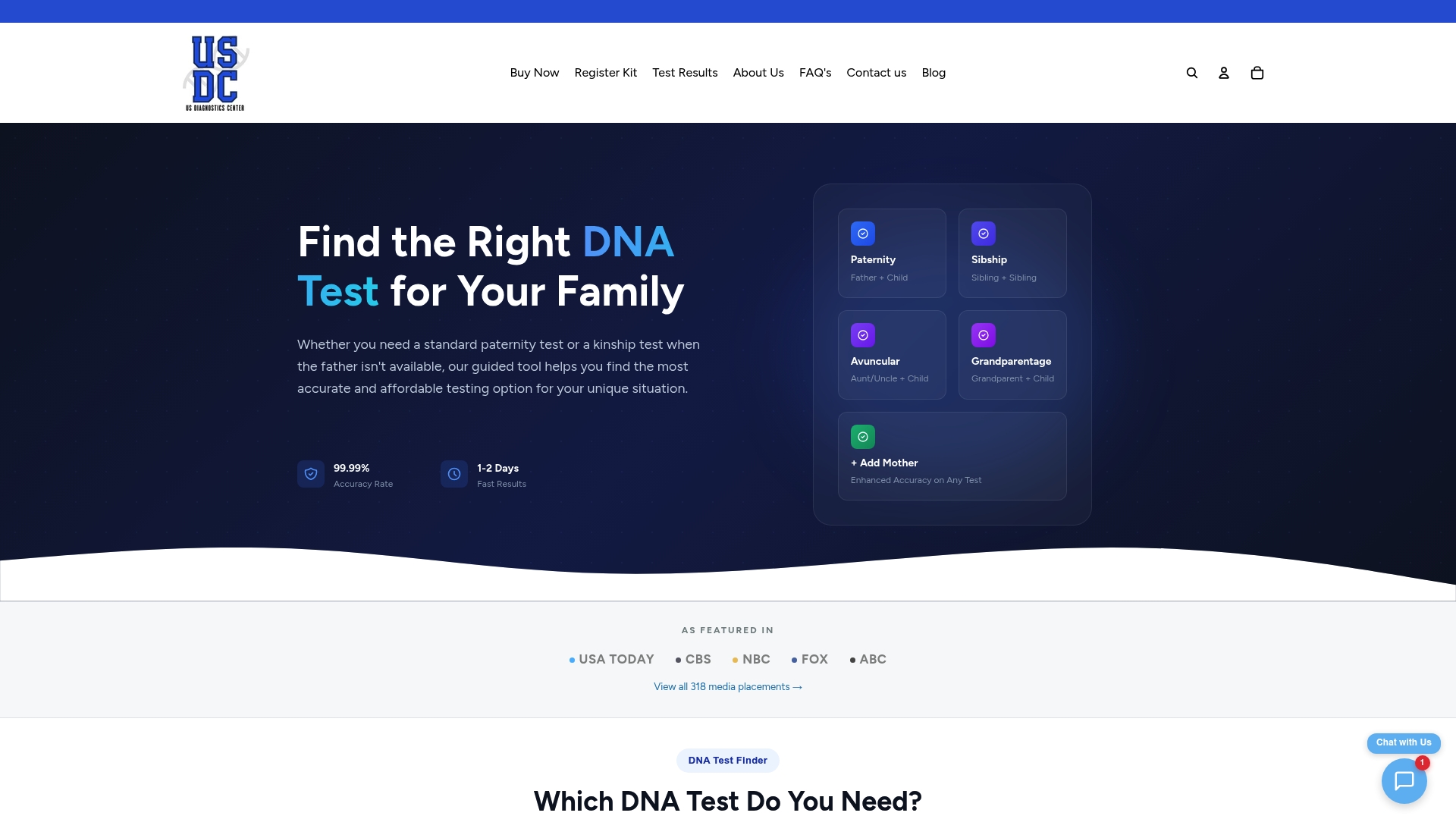
US Diagnostics Center offers a full range of at-home kinship DNA tests — paternity ($79), maternity ($129), and sibling, grandparent, and aunt/uncle tests ($139 each). Every kit is designed for personal knowledge — results are private, accurate, and delivered fast. Each kit includes a prepaid return shipping envelope, and lab processing takes 2–3 business days, with standard order-to-results in 7–10 business days. Tests analyze up to 28 genetic markers for maximum statistical reliability. A guided selection tool helps families identify the most accurate and affordable test for their specific situation.
FAQ
What is biological kinship testing used for?
Biological kinship testing establishes or clarifies biological family relationships, including paternity, maternity, siblingship, and grandparentage. At-home kinship tests are used for personal knowledge and peace of mind. If results are needed for a legal proceeding, inheritance dispute, or family reunification petition, a separate legal DNA testing service — conducted under strict chain-of-custody procedures — is required.
How does a kinship test produce a result?
Labs compare genetic markers between individuals using autosomal STR profiling and calculate a likelihood ratio. That ratio expresses how strongly the genetic data supports the claimed relationship compared to no relationship.
Can kinship testing give a 100% definitive answer?
No kinship test delivers absolute certainty. Parentage tests (paternity and maternity) report a probability percentage — a figure such as 99.99% reflects overwhelming statistical support for the claimed relationship. Non-parentage tests (sibling, grandparent, aunt/uncle) produce a Combined Relationship Index (CRI) instead: a CRI above 10 supports the claimed relationship, a CRI between 0.1 and 10 is inconclusive, and a CRI below 0.1 weighs against it. In all cases, results reflect strong but probabilistic evidence, not mathematical proof.
What happens if a kinship test result is inconclusive?
An inconclusive result means the current sample set lacks enough statistical power. Adding first-degree relatives of the absent party, such as a grandparent or full sibling, typically strengthens the likelihood ratio and produces a clearer conclusion.
How many genetic markers should a kinship test analyze?
Labs that analyze up to 28 genetic markers produce more statistically reliable results than those using fewer loci. A higher marker count reduces the probability that a match occurs by chance rather than by biological relationship.
Recommended
- See real-world scenarios that show how different test types are chosen and what results look like: Kinship DNA Testing Examples: A Clear Guide | USDC
- Understand when a sibling test makes sense and how the sample process works: Sibling DNA Test Kit: How It Works & When You Need One | USDC
- Compare top at-home sibling DNA test kits and what to look for when choosing one: Best Sibling DNA Test Kits: How to Choose (2026) | USDC
This article is part of our Kinship DNA Testing: Sibling, Grandparent, and Family Relationship Tests guide.


0 comments