

Full siblings share both biological parents and typically around half of their autosomal DNA. Half-siblings share one biological parent and typically about a quarter. Step-siblings share no biological parent and, genetically, are strangers to each other despite growing up under the same roof.
TL;DR:
- Full siblings share approximately 50% of their DNA, with ranges between 38% and 61%, but overlap exists with half-siblings, who share around 25%.
- DNA pattern analysis, especially examining IBD states and FIR/HIR regions, provides more accurate differentiation than simple percentage comparison.
- Adding a parent or known relative to the test improves accuracy, especially when results are ambiguous or fall within the gray overlap zone.
- Even with a high shared DNA percentage, the CSI value determines the confidence level of full versus half-sibling classification.
- Legal and medical implications require precise relationship determination, making comprehensive testing and context-specific analysis essential.
Table of Contents
- Full vs Half Sibling: Definitions and the Genetics Behind Them
- How DNA Testing Tells Full Siblings From Half-Siblings
- Reading Your Centimorgan Results Without Getting Confused
- Why Full vs Half Sibling Status Actually Matters
- When a Sibling DNA Test Makes Sense (and How to Do It Right)
- An Expert Note on Lab Practice and Test Accuracy
- When the Results Surprise You
- Getting Clarity Through US Diagnostics Center
- Sources
- FAQ
Full vs Half Sibling: Definitions and the Genetics Behind Them
Most families use “brother” and “sister” loosely, but genetics draws sharper lines. Understanding those lines matters whether you’re reading a DNA test report, sorting out a family tree, or trying to figure out why a relative’s ancestry results looked strange.
Full siblings share the same biological mother and father. Half-siblings share only one biological parent, either the mother or the father, and average about 25% shared DNA. Step-siblings become family through a parent’s remarriage or partnership, with no biological parent in common and no expected genetic overlap tied to that relationship, according to a breakdown from LoveToKnow.
There are less common categories worth knowing:
- Three-quarter siblings: a rarer scenario where two men are related (such as brothers) and each fathers a child with the same woman, or a similar setup on the mother’s side, producing a shared-DNA percentage that lands between half and full siblings.
- Adopted siblings: raised together with no biological connection, similar to step-siblings genetically.
- Donor-conceived siblings: may share one parent (often the same sperm or egg donor) without ever meeting that parent, genetically functioning as half-siblings.
- Twins: identical twins share nearly 100% of their DNA; fraternal twins are genetically equivalent to full siblings despite being born on the same day.
These distinctions come from DNAeXplained’s overview of sibling types, which lays out how modern family structures have outpaced the old vocabulary.
Why the numbers aren’t fixed
Inheritance is a random shuffle. When a parent passes down DNA, only one copy of each chromosome pair goes to a given child, and which copy gets passed is essentially a coin flip repeated across the genome.
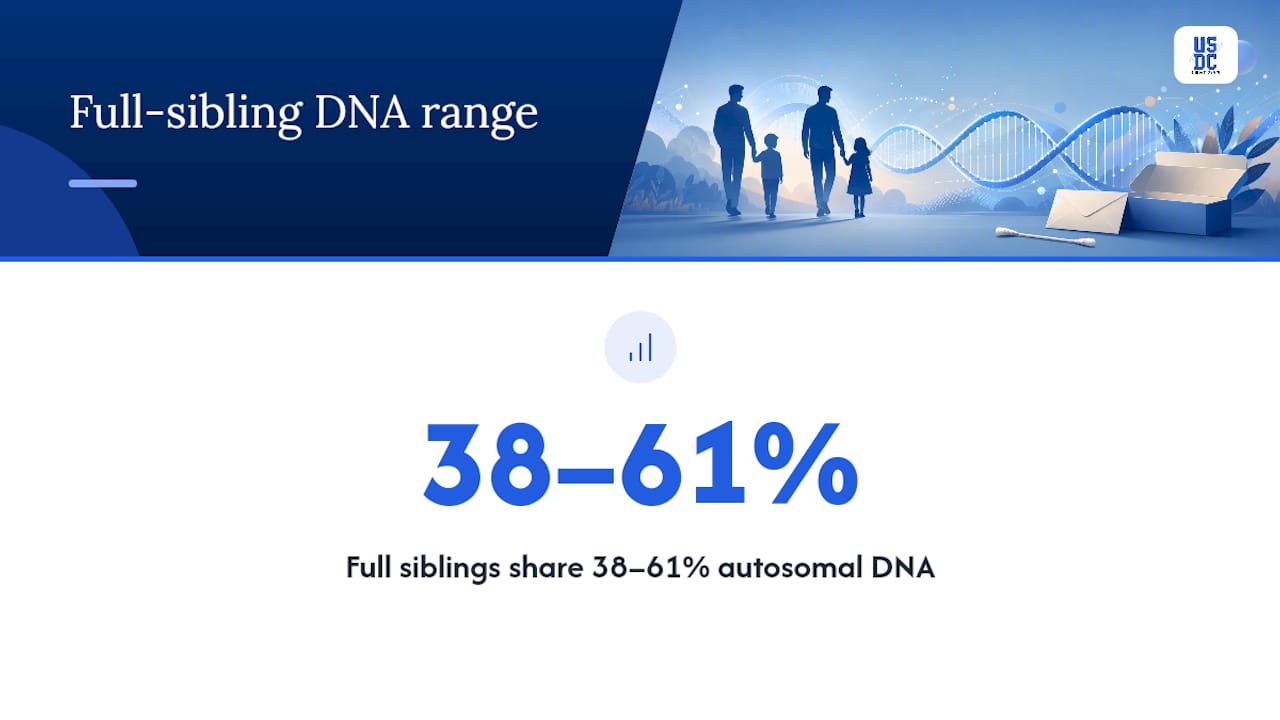
Observed ranges reflect this. Full siblings typically fall somewhere between 38% and 61% shared autosomal DNA, according to genetic genealogist Roberta Estes at DNAeXplained. Those ranges can edge close to each other at the margins, which is exactly why raw percentages alone sometimes aren’t enough to settle a question with total confidence.
Family relationship dynamics get complicated fast once you add remarriage, informal adoption, or unknown paternity into the mix. A person raised believing they had a full sibling might discover, often through a consumer DNA test, that the shared percentage points to a half-sibling relationship instead. That gap between social identity and genetic reality is one of the more common surprises genetic testing uncovers.
How DNA Testing Tells Full Siblings From Half-Siblings
Labs don’t just look at a single percentage and call it a day. They examine the actual pattern of DNA sharing across chromosomes, because that pattern reveals information a raw percentage can hide.
The key concept is identity by descent (IBD), sorted into three states:
- IBD0: neither copy of a DNA segment matches between two people at that location.
- IBD1: one copy matches (inherited from a shared parent).
- IBD2: both copies match (inherited from both parents at that location).
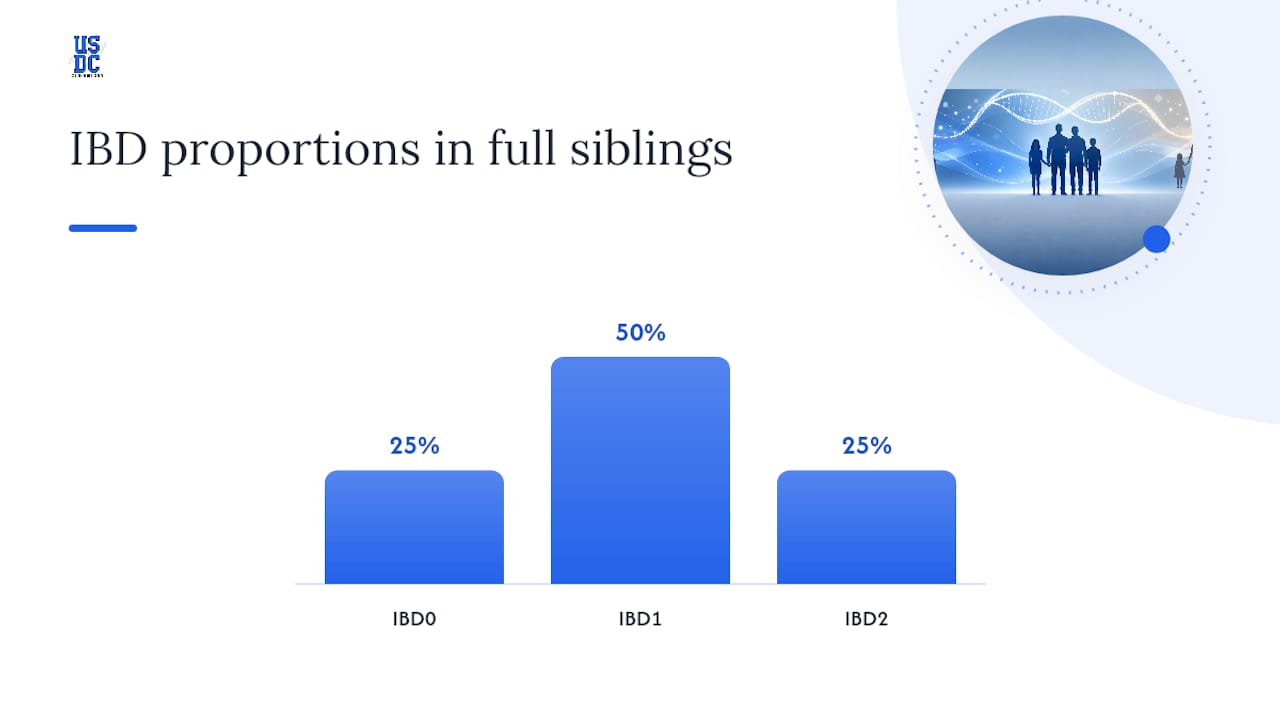
Full siblings show a mix of all three states across their genome, roughly 25% IBD0, 50% IBD1, and 25% IBD2, according to the IBD concepts reference from Lineage. Half-siblings show IBD1 only, with essentially no IBD2, because IBD2 can only occur when two people share DNA from both parents at the same spot. That’s a structural fact of inheritance, not a statistical tendency. Only relationships that pass through both parents, like full siblings or double first cousins, can produce IBD2 segments at all, per ISOGG’s autosomal DNA statistics page.
This is where the terms fully identical regions (FIR) and half-identical regions (HIR) come in. A FIR is a stretch of the genome where both chromosome copies match between two people, essentially a run of IBD2. An HIR is a stretch where only one copy matches, corresponding to IBD1. Finding substantial FIR segments across a genome is a strong signal of a full-sibling relationship, since half-siblings shouldn’t produce meaningful FIR at all.
Full siblings typically share a range of centimorgans of DNA that overlaps with half-siblings, who also share a varying range, based on reference ranges published by Lineage. Notice there is an overlap zone where a result could plausibly belong to either category without additional context.
Here’s a wrinkle that trips up a lot of people comparing results across different testing companies: vendors don’t all calculate “percent shared” the same way. A second calculation method produces an average closer to 37.5% for the same biological relationship, because it uses a different denominator when accounting for IBD2 segments, per ISOGG’s explanation of these methods. This is precisely why comparing a raw percentage from one company against another’s can mislead you. Centimorgan totals and IBD patterns are more reliable for cross-vendor comparisons than a bare percentage figure.
Labs that specialize in sibling determination often report a Combined Sibling Index (CSI), a likelihood ratio that expresses how many times more probable a full-sibling relationship is compared to a half-sibling or unrelated scenario, given the observed DNA data. A high CSI supports a confident conclusion. A CSI closer to 1 means the data doesn’t strongly favor either relationship, and the result should be treated as inconclusive rather than forced into a category. You can find a deeper walkthrough of how that number is built in this explanation of the Combined Sibling Index.
The bottom line: sibling DNA testing is probabilistic, not a simple yes-or-no calculation. Labs compute likelihood ratios across many genetic markers, and the strength of the conclusion depends heavily on how much comparative data is available, an idea covered in more depth in the Adnà overview of what sibling DNA tests reveal.
Reading Your Centimorgan Results Without Getting Confused
Once you have a report in hand, the centimorgan (cM) total is usually the most useful number to focus on, more useful than a bare percentage. Here’s a quick reference for what different relationships typically show, based on the ranges Lineage publishes:
The overlap zone between full and half siblings sits roughly between 2,300 and 2,600 cM. A full sibling pair that inherited an unusually uneven split of parental DNA can land at the low end of the full-sibling range, close to where the half-sibling range tops out. Less commonly, a half-sibling pair with an unusually generous inheritance pattern can edge toward the high end of their range. When a result falls in that gray zone, the centimorgan number alone won’t settle the question. That’s when the IBD2 and FIR analysis described earlier becomes the deciding factor, since half-siblings shouldn’t show meaningful IBD2 regardless of where their total cM count lands.
If your results come back ambiguous, or you want more certainty before making a decision that matters, here’s a practical path forward:
- Add the mother’s sample if she’s available. Including a parent isolates that parent’s genetic contribution, which makes it far easier to see what’s left over for comparison, according to Adnà’s research on sibling test reliability. This single step tends to resolve more ambiguous cases than any other option.
- Test a known parent, if one is available and willing. Even one confirmed parent narrows the field of possible explanations dramatically.
- Bring in a grandparent. Grandparent testing can indirectly confirm a parent-child link and, by extension, clarify sibling status.
- Consider a legal, chain-of-custody kinship test if the outcome affects legal decisions such as inheritance, custody, or benefits eligibility. A standard consumer kit isn’t built for that purpose; a court-admissible kinship test is.
- Get consent before testing anyone else. Every additional participant should understand what’s being tested and why, particularly in emotionally charged family situations.
Pro Tip: If your first sibling test result reads as “inconclusive” or shows a CSI close to 1, don’t assume the test failed. It usually means your specific DNA overlap happened to land in the gray zone between categories. Adding one more relative’s sample, ideally the mother, is almost always more useful than repeating the same test.
Why Full vs Half Sibling Status Actually Matters
The genetic distinction between full and half siblings isn’t just trivia for family trees. It carries weight in a handful of concrete, practical areas.
Medical history and inherited risk. Half-siblings share meaningful genetic overlap through their common parent, which means certain inherited health conditions, tendencies toward specific cancers, cardiovascular risk factors, and other hereditary patterns can still apply across a half-sibling relationship. Step-siblings, having no biological parent in common, generally don’t share this kind of inherited medical risk at all, even if they’ve lived in the same household their entire lives. Doctors compiling a family health history need to know which relationship type they’re dealing with, because a half-sibling’s diagnosis can be genuinely relevant to your own risk profile in a way a step-sibling’s diagnosis typically isn’t.
Legal status versus biological status. Being a “legal” sibling (through adoption, a parent’s remarriage, or other family arrangements) doesn’t always align with biological sibling status, and the two categories can carry different weight depending on the legal question at hand, such as inheritance rights, custody arrangements, or eligibility for certain benefits. These questions vary significantly depending on jurisdiction and the specific legal matter involved, so a family attorney or estate professional should be consulted rather than relying on genetic test results alone to settle a legal question.
Record-keeping and family history documentation. Blended families often carry a mix of full siblings, half-siblings, and step-siblings under one roof, and keeping those relationships straight in medical charts, estate documents, and genealogical records prevents confusion down the line. A few habits worth building:
- Note the specific relationship type (not just “sibling”) in any family medical history document.
- Keep DNA test reports and CSI results on file if a relationship was ever formally verified.
- Update family records when new information emerges, rather than relying on memory or assumption.
Emotional and social considerations. A half-sibling relationship or a step-sibling bond can be every bit as close, emotionally, as a full-sibling relationship. Genetics measures biological overlap, not the strength of a family bond. That distinction is worth keeping in mind, particularly in blended families where love and loyalty don’t map neatly onto a DNA percentage.
When a Sibling DNA Test Makes Sense (and How to Do It Right)
A sibling DNA test tends to come up in a specific handful of situations rather than as a general curiosity purchase. The most common reasons include: no surviving or available parent to test directly for a paternity question, questions arising from adoption or a discovered half-sibling, verifying shared medical history for a hereditary condition, and estate or inheritance matters where biological relationship needs documentation.
Accuracy depends heavily on who else gets tested alongside the two people in question. Testing just two potential siblings, with no other relatives involved, relies on comparing their DNA against general population statistics, which is inherently a weaker comparison than having a direct family reference point. Adding a parent, especially the mother, gives the lab a baseline to subtract from, which sharpens the comparison substantially. A grandparent sample can serve a similar purpose when a parent isn’t available.
On the lab side, a few practical features affect both accuracy and convenience:
- Marker count matters for resolution. Testing at up to 28 markers gives a lab more data points to work with than a bare-minimum panel, which matters most in borderline cases near the overlap zone between relationship categories.
- Turnaround time affects planning. Standard lab processing typically takes 2 to 3 business days, with the full order-to-results timeline running 7 to 10 business days when you factor in shipping and intake.
- Expedited processing exists for time-sensitive situations, such as legal deadlines or urgent medical decisions, and can shorten that window.
- Sample collection is straightforward with a home kit that includes a prepaid return shipping envelope, though legal kinship tests require a supervised collection process to maintain chain of custody.
- Confirm consent from every participant before samples are collected, particularly when a minor or an estranged relative is involved.
If you’re weighing whether your situation calls for a sibling test at all, this rundown of common situations where a sibling DNA test is the right call walks through the most frequent real-world scenarios in more detail. And if you want the mechanics of sample collection and the testing workflow itself, the sibling DNA test kit walkthrough covers what to expect from swab to report.
An Expert Note on Lab Practice and Test Accuracy
Dr. Todd Lewis, whose work informs the technical framing throughout this piece, points to one consistent lesson from sibling DNA analysis: the confidence of a result depends less on the marketing claims of any single test and more on the underlying comparison data available to the lab.
A test run at up to 28 markers, processed through a controlled chain-of-custody workflow, gives a stronger statistical foundation than a bare-bones panel. But even a well-run test has limits without a parent sample. Without that reference point, the lab must rely on population allele frequencies to estimate likelihood, which is inherently weaker than direct comparison against a known parent, a limitation described in Adnà’s technical breakdown of sibling test reliability. That’s the practical reason labs push so hard to include the mother whenever she’s available.
Standard lab processing typically runs 2 to 3 business days once a sample arrives, with the full order-to-results window running 7 to 10 business days for most orders, expedited options available for urgent timelines. None of this replaces professional judgment. Legal questions around inheritance or custody, and medical questions about hereditary risk, both deserve a conversation with a qualified attorney or physician rather than a DNA report read in isolation.
When the Results Surprise You
Unexpected results are more common than people expect, and they tend to land hard emotionally before the analytical part of the brain catches up. If a sibling test comes back differently than you anticipated, give yourself room to sit with it before making any big decisions or difficult phone calls.
Confirm before you confront. A single ambiguous result, especially one that falls near the overlap zone between full and half-sibling ranges, deserves a second look with additional relatives tested before you treat it as settled fact. Genetic genealogists who work with sibling data regularly note that surprising outcomes are often worth verifying with a retest or an added family sample before anyone acts on them, a pattern documented at DNAeXplained.
When you do talk to relatives, lead with curiosity rather than accusation. Most surprising results trace back to circumstances from decades earlier that no one currently in the conversation controlled. Keep a written record of every test result and date, since you may need that documentation again for medical or legal reasons later.
— Dr. Todd Lewis
Getting Clarity Through US Diagnostics Center
Testing specifically for a half-sibling relationship?
The at-home Half-Sibling DNA Test Kit analyzes up to 28 genetic markers and reports a sibship index that distinguishes a full-sibling relationship from a half-sibling relationship. Lab turnaround is 2 to 3 business days after samples arrive, prepaid return envelope included.
If you’ve read this far, you already know that a raw percentage isn’t always enough, and that the right next step usually depends on your specific family situation. US Diagnostics Center built a guided test-selection tool for exactly that reason: answer a few questions about your situation and it points you toward the sibling or kinship test that actually fits, rather than making you guess between options on a shelf.
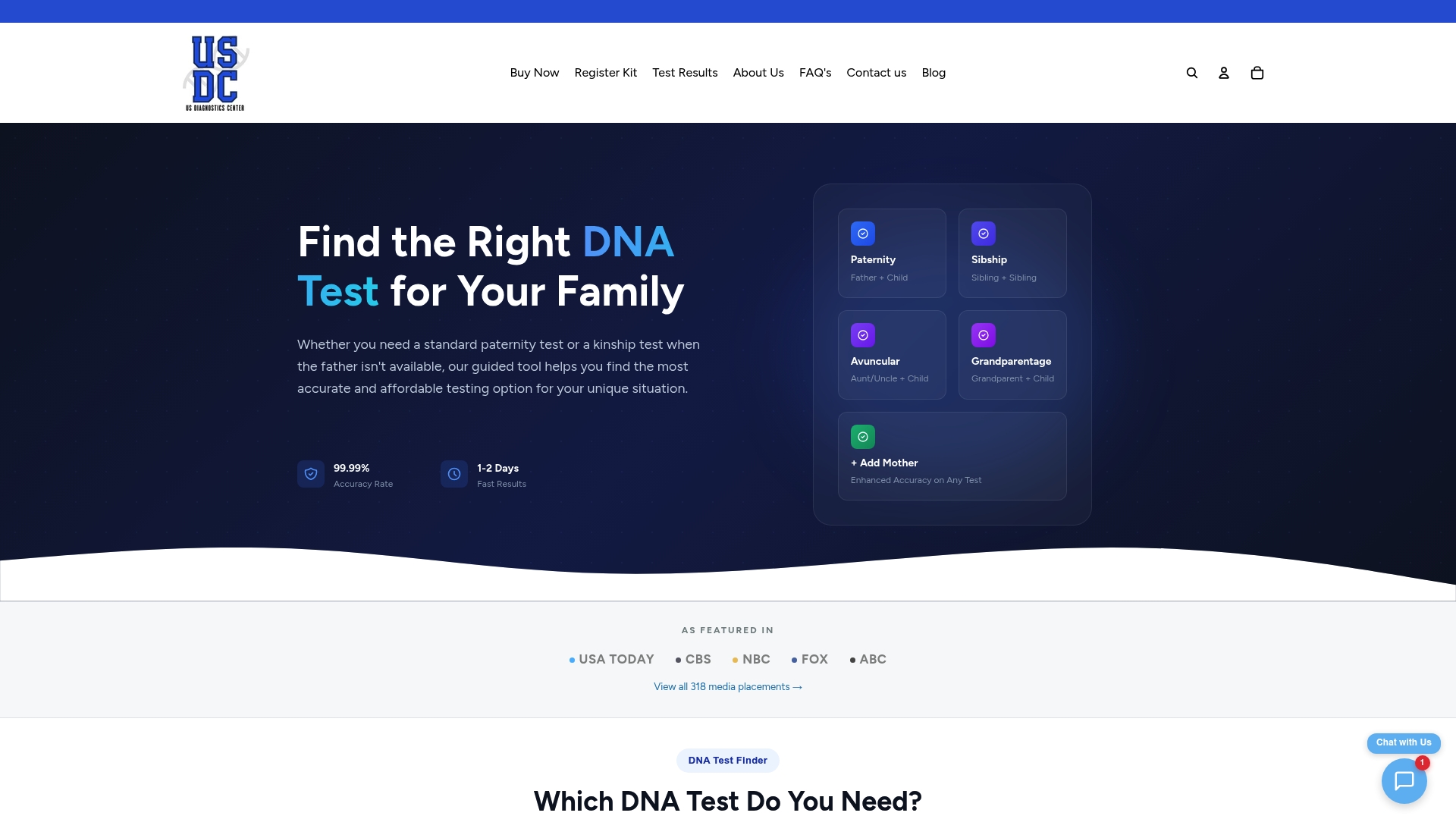
US Diagnostics Center offers home DNA test kits for sibling, grandparent, and aunt/uncle testing. USDC's legal, court-admissible kinship testing option is Coming Soon; for cases headed to court today, work with a provider that already offers witnessed collection. Testing runs at up to 28 markers, with standard lab processing completed in 2 to 3 business days and full order-to-results timelines of 7 to 10 business days; expedited options are available when time is tight. Every home kit ships with a prepaid return envelope, so getting your sample back to the lab doesn’t require a separate purchase.
If your situation calls for testing more than two people, the kinship DNA testing page breaks down grandparent, sibling, and avuncular options so you can add the right relative to your order. Start by answering a few questions in the guided tool to see which test fits your family’s situation.
Sources
For readers who want to dig into the technical details behind these figures, a few sources stand out. DNAeXplained, written by genetic genealogist Roberta Estes, offers detailed breakdowns of real sibling comparisons. ISOGG’s autosomal DNA statistics page explains vendor calculation differences in depth. The Lineage IBD concepts reference covers identity-by-descent math for readers who want the underlying framework. For readers curious about DNA’s role outside family testing, this guide to DNA in cold case investigations shows how the same genetic principles apply in forensic work.
- Autosomal DNA statistics | ISOGG
- Lineage IBD concepts
- Siblinghip DNA tests — what they really reveal | Adnà
FAQ
Do half-siblings still count as siblings?
Yes.
Do half-siblings count as siblings legally?
Generally yes for many purposes, though legal recognition can vary by jurisdiction and by the specific issue at hand, such as inheritance or custody. Anyone facing a legal question involving half-sibling status should consult a family law attorney rather than rely on a DNA percentage alone.
Are half-siblings considered cousins?
No. The relationship categories and shared-DNA percentages don’t overlap in any meaningful way.
Is it inbreeding if half-siblings have children together?
Yes, biologically. Half-siblings share one parent and roughly a quarter of their DNA, so children from that pairing would carry meaningfully higher genetic overlap between their parents than children from unrelated parents, raising the same recessive-condition risks associated with close-relative pairings.
How can I confirm whether my sibling is a full or half-sibling?
A DNA test comparing centimorgan totals and IBD patterns, ideally with a parent’s sample included, gives the clearest answer. Services like US Diagnostics Center’s kinship testing offer options built specifically for this kind of comparison.
Recommended
- How Much DNA Do Siblings Share? Percentages Explained (2026)
- Combined Sibling Index (CSI) Explained: What the Number on Your Sibling DNA Report Actually Means
- 8 Situations Where a Sibling DNA Test Is the Answer
- Sibling DNA Test Kit: How It Works & When You Need One
This article is part of our Paternity Testing: The Complete Guide and Kinship DNA Testing: Sibling, Grandparent, and Family Relationship Tests guides.


0 comments