

TL;DR:
- Legal paternity officially establishes a child's legal parenthood, granting enforceable rights and duties. It requires formal recognition, such as acknowledgment or court orders, beyond biological connection. Establishing paternity ensures the child's access to support, inheritance, and medical history, while clarifying parental responsibilities.
Legal paternity makes a person the child's legal parent, creating enforceable rights — custody, parenting time, and major decision-making authority — and enforceable duties, including child support and medical support. Biological connection alone does not create these rights or obligations; the law requires formal establishment. With 41% of U.S. children born to unmarried parents, the Office of Child Support Enforcement (OCSE) and state IV-D agencies rely heavily on the Voluntary Acknowledgment of Paternity (VAP) and administrative adjudication to close that gap. Understanding how legal paternity affects parental rights is the first step toward protecting your relationship with your child or securing the support your child is entitled to.
Two quick clarifiers before the details:
- A DNA result proves biology. It does not, by itself, create legal parenthood.
- There are fast voluntary routes (VAP, often completed at the hospital) and slower court or administrative routes when paternity is disputed.
Table of Contents
- How Legal Paternity Affects Parental Rights and Responsibilities
- How is paternity legally established in the United States?
- What is the difference between an at-home DNA test and a legal paternity test?
- What changes after paternity is legally established?
- What are your options when paternity is disputed?
- How to prepare for paternity testing
- Key Takeaways
- Why paternity is about the child's stability, not a parental contest
- US Diagnostics Center for personal paternity clarity
- Useful sources and next steps
- FAQ
How Legal Paternity Affects Parental Rights and Responsibilities
Legal paternity is the formal recognition of a father-child relationship under state law. Once established, it produces a specific and enforceable set of rights and duties for the father, the mother, and the child.
Rights the established father gains
- File for custody or joint custody in family court
- Petition for parenting time or visitation
- Be consulted on major decisions: schooling, medical care, religious upbringing
- Add the child to health insurance as a dependent
- Be listed on the birth certificate
Responsibilities the established father takes on
- Pay court-ordered child support calculated on income and the child's needs
- Provide medical support, which may include carrying the child on a health plan
- Contribute to educational and other child-related expenses as ordered
Benefits that flow to the child
Establishing paternity gives the child access to inheritance rights, Social Security dependent benefits, and potentially veterans' benefits if the father served. The child also gains access to the father's full medical family history, which can be critical for diagnosis and treatment decisions later in life.
State law governs the timing and procedures, and rules vary considerably. Texas, for example, requires paternity to be established before the state will issue a child support order for unmarried parents, as the Texas Attorney General's paternity guidance makes clear. Some states set strict deadlines for challenging a marital presumption, sometimes as short as two years from the child's birth.
With 41% of U.S. children born to unmarried parents, voluntary acknowledgments and administrative paternity orders are now the primary tools for securing both parental rights and child support obligations outside of marriage.
How is paternity legally established in the United States?
Three main pathways create legal paternity: the marriage presumption, voluntary acknowledgment, and court or administrative adjudication.

Marriage presumption
When the mother is married at the time of birth, her spouse is presumed the legal parent under every state's law, either by statute or common law. The 2017 Uniform Parentage Act applies this presumption in a gender-neutral manner, covering same-sex spouses as well. Rebutting the presumption requires evidence, typically DNA testing, and many states bar challenges brought more than two years after the child's birth regardless of when the questioning party learned of potential misattribution.
Voluntary Acknowledgment of Paternity (VAP)
The VAP is the fastest and lowest-cost route when both parents agree. It is typically signed at the hospital at birth or later at a vital records office. Both parents must sign, and signatures must be notarized or witnessed under 45 C.F.R. § 303.5. A VAP has the force of a legal judgment once the rescission window closes, typically about 60 days after signing. After that point, it can be challenged only on narrow grounds: fraud, duress, or a material mistake of fact. Hospitals participating in state voluntary paternity establishment programs are required to offer VAP services and explain the legal consequences before parents sign.
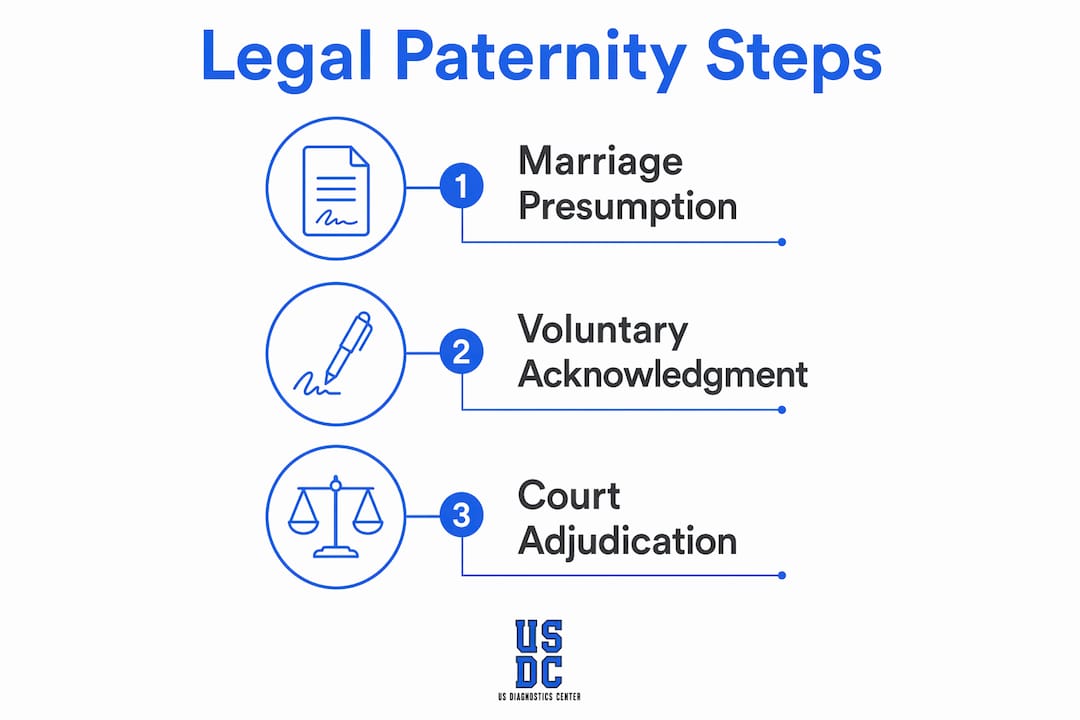
Court or administrative adjudication
When paternity is contested or neither parent has signed a VAP, a family court or IV-D agency can order genetic testing. Under 42 U.S.C. § 666, courts and IV-D agencies must order genetic testing in contested cases upon request. The typical sequence:
- A paternity petition is filed in family court, or the IV-D agency opens a case.
- The court or agency orders DNA testing and schedules sample collection.
- Results are reviewed against the state's probability threshold.
- If paternity is confirmed, the court issues an Order of Filiation or the agency issues an administrative order of paternity.
- A child support order is issued, and the father's name may be added to the birth certificate.
Failing to respond to a properly served paternity petition carries serious consequences. Under federal default procedures, a court may enter a default order establishing paternity and a support obligation without the alleged father appearing.
What is the difference between an at-home DNA test and a legal paternity test?
The distinction matters significantly when results need to hold up in court.
| Feature | At-home personal test | Legal chain-of-custody test |
|---|---|---|
| Court admissibility | Generally not admissible | Admissible when properly collected |
| Sample collection | Self-collected at home | Collected by a neutral third party |
| Identity verification | None required | Valid photo ID required for all parties |
| Chain-of-custody forms | Not included | Sealed, documented, and lab-verified |
| Typical turnaround | 7–10 business days | Varies by lab and urgency |
| Primary use | Personal knowledge | Legal proceedings, support orders |
Private at-home DNA tests offer personal clarity but are generally inadmissible in court unless they follow a verified chain-of-custody and meet lab accreditation standards. Accuracy for both types is typically reported at greater than 99% for inclusion of paternity; US Diagnostics Center tests analyze up to 28 markers, which is consistent with standard forensic practice.
Pro Tip: If your case is already in IV-D or family court, request an agency-ordered test or use a court-admissible chain-of-custody test from the start. Results from an at-home kit will likely be rejected, and you will need to repeat the process.
For guidance on what courts specifically require, the legal paternity test checklist at US Diagnostics Center covers the documentation and collection steps in detail.
What changes after paternity is legally established?
Once a paternity order or final VAP is in place, several administrative and legal actions become available or required.
Immediate administrative steps
- Obtain a certified copy of the paternity order or final VAP and keep multiple copies.
- Request that the father's name be added to the birth certificate through the state vital records office.
- Notify the father's health insurer to add the child as a dependent.
- Inform the child's school of the updated parental authority so both parents receive records and notices.
Legal actions now available
- Either parent may file for a custody or parenting time order in family court.
- The custodial parent or IV-D agency may petition for a child support order.
- The established father must be notified before any adoption proceeding can move forward.
- Either parent may seek modification of support or custody if circumstances change materially.
Established legal paternity also affects termination of parental rights proceedings. A court cannot terminate a legal father's parental rights without proper notice and a hearing. Conversely, a legal father who wishes to relinquish rights typically cannot do so unilaterally; a court must approve any termination, and an adoptive parent must be ready to assume the obligations.
For a full breakdown of every paternity establishment option, including post-establishment records steps, the USDC guide covers each pathway in sequence.
What are your options when paternity is disputed?
When paternity is contested, the procedural path depends on whether a VAP or court order already exists and how much time has passed.
- No prior order: Either parent or the IV-D agency may file a paternity petition. The court will order genetic testing under 42 U.S.C. § 666.
- VAP within the rescission window: Either parent may rescind the VAP in writing within approximately 60 days of signing.
- VAP after the rescission window: Challenge is limited to fraud, duress, or material mistake of fact. A DNA result showing non-paternity does not automatically overturn a final VAP in most states.
- Existing court order: A private DNA result rarely overturns an existing judgment. Relief requires a formal petition on narrow statutory grounds, and many states impose time limits.
Many states set deadlines for challenging a marital presumption, sometimes as short as two years from the child's birth, regardless of when the challenging party learned of the potential discrepancy.
Pro Tip: If you receive service of a paternity petition, respond by the deadline. A man who ignores proper service risks a default paternity order and a support obligation entered without his participation.
When facing a contested paternity matter with an existing order or a closing statutory window, consulting a family law attorney is advisable before taking any action.
How to prepare for paternity testing
For a court-admissible (chain-of-custody) test
- Confirm all participants have valid government-issued photo ID.
- Schedule collection at a designated neutral site or collection facility.
- Complete all consent and chain-of-custody forms at the time of collection.
- Verify the lab's accreditation status and confirm results will be delivered in a format the court accepts.
- Request expedited processing (2–3 business days lab turnaround) if a court date is approaching.
For a personal at-home test
- Follow kit instructions precisely; contaminated swabs are the most common cause of inconclusive results.
- Collect samples from all required participants before returning the kit.
- Understand that results are for personal knowledge only and will not be accepted in court proceedings.
- A prepaid return shipping envelope is included, so no separate postage is needed.
Selection factors to weigh: admissibility requirement, turnaround time, cost, and marker count. US Diagnostics Center's home paternity test is $79; maternity testing is $129; sibling, grandparent, and avuncular tests are $139 each. All tests analyze up to 28 markers. Standard order-to-results time is 7–10 business days, with expedited lab processing available at 2–3 business days for time-sensitive situations. If cost coverage is a question, the USDC guide on insurance and Medicaid coverage for paternity testing explains what programs may apply.
Key Takeaways
Legal paternity creates enforceable parental rights and duties; a DNA result proves biology but only formal legal establishment creates parenthood under U.S. law.
| Point | Details |
|---|---|
| Biology ≠ legal parenthood | A DNA result alone does not establish custody rights, support duties, or inheritance claims. |
| VAP is the fastest route | When both parents agree, a Voluntary Acknowledgment of Paternity avoids court and takes effect as a judgment after the ~60-day rescission window. |
| Default orders are real | Ignoring a paternity petition can result in a court order establishing paternity and support without your participation. |
| Test type determines admissibility | At-home tests serve personal knowledge; chain-of-custody tests are required for court proceedings. |
| US Diagnostics Center | Offers at-home paternity testing from $79 with up to 28 markers and 7–10 business day standard turnaround for personal clarity. |
Why paternity is about the child's stability, not a parental contest
Courts in every U.S. jurisdiction evaluate paternity and custody matters through the lens of the child's best interest, not as a zero-sum contest between parents. Biological evidence carries significant weight, but judges also weigh social and custodial factors, including the length and quality of the relationship between the child and the presumed parent. In some cases, courts have upheld nonbiological legal parentage precisely because disrupting an established bond would harm the child.
The more useful frame for families is the one OCSE practitioners consistently advocate: paternity establishment as a foundation for the child's long-term stability. A child with a legally recognized father has access to financial support, health coverage, inheritance rights, and a complete medical history. Both parents gain a defined legal structure within which to cooperate or, when necessary, to seek court resolution. Treating the process as adversarial from the outset tends to delay those benefits for the child while increasing legal costs for both parents. The DNA question is often the simplest part; the legal and relational work that follows is where families need clarity and, when disputes arise, qualified counsel.
US Diagnostics Center for personal paternity clarity
When the question is personal, not yet legal, an at-home DNA test can give you the biological answer you need before deciding on next steps. US Diagnostics Center offers at-home paternity testing at $79, with results analyzing up to 28 markers and a standard turnaround of 7–10 business days. A prepaid return shipping envelope is included with every kit. For court-admissible results, a chain-of-custody test collected by a neutral third party at a designated site is required — self-collected at-home kits do not satisfy the court's chain-of-custody standard regardless of lab accuracy.
If you are unsure which test fits your situation, the home DNA test collection and legal DNA test collection pages walk through the options clearly. US Diagnostics Center's support team can also help you determine whether your situation calls for a personal test, a court-admissible test, or both.
Useful sources and next steps
- OCSE/ACF: Establishing Fatherhood (Essentials for Attorneys) — federal guidance on paternity rights, responsibilities, and IV-D procedures
- OCSE/ACF: Child Support Handbook, Chapter 3 — the three establishment pathways explained
- 42 U.S.C. § 666 — federal statute requiring genetic testing in contested cases and default procedures
- 45 C.F.R. § 303.5 — federal regulations governing IV-D agency paternity establishment obligations
- WomensLaw.org: Voluntary Paternity Establishment — plain-language explanation of VAP rights and rescission rules
- Texas Attorney General: Paternity, Child Support, and You — state-level example of how paternity unlocks support and rights
- Your state's IV-D child support agency — contact them for administrative testing, support orders, and paternity petitions at no upfront cost in many cases
- US Diagnostics Center: Legal DNA Tests — court-admissible testing options
- US Diagnostics Center: Home DNA Tests — personal at-home testing options
FAQ
What rights does a legal father have that a biological father does not?
A legal father has standing to petition for custody, parenting time, and decision-making authority; a biological father who has not established legal paternity generally has none of those rights until he does so through a VAP, court order, or administrative adjudication.
Can an at-home DNA test be used in court?
Generally no. Courts require a chain-of-custody test with verified ID, witnessed sample collection, and sealed documentation; private at-home tests are typically inadmissible because the collection process cannot be independently verified.
How long does paternity establishment take?
A VAP signed at the hospital can be finalized in days; court or administrative adjudication typically takes several weeks to several months depending on the state, caseload, and whether testing is contested.
What happens if a man ignores a paternity petition?
Under federal default procedures in 42 U.S.C. § 666, a court may enter a default order establishing paternity and a child support obligation without the alleged father's participation.
Does legal paternity affect a child's right to inheritance?
Yes. A child with an established legal father has inheritance rights under that father's estate, as well as potential access to Social Security dependent benefits and, where applicable, veterans' dependent benefits.
Recommended
- Legal Paternity Test: What Courts Require in 2026 | USDC
- Home vs Legal Paternity Test: Key Differences (2026) | USDC
- At-Home Paternity Testing in Washington State: Laws & Options (2026) | USDC
- How to Establish Paternity: Every Option Explained (2026) | USDC
This article is part of our Paternity Testing: The Complete Guide guide.


0 comments