


TL;DR:
- Obtaining court-admissible DNA testing is essential to legally dispute paternity and requires strict procedures. Legal tests must follow chain-of-custody protocols and be conducted at accredited labs, with results at least 99% accurate. Court deadlines and considerations of the child's best interests heavily influence whether paternity can be challenged or disestablished.
Disputing paternity legally with DNA means obtaining a court-admissible genetic test that scientifically establishes or excludes biological fatherhood, then using that evidence within the formal legal system to challenge or confirm legal father status. Biological fatherhood and legal fatherhood are not the same thing. A man can be a child's biological father without holding legal paternity, and a man can hold legal paternity without being biologically related. Courts treat these distinctions seriously, and the process to dispute paternity legally with DNA requires following strict procedural rules, meeting evidentiary standards, and understanding that a DNA result alone does not automatically change a person's legal status.
How to dispute paternity legally with DNA: what courts actually require
Courts do not accept just any DNA test. Legal paternity tests must be conducted by an AABB-accredited laboratory using strict chain-of-custody protocols, including identity verification, witnessed sample collection, and documented handling at every stage. This standard exists because courts need to be certain the sample belongs to the person named in the case and was not tampered with.

The testing process itself is straightforward. A trained collector takes a buccal swab from the inside of each participant's cheek, photographs the collection, and seals the samples in tamper-evident packaging. The lab then analyzes up to 28 genetic markers to calculate a probability of paternity. Courts require 99% or higher probability to establish paternity legally. That threshold reflects the scientific confidence needed to support a binding legal judgment.
Home DNA kits are inadmissible in court because they lack chain-of-custody documentation. At-home results serve only personal knowledge. They cannot be submitted as evidence, cannot compel legal action, and cannot change a birth certificate or support order on their own. If you want to legally contest paternity, the test must be ordered through the court or conducted at an accredited facility following legal protocols.
Modern DNA testing achieves 99.99% accuracy, with results typically delivered within a few weeks depending on the lab and jurisdiction. US Diagnostics Center processes results within 2–3 business days in the lab, with standard order-to-results taking 7–10 business days.
Pro Tip: If you are unsure whether a test qualifies for court use, ask the lab directly whether it follows chain-of-custody procedures and whether its results are court-admissible before you order.
Step-by-step: the legal paternity dispute process
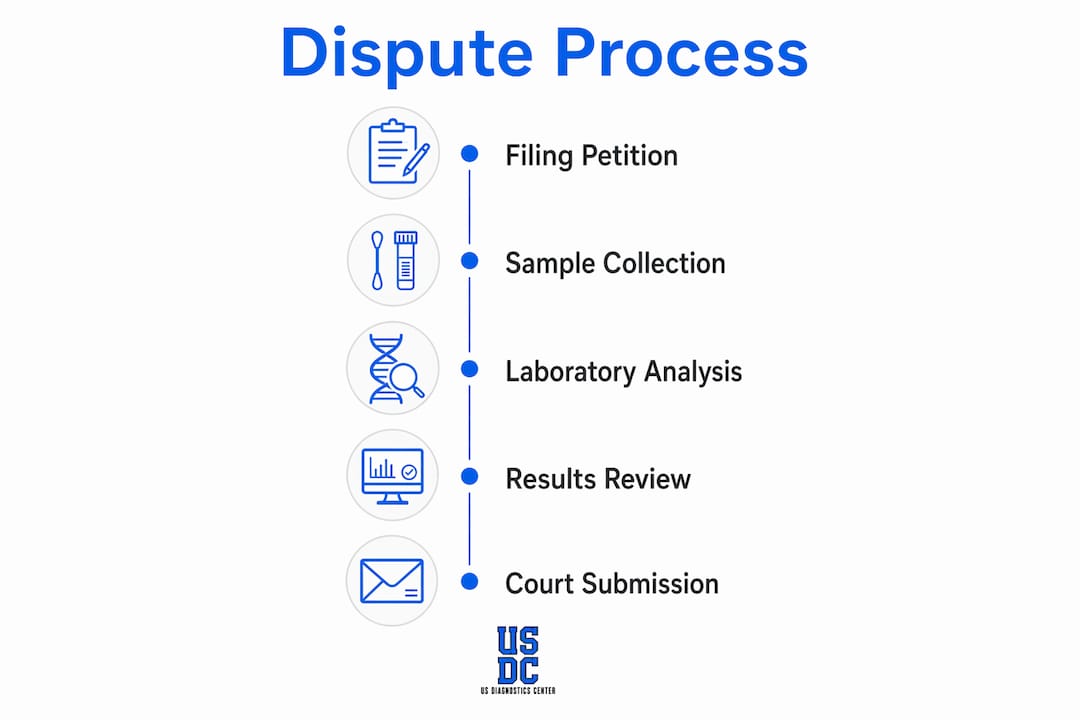
The formal process to legally contest paternity follows a defined sequence in family court. Each step builds on the last, and skipping any stage can delay or derail the case.
-
File a petition in family court. The person challenging paternity, whether the presumed father, the mother, or the child's representative, files a petition to establish or dispute paternity. The petition must include supporting documents such as the child's birth certificate, any existing voluntary acknowledgment of paternity, and a detailed factual narrative explaining the basis for the challenge.
-
Serve notice to all parties. All parties named in the petition must receive legal notice. This includes the mother, the presumed father, and in some states, the child's guardian ad litem.
-
Attend the initial hearing. The court reviews the petition and determines whether the challenge has legal standing. Judges look for specific factual allegations. Vague or unspecific claims are typically dismissed, so the petition narrative must be detailed and grounded in facts such as fraud, duress, or material mistake.
-
Receive a court order for genetic testing. When parties disagree or one party refuses voluntary testing, the court issues a formal order for DNA testing. Court-ordered paternity testing is federally mandated when disputes arise, and the process varies by state. The order specifies the accredited lab and the deadline for sample collection.
-
Complete the DNA test. All parties report to the designated collection site. The chain-of-custody process is followed exactly as required by the court order.
-
Submit results and attend the final hearing. The lab sends results directly to the court. Both parties may present arguments about what the results mean legally. The judge then issues a ruling on paternity status.
The table below summarizes the key documents typically required at each stage.
| Stage | Required document |
|---|---|
| Filing the petition | Birth certificate, existing acknowledgment of paternity |
| Initial hearing | Factual affidavit, supporting evidence of fraud or mistake |
| DNA testing order | Court order specifying lab and collection deadline |
| Final hearing | Lab-certified DNA results, legal arguments from both parties |
What legal complications can arise when challenging paternity?
DNA evidence is powerful, but it does not operate in a vacuum. Courts weigh several legal doctrines alongside biological results, and understanding this is critical before filing.
Marital presumption of paternity is the legal rule that a husband is presumed to be the father of any child born during the marriage. Rebutting this presumption requires clear and convincing evidence, and courts set a high bar. DNA exclusion results help, but they must be paired with a strong legal argument.
Deadlines matter enormously. Challenges to paternity vary from 2–4 years in some states, and missing those windows can bar a challenge entirely, regardless of what DNA evidence shows. Late challenges are frequently dismissed under statutes of limitations or equitable doctrines. Consulting a family law attorney promptly after discovering a potential paternity issue is not optional; it is necessary.
Paternity by estoppel applies when a man has acted as a father for years, creating emotional bonds and financial dependency. Courts may refuse to disestablish paternity in these cases even when DNA proves no biological relationship. The doctrine protects the child's stability over the biological truth.
Courts may deny disestablishment of paternity even with DNA proof, prioritizing the child's best interests and maintaining stability over biology. Judges have broad discretion to preserve established parental relationships when disrupting them would harm the child.
Consequences of ignoring court orders are severe. Ignoring a court-ordered DNA test can result in a default judgment establishing legal paternity without any test being conducted. Such judgments create full child support liabilities and are extremely difficult to reverse. Compliance with every court order is not negotiable.
Challenges to voluntary acknowledgments of paternity carry an additional burden. Proof of fraud, duress, or material mistake must meet the clear and convincing evidence standard. This is a higher threshold than the preponderance standard used in most civil cases.
What does a legal paternity dispute cost?
The financial side of disputing paternity deserves careful planning. Costs accumulate across several categories, and understanding them upfront prevents surprises.
Court-admissible DNA testing ranges between $300 and $500. That figure covers the accredited lab's chain-of-custody collection, analysis, and certified reporting. It does not include court filing fees, attorney fees, or travel to collection sites. Courts often split testing costs between parties or order the requesting party to pay upfront, with reimbursement possible depending on the outcome.
| Cost category | Typical range |
|---|---|
| Court-admissible DNA test | $300–$500 |
| Court filing fees | Varies by state and county |
| Attorney fees | Varies by complexity and representation |
| Default judgment liability | Full child support obligations if test is refused |
State child support agencies sometimes cover testing costs when paternity establishment is part of a support case. If the dispute arises through a state agency rather than a private petition, ask the agency directly whether it will fund the test. For affordable lab testing options, comparing accredited providers before committing to one can reduce out-of-pocket costs.
Pro Tip: Request an itemized cost estimate from the lab before scheduling. Some accredited labs include collection fees in the base price; others charge separately. Knowing the full cost upfront protects you from unexpected charges.
What happens after DNA results come in?
DNA results create a legal fork in the road. The outcome depends on the probability figure and how the court interprets it alongside other factors.
- A result showing 0% probability of paternity is biological exclusion. It means the tested man is definitively not the biological father. Courts treat this as strong evidence for disestablishment, but it does not guarantee it.
- A result of 99% or higher probability confirms biological paternity. Courts use this to establish or reinforce legal fatherhood, triggering child support and custody obligations.
- DNA results alone do not guarantee disestablishment. Judges may deny challenges to preserve stability regardless of biological truth. This is especially common when the presumed father has been involved in the child's life for years.
- Biological exclusion and legal disestablishment are different outcomes. A court can acknowledge that a man is not the biological father while still maintaining his legal paternity under estoppel doctrines.
- After disestablishment, child support obligations typically end, but courts may allow or require continued visitation if the relationship serves the child's interests.
- Custody and visitation arrangements established before the DNA result may remain in place if the court finds that disrupting them harms the child.
Legal counsel is critical at this stage. The DNA evidence in family law cases shapes the legal argument, but an attorney translates that evidence into a strategy the court will act on.
Key Takeaways
Disputing paternity legally with DNA requires court-admissible testing, a formal petition with specific factual allegations, and compliance with state deadlines that can bar challenges if missed.
| Point | Details |
|---|---|
| Court-admissible testing is mandatory | Home DNA kits cannot be used in court; only accredited chain-of-custody tests qualify. |
| Deadlines vary by state | Challenges must be filed within 2–4 years in many states; missing the window bars the case. |
| DNA results are not automatic | Courts weigh child's best interests and estoppel doctrines alongside biological evidence. |
| Ignoring court orders is costly | Refusing a court-ordered test triggers default paternity judgments with full support liability. |
| Legal counsel is necessary | Strong petition language and attorney representation significantly affect court outcomes. |
Why acting fast matters more than most people realize
I have seen people sit on a paternity concern for two or three years, convinced they have time to figure it out. By the time they file, the statute of limitations has closed the door. The DNA evidence they have is solid. The biology is clear. But the court cannot hear the case because the deadline passed. That is the most preventable outcome in this entire process.
The other mistake I see repeatedly is people relying on a home test result to make decisions. They get a result showing exclusion, assume the legal problem is solved, and stop there. It is not solved. A home test is personal information. It is not a legal instrument. The moment you decide to act on that result in a court context, you need a proper chain-of-custody test from an accredited lab. The difference between home and legal tests is not a technicality. It is the difference between evidence and a piece of paper.
Courts also do not operate on biology alone. I have watched cases where the DNA was conclusive and the judge still maintained legal paternity because the man had been the child's father in every practical sense for years. That is not a flaw in the system. It reflects the court's primary obligation to the child. Going into a paternity dispute expecting biology to be the only factor is a setup for frustration. Go in understanding that the court will weigh the child's stability, the existing relationship, and the quality of your legal argument alongside the DNA result.
— Todd
US Diagnostics Center: legal DNA testing for your paternity case
Resolving a paternity dispute requires a test the court will actually accept. legal paternity test kit that follows chain-of-custody protocols and analyzes up to 28 genetic markers, with lab processing completed within 2–3 business days. Its testing process is designed to meet the evidentiary standards family courts require.
Results are 99.99% accurate and include certified documentation suitable for court submission. Orders include a prepaid return shipping envelope. If you need to confirm biological relationships for a legal case, US Diagnostics Center's guided tool helps identify the right test for your specific situation, whether that involves paternity, grandparentage, or sibling testing. Contact US Diagnostics Center directly for support on next steps.
FAQ
What makes a DNA paternity test legally admissible?
A legally admissible paternity test must be conducted by an accredited lab using chain-of-custody protocols, including identity verification and witnessed sample collection. Home DNA kits do not meet this standard and cannot be used as court evidence.
How long do I have to dispute paternity?
Deadlines vary by state, with many states allowing 2–4 years from the child's birth or from the date paternity was acknowledged. Missing this window typically bars the challenge regardless of DNA evidence.
Can a court refuse to remove legal paternity even with DNA proof?
Yes. Courts can deny disestablishment when doing so serves the child's best interests, particularly when the presumed father has an established emotional and financial relationship with the child.
What happens if someone refuses a court-ordered DNA test?
Under the Uniform Parentage Act, refusing a court-ordered test allows the court to establish paternity by default. That default judgment carries full child support obligations and is very difficult to reverse.
How much does a court-admissible paternity test cost?
Court-admissible DNA testing typically costs between $300 and $500. Courts may split this cost between parties, and state child support agencies sometimes cover testing fees when the dispute is part of a support case.

0 comments