

Admissible paternity evidence in court is any legally recognized proof that a judge accepts to establish or disprove a biological father-child relationship in a legal proceeding. DNA testing stands as the strongest form of such evidence, but courts also recognize documentary records, signed acknowledgments, and testimonial statements. Understanding what constitutes paternity evidence matters because submitting the wrong type — or the right type collected incorrectly — can result in evidence rejection regardless of its scientific accuracy. Many people start with an at-home DNA test to confirm paternity for personal knowledge before pursuing the stricter legal route. This article covers every major category of legal paternity evidence, the standards courts apply to DNA test admissibility, and the practical steps required to present a credible case.
What types of evidence are admissible in paternity cases?
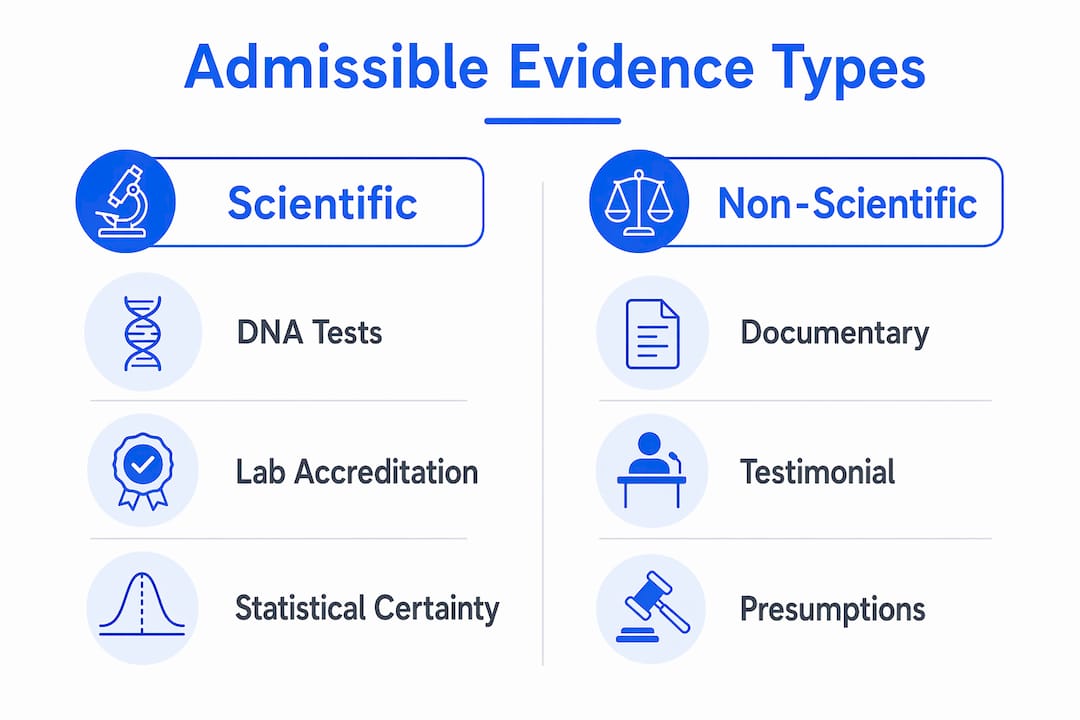
Admissible evidence in paternity cases falls into three primary categories: DNA test results, documentary evidence, and testimonial evidence. Courts treat these categories differently in terms of weight, but all three can contribute to a final determination of paternity.
DNA test results are the most persuasive form of legal paternity evidence. Statistical probabilities from accredited laboratory analysis routinely exceed 99.9%, making DNA the closest thing to certainty available in a courtroom. A result showing 0% probability is equally definitive for excluding paternity.

Documentary evidence covers a broad range of records. Birth certificates, hospital records, signed acknowledgments, financial support records, and written paternity affidavits all qualify as documentary proof. These records supplement DNA results and become especially relevant when DNA testing is unavailable or disputed. A signed Voluntary Acknowledgment of Paternity, for example, carries legal weight in most U.S. states and can establish paternity without a court order. For a broader overview of how DNA testing works and what it proves, USDC's knowledge hub is a useful starting point.
Testimonial evidence includes sworn statements from witnesses who can speak to the relationship between the alleged father and the child's mother during the likely period of conception. Text messages, emails, and financial transaction records that demonstrate an ongoing relationship also fall into this category when properly authenticated. In some cases, testimony about other biological relatives — such as grandparents or siblings — may support or contextualize a paternity claim, which is why kinship DNA testing is increasingly referenced in complex family law proceedings.
| Evidence type | Typical strength | Legal weight |
|---|---|---|
| DNA test results (accredited lab) | Very high | Primary, often determinative |
| Voluntary Acknowledgment of Paternity | High | Legally binding in most states |
| Birth certificate listing father | Moderate | Presumptive, rebuttable |
| Financial support records | Moderate | Corroborative |
| Witness testimony | Variable | Supplementary |
Pro Tip: Collect documentary evidence before requesting a DNA test. Judges require a showing of reasonable possibility of parentage before authorizing court-ordered testing, so having records ready accelerates the process.
What standards ensure DNA paternity test admissibility in court?
Court-admissible DNA paternity tests must meet specific procedural and scientific standards before a judge will accept the results. Meeting those standards is not automatic. The science behind the test and the legal handling of the sample are equally important.
The core requirements for paternity test admissibility include:
- Chain of custody documentation. The DNA sample must be collected by an unrelated, neutral third party. This documented chain of custody confirms who collected the sample, how it was stored, and how it was transferred to the laboratory. Without it, courts have no way to verify that the sample belongs to the person named in the report.
- AABB-accredited laboratory analysis. The laboratory must hold recognized accreditation, such as AABB accreditation, which signals that the facility follows accepted scientific standards for DNA analysis and reporting.
- Minimum probability thresholds. Courts require a statistical probability of at least 95% to 99% to establish paternity, depending on the jurisdiction and the type of proceeding. Administrative actions, such as child support enforcement, typically require the higher 99% threshold. This means a test result just below the threshold may be scientifically accurate but legally insufficient.
- Proper sample collection method. A buccal swab collected at an approved collection site is the standard method. Buccal swab samples collected at home without third-party supervision do not satisfy chain-of-custody requirements.
Home DNA testing kits are generally inadmissible in court because no verified chain of custody exists. The result may be accurate, but a judge cannot confirm the sample was not tampered with or switched. This distinction catches many people off guard. A test purchased at a pharmacy and processed by a reputable lab still fails the legal standard if a neutral third party did not supervise collection.
Pro Tip: Before ordering any DNA test for legal use, confirm that the lab holds AABB accreditation and that sample collection is performed at an approved site by a trained, independent collector. Ask for written confirmation of both before proceeding.
How do courts weigh DNA evidence alongside other paternity evidence?
DNA evidence is treated as extraordinary scientific evidence in paternity proceedings, but it does not automatically override all other considerations. Courts weigh the child's rights carefully before ordering tests, and a DNA result alone does not always resolve every legal question.
Best practice combines DNA results with contextual documentary and witness evidence to build a compelling paternity case. A single piece of evidence, even a 99.9% DNA match, rarely closes a case on its own when other factors are in dispute. Courts prefer a composite approach where multiple evidence types reinforce each other.
Several nuances affect how courts evaluate the full evidentiary picture:
- Refusal to test. When a party refuses a court-ordered DNA test, courts may draw adverse inferences against that party. The refusal itself becomes a form of evidence.
- Legal presumptions. A child born during a marriage is presumed to be the husband's child under most state laws. Signed affidavits and birth during marriage may establish paternity without DNA if supported by convincing documentary or testimonial evidence.
- Established parental bonds. Even a definitive DNA exclusion result does not automatically sever parental rights. Courts consider the best interests of the child and any established emotional or financial bonds when making final determinations.
"Courts prefer a composite approach where DNA evidence is supported by circumstantial and testimonial evidence to establish paternity on a balance of probabilities." — DNA Evidence Without Expert Testimony in Paternity Cases
The practical implication is clear. Building a strong paternity case means assembling a narrative that DNA results confirm, not one that DNA results alone must carry.
Once paternity is legally established, the consequences extend well beyond the courtroom. A legal finding of paternity can trigger enforceable child support obligations, affect custody and visitation arrangements, establish inheritance rights for the child, and determine eligibility for benefits such as Social Security survivor benefits or veterans' benefits. This is why courts treat the evidentiary record so seriously — the stakes reach into nearly every aspect of a family's financial and legal future.
What practical steps should you take to gather admissible paternity evidence?
Gathering legally valid paternity evidence follows a logical sequence. Skipping steps or collecting evidence out of order can delay court proceedings or result in evidence being excluded.
- Compile documentary evidence first. Gather birth certificates, hospital records, financial support records, text messages, and any written acknowledgments of parentage. Courts require reasonable possibility of biological parentage before authorizing a DNA test, so this documentary foundation is not optional.
- Consider a home DNA test for personal clarity first. Before investing in the full legal testing process, many families use an at-home DNA test to confirm the biological relationship for their own knowledge. Home tests are not admissible in court, but they can help you decide whether to proceed with legal testing and how to approach the process. The Child Welfare Information Gateway provides state-by-state guidance on paternity establishment procedures and legal resources.
- Identify an AABB-accredited laboratory. Search for labs that hold recognized accreditation and offer supervised collection at approved sites. Confirm in writing that the lab's results are accepted by courts in your jurisdiction.
- Schedule a supervised collection appointment. Do not collect samples at home for legal purposes. Arrange collection at an approved site where a neutral third party documents the process and maintains the chain of custody from collection through laboratory delivery.
- Maintain all documentation. Keep copies of the chain-of-custody form, the collection appointment confirmation, the laboratory's accreditation certificate, and the final test report. These documents may all be requested during court proceedings.
- Submit results through proper legal channels. Work with a family law attorney or your local child support enforcement office to file the DNA results correctly. Improper submission can delay proceedings even when the results themselves are valid.
- Consult legal counsel early. An attorney familiar with paternity law in your state can identify jurisdiction-specific requirements, such as filing deadlines or specific affidavit formats, that affect admissibility.
Professional legal DNA testing typically costs between $300 and $500 and includes the procedural safeguards courts require. That cost reflects not just the laboratory analysis but the documentation, accreditation, and chain-of-custody procedures that make the result legally usable.
Pro Tip: If urgency is a factor, ask your testing provider about expedited processing. Some accredited labs offer rush paternity results that maintain full chain-of-custody compliance while delivering reports within 24 to 48 hours.
Key takeaways
Admissible paternity evidence requires both scientific accuracy and strict procedural compliance, with DNA results from AABB-accredited labs carrying the greatest legal weight when supported by documentary and testimonial evidence.
| Point | Details |
|---|---|
| DNA is the strongest evidence | Accredited lab results with 99%+ probability are highly persuasive in court proceedings. |
| Procedure determines admissibility | Chain-of-custody documentation and third-party collection are required for DNA results to be accepted. |
| Home kits are inadmissible | At-home DNA tests lack verified chain of custody and are generally rejected by courts — but they remain a valuable first step for personal knowledge before you decide to pursue legal testing. |
| Documentary evidence matters | Birth certificates, affidavits, and financial records support or substitute DNA when needed. |
| Courts weigh evidence collectively | A composite of DNA, documentary, and testimonial evidence produces the strongest legal case. |
| Legal consequences are far-reaching | Established paternity affects child support, custody, inheritance, and government benefit eligibility. |
Why procedural compliance matters more than most people expect
From my experience reviewing how paternity cases unfold, the most common and costly mistake is treating DNA testing as a standalone solution. People order a test, receive a result showing 99.9% probability, and assume the legal question is settled. It rarely is that simple.
Procedural failures such as broken chain of custody or non-accredited labs are the most common reasons DNA evidence gets rejected, despite the underlying science being accurate. I have seen cases where the result was scientifically sound but legally worthless because the sample was collected at home without supervision. The court did not question the biology. It questioned the handling. Accreditation bodies like AABB exist precisely to set the bar for what rigorous, court-ready laboratory science looks like — and courts rely on that standard when deciding whether to trust a result.
The other misunderstanding I encounter regularly is the belief that DNA evidence eliminates the need for supporting documentation. Courts are not just resolving a biological question. They are making legal determinations that affect custody, child support, inheritance rights, and parental obligations. Those determinations require a full evidentiary record, not a single test result.
My advice is to treat the legal process and the scientific process as equally important from the start. Engage a family law attorney before you order any test. Confirm your lab's accreditation. Document every step. The families who navigate paternity proceedings most effectively are the ones who prepare the full evidentiary picture before they walk into a courtroom.
— Todd
Home DNA Testing and Legal Paternity Testing from US Diagnostics Center
When you need answers about paternity, the right starting point depends on your goal. US Diagnostics Center offers home DNA tests for personal knowledge — a private, affordable way to confirm a biological relationship on your own terms. Our home paternity test starts at $79 and analyzes up to 28 genetic markers for a clear, accurate result you can rely on for peace of mind.
Home DNA tests are for personal knowledge only and are not court-admissible. If you need a result that meets legal paternity evidence standards in court, legal DNA testing is Coming Soon at US Diagnostics Center. In the meantime, starting with a home test can help you understand the biology before you engage the legal process.
Visit US Diagnostics Center to explore home DNA testing options and to be notified when legal DNA testing becomes available.
FAQ
What is admissible paternity evidence?
Admissible paternity evidence is any legally accepted proof that establishes or disproves a biological father-child relationship in court, including DNA test results from accredited labs, birth certificates, signed acknowledgments, financial records, and witness testimony.
Are home DNA paternity tests admissible in court?
Home DNA tests are generally inadmissible in court because they lack a verified chain of custody. Courts require that samples be collected by a neutral third party at an approved site to confirm the integrity of the sample. Home tests are still useful for personal knowledge — many people use them to confirm paternity privately before deciding whether to pursue a legal proceeding.
What probability threshold does a DNA test need for court?
Courts typically require a statistical probability of at least 95% to 99% to establish paternity, with administrative proceedings such as child support cases often requiring the higher 99% threshold.
Can paternity be established without a DNA test?
Yes. Legal presumptions such as birth during marriage, signed paternity affidavits, and convincing documentary or testimonial evidence can establish paternity without DNA testing in many jurisdictions.
What happens if someone refuses a court-ordered DNA test?
Refusal to undergo a court-ordered DNA test can lead a judge to draw adverse inferences against the refusing party, effectively treating the refusal as evidence supporting the opposing claim.
What is a Voluntary Acknowledgment of Paternity?
A Voluntary Acknowledgment of Paternity (VAP) is a legal document, typically signed at the hospital after birth or later at a vital records office, in which both parents formally declare who the biological father is. In most U.S. states, a signed VAP carries the same legal weight as a court order establishing paternity and can be used to add the father's name to a birth certificate, establish child support obligations, and confirm parental rights — all without requiring a DNA test or a court proceeding. Once signed and filed, a VAP is very difficult to rescind, making it a serious legal commitment.


0 comments