

TL;DR:
- USCIS uses DNA testing to verify biological relationships when official documents are missing or fraudulent. The process requires testing from accredited labs and results showing at least 99.5% probability to support visa petitions. Positive results help but do not guarantee approval, and timing, proper procedures, and legal requirements critically influence outcomes.
USCIS uses DNA testing for visas as a scientific method to confirm biological relationships when official documents are missing, inconsistent, or suspected of being fraudulent. The process is technically voluntary, but testing is effectively essential when documentary evidence falls short. All tests must come from AABB-accredited laboratories following strict chain-of-custody protocols, and results must show at least a 99.5% probability of the claimed relationship to satisfy USCIS standards. DNA evidence confirms biological ties only, not legal ones, and a positive result supports a petition without guaranteeing approval. Understanding this distinction from the start saves applicants significant time and expense.
How USCIS uses DNA for visas: when and why it requests testing
USCIS requests DNA testing in family-based visa cases when the documentary record cannot reliably establish a biological relationship. DNA fills the evidentiary gap left by missing birth certificates, civil registry records that were never created, or documents that appear inconsistent with other application materials. The agency treats DNA results as highly reliable proof of biological kinship for visa adjudication purposes.

The two most common formal triggers are a Request for Evidence (RFE) and a Notice of Intent to Deny (NOID). Both documents arrive from USCIS or a U.S. consulate and specify what additional evidence the applicant must provide. Receiving one of these notices does not mean the petition has failed. It means the officer needs more proof before making a final decision.
Common scenarios that lead to a DNA testing request include:
- Missing or destroyed civil documents: Birth certificates lost in natural disasters, conflicts, or administrative failures are a frequent cause.
- Inconsistent records: Dates, names, or other details that conflict across documents raise questions about authenticity.
- Suspected document fraud: Officers are trained to identify irregularities that suggest records may have been altered or fabricated.
- No civil registration system: Some countries lack reliable civil registry infrastructure, making original documents unavailable by default.
- Discrepancies in prior immigration filings: Conflicting information across multiple applications can prompt closer scrutiny of claimed relationships.
DNA testing does not apply to every family relationship. USCIS does not use it to verify legal relationships such as adoption or stepchild eligibility. Those situations require legal documentation, not biological evidence. If a petitioner is sponsoring an adopted child, DNA testing will not help and may actually create confusion by confirming the absence of a biological link.
Pro Tip: If you receive an RFE or NOID requesting DNA evidence, read the notice carefully before taking any action. The notice will specify which relationships need verification and which lab or process to follow.
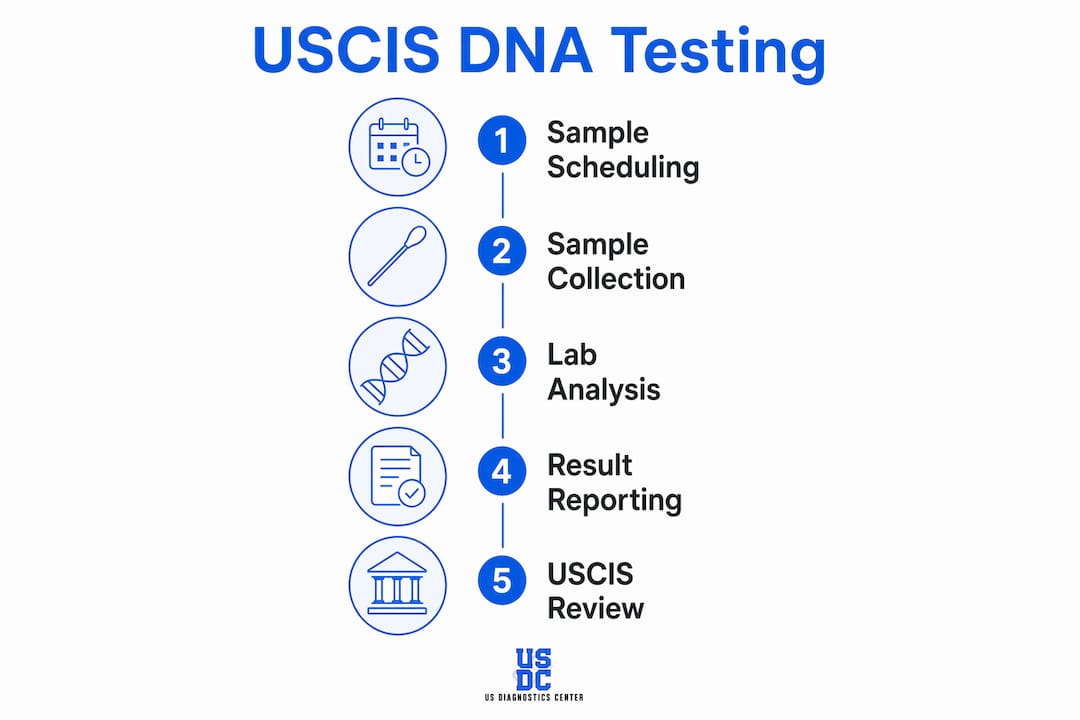
What is the USCIS DNA testing process for visa applicants?
The USCIS DNA testing process follows a defined sequence designed to protect the integrity of the evidence from sample collection through final reporting. All immigration DNA tests must be conducted by AABB-accredited laboratories following strict chain-of-custody procedures. Understanding what AABB accreditation means for a laboratory helps applicants confirm they are using a facility that meets federal evidentiary standards.
The process unfolds in the following steps:
- Receive official notice. Wait for a formal RFE, NOID, or consular letter before contacting any laboratory. The notice will identify the authorized lab or provide instructions for selecting one.
- Contact an authorized lab. Not all AABB-accredited labs are automatically acceptable for a specific case. The official notice specifies which labs are approved for that consulate or USCIS office.
- Schedule sample collection. The petitioner in the U.S. and the beneficiary abroad each visit a designated collection site. Both parties must appear in person.
- Bring required identification. Applicants must present a government-issued photo ID, passport-style photos, and original birth certificates for minor children. These documents are required at the collection site to verify identity before samples are taken.
- Provide a buccal swab sample. A trained collector takes a cheek swab from each participant. The sample is sealed, labeled, and logged under chain-of-custody protocols immediately.
- Lab analyzes the samples. The laboratory compares genetic markers from both parties. Lab processing typically takes 3–7 business days.
- Results go directly to USCIS or the consulate. Results are transmitted from the lab to the government agency. Applicants do not handle or deliver the results themselves. This direct transmission is what maintains evidentiary integrity.
- USCIS reviews results alongside the full application. Officers consider DNA findings as one component of the overall petition, not as a standalone determination.
The total timeline from sample collection through final reporting typically runs 3–8 weeks, depending on the lab, the consulate’s workload, and whether any follow-up is needed.
| Stage | Typical Duration |
|---|---|
| Sample collection scheduling | 1–2 weeks |
| Lab analysis | 3–7 business days |
| Results transmission to USCIS | 1–3 business days |
| USCIS review and response | Varies by case |
Pro Tip: Confirm the chain-of-custody procedures with the lab before your appointment. Any break in the custody record, even a minor one, can invalidate the entire sample.
How does USCIS interpret DNA test results for visa decisions?
USCIS evaluates DNA results against a specific evidentiary threshold. A result showing a 99.5% or higher probability of the claimed biological relationship meets the standard for acceptance. Results below that threshold do not automatically cause denial, but they weaken the petition significantly and require additional supporting evidence.
USCIS and consular officers receive specific training on interpreting DNA reports. They understand that probability statistics reflect population-level comparisons, not absolute certainty, and they evaluate results in the context of the full application record. A positive DNA result is strong evidence, but it is not the final word.
“A positive DNA test supports a visa petition but does not guarantee approval. USCIS officers weigh DNA results alongside all other eligibility criteria, including immigration history, financial sponsorship, and the legal basis for the relationship claimed.”
The type of relationship being tested affects how reliable the result will be:
- Parent-child tests are the most definitive. They produce clear probability statistics and almost always meet the 99.5% threshold when the relationship is genuine.
- Sibling tests are less conclusive. Sibling DNA tests can fall below 99.5% even when the relationship is real, because siblings share only a portion of their DNA. USCIS expects supplemental evidence in these cases.
- Grandparent-grandchild tests are accepted by USCIS and can be useful when a parent is unavailable for testing. Results are less definitive than parent-child tests but still carry significant weight.
- Cousin or distant kinship tests are generally not suggested by USCIS and carry limited evidentiary value in visa adjudication.
Negative or inconclusive results do not automatically end a petition. Negative results severely weaken the case by removing the strongest available scientific proof, but applicants can still pursue approval through other documentary evidence. That path is significantly harder and less predictable.
DNA testing also cannot establish legal relationships. A test confirming that a petitioner and a child share no biological connection does not affect an adoption, but it does confirm the adoption paperwork must carry the full evidentiary burden. Legal DNA tests used in immigration contexts are specifically structured to meet chain-of-custody and accreditation requirements that home-use kits do not satisfy.
Common misconceptions about DNA testing in the immigration process
The most costly mistake applicants make is ordering a DNA test before receiving an official request. Independent or proactive testing conducted before an RFE or consular letter arrives is almost always rejected. The reason is straightforward: chain-of-custody protocols require that the collection process be initiated under official authorization. A test taken outside that framework has no verified chain of custody and carries no evidentiary weight with USCIS.
Several other misconceptions regularly delay or damage petitions:
- “Any AABB-accredited lab will work.” This is false. Applicants must use labs specifically authorized by the USCIS office or consulate handling their case. The official notice will identify acceptable labs or provide instructions for finding them.
- “A positive result means the visa is approved.” DNA evidence is one factor among many. USCIS considers financial sponsorship, immigration history, and the legal basis of the petition alongside any DNA findings.
- “The government pays for the test.” All testing costs are paid by the petitioner or beneficiary. There is no government fee waiver for immigration DNA testing.
- “DNA testing works for adoptions.” DNA testing establishes biological relationships only. For adoptions and stepchild eligibility, legal documentation is the required evidence, and a DNA test confirming no biological link can actually complicate an adoption-based petition if not properly contextualized.
- “Home DNA test kits are acceptable.” Home kits do not follow chain-of-custody protocols and are not conducted by authorized collectors. USCIS will not accept results from home-use kits regardless of the lab’s accreditation status.
Pro Tip: Keep a copy of every official notice you receive from USCIS or the consulate. The notice contains the specific lab authorization instructions and the deadline for submitting results. Missing that deadline can require restarting the process.
Applicants navigating complex immigration document requirements may also find it useful to understand how other official verification processes work. The FBI background check apostille process follows similarly strict chain-of-custody and authentication standards, which illustrates how U.S. government agencies consistently require verified, tamper-proof documentation for immigration-related decisions.
Key takeaways
USCIS DNA testing for visas requires AABB-accredited labs, a 99.5% probability threshold, and direct result transmission to the agency, with positive results supporting but never guaranteeing visa approval.
| Point | Details |
|---|---|
| DNA testing is voluntary but critical | Without it, petitions lacking documentary proof face a high risk of denial. |
| Wait for official authorization | Testing before an RFE or consular letter invalidates results due to chain-of-custody violations. |
| 99.5% probability is the threshold | Results below this level require supplemental evidence to support the claimed relationship. |
| DNA confirms biology, not legal status | Adoptions and stepchild eligibility require legal documents, not biological test results. |
| Positive results do not guarantee approval | USCIS weighs DNA findings alongside financial, legal, and immigration history criteria. |
What I’ve learned from watching families navigate USCIS DNA requests
The part that surprises most applicants is how much the process depends on timing. Families who act quickly after receiving an RFE, contact the right lab, and submit results within the deadline almost always move forward without additional complications. Families who try to get ahead of the process by ordering tests early end up starting over, paying twice, and losing weeks or months.
The second thing I’d emphasize is the sibling test limitation. Many petitioners assume that if the relationship is real, the test will prove it conclusively. That is not how sibling DNA works. Siblings share roughly 50% of their DNA on average, but the actual overlap varies, and some genuine siblings produce results that fall below the 99.5% threshold. If you are sponsoring a sibling, prepare supplemental evidence before the test comes back, not after.
The third observation is about expectations after a positive result. Families sometimes treat a positive DNA test as the finish line. It is not. USCIS still evaluates the full petition. A petitioner with an unresolved immigration violation or an incomplete financial sponsorship package will not receive approval based on DNA evidence alone. The test removes one obstacle. The rest of the application still has to stand on its own.
— Todd
DNA testing resources for your visa application
Navigating USCIS DNA requirements is easier when you understand exactly what type of test your case calls for and what standards it must meet.
US Diagnostics Center offers home DNA testing for personal knowledge. Legal DNA test kits are Coming Soon. and provides detailed guidance on test types, chain-of-custody requirements, and what to expect from the process. If you are preparing for a USCIS DNA request or want to understand your options before one arrives, the US Diagnostics Center kinship testing resource covers the full range of relationship tests accepted in immigration contexts. Results are available within 2–3 business days of lab processing, with expedited options for time-sensitive cases.
FAQ
What triggers a USCIS DNA testing request?
USCIS requests DNA testing when official documents like birth certificates are missing, inconsistent, or suspected of being fraudulent. The formal trigger is typically a Request for Evidence or a Notice of Intent to Deny.
Can I order a DNA test before USCIS asks for one?
No. Testing before receiving an official RFE or consular letter violates chain-of-custody protocols and will result in rejected results. Always wait for the official notice before contacting a lab.
What probability does a DNA test need to show for USCIS to accept it?
USCIS requires a result showing at least a 99.5% probability of the claimed biological relationship. Results below that threshold require additional supporting evidence and do not automatically satisfy the evidentiary standard.
Does a positive DNA test guarantee visa approval?
A positive result supports the petition but does not guarantee approval. USCIS evaluates DNA findings alongside financial sponsorship, immigration history, and the legal basis of the claimed relationship.
Can DNA testing prove an adoption for immigration purposes?
No. DNA testing establishes biological relationships only. Adoptions and stepchild eligibility require legal documentation. A DNA test confirming no biological link does not help an adoption-based petition and may complicate it if not properly explained.
Recommended
- Immigration DNA Profile Test | AABB Required | Coming Soon | USDC
- Immigration Full Sibling DNA Test | AABB Required | Coming Soon | USDC
- Immigration Sibling DNA Test | AABB Required | Coming Soon | USDC
This article is part of our Paternity Testing: The Complete Guide guide.


0 comments