

Grandparentage, avuncular, and full or half sibling tests can support or exclude a biological relationship when a parent is missing, but every one of them produces a statistical estimate, not a direct match. Testing the closest available relatives yields the strongest evidence, and labs that analyze up to 28 markers reduce the odds of a murky result. This article covers at-home kinship testing for personal and family use, not immigration or legal testing.
TL;DR:
- Testing two grandparents on the correct side of the family provides more statistical power than testing only one, especially when direct testing isn’t possible.
- Using up to 28 markers in the kit significantly reduces the likelihood of inconclusive results for indirect kinship tests compared to panels with fewer markers.
- An inconclusive outcome often indicates low statistical power or distant relationships rather than the absence of a biological link.
- For legal or immigration purposes, at-home tests lack the documented chain of custody required, and results should be used only as a preliminary understanding.
- Drawing a detailed family tree and consulting with the lab beforehand can greatly increase the chances of obtaining a clear, definitive result.
Table of Contents
- Which Kinship Tests Exist and When Should You Choose Them?
- Who Should You Test First?
- How Should You Read Your Results?
- How Do You Order the Right Kit and Collect a Good Sample?
- What If Your Test Comes Back Inconclusive?
- What Are the Legal Implications of Using These Tests to Prove a Relationship?
- How Do You Use DNA Results in Immigration Applications or Court Cases?
- What Disputes Come Up Around Missing-Parent DNA Tests in Immigration Cases?
- How Do You Choose an Accredited Lab for This Kind of Testing?
- What Privacy and Consent Rules Apply When You Test Someone Else?
- A Short Note on Planning Before You Test
- How US Diagnostics Center Can Help You Get Answers
- Sources
- FAQ
Which Kinship Tests Exist and When Should You Choose Them?
Four test types cover most missing-parent situations, and picking the right one depends entirely on who is available to swab.
- Grandparentage tests compare a child to one or both biological grandparents on the parent’s side. This is the go-to option when the missing parent’s own parents are living and willing to test.
- Avuncular tests compare a child to an aunt or uncle, meaning a sibling of the missing parent. Families use this when grandparents have passed away but the missing parent had a brother or sister.
- Full sibling tests compare two people who may share both biological parents.
- Half sibling tests compare two people who may share only one parent, common when a missing parent had children with more than one partner.
The math behind these tests matters more than most people realize. Full siblings share roughly 50% of their DNA on average, the same expected overlap as a parent and child, according to genetics instructional material from the University of Washington. That drop from 50% to 25% is exactly why indirect tests carry more uncertainty than a direct parent-child comparison. Side of family matters too. A grandparent test only answers questions about the lineage it actually traces, so testing a grandparent on the wrong side won’t resolve anything, and in some family reconstructions, mitochondrial DNA (maternal line) or Y-STR analysis (paternal line) becomes relevant for confirming which branch of the family a sample belongs to.
Who Should You Test First?
Start with whoever shares the most DNA with the missing parent, then work outward. The FBI Laboratory’s guidance on kinship analysis confirms that first-degree relatives provide stronger evidence than second-degree relatives, and labs need an accurate proposed relationship to interpret results correctly in the first place.
- Test first-degree relatives if any are available. A known child, a known parent, or a full sibling of the missing parent gives the clearest signal.
- If no first-degree relative can test, aim for both biological grandparents. Two grandparents on the correct side of the family provide far more statistical power than one.
- If grandparents aren’t available, build a family reconstruction. Combine samples from multiple known relatives, such as two or three aunts and uncles, to strengthen the overall picture.
- Test both sides of the family when you can. Even a single relative from the “other” parent’s side helps the lab rule out shared ancestry noise.
Pro Tip: Before you order anything, sketch a simple family tree on paper and mark who is living, who is willing to swab, and which side of the family each person belongs to. Labs use this pedigree to choose the right statistical model, and a clear diagram often prevents a delayed or inconclusive result.
How Should You Read Your Results?
Kinship results come back as a probability, not a yes-or-no verdict. Labs typically report a statistical likelihood that compares how probable the DNA patterns are if the people are related as claimed versus unrelated, with higher values supporting the relationship and lower ones indicating exclusion. Neither is as absolute as a direct parent-child test, and the Department of State’s own guidance notes that indirect tests are evaluated statistically and don’t always reach the same certainty as direct testing.
Several factors can pull that certainty down:
- Fewer markers analyzed, which limits how much genetic data the lab has to work with.
- A more distant relationship, since avuncular and grandparent pairs already share less DNA than parent-child pairs.
- Population admixture, where shared ancestry within an ethnic group can blur the statistical picture for relatedness-inference methods that rely on distinguishing family-specific DNA sharing from broader population patterns.
Testing up to 28 markers, instead of a lower-marker panel, gives the statistical model more data points to work with and can meaningfully cut down on inconclusive outcomes in indirect relationship testing. If your report comes back murky, call the lab and ask directly whether adding another relative would change the conclusion.
How Do You Order the Right Kit and Collect a Good Sample?
Match the kit to the actual relationship you’re testing, not the relationship you wish you could test. A kinship testing overview can help you confirm which kit fits your situation, whether that’s sibling, grandparent, or aunt/uncle. Check that the kit you choose analyzes up to 28 markers, since that marker count matters more here than it does for a straightforward paternity case.
- Avoid eating, drinking, or smoking for at least 30 minutes before swabbing. Food residue and drink acidity can weaken the sample.
- Swab the inside of the cheek firmly for the time specified in your kit instructions, usually about 30 to 60 seconds per swab.
- Label each swab clearly with the correct person’s name before sealing it, especially when multiple relatives are testing at once.
- Package everything in the provided kit materials and use the prepaid return envelope to send samples back.
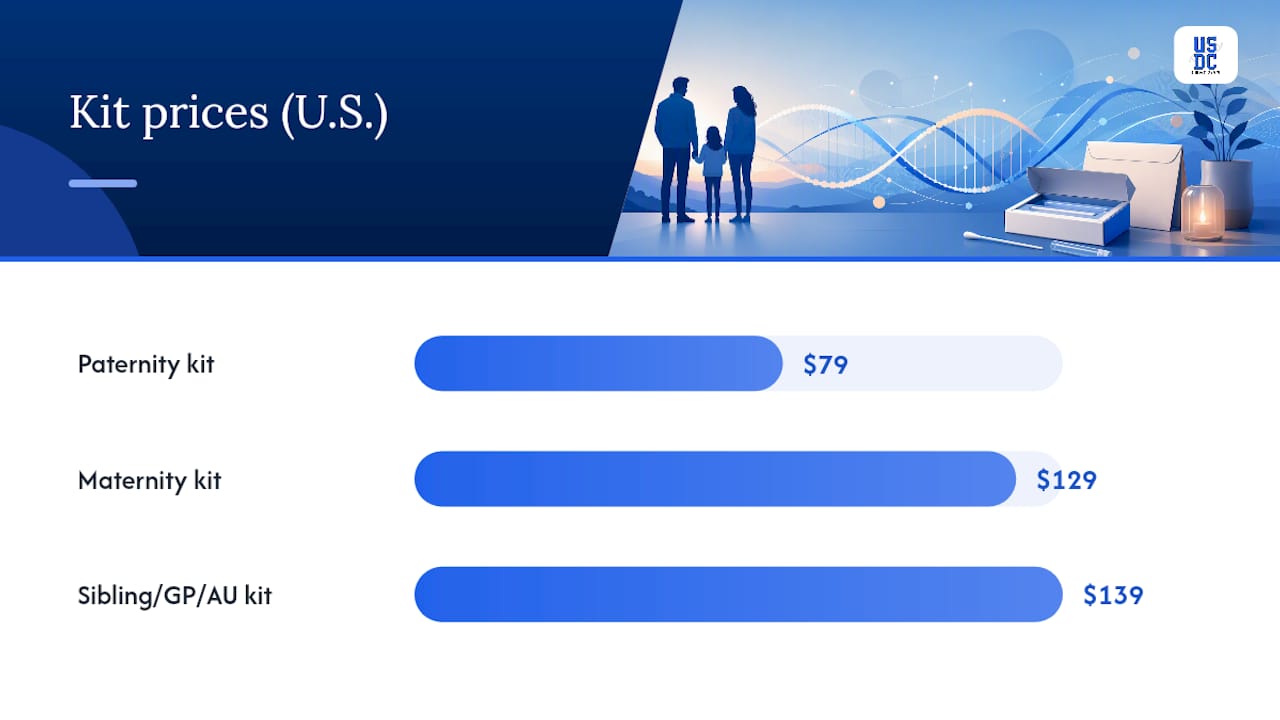
Lab processing typically takes 2 to 3 business days after your sample arrives, with standard order-to-results averaging 7 to 10 business days; expedited options are available if you need answers faster. On pricing, a home paternity kit runs $79, a maternity kit runs $129, and sibling, grandparent, or aunt/uncle kits run $139 each.
Pro Tip: If two relatives live in different states, order both kits at the same time and ship them together when possible. Staggered arrivals can add days to your total timeline without adding any accuracy.
What If Your Test Comes Back Inconclusive?
An inconclusive result doesn’t mean the two people aren’t related. It often means the statistical evidence wasn’t strong enough to land confidently on either side. This happens more with distant relationships and fewer markers, and a University of Washington teaching resource makes the point directly: a “no conclusion” outcome usually reflects low statistical power, not proof of no relationship.
A few practical moves can push a murky case toward clarity:
- Add another relative to the analysis, ideally one from the same side of the family.
- Ask the lab whether an expanded marker panel is available for your test type.
- Request family reconstruction analysis if you have several relatives willing to participate.
- Ask for an interpretive review from the lab’s staff before assuming the worst.
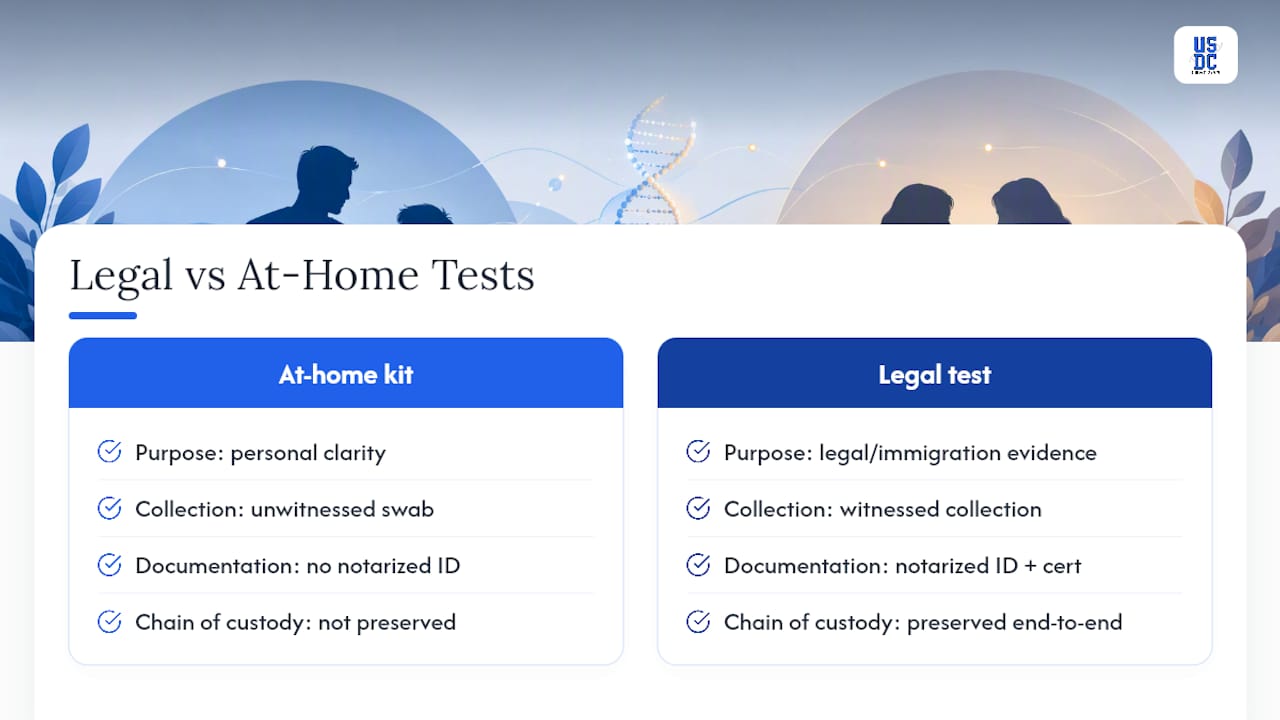
If you need the result for a legal or immigration proceeding, this is where the path diverges. Chain-of-custody legal testing follows different collection and documentation rules than at-home kits, and that process falls outside what this article covers.
What Are the Legal Implications of Using These Tests to Prove a Relationship?
At-home kinship tests were built for personal clarity, not legal or immigration proceedings, and that distinction has real consequences. A standard at-home cheek swab kit, collected without a witnessed chain of custody, generally won’t satisfy the evidentiary standards that courts or federal agencies require. The 8 FAM guidance from the Department of State is explicit that indirect kinship tests are treated as likelihood-based evidence, which is a different legal weight than a direct, chain-of-custody parentage test.
That gap matters most when a missing parent can’t be tested directly and a family turns to grandparents or siblings instead. The science behind the test doesn’t change based on its intended use, but the documentation around it does. A legal or immigration case typically requires notarized identification, a witnessed collection process, and a laboratory willing to certify that the sample never left a controlled chain of custody from swab to report. None of that is part of a standard at-home kit, and using one in place of a properly documented legal test can create real setbacks, including a rejected application or a case sent back for redoing the entire testing process with a different provider. If your situation may end up in front of an immigration officer, a judge, or an attorney, treat your at-home kinship results as a starting point for your own understanding, not as your final piece of evidence. If your situation is headed to court or immigration, speak with an attorney about which testing path meets the applicable evidentiary standard, and work with a lab specifically credentialed for that use before ordering anything.
How Do You Use DNA Results in Immigration Applications or Court Cases?
The short answer: you generally don’t use an at-home kinship result directly in these settings, because the agencies and courts involved typically require testing that follows a specific, documented process from start to finish. Immigration applications and court cases both depend on results that can be traced, verified, and defended if challenged, which is a fundamentally different standard than a kit ordered for personal peace of mind.
If your case involves proving a relationship for a legal or immigration purpose, the practical move is to ask the relevant agency or your attorney what specific documentation and testing standard they require before you spend money on any kit. Requirements can vary depending on the type of application and the relationship being proven, so a generic answer rarely fits every situation. What an at-home kinship test can do in this context is help your family understand the underlying biological relationships before you commit to a formal, documented process. Knowing that a grandparent test already suggests a strong relationship, for example, can help you and your attorney decide how to proceed with the properly documented version of that same question. Think of the at-home result as private information for your own planning, not as a substitute for whatever the receiving agency or court actually requires.
What Disputes Come Up Around Missing-Parent DNA Tests in Immigration Cases?
Disputes tend to cluster around three points: who counts as an acceptable substitute relative, how strong the statistical evidence needs to be, and whether the sample collection method meets the required standard. When a parent is genuinely unavailable, deceased, or unreachable, families often assume any willing relative can step in for testing. In practice, the acceptable substitute and the strength of evidence required both depend heavily on the specific case and the agency reviewing it.
A second common friction point is the gap between a “supportive” statistical result and a “conclusive” one. Families sometimes submit an avuncular or grandparent result expecting it to carry the same weight as a direct parent-child match, not realizing the Department of State’s own framework treats these as likelihood-based rather than definitive. That mismatch between expectation and actual evidentiary weight causes real delays.
The third source of dispute is documentation. A sample collected without a witnessed process, proper identification, and an unbroken chain of custody can be challenged regardless of how strong the underlying statistical result looks. If you anticipate any of these friction points, raise them with an attorney or the relevant agency before you test, not after you’ve already submitted a result that gets questioned.
How Do You Choose an Accredited Lab for This Kind of Testing?
If your situation requires legal or immigration-grade testing, accreditation is not optional. Look specifically for a laboratory accredited to perform relationship testing under recognized industry standards, and confirm that accreditation covers the exact test type you need, since not every accredited lab offers every kinship test. Ask the lab directly whether their process includes a witnessed collection, verified photo identification, and a documented chain of custody from the moment of collection through the final report.
It’s worth being direct about scope. US Diagnostics Center’s home DNA tests are built for personal, non-legal kinship questions like sibling, grandparent, and aunt/uncle relationships. For anything headed toward a government agency or a courtroom, accreditation and legal-testing credentials matter enormously, and you should confirm those directly with any lab you consider before submitting any sample for that purpose. A general primer on DNA testing options can help you understand the broader landscape of providers and what questions to ask before you commit to one.
What Privacy and Consent Rules Apply When You Test Someone Else?
Testing a relative isn’t the same as testing yourself, and that distinction carries real weight. Every adult who provides a sample should give informed consent, meaning they understand what the test checks, who will see the results, and how long the lab keeps their genetic data on file. This matters even more in a missing-parent scenario, where you may be asking a grandparent, aunt, or uncle to participate in a process tied to a sensitive family situation they didn’t create.
Minors present an added layer. A parent or legal guardian typically provides consent on a child’s behalf, but that authority should rest with someone who actually has legal standing to make that decision, not simply whoever is present at swab time. Before you loop a relative into testing, tell them plainly what you’re trying to find out and what you’ll do with the result, whether that’s private family clarity or a first step toward something more formal like a legal case. The ASHG’s guidance on analyzing DNA also cautions that consumer-grade ancestry kits are built for a different purpose than kinship confirmation, so make sure everyone testing understands they’re participating in a relationship test, not a general ancestry survey. Respecting that boundary keeps the process honest for everyone involved, especially relatives who may be revisiting a painful family gap by agreeing to test at all.
A Short Note on Planning Before You Test
Most of the frustration I see with kinship testing traces back to one thing: families order a kit before they’ve mapped out who’s actually available to test. Draw the pedigree first. Note which relatives are on the maternal side versus the paternal side, and write down who is living, willing, and reachable. That fifteen-minute exercise does more for your odds of a clear result than almost anything else you can control.
Call the lab’s support line before you order, too. Describe your exact situation and ask what marker count and relationship model they’d recommend. A five-minute conversation before you swab can save you weeks of waiting on a result that turns out inconclusive simply because the wrong relative got tested first.
Checklist for today: draw the family tree, mark maternal and paternal sides, list who’s available, and call before you order.
— Dr. Todd Lewis
How US Diagnostics Center Can Help You Get Answers
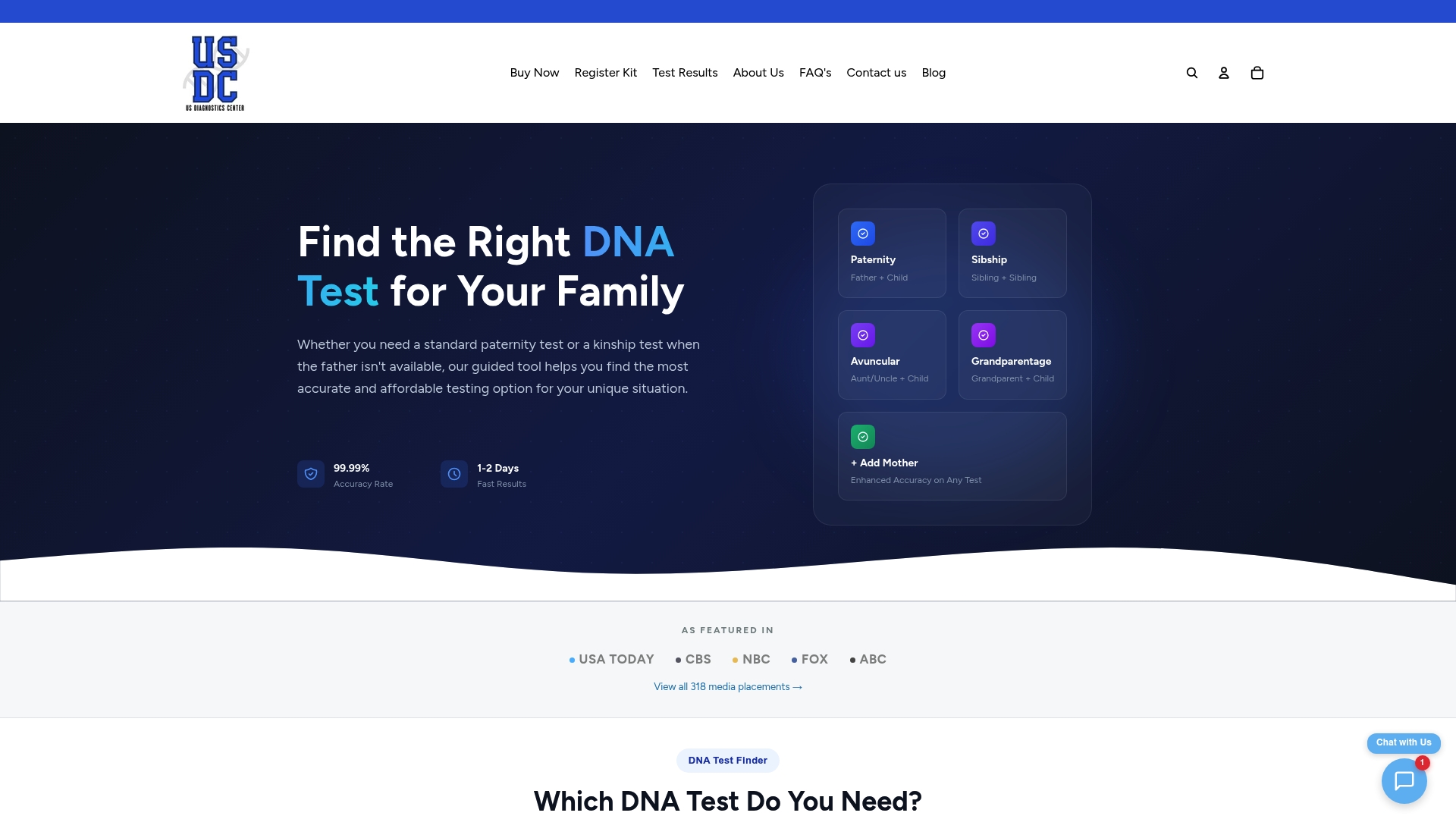
US Diagnostics Center offers a straightforward path when a parent is missing and you need real answers, not another confusing form. Its home DNA test collection includes sibling, grandparentage, and aunt/uncle kits, each analyzing up to 28 markers to give the statistical model more to work with than a lower-marker panel would.
Lab processing typically takes 2 to 3 business days once your sample arrives, with standard order-to-results averaging 7 to 10 business days. Expedited options are sometimes available. Kits generally include a prepaid return envelope for sample shipping. Pricing details are available on the provider’s website.
For questions that will go to a court or immigration authority, work with a lab specifically credentialed for that purpose. A Test Finder tool is available to help select the appropriate kit for family kinship questions.
Sources
- FBI Laboratory DCU case acceptance guidance
- 8 FAM 304.2 DNA testing and citizenship
- University of Washington — genetics instructional materials
FAQ
Can a Sibling DNA Test Replace a Missing Parent’s Test?
A sibling test can support or exclude a family relationship, since full siblings share about 50% of their DNA on average, the same as a parent-child pair, according to University of Washington genetics materials. It’s still a statistical estimate, not a direct match to the missing parent.
How Many Markers Do I Need for an Accurate Grandparent Test?
Look for a kit that analyzes up to 28 markers, since more markers give the statistical model more data and reduce the chance of an inconclusive result. Lower-marker panels work fine for direct paternity but leave more uncertainty on indirect kinship tests.
What Does US Diagnostics Center Charge for a Grandparent or Sibling Test?
Sibling, grandparent, and aunt/uncle kits from US Diagnostics Center each cost $139, while a home paternity kit costs $79 and a maternity kit costs $129. Every kit ships with a prepaid return envelope included.
How Long Does an At-Home Kinship Test Take?
Lab processing typically takes 2 to 3 business days once your sample arrives, and standard order-to-results averages 7 to 10 business days. Expedited processing is available for families who need faster answers.
Can I Use an At-Home Kinship Test for an Immigration Case?
At-home kinship kits are built for personal family clarity, not for immigration or court proceedings, which typically require witnessed collection and a documented chain of custody. If you need results for an immigration application, speak with an attorney or the relevant agency about which specific legal testing process meets their requirements.
Recommended
- Best Grandparent DNA Test When Father Is Unavailable (2026)
- Paternity Test When Possible Fathers Are Related (2026)
- DNA Profiling: How Genetic Markers Confirm Family Relationships
- 28 Genetic Markers on a Paternity Test: 6 Facts
This article is part of our Paternity Testing: The Complete Guide and Kinship DNA Testing: Sibling, Grandparent, and Family Relationship Tests guides.


0 comments