

Paternity test confidentiality is defined as the legal and procedural protection of genetic information collected during DNA testing, limiting access to authorized parties only. Understanding paternity test confidentiality explained in full means knowing that two distinct testing categories exist: private home tests and court-admissible legal tests. Each carries different privacy protections, different costs, and different legal consequences. The American Pregnancy Association confirms that lab confidentiality standards vary widely across providers, which means the privacy you receive depends heavily on which lab you choose and which test type you order.
How do private and legal paternity tests differ in confidentiality?
Private and legal paternity tests protect your data in fundamentally different ways. Understanding that difference is the first step toward choosing the right test for your situation.
Private home tests: strong privacy, no legal weight
Private at-home paternity tests are designed to protect your identity from the start. Labs typically assign barcode identifiers to samples rather than recording names, and many allow alias registration so your legal name never appears in the system. Home DNA tests of this type give you results without creating a paper trail tied to your identity.

The trade-off is significant. Anonymous test results hold no legal weight because no neutral third party verifies the sample source. No chain of custody exists, so the results cannot be submitted to a court. If your situation ever becomes a legal matter, a private test result will not help you.
Legal tests: verified identity, public record risk
Legal paternity tests require identity verification, witnessed sample collection, and a documented chain of custody. These procedures confirm that the sample came from the person named in the test. The chain of custody process protects sample authenticity and gives the result legal validity.
The privacy cost is real. Once a legal test result is submitted to a court, results become public record and confidentiality is lost at that stage. Any person with access to court filings can view the outcome. This is a critical distinction that many people overlook when ordering a test.
Side-by-side comparison
| Feature | Private home test | Legal court-admissible test |
|---|---|---|
| Identity protection | Barcode or alias registration | Full ID verification required |
| Chain of custody | Not required | Mandatory |
| Results confidentiality | High, within the lab | Lost upon court submission |
| Legal admissibility | No | Yes |
| Typical cost range | $190–$380 | $380–$760 |
| Best use | Personal peace of mind | Child support, custody, immigration |
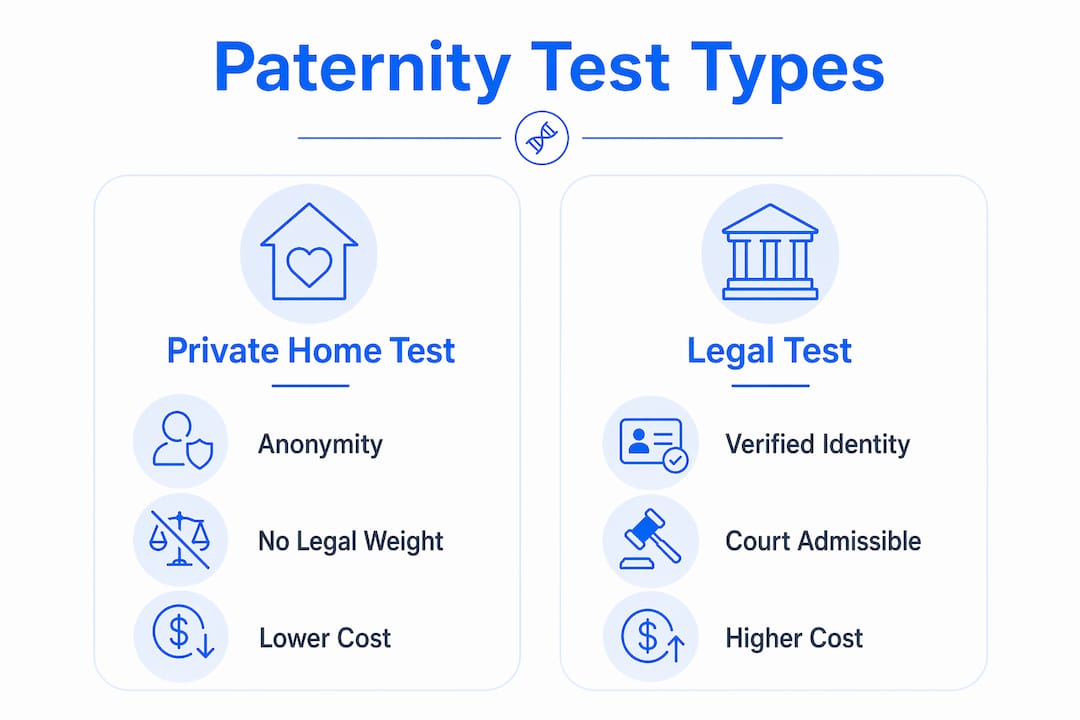
Private tests cost $190–$380 while legal tests cost $380–$760. That price gap reflects the added procedural requirements, not just the lab work.
What security protocols do DNA labs use to protect your data?
Most reputable laboratories maintain strict internal confidentiality protocols, but industry standards are not uniform across all providers. That variability means you cannot assume every lab handles your genetic data the same way.
Common security measures used by established labs include:
- Data encryption: Genetic profiles and personal records are stored in encrypted databases with restricted access.
- Sample anonymization: Barcodes replace names on physical samples, reducing the risk of identity exposure during processing.
- Limited staff access: Only authorized personnel handle samples and view associated records.
- Secure result delivery: Results are transmitted through password-protected portals or sealed physical documents.
- Data retention policies: Reputable labs define how long they store your genetic data and whether they share it with third parties.
The absence of a universal regulatory standard makes individual verification necessary. Contact the lab directly before ordering and ask for their written privacy policy. Ask specifically whether they sell or share genetic data with research institutions or commercial partners. Some labs do, and the answer may change your decision.
Pro Tip: Confirm that your chosen lab holds AABB accreditation before submitting any sample. AABB-accredited labs meet independently verified standards for both accuracy and data handling, giving you a concrete benchmark rather than a marketing claim.
When can paternity test confidentiality be legally overridden?
Confidentiality in paternity testing is not absolute. Courts have the authority to override privacy protections when a child’s legal interests are at stake.
The following circumstances commonly lead to a loss of confidentiality:
- Court-ordered testing: A judge can compel a paternity test in child support, custody, or inheritance proceedings. The results become part of the court record.
- Contested paternity litigation: When paternity is disputed in a legal proceeding, both parties may lose control over how results are disclosed.
- Child welfare determinations: Courts prioritize a child’s right to know their biological parentage when making welfare decisions.
- Estate and inheritance disputes: Probate courts can order DNA testing to establish biological relationships for inheritance purposes.
- Immigration proceedings: Federal agencies may require court-admissible DNA results, removing the option of private testing entirely.
The legal framework governing these situations shifted significantly with recent Supreme Court rulings. The right to privacy regarding DNA testing is not absolute and can be outweighed by a child’s legitimate interest in knowing their biological parentage. That ruling reflects a broader judicial trend favoring truth-seeking over individual privacy when children’s rights are involved.
Courts do not ignore privacy entirely. Judges weigh social stigma and privacy harms when ordering DNA tests, and they apply a balance-of-interests standard. However, when evidence of biological parentage is lacking and a child’s welfare depends on establishing it, privacy interests regularly yield.
Important: Submitting another person’s DNA without their consent is a criminal offense in several U.S. states, including Florida. Lab confidentiality policies do not protect you from criminal liability for unauthorized sampling. Consent is a legal requirement, not just an ethical preference.
The practical implication is clear. If you anticipate that your paternity question may ever enter a legal proceeding, plan for the possibility that your results will become accessible beyond the lab’s walls.
How should you protect your privacy when using a paternity test?
Protecting your privacy during paternity testing requires deliberate choices at every stage, from selecting a lab to storing your results.
- Choose an accredited lab. AABB-accredited providers meet verified standards for both accuracy and data security. Accreditation is publicly searchable and verifiable.
- Understand the limits of anonymous testing. Anonymous DNA tests cannot be used in court. If there is any chance your situation becomes legal, an anonymous test may waste time and money.
- Get written consent from all parties. Collecting a DNA sample from another person without their knowledge is a criminal offense in multiple jurisdictions. Document consent before collection.
- Store results securely. Physical documents should be kept in a locked location. Digital results should be stored in password-protected files, not in shared cloud folders.
- Limit who you tell. Results shared verbally or digitally can spread beyond your control. Treat paternity results with the same discretion as medical records.
- Read the lab’s data retention policy. Some labs retain genetic profiles for years. Know how long your data stays in their system and whether you can request deletion.
Pro Tip: If you intend to use results in a legal proceeding, order a legal paternity test from the start and document the chain of custody at every step. Attempting to convert a private test result into legal evidence after the fact is not possible.
Secure paternity testing also means choosing a provider whose privacy practices you can verify, not just trust. Ask for documentation, not assurances.
Key takeaways
Paternity test confidentiality depends on the test type you choose, the lab’s security protocols, and whether your results ever enter a legal proceeding.
| Point | Details |
|---|---|
| Test type determines privacy | Private tests offer stronger anonymity; legal tests lose confidentiality once filed in court. |
| Lab standards vary | Verify AABB accreditation and request written privacy policies before submitting any sample. |
| Courts can override privacy | Supreme Court rulings confirm a child’s right to know parentage can outweigh individual privacy. |
| Consent is legally required | Collecting another person’s DNA without consent is a criminal offense in several U.S. states. |
| Chain of custody matters | Legal tests require documented chain of custody; without it, results carry no legal validity. |
Privacy, legal reality, and what I’ve learned from years in this space
Todd’s perspective:
The most common mistake I see is people treating paternity test privacy as binary. They assume a test is either completely private or completely public. The reality is more nuanced, and that nuance has real consequences.
Private tests offer genuine confidentiality within the lab. But the moment a personal situation becomes a legal dispute, that privacy can evaporate. I have seen people order home tests for peace of mind, then find themselves in a custody proceeding where those results are useless and a new court-ordered test is required anyway.
The legal trend in 2026 is clear. Courts are increasingly willing to prioritize a child’s right to know their biological parentage over an adult’s privacy preference. That is not a criticism of the legal system. It reflects a legitimate balancing of competing rights. But it does mean that anyone entering a paternity dispute should plan for the possibility that their genetic information will become part of a public record.
My practical advice: decide upfront whether your question is personal or legal. If it is personal, a private test from an accredited lab gives you reliable, confidential results. If there is any legal dimension at all, order a court-admissible test from the start and follow chain-of-custody procedures exactly. Switching tracks midway costs time, money, and sometimes the case itself.
Choosing a provider is the single most reliable way to verify that a lab’s privacy and accuracy claims are independently backed. Marketing language is not a substitute for that credential.
— Todd
US Diagnostics Center: confidential and court-ready paternity testing
US Diagnostics Center offers home DNA testing for personal knowledge. Court-admissible testing requires a separate legal test with witnessed collection and documented chain of custody.com" target="_blank" rel="noopener">paternity testing options backing every result. Their guided selection tool matches you to the right test based on your specific situation, whether you need personal clarity or legally valid documentation.
Results are delivered within 2–3 business days, with expedited options available for urgent needs. US Diagnostics Center’s legal DNA tests follow full chain-of-custody procedures, and their home kits use barcode-based anonymization to protect your identity throughout the process. Every test delivers 99.99% accuracy. If you need to understand your options before ordering, their complete paternity testing guide covers every scenario in plain language.
FAQ
Are paternity tests confidential?
Private paternity tests are confidential within the lab, using barcode anonymization and restricted access. Legal tests lose confidentiality once results are submitted to court and become part of the public record.
Can a paternity test be done without the other person knowing?
Collecting another person’s DNA without their consent is a criminal offense in several U.S. states, including Florida. Consent is a legal requirement regardless of the lab’s confidentiality policies.
What is the difference between a private and a legal paternity test?
Private tests protect identity through anonymization but hold no legal weight in court. Legal tests require identity verification and chain-of-custody documentation, making results court-admissible but subject to public record rules.
How do I know if a lab’s privacy practices are trustworthy?
Verify that the lab holds AABB accreditation, which is an independently audited standard for accuracy and data handling. Request the lab’s written data retention and sharing policy before submitting any sample.
Can a court force a paternity DNA test?
Yes. Courts can order paternity testing in child support, custody, inheritance, and immigration proceedings. The child’s right to know parentage can legally override an individual’s privacy objection under current Supreme Court rulings.


0 comments