


TL;DR:
- Urgent paternity tests confirm biological fatherhood quickly, with results typically available within 7–10 business days for standard orders, or sooner with expedited lab add-ons available during checkout. The process requires proper legal documentation, chain of custody, and choosing the correct test type; legal tests are court-admissible and involve more strict procedures. Accurate results depend on timely legal filings, proper collection, and clear communication with laboratories about deadlines.
An urgent paternity test is a court-admissible or personal-use DNA analysis that confirms biological fatherhood quickly, typically within 7–10 business days depending on the method chosen. Whether you face a court deadline, a child support filing, or a personal need for clarity, the testing process follows the same core steps: collect DNA samples, maintain chain of custody for legal cases, and submit to an accredited lab. Legal and immigration-related tests require AABB-accredited labs and specific documentation to meet court and USCIS standards. This urgent paternity test guide covers every step, from choosing the right test type to receiving results you can actually use.
What types of paternity tests are available for urgent needs?
Two primary categories exist: legal (court-admissible) tests and personal (home) tests. Each serves a different purpose, and choosing the wrong one wastes time and money.
Legal paternity tests require identity verification, witnessed sample collection, and a documented chain of custody. Legal tests require chain of custody with ID verification; home tests are non-legal and for personal use only. This distinction matters because a home test result cannot be submitted to a court, a child support agency, or an immigration authority.
Personal (home) tests are appropriate when you need private confirmation with no legal proceedings involved. They are faster to order and less expensive, but the results carry no legal weight.
Here is a quick comparison of the two test types:
| Feature | Legal (court-admissible) test | Personal (home) test |
|---|---|---|
| Chain of custody required | Yes | No |
| ID verification at collection | Yes | No |
| Court or agency admissible | Yes | No |
| Typical turnaround | 7–10 business days (order-to-results) | 2–3 business days (lab processing) |
| Expedited option available | Yes (1–2 days, extra fee) | Limited |
| Starting price (US Diagnostics Center) | See legal DNA tests page | $79 |
Paternity DNA tests confirm biological relationship with 99.99% accuracy when correctly conducted with chain of custody. That figure rises to 100% certainty when the result excludes a non-father. US Diagnostics Center tests up to 28 markers to reach that accuracy threshold.
Pro Tip: If you are unsure whether your situation requires a legal or personal test, contact the court clerk or agency handling your case before ordering. Ordering the wrong test type is the single most common and costly mistake in urgent cases.
What preparation and documentation do you need for an urgent paternity test?
Preparation determines how fast your case moves. Missing one document can delay collection by days, which is time you may not have.
For a legal test, gather the following before scheduling:
- Government-issued photo ID for every adult participant (alleged father, mother if participating, and the child's legal guardian if the child is a minor)
- Court order or case number if the test is court-ordered
- Consent forms signed by all adult participants; a parent or legal guardian must sign for minors
- Birth certificate for the child in most legal and immigration contexts
- Lab requisition form provided by the testing service at the time of scheduling
Filing a petition promptly is critical when facing court deadlines, because missing state statute of limitations on filing for paternity tests can result in dismissal regardless of the evidence. Courts do not grant extensions simply because testing was delayed. Start the legal petition before you even schedule the DNA appointment.
When choosing a lab, confirm it is pursuing or holds AABB accreditation if your case involves court or immigration requirements. Learn what AABB accreditation requires and why it matters for legal and immigration DNA testing.
Pro Tip: Call the lab directly and state that your case has an active court deadline. Labs that handle legal cases often have a priority queue for time-sensitive orders. This one phone call can move your case to the front of the processing line.
How does the urgent paternity testing process actually work?
The collection step is where most errors occur. Understanding the process prevents mistakes that can invalidate results or force a retest.
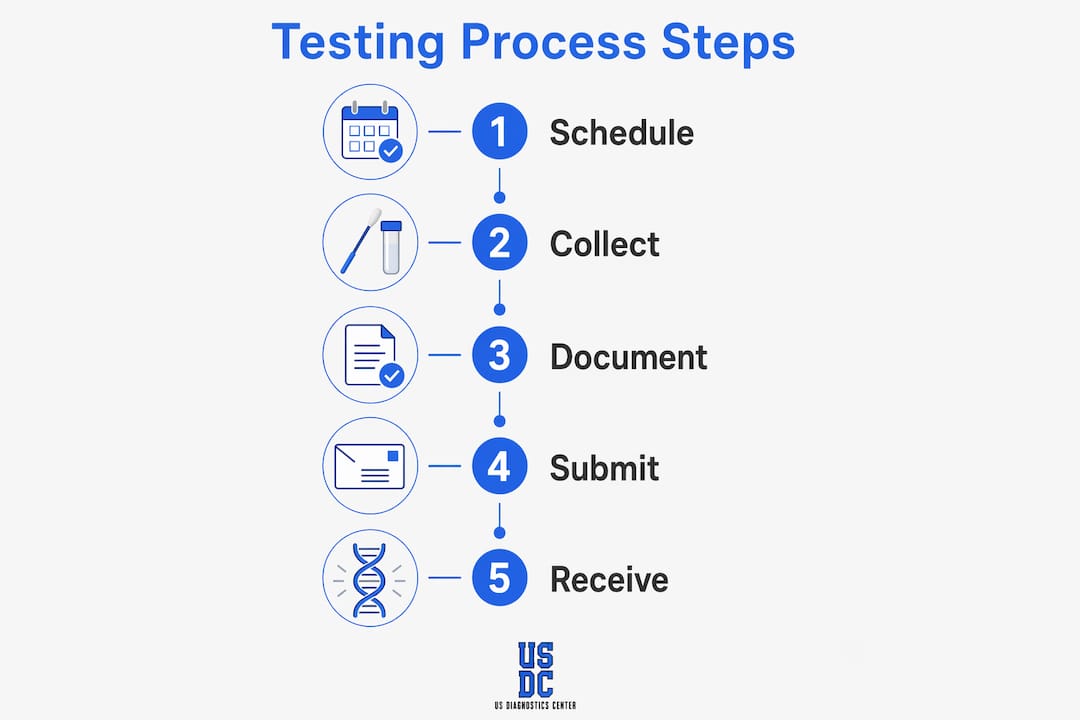
Step 1: Schedule a witnessed collection appointment
For legal tests, sample collection must happen at an approved collection site, such as a clinic, hospital, or designated collection center. An authorized collector witnesses the process, verifies IDs, and seals the samples. At-home self-collection is not valid for court-admissible results.
Step 2: Collect DNA samples using cheek swabs
The standard collection method is a buccal (cheek) swab. The collector rubs a sterile swab inside the cheek of each participant for 30–60 seconds. Blood draws are used in specific medical or legal circumstances but are not the standard for routine paternity testing. Each participant's samples go into separately labeled, sealed envelopes.

Step 3: Maintain chain of custody documentation
Chain of custody is the paper trail that proves samples were not tampered with between collection and lab analysis. The collector signs and dates the collection forms, seals the samples in the presence of participants, and ships directly to the lab. Samples from discarded personal items are generally inadmissible for court tests; proper consent and chain of custody is required for legal results. Any break in that chain renders the test inadmissible.
Step 4: Submit samples and notify the lab of urgency
Ship samples using the prepaid return shipping envelope included with your US Diagnostics Center kit, or deliver directly to the lab if same-day submission is possible. At the time of submission, inform the lab of any active court deadlines. Notifying the laboratory promptly can prioritize case processing and shorten turnaround times. This is not guaranteed, but labs handling legal cases regularly accommodate documented urgent requests.
Pro Tip: Never collect samples from a hairbrush, toothbrush, or discarded cup and submit them as a substitute for a witnessed cheek swab. Even if the DNA analysis produces a result, no court will accept it, and you will have lost both time and money.
What are the fastest paternity test options available?
Speed depends on two factors: how quickly the legal process moves and how fast the lab processes samples. Most people focus on the lab, but the rush is often about the legal process, not the testing itself.
That said, lab turnaround is still a variable you can control. Here are the realistic timelines:
- Standard legal test: 2–3 business days from sample receipt at the lab
- Expedited legal test: 1–2 business days at additional cost
- Express lab processing add-ons — available during checkout — can shorten lab turnaround to same day or 1–2 business days
- Court-ordered process (full timeline): 2–4 months from petition filing to results, depending on court scheduling and whether parties contest the order
- US Diagnostics Center lab processing: 2–3 business days; standard order-to-results is 7–10 business days
The gap between "lab processing" and "order-to-results" reflects shipping time and scheduling. You can compress that gap by scheduling a local collection appointment immediately after ordering and shipping samples the same day they are collected.
For court-ordered cases specifically, the bottleneck is almost always the court calendar, not the lab. Initiating the legal petition immediately when facing court deadlines is the single most effective way to shorten the overall timeline. Once a court order is in hand, labs treat those cases as priority. You can also review rush paternity test options to understand what expedited services typically include and cost.
How do you interpret results and act on them quickly?
A paternity test report states either inclusion or exclusion. Inclusion means the alleged father cannot be excluded as the biological father, expressed as a probability of paternity of 99.99% or higher. Exclusion means the alleged father is definitively not the biological father, expressed as 0% probability.
The actions you take after receiving results depend on the context:
- Child support cases: Submit the certified result directly to the court or child support agency. The agency uses the result to establish or modify a support order.
- Custody and visitation: A confirmed result can support a petition to establish legal parental rights. Consult a family law attorney before filing. Learn more about what courts require for child support paternity cases.
- Voluntary acknowledgment: If both parties agree on paternity, a Voluntary Acknowledgment of Paternity (VAP) signed at the hospital or later at a vital records office may eliminate the need for a court-ordered test entirely.
- Disputed results: If one party disputes the result, a court can order a retest at a different accredited lab. Results from two independent accredited labs are considered conclusive.
- Refusal to test: Courts treat refusal to comply with a court-ordered test as a significant legal factor. In many states, refusal creates a legal presumption of paternity against the refusing party. Read more about what happens if you refuse a court-ordered paternity test.
Keep certified copies of all results in a secure location. Courts, agencies, and attorneys may request copies at multiple points in a legal proceeding.
Key Takeaways
The fastest path to valid paternity results is filing the legal petition immediately, choosing an accredited lab, and notifying the lab of any active court deadlines before samples are even collected.
| Point | Details |
|---|---|
| Legal vs. personal test | Legal tests require chain of custody and ID verification; home tests are inadmissible in court. |
| Accuracy standard | Correctly conducted paternity tests confirm biological relationship at 99.99% accuracy. |
| Fastest lab turnaround | Expedited processing delivers results in 1–2 business days; express add-ons available during checkout can shorten turnaround to same day. |
| Biggest timeline bottleneck | Court scheduling, not lab processing, causes most delays in court-ordered cases. |
| Chain of custody is non-negotiable | Samples collected without witnessed, documented chain of custody are inadmissible regardless of accuracy. |
What I have learned after years of watching urgent paternity cases go wrong
The most consistent mistake I see is people treating this as a lab problem when it is actually a legal process problem. Someone gets a court date three weeks out, orders a test on day 14, and then panics when results take longer than expected. The lab was never the constraint. The petition that should have been filed on day one was the constraint.
The second mistake is assuming that speed and legal admissibility are interchangeable. A personal home test can return results in 2–3 business days. That speed is real. But if you need those results in a courtroom, that speed is worthless. I have seen people spend $79 on a home test, get a result in three days, and then spend weeks starting over with a legal test because their attorney told them the first result could not be used.
The third thing worth saying plainly: chain of custody documentation is not bureaucratic formality. It is the mechanism that makes a result legally defensible. A result without it is an opinion, not evidence. Labs that handle legal cases understand this. The collection process feels more formal than a home test for a reason.
If you are facing an urgent situation, the order of operations matters more than the speed of any individual step. File the petition. Get the court order if required. Schedule the witnessed collection immediately. Notify the lab of the deadline. Then wait. The process, when followed correctly, is faster than most people expect.
— Todd
How US Diagnostics Center supports urgent paternity testing needs
US Diagnostics Center offers legal DNA tests designed for exactly the situations described in this guide: court filings, child support proceedings, and personal cases where accuracy and speed both matter. Lab processing runs 2–3 business days, and the standard order-to-results timeline is 7–10 business days. Every kit includes a prepaid return shipping envelope. Pricing starts at $79 for a home paternity test, with legal test options available for cases requiring court-admissible results. US Diagnostics Center tests up to 28 markers to deliver 99.99% accuracy. If you have a court deadline or need guidance on which test fits your situation, contact the support team directly before ordering.
FAQ
What is the fastest turnaround for a legal paternity test?
Expedited legal paternity tests return results in 1–2 business days at additional cost. Express lab processing add-ons — available during checkout — can shorten lab turnaround to same day or 1–2 business days.
Can a home paternity test be used in court?
No. Home tests are for personal use only and are not admissible in court. Legal proceedings require a test conducted with witnessed sample collection, ID verification, and a documented chain of custody.
How long does a court-ordered paternity test take from start to finish?
The full court-ordered process, from petition filing to receiving results, typically takes 2–4 months. The delay comes from court scheduling, not lab processing, which usually takes 2–3 business days.
What documents do I need to bring to a paternity test appointment?
Bring a government-issued photo ID for each adult participant, the court order or case number if applicable, signed consent forms, and the child's birth certificate. Missing any of these can delay or invalidate the collection.
What happens if the alleged father refuses to take a court-ordered paternity test?
Refusal to comply with a court-ordered test carries serious legal consequences. In many states, courts treat refusal as grounds to presume paternity against the refusing party, which can result in a default judgment establishing legal fatherhood.

0 comments