

Grandparentage home DNA testing is defined as a method for confirming a biological relationship between a child and one or both grandparents when direct parent testing is not possible. These tests analyze DNA inherited through the family line, providing families with meaningful answers about biological connections. The reasons why grandparentage home tests are available come down to a clear gap in the testing market: the alleged parent is often absent, deceased, or unwilling to participate. Families facing paternity disputes, inheritance claims, or immigration proceedings need a reliable alternative. This guide explains how these tests work, when to use them, and what to expect from the process.
Why grandparentage home tests are available and widely used
Grandparentage testing exists because direct paternity testing is not always an option. Families use these tests in paternity disputes, inheritance cases, immigration proceedings, and legal matters when the alleged father's DNA is inaccessible. That single reality drives most of the demand for this type of testing.
The test itself compares a child's DNA with one or both grandparents to establish the probability of a biological relationship. It does not test the parent directly. Instead, it works backward through the genetic chain to draw conclusions about parentage.

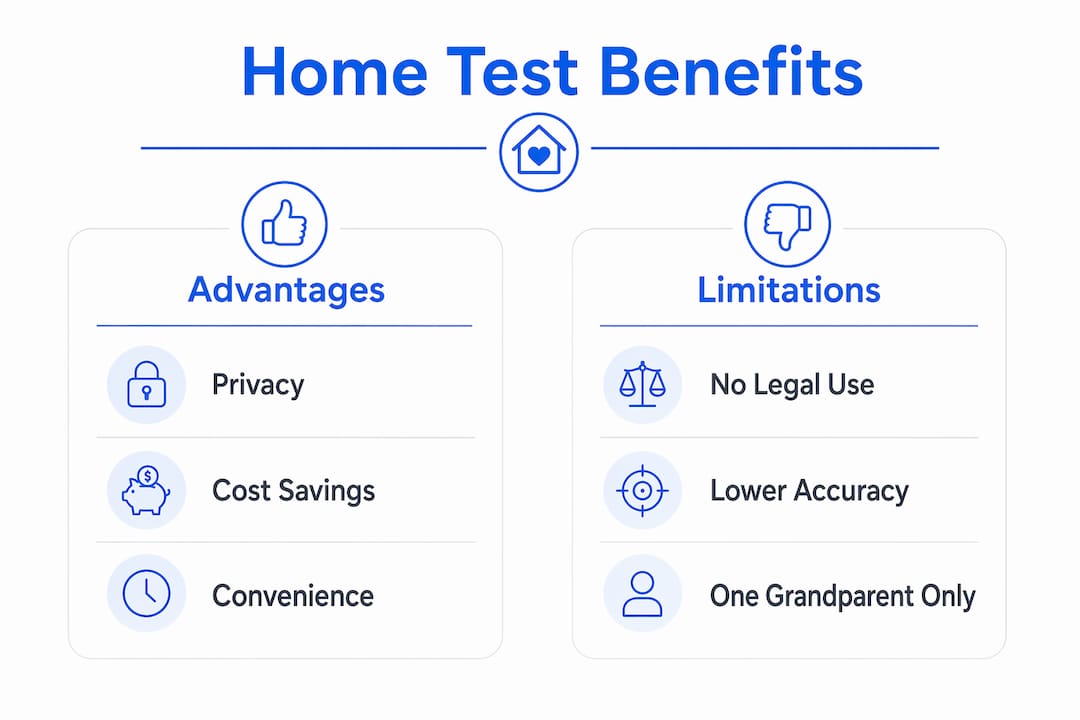
Home testing options make this process accessible to families who cannot or do not want to visit a clinic. Privacy, convenience, and cost are the three factors that consistently bring families to at-home options over clinical alternatives. The ability to collect samples privately at home removes a significant barrier for many people.
How do grandparentage home tests work?
Every person inherits approximately 25% of their DNA from each grandparent. That shared genetic material is the foundation of grandparentage testing. Laboratories analyze specific genetic markers to determine whether the pattern of inheritance is consistent with a biological grandparent-grandchild relationship.
The standard laboratory method uses Short Tandem Repeat (STR) marker analysis. STRs are repeating sequences of DNA that vary between individuals but follow predictable inheritance patterns within families. By comparing STR profiles across the child and grandparent samples, labs calculate a Combined Relationship Index (CRI) to assess the statistical support for the claimed biological relationship.
Sample collection is straightforward. At-home test kits include buccal swabs, instructions, and return packaging for mailing samples to an accredited laboratory. A buccal swab is a simple cheek swab that collects cells from the inside of the mouth. No blood draw or clinic visit is required.
Several factors affect accuracy:
- Both grandparents tested: Provides the strongest outcome, typically producing a Combined Relationship Index (CRI) well above 10, which per AABB standards is supportive of the claimed biological relationship.
- One grandparent and the mother: Improves accuracy compared to one grandparent alone by allowing the lab to isolate paternal alleles.
- One grandparent only: Results may be reported as "supported" or "not supported" but carry more statistical uncertainty.
- Mother's DNA included: Helps the laboratory separate the child's maternal DNA contribution from the paternal side, sharpening the analysis.
The difference between a home test and a legal test is not in the science. It is in the collection process. Home tests use self-collected samples. Legal tests require witnessed collection and a documented chain of custody to be admissible in court proceedings.
Primary reasons families seek grandparent DNA tests
Grandparentage testing is most commonly used when the alleged father cannot participate due to absence, refusal, or death. That covers a wide range of real-life situations that families encounter regularly.
The most common reasons families pursue this type of testing include:
- Alleged father is deceased: The grandparents carry the genetic evidence that can still confirm or exclude a biological relationship.
- Alleged father refuses testing: Grandparent testing provides an indirect route to the same answer without requiring the father's cooperation.
- Legal and inheritance matters: Courts and immigration authorities sometimes accept grandparentage test results as supporting evidence when direct paternity testing is unavailable.
- Immigration proceedings: Some visa and citizenship applications require proof of biological family relationships. Grandparent testing can supply that documentation.
- Family reunification: Families separated by adoption, estrangement, or circumstance use these tests to confirm biological connections for personal clarity.
- Peace of mind: Many families simply want a definitive answer for their own records, with no legal proceeding involved.
Home DNA testing options offer privacy, cost savings, and ease of use. That combination motivates families who value confidentiality or who cannot easily access a clinic. The at-home format removes the need to schedule appointments, travel, or involve third parties in a sensitive process.
Pro Tip: If you anticipate needing results for a legal proceeding, order a legal-grade test from the start. Upgrading from a home test result to a court-admissible result requires a completely new collection process under witnessed chain-of-custody protocols.
Advantages and limitations of grandparentage home tests
Grandparentage home tests offer real benefits, but they also carry limitations that families should understand before ordering.
Key advantages
Home testing is non-invasive, private, and does not require a clinic visit. Testing both paternal grandparents alongside the child typically produces a Combined Relationship Index (CRI) well above 10, which per AABB standards is supportive of the claimed biological relationship and a clinically meaningful result for personal use. Cost is generally lower than legal testing, though grandparent tests tend to cost more than basic paternity tests due to the additional participants and analysis complexity.
Key limitations
| Factor | Home test | Legal test |
|---|---|---|
| Sample collection | Self-collected buccal swab | Witnessed collection with chain of custody |
| Court admissibility | Personal use only | Admissible in legal proceedings |
| Accuracy with both grandparents | CRI typically well above 10 (supportive per AABB standards) | CRI typically well above 10 (supportive per AABB standards) |
| Accuracy with one grandparent | Reduced; result may be inconclusive | Same limitation applies |
| Turnaround time | Varies by provider | Varies by provider |
Using only one grandparent increases the chance of an inconclusive result. Experts advise testing both grandparents and including the mother's DNA whenever possible to maximize accuracy. That is not always feasible, but it is the standard recommendation from accredited laboratories.
When grandparents are unavailable, families can consider alternative kinship DNA tests such as avuncular testing (aunt or uncle) or sibling testing. These tests follow similar STR-based principles and can provide supporting evidence of biological relationships through other family members.
Pro Tip: Always include the mother's DNA sample if she is willing to participate. Including more close relatives helps the laboratory isolate paternal alleles and significantly reduces the chance of an inconclusive result.
Step-by-step process for using a grandparentage home DNA test
Following a clear process from ordering to results protects the integrity of your samples and gives you the most reliable outcome.
-
Select a reputable test provider. Choose a laboratory with AABB accreditation. AABB accreditation is the recognized standard for DNA testing quality in the United States. It confirms that the lab meets strict procedural and accuracy requirements.
-
Order the test kit. Select the correct kit for your situation, specifying whether you are testing one grandparent, both grandparents, or including the mother. US Diagnostics Center offers a home grandparent DNA test kit with clear instructions and all required materials included.
-
Collect samples using buccal swabs. Swab the inside of each participant's cheek for 30–60 seconds. Do not eat, drink, or smoke for at least 30 minutes before collection. Label each swab with the participant's name and relationship to the child.
-
Complete consent forms. Each adult participant must sign a consent form. For minors, a parent or legal guardian provides consent. Keep copies of all completed forms.
-
Mail samples to the laboratory. Use the prepaid return packaging included in the kit. Follow the mailing instructions exactly. Delays or improper packaging can compromise sample integrity.
-
Receive and interpret results. Most home tests return results within a few business days. Results are reported using the Combined Relationship Index (CRI). Per AABB standards, a CRI greater than 10 is considered supportive of the claimed biological relationship, a CRI between 0.1 and 10 is inconclusive, and a CRI less than 0.1 is not supportive of the claimed relationship.
-
Upgrade to legal testing if needed. If results will be used in a court proceeding, immigration application, or inheritance dispute, a legal DNA test with witnessed sample collection is required. Home test results alone are not admissible in court.
Key Takeaways
Grandparentage home DNA tests fill a critical gap when direct paternity testing is unavailable, providing families with reliable biological relationship data through STR marker analysis of shared grandparent-grandchild DNA.
| Point | Details |
|---|---|
| Core purpose | Grandparentage tests confirm biological relationships when the alleged parent is absent, deceased, or unwilling to test. |
| Accuracy depends on participants | Testing both grandparents and including the mother produces the strongest CRI outcomes, most supportive of the claimed relationship per AABB standards. |
| Home tests are for personal use | Results from self-collected samples are not court-admissible without a witnessed chain-of-custody process. |
| STR analysis is the standard method | Laboratories compare Short Tandem Repeat markers across participants to calculate the Combined Relationship Index (CRI). |
| Legal testing is a separate process | Families needing court-admissible results must order a legal-grade test with professional sample collection from the start. |
What I've learned from watching families use these tests
I've seen families approach grandparentage testing with two very different expectations. Some treat it as a final answer. Others treat it as a first step. The second group almost always ends up better served.
A home grandparentage test is a powerful tool for personal clarity. When both grandparents participate and the mother's sample is included, the results are statistically strong. But "statistically strong" and "legally admissible" are not the same thing. Families who discover this after the fact often have to restart the entire process under legal chain-of-custody conditions. That costs time and money that could have been avoided.
The privacy benefit of home testing is real and worth acknowledging. Many families are not ready to involve attorneys, courts, or third-party witnesses in a deeply personal matter. A home test gives them a private answer first. That answer can then inform whether they pursue legal testing.
My consistent advice is this: be honest with yourself about why you are testing. If the answer is purely personal, a home test from a reputable, quality-certified lab is a sound choice. If there is any chance the result will be needed in a legal proceeding, start with a legal-grade test. The genetics behind IVF and family planning show how deeply genetic knowledge shapes family decisions. Grandparentage testing is part of that same continuum of informed family decision-making.
— Todd
Grandparentage DNA testing options at US Diagnostics Center
US Diagnostics Center provides grandparentage DNA test kits designed for families who need clear, reliable answers at home or through a court-admissible process.
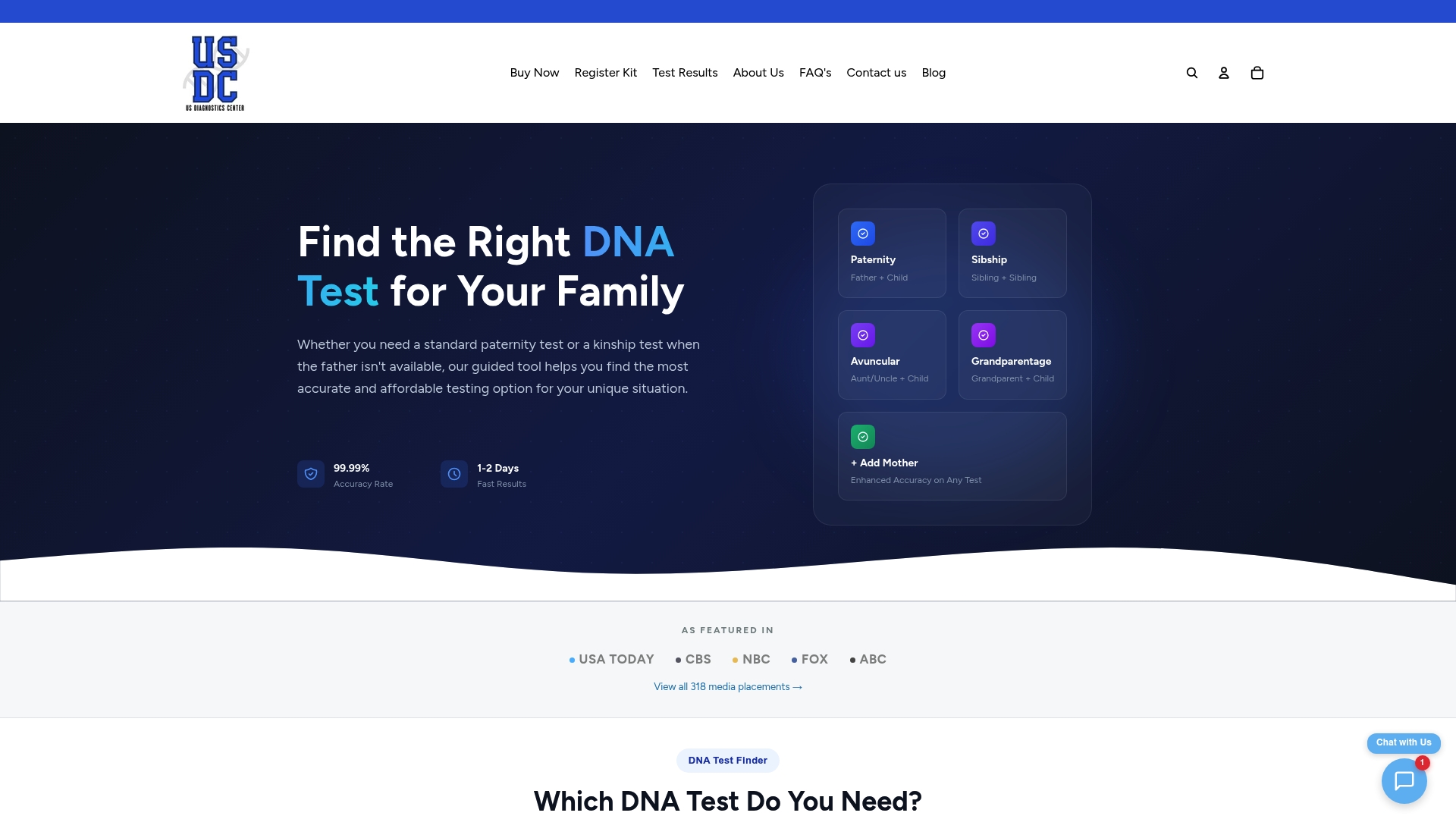
The home DNA test collection includes grandparentage kits with buccal swabs, step-by-step instructions, and prepaid return packaging. Results are processed in our laboratory, with turnaround typically within 2–3 business days. For families who need results that hold up in court, US Diagnostics Center also offers legal grandparentage testing with witnessed sample collection and full chain-of-custody documentation. The home grandparentage test is available at transparent pricing. Expedited processing is available as an add-on during checkout for time-sensitive situations.
FAQ
What is a grandparentage home DNA test?
A grandparentage home DNA test compares a child's DNA with one or both grandparents to determine the probability of a biological relationship, using buccal swabs collected privately at home.
How accurate are grandparentage home tests?
Testing both paternal grandparents alongside the child typically produces a Combined Relationship Index (CRI) well above 10, which per AABB standards is supportive of the claimed biological relationship. Testing only one grandparent reduces accuracy and may yield an inconclusive result.
Why are grandparentage home tests available when paternity tests exist?
Grandparentage tests are available because the alleged father is often deceased, absent, or unwilling to test. They provide an indirect genetic route to the same biological answer.
Can grandparentage home test results be used in court?
Home test results collected without a witnessed chain of custody are for personal use only and are not admissible in court. A legal-grade test with professional sample collection is required for court proceedings.
What is the importance of including the mother's DNA in grandparentage testing?
Including the mother's DNA allows the laboratory to isolate the child's paternal genetic contribution, which improves result clarity and reduces the chance of an inconclusive outcome.
Recommended
- Legal Grandparent DNA Test | Court-Admissible | Coming Soon | USDC
- Grandparent DNA Test | $139 | USDC
- Kinship DNA Tests: Sibling, Grandparent & More | USDC
Related resources
- Kinship DNA testing overview
- Home grandparent DNA test
- Home aunt or uncle DNA test
- When to use a grandparent DNA test
This article is part of our Paternity Testing: The Complete Guide and Kinship DNA Testing: Sibling, Grandparent, and Family Relationship Tests guides.


0 comments