

Yes, anonymous paternity and kinship DNA tests exist, and our home DNA kits are available for private, informal confirmation. They are generally not accepted for court proceedings or immigration applications, which require AABB-accredited testing instead. When you choose a test, weigh confidentiality practices, marker count, turnaround time, and whether a legal verification might come up later.
TL;DR:
- Anonymous tests use coded IDs and cheek swabs collected at home; verify data deletion, staff access, and secure report delivery before ordering.
- Most reports indicate 99.99% paternity probability for confirmed relationships when samples are of high quality; many labs test up to 28 genetic markers.
- Standard delivery takes 7 to 10 business days, including lab processing that commonly lasts 2 to 3 business days; expedited options may shorten the wait.
- If court or immigration use may arise, choose accredited testing with chain of custody from the outset, because later retesting adds time and cost.
Table of Contents
- What Is an Anonymous Paternity or Kinship DNA Test?
- How Anonymous DNA Testing Works, Step by Step
- What Anonymity Protects and What It Doesn’t
- When Anonymous Testing Isn’t the Right Choice
- Checklist: Choosing a Discreet DNA Test
- Balancing Privacy Today Against Legal Needs Tomorrow
- Discreet At-Home Testing Through US Diagnostics Center
- FAQ
- Sources
What Is an Anonymous Paternity or Kinship DNA Test?
An anonymous or confidential DNA test establishes the probability of a biological relationship, such as paternity, siblingship, or a grandparent connection, without the identity verification steps that a legal test requires. The sample is still analyzed in a laboratory, but the process is built around privacy rather than courtroom standards.
People choose this route for several reasons:
- They want personal closure or confirmation without involving a lawyer or court.
- They prefer to keep the matter private from family, an employer, or an insurer.
- They want an initial result before deciding whether a legal process is necessary.
This type of testing is distinct from ancestry or ethnicity testing, and it is not the same as prenatal testing. If your question involves a family relationship rather than heritage or genealogy, anonymous testing is built for your situation.
How Anonymous DNA Testing Works, Step by Step
Anonymous testing follows a straightforward sequence, and understanding each stage helps you know what to expect once a kit arrives.
- Order and receive your kit. A home paternity, maternity, or kinship kit ships with buccal swabs, collection instructions, and a prepaid return shipping envelope.
- Collect samples privately. Each participant swabs the inside of the cheek at home, with no clinic visit and no witness requirement.
- Return samples under a coded ID. Labs commonly assign a sample identification number rather than processing the kit under participant names, which keeps personal identifiers separate from the testing workflow.
- Laboratory analysis. Technicians compare genetic markers across samples to calculate the probability of the claimed relationship. According to the Forensic Science Center at Marshall University, most laboratory reports indicate a 99.99% probability of paternity when a relationship is confirmed, assuming high-quality samples. Many labs test up to 28 markers to reach that level of confidence.
- Results delivery. Lab processing commonly takes 2 to 3 business days, with standard order-to-results timelines of 7 to 10 business days; expedited options can shorten that wait.
Sample quality can affect accuracy, so follow the swabbing instructions and return-process guidance even for an informal test.
What Anonymity Protects and What It Doesn’t

Confidentiality in DNA testing has real boundaries, and it helps to know exactly what a provider is promising before you send in a sample. Typical privacy practices include coded samples that separate identity from genetic data, restricted staff access to results, and secure delivery of the final report.
Before ordering, it’s worth asking a provider:
- Do you delete personal data on request, and after what period?
- Who at your lab has access to my results?
- Is the report delivered on paper, through an encrypted portal, or both?
A documented confidentiality policy and a secure delivery method are the two most practical things you can verify. Our guide to paternity test confidentiality walks through these privacy practices in more detail.
Pro Tip: Ask for written confirmation of a lab’s confidentiality practices before you place an order, not after.
When Anonymous Testing Isn’t the Right Choice
Anonymous tests are built for private confirmation, not for legal proceedings. If your situation touches a court case, custody matter, or immigration application, the rules change considerably.
- AABB accreditation is voluntary for private testing in the United States, but it is required for results accepted by most state court systems and by federal immigration, visa, and passport processes.
- Before using results from a non-accredited facility for a legal or immigration purpose, confirm acceptance requirements with the relevant court or agency.
- If you may need results for a legal purpose later, check the applicable requirements before testing. The AABB discusses this risk.
- Even if court use seems unlikely now, understanding this distinction up front helps you pick the right kit the first time.
Our comparison of home versus legal paternity testing breaks down exactly how the two paths diverge in process and acceptance. Readers weighing medical confidentiality more broadly, including how sensitive test records are handled for minors, may also find this overview of confidentiality in medical testing useful background reading.
Checklist: Choosing a Discreet DNA Test
A few practical checks will keep you from guessing at quality or confidentiality once you’re ready to order.
- Confirm the advertised accuracy and ask what marker count backs it. Up to 28 markers is a common benchmark for a confirmed relationship result, supported by laboratory reporting standards in the field.
- Check the stated turnaround and whether expedited processing is offered.
- Read the privacy policy directly and ask about sample coding, data deletion, and who can view your results.
- Decide whether you might need the result for a legal or immigration purpose later. If so, check the applicable requirements before choosing a test.
- Compare price ranges across test types before you commit to one kit.
Up to 99.99% probability of paternity is the typical benchmark reported when a relationship is confirmed with quality samples, according to the Forensic Science Center at Marshall University. That figure reflects laboratory analysis, not a guarantee tied to any single provider’s marketing.
Balancing Privacy Today Against Legal Needs Tomorrow
We think the decision between anonymous and accredited testing comes down to one honest question: will this result ever need to leave your home? If the goal is personal confirmation, closure, or a conversation within the family, an anonymous test answers that need without unnecessary cost or paperwork.
If there’s any real chance a court, an attorney, or an immigration office will ask for proof later, start with an accredited, chain-of-custody collection from the beginning. Re-testing after the fact costs more time and money than doing it right the first time. A guided test-selection tool, like the one we built, can help match your specific situation (paternity, grandparentage, or sibling testing) to the kit that actually fits it.
— Dr. Todd Lewis
Discreet At-Home Testing Through US Diagnostics Center
We built our home testing line around exactly the privacy and simplicity this guide describes. Our kits ship with everything needed for private collection at home, including a prepaid return envelope, and results commonly arrive within 2 to 3 business days of lab processing.
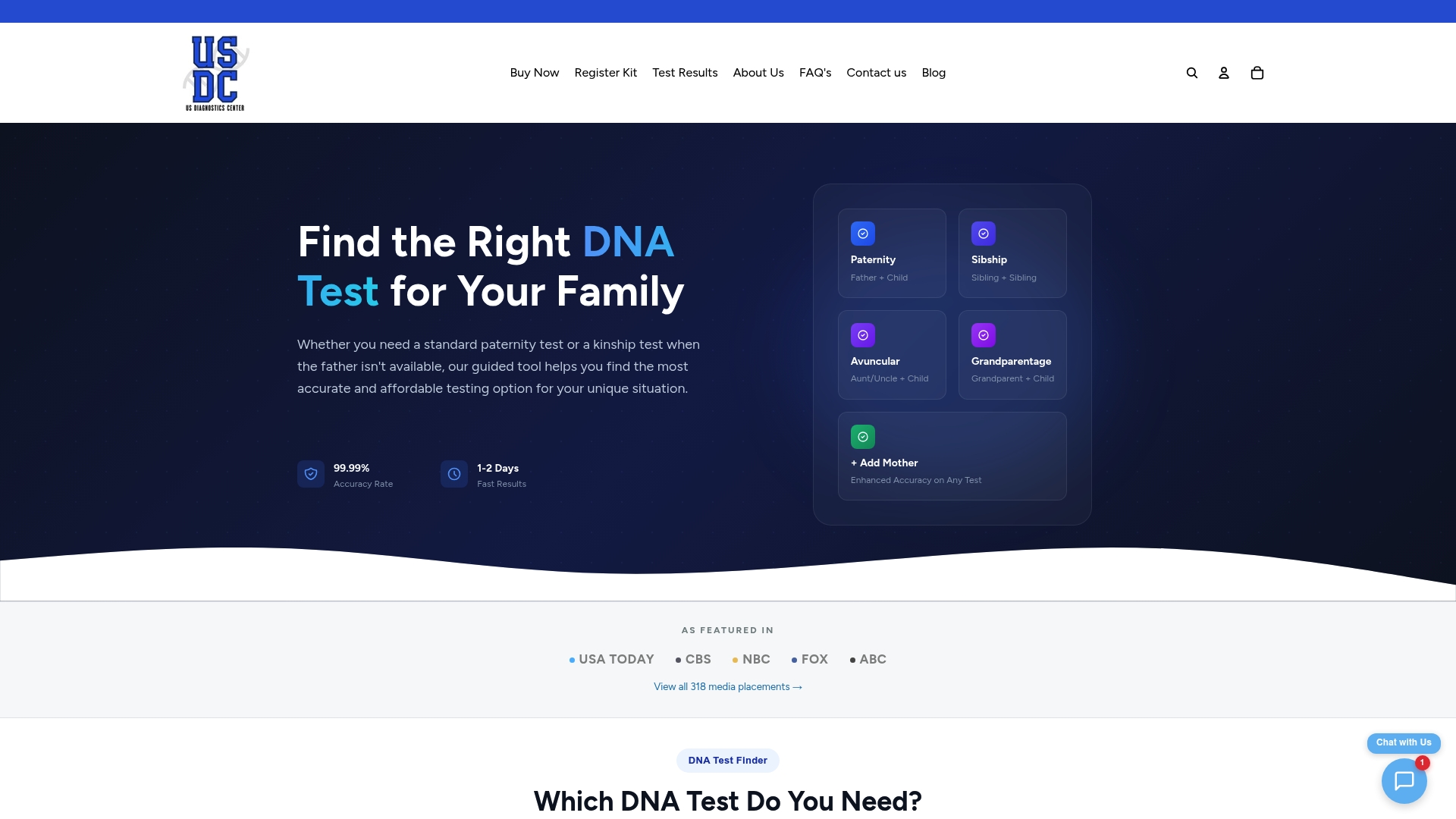
Our current home kit lineup includes:
- Home Paternity Test Kit at $79
- Home Maternity Test Kit at $129
- Home Aunt/Uncle, Grandparent, and Sibling DNA Test Kits at $139 each
Our guided test-selection tool helps you match your exact situation to the right kit, and Next-Day Results processing is available for an additional $100 when you need an answer fast. If your situation might involve court or immigration proceedings, check the applicable requirements before choosing a test; our home kits are intended for private confirmation rather than legal submission.
Ready to find the right kit for your situation? Browse our home DNA test kits and get started today.
FAQ
Can you do a DNA test anonymously?
Yes, home paternity and kinship tests can be done with coded samples that limit personal identification during lab processing. These results work well for private confirmation but are not accepted for court or immigration purposes, which require AABB-accredited testing instead.
Are paternity tests confidential?
Confidentiality depends on the provider’s specific practices, including sample coding, restricted staff access, and secure report delivery. Before ordering, ask whether personal data is deleted on request and how your report will be delivered, since policies vary by lab.
How accurate is an anonymous DNA test?
Most laboratory reports show up to a 99.99% probability of paternity when a relationship is confirmed with quality samples, according to the Forensic Science Center at Marshall University. Many labs reach that accuracy using up to 28 genetic markers.
What’s the difference between an anonymous test and a legal one?
An anonymous test focuses on convenience and privacy, while a legal test verifies the identity of each participant through chain-of-custody collection. Our comparison of home versus legal paternity testing explains how that distinction affects which results courts and agencies will accept.
How long does it take to get anonymous DNA test results?
Lab processing commonly takes 2 to 3 business days once samples arrive, with standard order-to-results timelines of 7 to 10 business days. Expedited processing options can shorten that wait for an additional fee.
Sources
- Relationship Testing – Forensic Science Center
- AABB-Accredited Relationship (DNA) Testing Facilities


0 comments