

No, standard ancestry DNA tests are not court admissible. Courts require a kinship DNA test collected under a documented chain of custody and reported by a qualified laboratory, not a consumer ethnicity kit. If you need proof of paternity, grandparentage, or sibling relationship for a legal proceeding, a legal kinship DNA test with witnessed collection and documented chain of custody is what courts require. Judges evaluate this evidence under Rule 702/Daubert, and several states set statutory probability thresholds that create a rebuttable presumption of parentage.
TL;DR:
- Court-admissible DNA tests require verified participant identity, a documented chain of custody, and a certified laboratory report, unlike consumer ancestry kits.
- Proper chain-of-custody procedures include photo ID verification, signed custody forms, tamper-evident seals, and minimized sample handlers to prevent legal challenges.
- Laboratories must follow recognized standards, analyze up to 28 genetic markers, and produce reports using either a probability-of-parentage percentage for paternity and maternity cases — with many state statutes setting thresholds at 95% or 99% — or a Combined Relationship Index (CRI) for kinship tests such as grandparentage, sibling, and avuncular testing, where a CRI above 10 supports the claimed relationship.
- Processing time for legal DNA tests is usually 2 to 3 business days in lab, with 7 to 10 business days for results, and expedited options are available for court deadlines.
- Challenges against DNA evidence typically focus on procedural gaps like identity verification or chain-of-custody breaches, not the science itself.
Table of Contents
- What Does "Court-Admissible Kinship DNA Test" Actually Mean?
- What Do Courts and Labs Expect From Chain of Custody?
- How Do Courts Decide Whether to Accept DNA Evidence?
- How Do You Get a Court-Admissible Kinship DNA Test?
- How Might a Court or Attorney Challenge DNA Evidence?
- Why the Paperwork Matters More Than the Science
- Getting a Legal Kinship Test Through US Diagnostics Center
- Sources
- FAQ
What Does "Court-Admissible Kinship DNA Test" Actually Mean?
A court-admissible kinship test is a DNA test performed with three things a mail-in ancestry kit never includes: verified participant identity, a documented chain of custody, and a certified laboratory report designed to withstand legal scrutiny. Courts do not care how accurate the underlying science is if nobody can prove whose cheek swab actually produced the result.
This category covers several relationship types, each useful in different legal scenarios:
- Paternity testing — establishing legal fatherhood for child support, custody, or inheritance
- Grandparentage testing — used when the alleged father is unavailable and grandparents stand in
- Sibling (full or half) testing — common in probate and inheritance disputes
- Avuncular (aunt/uncle) testing — used when direct parent-child comparison isn't possible
Ancestry and ethnicity kits are built for a different job entirely. They estimate ethnic percentages and connect you with distant relatives, and they were never designed to survive cross-examination. As one legal analysis of informational versus legal testing puts it, consumer DNA tests lack the identity verification and chain-of-custody controls courts require, which is exactly why they get excluded even when the science behind them is sound. Federal courts apply Rule 702 and the Daubert standard to decide whether DNA methodology is reliable enough to admit, and state statutes layer additional requirements on top. If you're weighing your options, US Diagnostics Center's guide on court-admissible testing benefits walks through why the distinction matters before you order anything.
What Do Courts and Labs Expect From Chain of Custody?
Chain of custody is the paper trail that proves the DNA in the lab report came from the person the case says it came from. Skip a step, and opposing counsel has an opening to challenge the entire result. The National Institute of Justice treats this documentation as essential to preventing contamination or tampering claims.
Here's what a defensible chain actually requires, in order:
- Photo ID verification for every participant at the moment of collection
- Signed custody forms naming the collector and confirming identity checks were performed
- Unique sample IDs assigned to each swab so nothing gets mixed up in transit
- Witness or collector signature on the collection record itself
- Tamper-evident seals applied to the sample packaging before it leaves the collection site
- Sealed kit return with dated transfer receipts documenting each handoff
- Limited handlers — the fewer people who touch the sample, the fewer opportunities for a challenge
- Lab intake records and storage logs documenting receipt, storage conditions, and analysis dates
According to forensic evidence standards, chain-of-custody documentation is the single most critical factor in evidence integrity, and a broken link anywhere in that sequence can render an otherwise accurate result inadmissible.
Pro Tip: Ask your provider up front how many people will physically handle your sample between collection and the final report. Fewer transfers mean fewer places for a defense attorney to poke holes.
How Do Courts Decide Whether to Accept DNA Evidence?
Judges act as gatekeepers. Under Rule 702 and the Daubert standard, a judge must determine that the testing methodology is scientifically reliable and was properly applied before letting a jury or fact-finder see the result. A 2023 clarification to Rule 702 reinforced that admissibility runs on a preponderance-of-evidence standard, meaning the party offering the DNA report has to show it's more likely than not that the method and its application were sound, according to NCBI's overview of DNA evidence admissibility.
Many states go further and make properly prepared reports self-authenticating, meaning they can be admitted without a lab technician testifying in person. Statutory examples include:
- New York's Family Court Act § 532
- Tennessee Code § 24-7-112, which spells out who can order testing and who pays for it
Several of these statutes set probability thresholds, commonly 95% or 99%, which trigger a rebuttable presumption of parentage once met, based on aggregated state statutory language. A compliant lab report typically documents the testing methods used, the genetic markers analyzed, up to 28 markers in a standard panel, and either a Combined Relationship Index (CRI) for kinship tests such as grandparentage, sibling, or avuncular testing, or a probability-of-parentage percentage for paternity and maternity cases. Miss any of these components and a judge has grounds to question the report before it even gets to the merits.
How Do You Get a Court-Admissible Kinship DNA Test?
Getting a result a judge will actually accept takes more planning than ordering a home kit off a shelf. Follow these steps in order:
- Choose a provider that documents chain of custody and offers witnessed or in-person collection rather than an unsupervised mail-in swab.
- Verify identity for every participant at the collection appointment using government-issued photo ID, and make sure signed custody forms are completed on the spot.
- Keep all original paperwork — collection forms, transfer receipts, and any correspondence with the lab — in one place, and request a certified laboratory report along with certified copies for your attorney or the court clerk.
- Ask about expedited processing if you're facing a filing deadline or court date.
Lab processing itself generally takes 2 to 3 business days, with standard order-to-results timelines running 7 to 10 business days once you account for shipping and paperwork. Expedited options exist for families facing tighter court deadlines. US Diagnostics Center's breakdown of what courts require covers the documentation attorneys tend to ask for most often.
How Might a Court or Attorney Challenge DNA Evidence?
Opposing counsel doesn't need to disprove the science to keep a DNA report out. They just need to find a procedural gap. The most common objections include:
- Identity verification gaps — no proof the person tested is who they claim to be
- A broken chain of custody — unexplained gaps between collection and lab receipt
- Unaccredited lab credentials — questions about whether the lab follows recognized quality standards
- Misinterpreted statistics — confusing a likelihood ratio with an absolute certainty
An NIJ prosecutors' notebook on DNA evidence notes that labs need written procedures documenting every step from sample receipt through final report specifically so an analyst can defend that process if challenged. Even where a statute makes a report self-authenticating, an attorney may still request expert testimony if the other side raises a credible objection about handling or methodology.
Pro Tip: If your case is contested, ask your attorney early whether an expert affidavit from the testing lab makes sense. It's often cheaper to arrange upfront than to scramble for one after a challenge is filed.
Securing your paperwork, confirming lab credentials before you order, and minimizing the number of people who handle your sample are the three moves that cut challenge risk the most. For more detail on the documentation trail itself, see how chain of custody makes a DNA test court admissible.
Why the Paperwork Matters More Than the Science
Most families assume the hard part of a legal DNA case is the lab work. It isn't. The hard part is proving, on paper, that the sample in the lab's freezer belongs to the person named in the court filing.
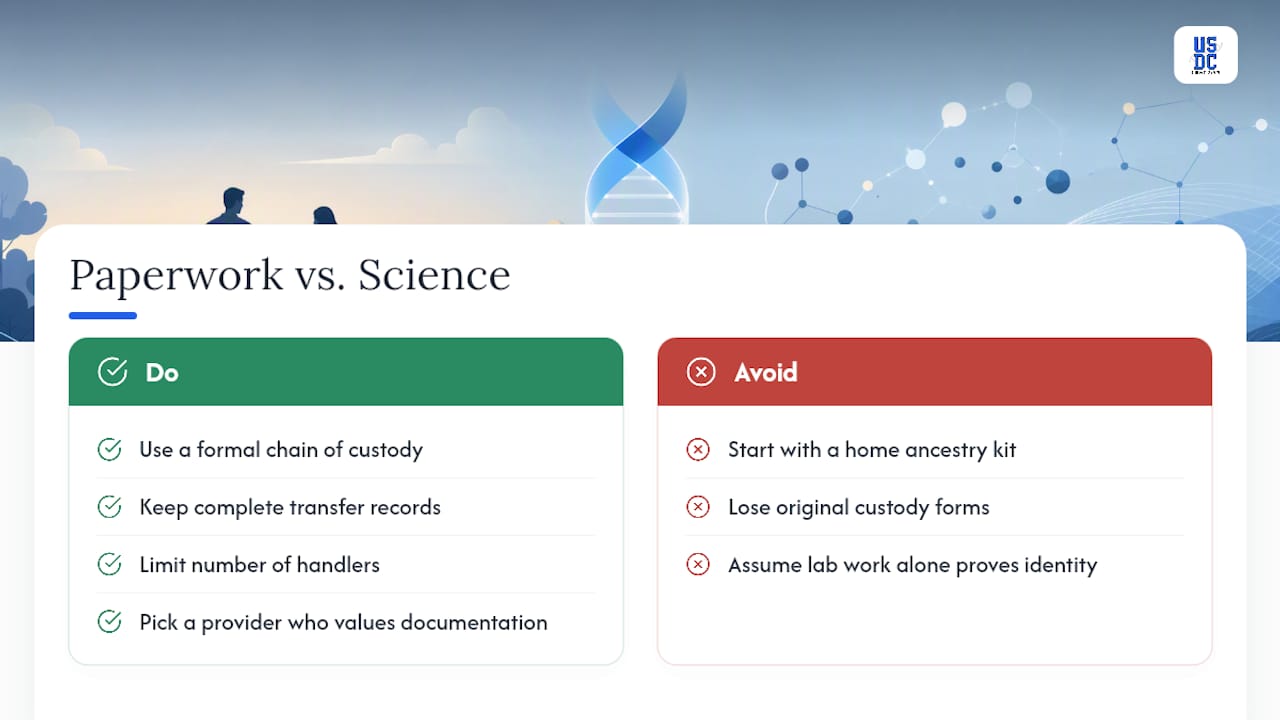
Cases get decided on custody documentation as often as they get decided on genetic markers. A well-run chain of custody, with clean transfer records and minimal handlers, tends to survive scrutiny even when opposing counsel comes in swinging. The mistake families make most often is starting with a home ancestry kit because it's cheaper or faster, then discovering months later that the result can't be used where it matters. Losing the original custody forms is a close second.
The good news: none of this requires a law degree to get right, just attention to the checklist and a provider that takes documentation as seriously as the science. Families dealing with a sensitive kinship question deserve a process that respects both their privacy and their timeline.
— Dr. Todd Lewis
Getting a Legal Kinship Test Through US Diagnostics Center
US Diagnostics Center currently offers home DNA tests for personal knowledge, including home paternity, maternity, sibling, grandparent, and aunt/uncle testing. Every kit ships with a prepaid return envelope, results analyze up to 28 genetic markers, lab processing runs 2 to 3 business days, and standard order-to-results timing is 7 to 10 business days, with expedited options for time-sensitive situations. For court-admissible and legal versions, visit the product pages for availability updates.
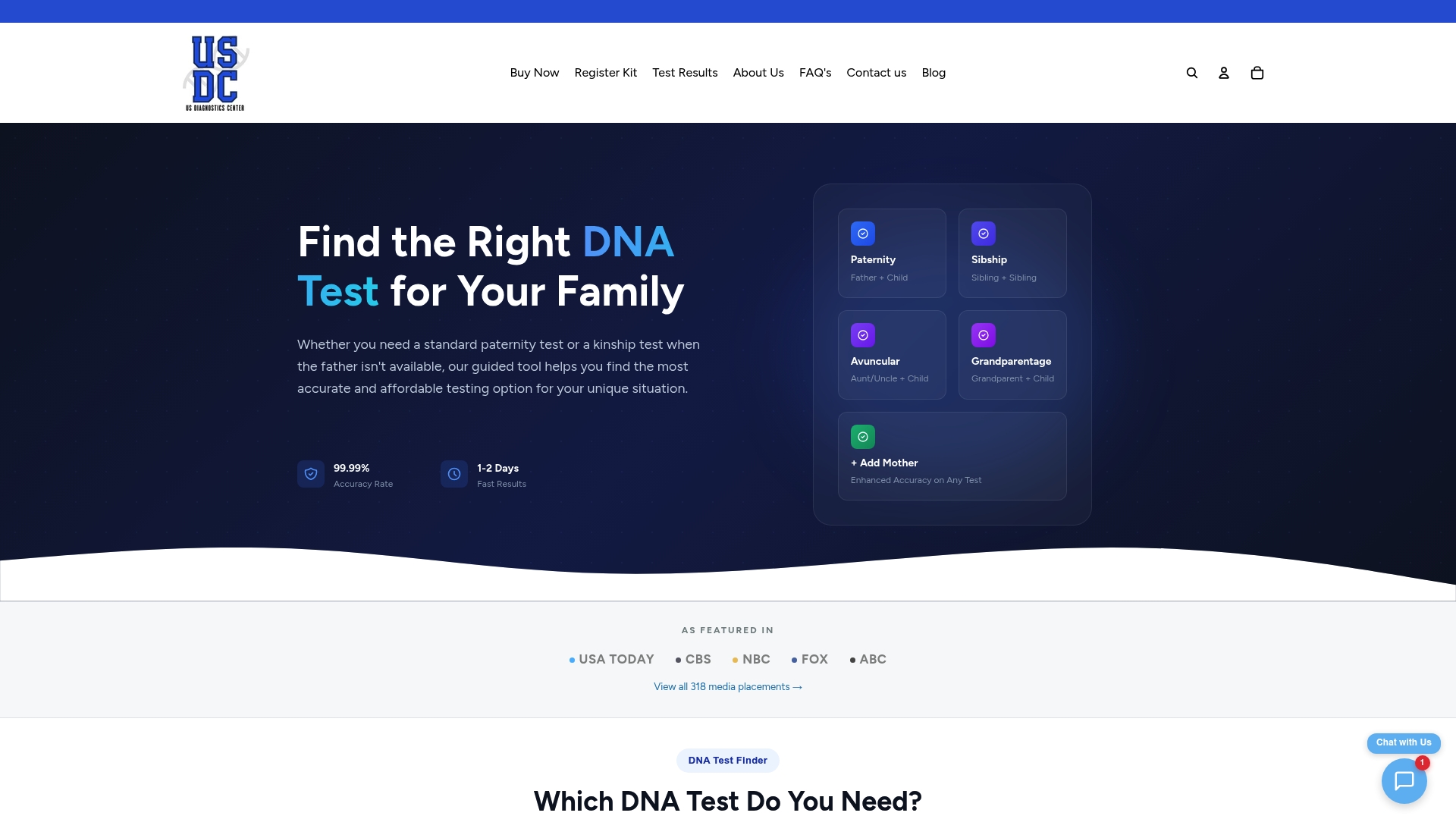
If you have a kinship question you want to resolve at home — whether that's confirming a biological relationship between siblings, between grandparent and grandchild, or between a parent and child — the home test options cover those relationship types. Visit the US Diagnostics Center product pages to learn what is currently available and what the ordering process involves, or visit the US Diagnostics Center testing overview to learn more about the process.
This article is general information, not a substitute for advice from a qualified lawyer. Consult a qualified legal professional about your own circumstances before acting on anything here.
Sources
- What Every First Responding Officer Should Know About DNA Evidence | Chain of Custody of Evidence (NIJ)
- Chain of Custody - StatPearls - NCBI Bookshelf
FAQ
Can Ancestry DNA Results Be Used in Court?
No. Consumer ancestry and ethnicity tests lack the identity verification and chain-of-custody documentation courts require, so they're generally inadmissible for proving a legal relationship.
What Makes a DNA Test Legally Admissible?
A test becomes court admissible when it includes verified participant identity, a documented chain of custody from collection through lab report, and results from a lab that follows recognized quality procedures.
Do I Need a Lawyer to Order a Legal DNA Test?
Not always. You can order directly from a provider that offers witnessed collection and chain-of-custody documentation, though an attorney can advise whether your specific case needs an expert affidavit.
How Long Does a Court-Admissible DNA Test Take?
Lab processing typically takes 2 to 3 business days, with standard order-to-results timing of 7 to 10 business days; expedited processing is available for urgent court deadlines.
What Probability Threshold Do Courts Use for Paternity?
Many states set thresholds at 95% or 99% probability of parentage, which can create a rebuttable presumption of paternity under state statutes like Tennessee Code § 24-7-112.
Recommended
- DNA Testing for Immigration: At-Home Kinship Tests Explained
- Court-Admissible DNA Testing Benefits for U.S. Families
- Kinship DNA Testing Examples: A Clear Guide
- Kinship DNA Tests: Sibling, Grandparent & More
This article is part of our Kinship DNA Testing: Sibling, Grandparent, and Family Relationship Tests and Understanding DNA Testing: How It Works and What to Expect guides.


0 comments