

A personal DNA profile in this context is a relationship test, one that compares genetic markers between two or more people to confirm or rule out biological kinship, whether that's paternity, a grandparent link, or a sibling relationship. Most people should start with an at-home peace-of-mind kit unless a court, school, or government agency needs the result, in which case a legal chain-of-custody test is the only option. US Diagnostics Center offers both paths.
TL;DR:
- Most relationship tests, including paternity and maternity, analyze up to 28 genetic markers, with complex cases often requiring expanded panels for conclusive results.
- Sample collection for at-home tests involves a cheek swab that must be air-dried and sealed properly; legal tests require photo ID and witnessed collection.
- Legal DNA tests include chain-of-custody documentation and are necessary if results will be used in court, immigration, or official proceedings.
- Turnaround time for processing is typically 2 to 3 business days after lab receipt, with total results delivered in 7 to 10 business days; expedited options are available.
- Inconclusive extended family tests are resolved by adding markers or advanced testing, rather than re-collecting samples, to increase statistical certainty.
Table of Contents
- What Is a Personal DNA Profile for Relationship Testing?
- How Do Relationship DNA Tests Work?
- At-Home vs. Legal DNA Testing: How to Choose
- What Does Relationship Testing Cost, and How Long Does It Take?
- How Do You Collect and Submit a DNA Sample?
- Preparing for Testing, Practically and Emotionally
- Ordering a Relationship DNA Test Through US Diagnostics Center
- Sources
- FAQ
What Is a Personal DNA Profile for Relationship Testing?
Before picking a test, it helps to know the standard term for what you're actually buying. In the testing industry, this is called relationship DNA testing or kinship analysis, and it covers a specific family of tests that answer one question: are these two people related the way someone thinks they are? It is a different animal from ancestry testing, which estimates ethnic background, or forensic DNA profiling, which law enforcement uses to identify individuals from crime scene evidence. None of that applies here.
Here's how to match the scenario to the right test.
- Paternity test: Compares a child's DNA to an alleged father's DNA. This is the most common relationship test ordered.
- Maternity test: Confirms the biological mother, often needed for adoption records, surrogacy situations, or documentation gaps.
- Grandparent test: Used when the alleged father is unavailable and his parents stand in as the tested relatives instead.
- Sibling test: Determines whether two people share one or both biological parents.
- Avuncular test: Checks an aunt or uncle relationship, commonly used in immigration or inheritance disputes.
- Twin zygosity test: Confirms whether twins are identical (monozygotic) or fraternal (dizygotic).
Testing alternate relatives, like grandparents instead of a deceased father, still produces a usable result, but it's a statistical estimate built on shared DNA percentages rather than a direct comparison, so labs sometimes need alternative sample sources or a wider marker panel to reach a firm conclusion. One rule cuts through most of the confusion: if a court, government office, or insurance company will ever see the result, you need a legal chain-of-custody test from the start. Peace-of-mind kits can't be upgraded after the fact.
How Do Relationship DNA Tests Work?
Every relationship test starts the same way: a cheek swab collects cells from inside the mouth, and the lab extracts DNA from those cells to examine specific genetic markers, called loci, that get compared between the tested people. Each marker is a location on the DNA where humans show natural variation, and the more markers a lab checks, the sharper the resulting picture becomes. According to the Cleveland Clinic's explainer on paternity testing, legal tests additionally require an approved facility and a documented chain of custody so the results hold up in court.
US Diagnostics Center analyzes up to 28 genetic markers per test, which matters most in complicated cases. A basic paternity test with a directly available father usually resolves cleanly. Sibling, grandparent, and avuncular tests are trickier because those relationships share DNA in less predictable proportions, so the lab reports a statistical likelihood rather than a flat yes or no. That statistical result is expressed as a Combined Relationship Index (CRI). A CRI greater than 10 supports the claimed relationship, a CRI below 0.1 weighs against it, and a CRI between 0.1 and 10 is considered inconclusive — which is why labs sometimes need to expand the marker panel before issuing a final report. Extended family comparisons can land in an inconclusive middle zone more often than direct paternity tests do, and when they do, labs typically recommend expanding the marker panel or moving to advanced testing to push the result toward certainty.
When the person in question has died or can't be reached, testing shifts to available relatives or, in some cases, preserved medical samples, which is why grandparent and sibling tests exist as fallback paths in the first place (the role of DNA in cold cases).
At-Home vs. Legal DNA Testing: How to Choose
The split between at-home and legal testing isn't about accuracy. It's about whether the result can be used officially.
- At-home (peace-of-mind) tests let you collect your own cheek swab, mail it back, and get results privately. They're less expensive, faster to arrange, and completely confidential, but they carry no chain-of-custody documentation, so courts, immigration offices, and most government agencies won't accept them.
- Legal (court-admissible) tests require photo identification for every participant and a collection witnessed by a neutral third party, with each sample logged and sealed the moment it's taken. That paper trail is what makes the result admissible in a custody case, a child support hearing, or an estate dispute.
- When in doubt, check first. If there's any chance a result will end up in front of a judge, caseworker, or attorney, confirm with that receiving party what documentation they require before you order anything.
Genetically, the science behind both testing paths is identical, same markers, same lab process. What changes is custody of the sample, and that single difference decides whether a result is admissible. US Diagnostics Center's legal DNA test collection walks through exactly what courts expect, and it's worth reading before you assume a home kit will do.
What Does Relationship Testing Cost, and How Long Does It Take?
Price and timing are usually what push people to procrastinate on ordering, so here's the actual breakdown.
- Home paternity test: at a lower cost.
- Maternity test: at a moderate cost.
- Sibling, grandparent, or aunt/uncle test: at a higher cost.
Turnaround: Lab processing runs 2 to 3 business days once the sample arrives, and standard order-to-results timing, including shipping both directions, is 7 to 10 business days. Expedited processing is available for anyone who can't wait.
Direct paternity tests, where the alleged father is available and tested, routinely reach conclusive accuracy above 99.99% when the father is the true biological parent. Extended relationships don't always resolve that cleanly on the first pass, since siblings and grandparents share DNA in more variable amounts than a parent and child do. If a report comes back inconclusive, the next step is almost always the same: the lab adds markers or runs an advanced panel to sharpen the statistical picture rather than asking you to start over with a new sample.
How Do You Collect and Submit a DNA Sample?

Ordering the wrong test, or fumbling the sample collection, is the easiest way to waste both time and money. US Diagnostics Center's guided selection tool asks a few questions about your situation and points you to the correct kit, whether that's a home test or a legal one, so you're not guessing based on a product description.
Once the kit arrives:
- Swab the inside of each cheek firmly for the full time listed in the instructions; a rushed swab is the top reason labs reject samples.
- Let each swab air dry before sealing it, since moisture trapped in the packaging can degrade the sample.
- Pack everything into the prepaid return envelope included with your kit and drop it in the mail; there's no separate shipping cost to arrange.
- To add a participant, such as a second alleged father or an additional sibling, use the account portal or call customer support before the kit ships.
- For legal tests, bring valid photo ID to your scheduled collection appointment; without it, the collection can't proceed.
If you want a visual walkthrough before you swab, the step-by-step cheek swab guide covers the exact technique labs expect.
Preparing for Testing, Practically and Emotionally
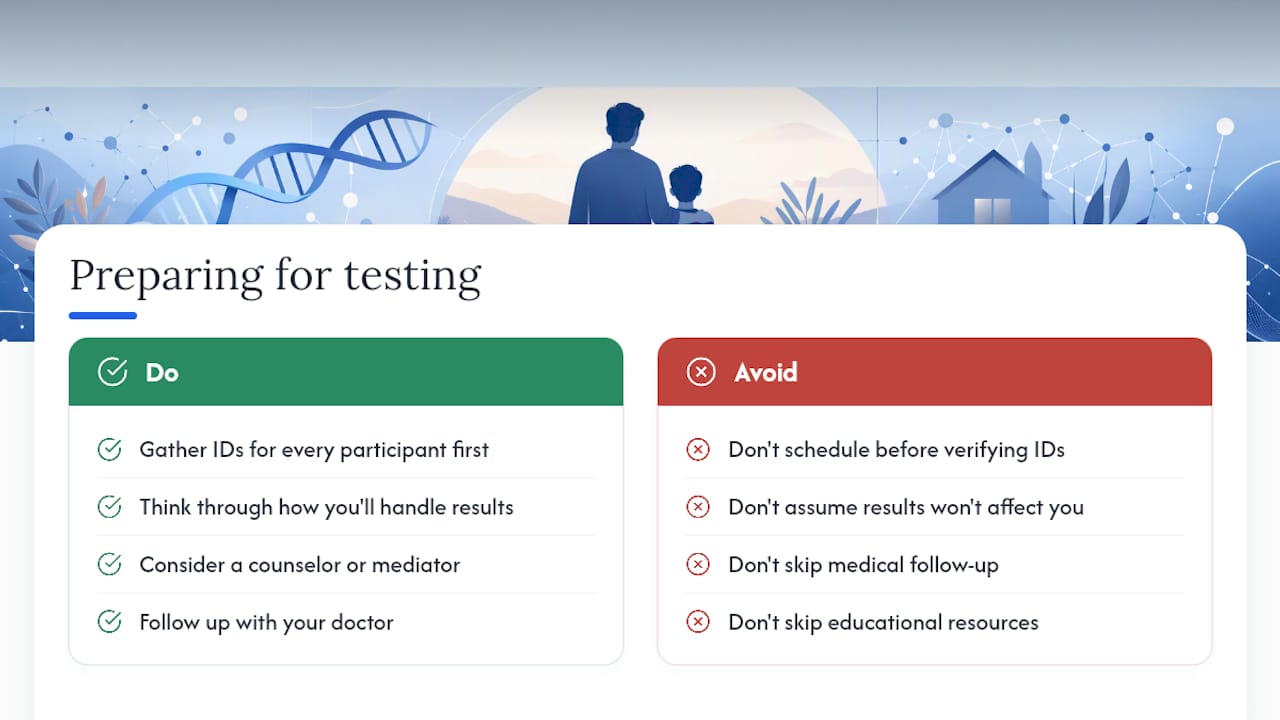
Ordering a relationship test is rarely just a logistics task. Families come to this decision after months of doubt, difficult conversations, or a legal deadline that won't wait, and the paperwork is the easy part. If the result is going anywhere near a courtroom or a government office, gather identification for every participant before you schedule collection, not after, because a missed document can push a legal case back weeks.
The harder preparation is emotional. Think through how you'll handle the result, whatever it turns out to be, before it arrives, and consider a family counselor or mediator if the outcome could reshape a relationship or a custody arrangement. Following up with your doctor also matters if a paternity or maternity result carries medical implications, since genetic relationship confirms lineage but doesn't screen for health conditions. US Diagnostics Center's guided selection tool and educational articles exist for exactly this reason: to walk you through the decision one step at a time instead of leaving you to sort through jargon alone.
— Dr. Todd Lewis
Ordering a Relationship DNA Test Through US Diagnostics Center
US Diagnostics Center gives you a faster, clearer path than piecing together a test on your own: one guided tool matches your exact scenario, paternity, maternity, sibling, grandparent, avuncular, or twin zygosity, to the correct kit, so you're not stuck guessing between products that sound the same but aren't.
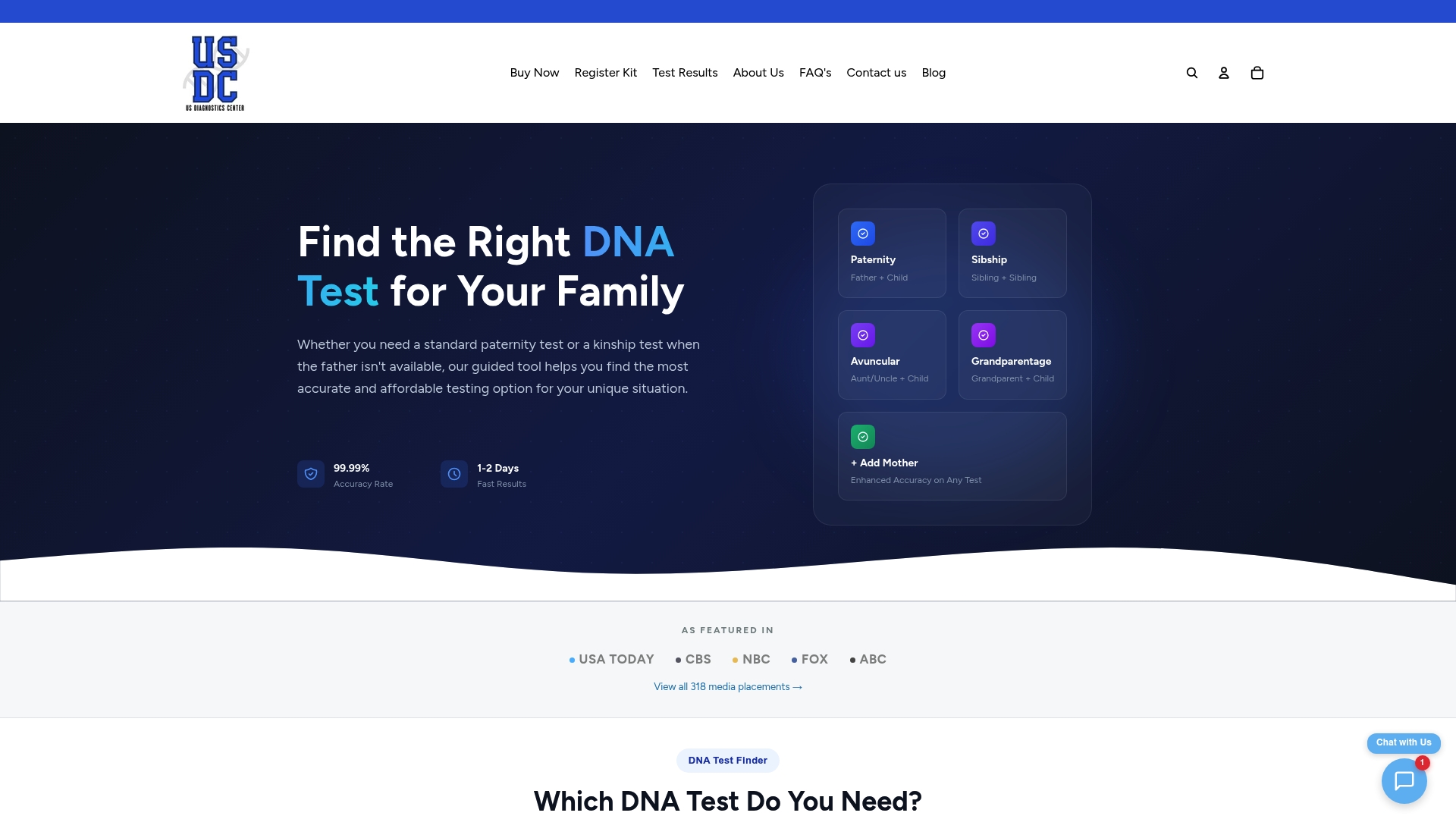
Every order ships with a prepaid return envelope, and lab processing takes 2 to 3 business days once your sample arrives, with standard order-to-results timing of 7 to 10 business days. Home paternity starts at $79, maternity at $129, and sibling, grandparent, or aunt/uncle testing at $139. Legal tests add witnessed collection and full chain-of-custody documentation for court, custody, or agency use. If your situation needs to hold up officially, start with the legal DNA test collection; for private peace of mind, browse the home DNA test collection and get your kit moving today.
This article is general information, not a substitute for advice from a qualified doctor. Consult a qualified healthcare professional about your own circumstances before acting on anything here.
Sources
- DNA Paternity Test: Procedure, Accuracy & Results — Cleveland Clinic
- Why Some DNA Tests for Relationships Are Inconclusive | AssureDNA
FAQ
What Does "Personal DNA Profile" Mean in This Context?
It refers to relationship DNA testing, comparing genetic markers between two or more people to confirm biological kinship such as paternity, sibling status, or grandparentage, not ancestry or forensic profiling.
Can an At-Home DNA Test Be Used in Court?
No. At-home kits lack the witnessed collection and chain-of-custody documentation courts require; you need a legal test from the start if the result will be used officially.
How Many Markers Does US Diagnostics Center Test?
US Diagnostics Center analyzes up to 28 genetic markers, with higher-resolution panels available for complex cases like sibling or avuncular testing.
How Long Does It Take to Get Results?
Lab processing typically takes 2 to 3 business days, with standard order-to-results timing of 7 to 10 business days; expedited options are available.
What Happens if a Relationship Test Comes Back Inconclusive?
The lab typically expands the marker panel or moves to advanced testing to reach a more definitive statistical conclusion, especially for extended family comparisons.
Recommended
- How Fast Home DNA Test Results Arrive: A Clear Guide
- 10 Questions to Ask Before Ordering a Home DNA Test Kit
- How DNA Testing Works: Step-by-Step Guide
- Home DNA Test vs Legal DNA Test: How to Choose (Framework)
This article is part of our Understanding DNA Testing: How It Works and What to Expect guide.


0 comments