

TL;DR:
- Court-admissible DNA testing provides legally recognized proof with chain-of-custody collection, accredited reporting, and signed documentation. It is necessary for legal matters such as child support, custody, and inheritance claims, but not for personal or medical knowledge. Always consult a family law attorney before relying on private DNA results for legal changes.
Court-admissible DNA testing, sometimes called "embassy-approved" testing in consumer searches, delivers three things a private at-home swab cannot: legal weight in court, a documented chain of custody that survives evidentiary challenges, and a standardized signed report that administrative agencies and judges will actually accept. This article covers those benefits exclusively for U.S. family and personal legal needs, including paternity disputes, custody proceedings, inheritance claims, and Social Security determinations. It does not address immigration, consular visa applications, or USCIS petitions, which operate under an entirely separate regulatory framework.
Table of Contents
- What "court-admissible" DNA testing actually means
- Why a legal DNA test carries more weight than a private one
- What a DNA result can and cannot do legally
- How to get a court-admissible DNA test: a step-by-step checklist
- Private at-home tests vs. legal tests: which one do you actually need?
- Key Takeaways
- What families often get wrong about DNA testing
- At-home DNA testing from US Diagnostics Center
- FAQ
- Primary sources and further reading
What "court-admissible" DNA testing actually means
The phrase "embassy-approved DNA testing" circulates widely in consumer searches, but the recognized industry term is court-admissible or **legal-pattern DNA testing. The distinction matters because the collection procedure, not the laboratory alone, determines admissibility.
A court-admissible test requires:
- Probability and exclusion statistics derived from a marker panel, with up to 28 markers analyzed to maximize certainty
What this article does not cover: immigration DNA testing for USCIS or consular offices, prenatal or non-invasive prenatal paternity (NIPP) testing, and ancestry or ethnicity panels. Those involve different regulatory bodies and collection protocols.
Pro Tip: Ask any lab you are considering whether their collection process includes a signed chain-of-custody form and photo ID verification. If the answer is no, the result will likely not hold up in court, regardless of the lab's accuracy claims.

Why a legal DNA test carries more weight than a private one
The core benefit of court-admissible testing is that its results can actually be used. According to the Cleveland Clinic, at-home tests are generally not admissible in court, while tests completed at an approved facility are. That single distinction drives every other advantage below.
- Child support and IV-D agency use. Under 45 CFR § 303.5, IV-D agencies must use competitively procured, legally acceptable labs. A test ordered through or accepted by a child support office carries statutory weight that a pharmacy kit does not.
- Accurate medical history for the child. The OCSE Child Support Handbook notes that establishing legal paternity also gives a child access to the father's medical history, which can affect healthcare decisions for years.
What a DNA result can and cannot do legally
A positive DNA result is powerful evidence, but it is not a self-executing legal order. California's court self-help guidance states plainly that a DNA test does not automatically make someone a legal parent. Courts weigh statutory presumptions, voluntary acknowledgments of paternity (VAPs), and equitable factors alongside the genetic result.
Key limits to understand:
- State law varies significantly — Some states allow disestablishment petitions; others do not. Consulting a family law attorney before relying on a DNA result to alter an existing legal relationship is not optional — it is necessary.
Pro Tip: If a court order already exists regarding parentage, speak with a family law attorney before ordering any DNA test. Acting on a private result without court authorization can complicate, rather than resolve, your legal situation.
Consent is equally non-negotiable. The Cleveland Clinic advises that testing a child's DNA should involve all legal guardians, and that transparency at the outset prevents legal and ethical disputes later, even when the results themselves are accurate.
How to get a court-admissible DNA test: a step-by-step checklist
- Identify the test type you need. Paternity, maternity, grandparentage, sibling, or avuncular testing each has a specific collection protocol. Confirm which relationship you are establishing before ordering. The paternity testing guide at US Diagnostics Center explains the differences clearly.
- Select a lab that performs legal-pattern testing. Verify that the lab requires photo ID at collection, uses a neutral third-party collector, and provides signed chain-of-custody documentation. AABB accreditation is the standard to look for in a lab.
- Schedule certified collection. Collection must occur at an approved site: a clinical lab, a licensed collection facility, or a location designated by the court or IV-D agency. Bring government-issued photo ID for every participant.
- Complete all required paperwork at collection. Sign the chain-of-custody form, confirm sample labeling, and retain a copy of the custody documentation. This paperwork is what courts and agencies will review.
- Await the lab report. The report should include the marker panel results (up to 28 markers), a probability of paternity or exclusion statement, and the analyst's signature and credentials.
- Submit results with supporting documentation. Attach the original signed chain-of-custody form to the lab report when filing with a court or administrative agency. Check with the court clerk or your attorney about any jurisdiction-specific filing requirements.
Actionable checklist for court submission:
- Signed chain-of-custody form (original, not a photocopy)
- Lab report with analyst signature and accreditation details
- Photo ID copies of all tested parties (as required by the court)
- Filing fee and any court-required cover sheet
- Attorney review if a prior parentage order exists
Pro Tip: Request a certified copy of the lab report directly from the laboratory, not just a PDF download. Courts and agencies often require a document with an original or certified signature rather than a self-printed copy.
Private at-home tests vs. legal tests: which one do you actually need?
Legal and non-legal DNA tests differ in three fundamental ways: collection oversight, chain-of-custody documentation, and court admissibility. The right choice depends entirely on what you plan to do with the result.
| Situation | At-home test sufficient? | Legal test required? |
|---|---|---|
| Personal peace of mind / family knowledge | Yes | No |
| Medical family-history research | Yes | No |
| Child support or custody filing | No | Yes |
| Probate / inheritance claim | No | Yes |
| Social Security benefits claim | No | Yes |
| Name-change or birth-certificate amendment | No | Usually yes |
| Informal family confirmation before pursuing legal action | Yes | No (yet) |
Scenarios where an at-home test is appropriate:
- You want to confirm a biological relationship privately before deciding whether to pursue legal action
- The result is for personal or medical knowledge only, with no planned court or agency filing
- All parties are adults who consent freely and understand the result is informational
Scenarios where only a legal test will do:
- A court, IV-D agency, or attorney has requested documented genetic evidence
- You intend to file for child support, modify a custody order, or contest an inheritance
- The result will be submitted to a federal or state agency
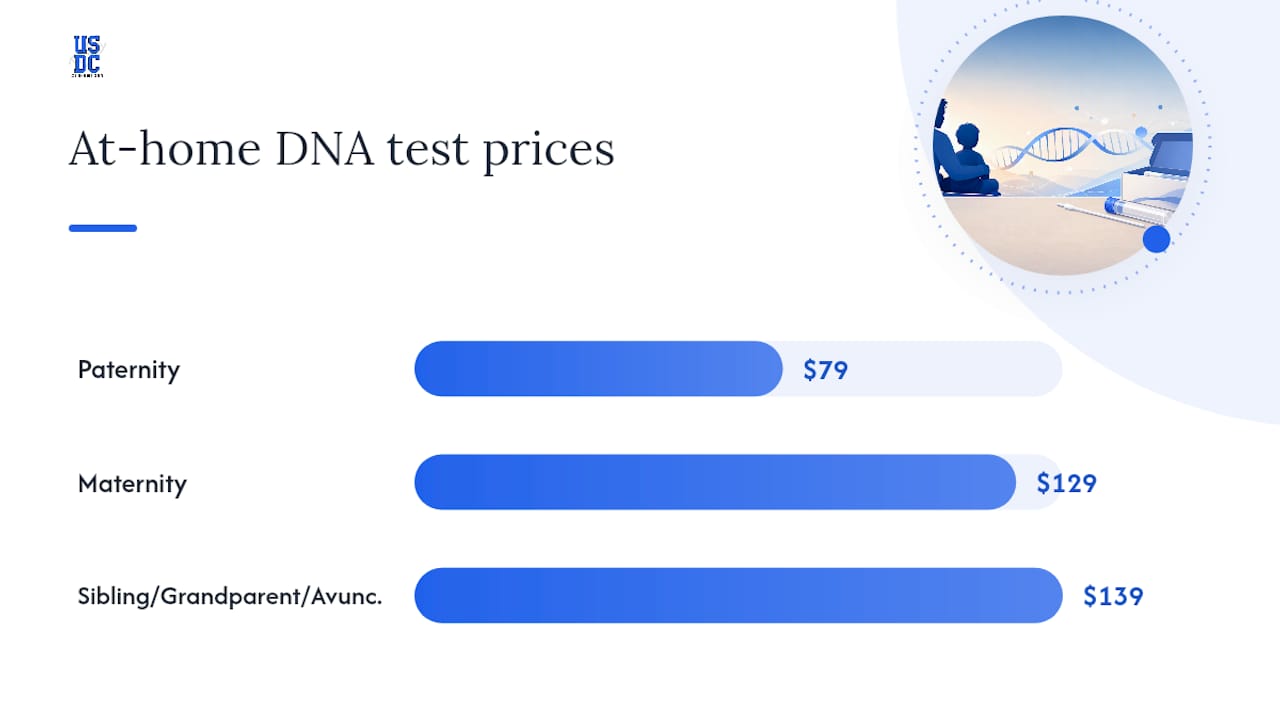
US Diagnostics Center offers at-home DNA tests for paternity ($79), maternity ($129), and sibling, grandparent, or avuncular relationships ($139), with results in 7–10 business days and a prepaid return shipping envelope included. These tests are designed for informational use and are not court-admissible unless ordered and collected under a legal chain-of-custody protocol. For readers who need a legal DNA test, that requires a separate, certified-collection process.
Key Takeaways
Court-admissible DNA testing provides legally usable proof of biological relationships through chain-of-custody collection, accredited lab reporting, and signed results that courts and agencies will accept.
| Point | Details |
|---|---|
| Legal admissibility requires chain of custody | Witnessed collection, photo ID, and signed custody forms are mandatory for court use. |
| DNA alone does not create legal parenthood | Courts weigh statutory presumptions and prior orders alongside genetic results. |
| Cost and timeline | Standard order-to-result is 10–21 days for a private legal test; total price varies by provider and agency involvement. |
| Consent is non-negotiable | All legal guardians must consent before a minor's DNA is collected. |
| US Diagnostics Center | Offers at-home informational tests from $79; not court-admissible without legal chain-of-custody collection. |
What families often get wrong about DNA testing
The most persistent misconception in this space is that accuracy equals admissibility. A test can be 99.99% accurate and still be thrown out of court if the sample was self-collected at home without a neutral witness. Judges are not evaluating the science; they are evaluating the procedure. That is why chain-of-custody documentation exists — not to make testing harder, but to make the result unassailable.
A second underappreciated point: the legal test is often the cheaper long-term choice. Families who start with a private at-home test, then discover they need a court-admissible result, end up paying for both. Deciding upfront whether the result will ever need to stand in court saves time and money.
Finally, consent deserves more attention than it typically gets. Testing a child without the knowledge of all legal guardians can expose the requesting party to legal liability, even when the intent is entirely benign. Transparency at the outset is not just ethical — it is protective.
At-home DNA testing from US Diagnostics Center
When a court-admissible test is not what you need, US Diagnostics Center offers a straightforward at-home alternative for families seeking biological clarity without the cost and logistics of certified collection.
Available tests include paternity ($79), maternity ($129), and sibling, grandparent, or avuncular testing ($139). Each kit analyzes up to 28 markers, includes a prepaid return shipping envelope, and delivers results within 7–10 business days, with 2–3 business days of lab processing time.
These results are informational. They are not court-admissible unless the sample is collected under a certified legal chain-of-custody protocol. If you are unsure which test type fits your situation, the home DNA test collection and the kinship testing options pages explain each product clearly. For situations that require a court-ready result, review the legal test options before ordering.
FAQ
What makes a DNA test court-admissible?
A court-admissible DNA test requires witnessed collection by a neutral third party, photo ID verification, signed chain-of-custody documentation, and a signed lab report from an accredited facility. At-home self-collected tests are generally not accepted by courts.
Does a DNA test automatically establish legal parenthood?
No. A DNA result is strong evidence, but courts also consider statutory presumptions, voluntary acknowledgments of paternity, and prior court orders before changing legal parentage status.
How long does a legal DNA test take from order to result?
Standard order-to-result timelines run approximately 10–21 days, including collection scheduling, shipping, and lab processing. Expedited processing can reduce the lab portion to 3–5 days for an additional fee.
Can US Diagnostics Center's at-home tests be used in court?
US Diagnostics Center's at-home tests are informational and are not court-admissible unless collected under a certified legal chain-of-custody protocol.
Do I need an attorney to use a DNA test result in court?
Not always, but consulting a family law attorney is strongly advisable, particularly if a prior court order regarding parentage already exists or if you intend to file for child support, modify custody, or contest an inheritance.
Primary sources and further reading
- Genetic testing and parentage | California Courts | Self Help Guide
- DNA Paternity Test: Procedure, Accuracy & Results
- 45 CFR § 303.5 - Establishment of paternity.
- Child Support Handbook: Chapter 3 - Establishing Fatherhood
- Should You Purchase a Legal or Non-Legal DNA test? Three Key Differences to Know - ARCpoint Labs
This article provides general information about DNA testing procedures and legal concepts. It is not legal or medical advice. Consult a licensed family law attorney and your state's court clerk for rules that apply to your specific situation.
Recommended
- Why Court DNA Differs from Private Tests: A Clear Guide | USDC
- Why DNA Tests Beat Blood Tests for Relationship Proof | USDC
- Why Legal DNA Testing Has Strict Protocols Explained | USDC
- DNA Testing for Probate & Inheritance Disputes (2026) | USDC
This article is part of our Understanding DNA Testing: How It Works and What to Expect guide.


0 comments