

TL;DR:
- Legal DNA tests require strict documentation protocols, including witnessed collection and chain-of-custody forms. Courts rely on verifiable evidence, and any missing record can lead to evidence exclusion or limited credibility. At-home kits offer affordable personal verification but lack the documented custody necessary for legal admissibility.
Legal DNA tests require strict protocols because courts treat the paper trail and sample handling as equally important as the lab result itself. The National Institute of Justice explains that an unbroken, documented chain of custody, combined with validated lab procedures, is what allows a court to verify that the sample presented as evidence is the same one collected from the donor. Without that documentation, even a scientifically accurate result can be excluded from court. Standards bodies including the American Bar Association and quality frameworks such as AABB and ISO/IEC 17025 exist precisely to enforce those requirements.
Table of Contents
- Why legal DNA testing has strict protocols: what the rules actually cover
- Why do courts insist on such strict documentation?
- What does a court-admissible DNA test look like, step by step?
- How strict protocols prevent contamination, mislabeling, and fraud
- At-home kits vs. court-admissible legal tests: key differences
- What should you ask for if you need court-admissible results?
- What does legal DNA testing typically cost and how long does it take?
- What should you do if you need DNA evidence for a court case?
- Key Takeaways
- The protocols matter more than most consumers realize
- At-home DNA testing from US Diagnostics Center
- Useful sources
- FAQ
Why legal DNA testing has strict protocols: what the rules actually cover
"Strict protocols" is shorthand for a specific set of documented practices that govern every step from sample collection to final report. Here is what that covers in practice:
- Identity verification: Photo ID is checked and recorded before any sample is collected.
- Witnessed/observed collection: A neutral third party watches the donor provide the cheek swab, so the lab can confirm who gave the sample.
- Tamper-evident packaging: Samples are sealed immediately in packaging that shows visible signs of interference if opened.
- Chain-of-custody forms: A paper form travels with the sample, capturing every transfer with signatures, dates, and times. StatPearls describes this as a sequential documentation trail that accounts for every custody change, control event, and analysis step.
- Unique labeling and accession numbers: Each sample receives a unique ID code at collection and again when the lab logs it in, a process called accessioning.
- Documented storage and transport: Temperature, access logs, and courier records are maintained throughout.
- Proficiency testing and method validation: Lab analysts undergo regular external proficiency tests, and every analytical method must be internally validated before use in casework.
Pro Tip: If you need results that can be used in a custody hearing, child support proceeding, or any other legal matter, insist on a neutral third-party collector at a designated collection site. A sample collected at home by the parties involved cannot be witnessed, which is the single most common reason courts reject DNA evidence.
Understanding the chain of custody paperwork behind a legal test helps consumers ask the right questions before they order.
Why do courts insist on such strict documentation?
Courts require verifiability. A DNA result is only as credible as the documented history of the sample that produced it.
"The chain of custody of evidence is a record of individuals who have had physical possession of the evidence. Documentation is critical to maintaining the integrity of the chain of custody." — National Institute of Justice
The legal rationale is straightforward: if a party challenges the result, the court needs to call witnesses who can testify to every handoff. NIJ guidance makes clear that every transfer, receipt, and storage event must be documented and that labs must limit access and log custody entries to preserve admissibility.
When those records are incomplete, the consequences are concrete. A broken chain of custody is one of the most common reasons courts exclude DNA evidence entirely, or instruct a jury to give it limited weight. Any unlogged transfer or unaccounted-for period creates a legal challenge to authenticity that the opposing party can exploit.
The American Bar Association's standards for DNA evidence reinforce this by requiring written policies, validated testing protocols, and quality assurance audits for any DNA result used in a legal setting.
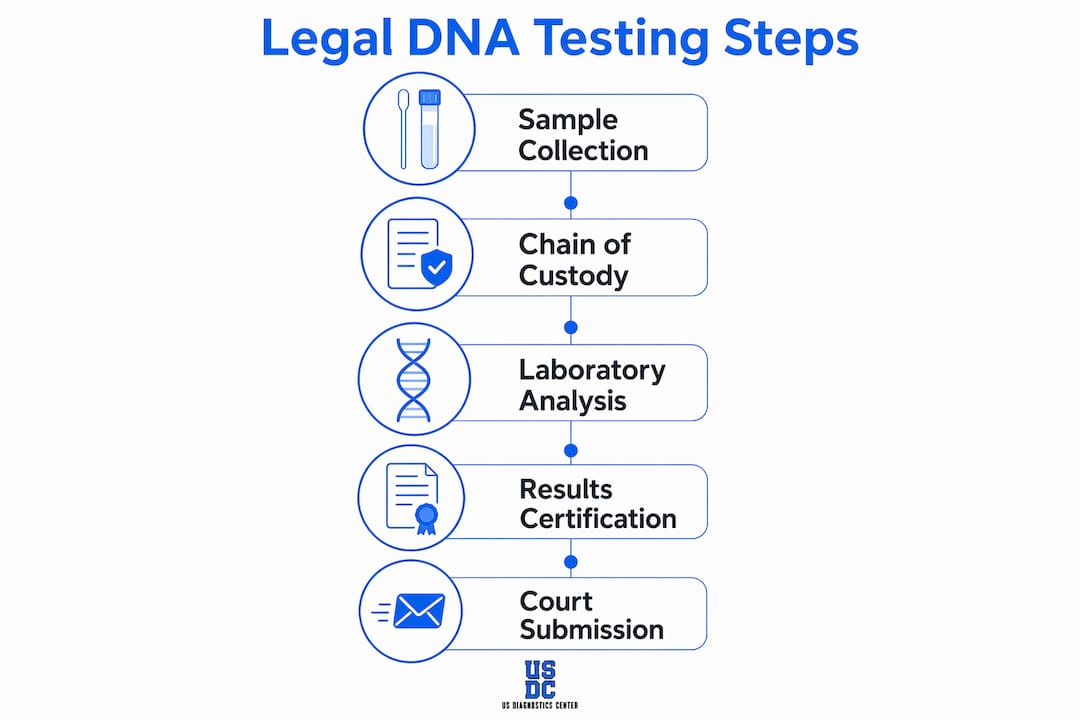
What does a court-admissible DNA test look like, step by step?
A legal test follows a fixed sequence. Each step generates documentation that feeds into the next.
- Pre-test intake and chain-of-custody form: The collector opens a new chain-of-custody form, records the case number, and notes the date, time, and location.
- Identity verification: Each donor presents government-issued photo ID. The collector records the ID details and signs the form.
- Observed collection: The collector watches each donor swab their own cheek. No sample leaves the donor's presence unwitnessed.
- Sealing and labeling: Swabs go immediately into labeled, tamper-evident envelopes. The donor and collector both sign across the seal.
- Transport with documentation: Samples ship via tracked courier. Every handoff is logged with a signature and timestamp.
- Lab accessioning: The receiving lab assigns an internal accession number, logs the condition of the packaging, and notes any anomalies.
- Analysis with validated STR methods: Analysts run short tandem repeat (STR) profiling using internally validated methods. Separate pre-PCR and post-PCR work areas prevent contamination between stages.
- Case review and certified report: A technical reviewer checks the analyst's work. The final report carries the analyst's signature and, where required, a notarized certification.
Accreditation checkpoints are embedded throughout. Labs holding AABB or ISO/IEC 17025 accreditation are audited against written quality standards, and professional guidelines recommend minimized transfers, retained sample portions where feasible, and documented checkpoints to detect mislabeling.
How strict protocols prevent contamination, mislabeling, and fraud
Each protocol maps directly to a failure mode it is designed to prevent.
Mislabeling is the most common source of false inclusions or exclusions. If a sample tube carries the wrong name, the result is attributed to the wrong person. Unique ID codes assigned at collection and again at accessioning create two independent checkpoints that catch transposition errors before analysis begins.
Contamination produces mixed DNA profiles, which can make a result uninterpretable or, worse, misleading. Physically separated pre-PCR and post-PCR laboratory areas, combined with reagent blank controls run alongside every case, catch contamination events before they affect a reported result. The Reference Manual on Scientific Evidence notes that sample mishandling is more likely to compromise outcomes than the DNA typing chemistry itself.
Chain gaps and possible tampering are addressed by the custody form's requirement that every transfer be signed and timestamped. A gap in that record, even an honest one caused by an undocumented storage move, creates reasonable doubt that the defense can use to challenge admissibility.
Proficiency testing adds a final layer. Analysts are tested against known samples on a regular schedule, so any systematic error in technique is identified and corrected before it affects casework.
At-home kits vs. court-admissible legal tests: key differences
| Feature | At-home kit | Court-admissible legal test |
|---|---|---|
| Collection method | Self-collected cheek swab at home | Observed by neutral third-party collector |
| Identity verification | None | Government-issued photo ID required |
| Chain-of-custody form | Not included | Required; signed at every transfer |
| Lab accreditation | Varies | AABB or ISO/IEC 17025 typically required |
| Certified report | Not standard | Signed, certified report issued |
| Court use | Not admissible | Admissible when protocols are followed |
| Typical cost | A range of prices that depend on the relationship type | Higher; includes collection and handling fees |
| Turnaround | 7–10 business days | Varies; often longer due to scheduling |
At-home kits do offer real advantages: they are affordable, private, and can test up to 28 markers for high accuracy. What they cannot provide is the witnessed collection and documented custody trail that courts require. A result from a home kit can be scientifically accurate and still inadmissible in court because no impartial witness exists for the sample.
Pro Tip: If your situation may eventually involve a court, order the legal chain-of-custody test from the start. Retesting later costs more time and money, and a home-kit result cannot be retroactively converted into court-admissible evidence.
What should you ask for if you need court-admissible results?
Before scheduling a legal DNA test, confirm the following:
- Neutral, third-party observed collection: Ask whether the provider uses a certified collector at a designated site, not a self-collection option.
- Chain-of-custody form: Request a copy for your records. It should include unique sample IDs, collector signatures, witness signatures, and timestamps for every transfer.
- Lab accreditation status: Confirm the testing lab holds AABB or ISO/IEC 17025 accreditation. Ask for the accreditation number.
- Certified report with analyst signature: The final report should name the analyst, the methods used, and carry a certification statement.
- Documented ID verification: Confirm that government-issued photo IDs will be recorded for all parties.
- Turnaround and rush options: Ask for the standard and expedited timelines in writing before you commit.
Retain every document you receive, including the chain-of-custody form, the accession confirmation, and the final certified report. Courts may ask for originals.
What does legal DNA testing typically cost and how long does it take?
Legal tests carry higher costs than at-home kits because they include collection-site fees, courier and chain-of-custody handling, and accredited lab processing. Collection fees at a neutral site can add a meaningful amount to the base lab price, and rush processing typically costs more on top of that.
At-home relationship kits from US Diagnostics Center are priced at $79 for home paternity, $129 for maternity, and $139 for sibling, grandparent, or aunt/uncle tests. Lab processing runs 2–3 business days, with a standard order-to-results window of 7–10 business days. These kits include a prepaid return shipping envelope and test up to 28 markers. They are not court-admissible, but they are a practical and affordable option when the goal is personal family verification rather than legal evidence.
For legal tests, scheduling a collection appointment, shipping to an accredited lab, and generating a certified report typically extends the total timeline beyond what a home kit requires. Budget accordingly if you have a court deadline.
What should you do if you need DNA evidence for a court case?
Follow these steps in order to protect the chain of custody from the start.
- Consult your attorney first. Confirm what type of DNA evidence the court requires and whether the opposing party must be notified before testing.
- Choose an accredited legal testing provider. Verify AABB or ISO/IEC 17025 accreditation before ordering.
- Schedule observed collection at a certified site. Do not collect samples at home if the results are intended for court.
- Retain your chain-of-custody copies. Ask for a copy of the form at the time of collection, before the samples leave the site.
- Request the certified report in writing. Confirm the report will carry the analyst's signature and a certification statement.
- Store original documents securely. Courts may require originals, not photocopies.
Pro Tip: Document every handoff yourself, even if the provider does too. Note the date, time, and name of every person who handles your paperwork or samples. If a dispute arises later, your independent record can corroborate the official chain-of-custody form.
Avoid unwitnessed home collection entirely if court admissibility is the goal. No amount of lab accuracy compensates for the absence of a witnessed collection record.
Key Takeaways
Legal DNA tests have strict protocols because courts evaluate the documented history of a sample, not just the numerical result, and any gap in that record can render even accurate findings inadmissible.
| Point | Details |
|---|---|
| Chain of custody is the deciding factor | Courts rely on documented handoffs, signatures, and timestamps to verify sample integrity. |
| Witnessed collection is non-negotiable | Labs cannot legally assert who provided a sample without an impartial witness at collection. |
| Broken protocols mean excluded evidence | An unlogged transfer or missing signature gives opposing counsel grounds to challenge admissibility. |
| At-home kits serve a different purpose | Kits testing up to 28 markers are accurate and affordable but lack the custody documentation courts require. |
| US Diagnostics Center for home verification | At-home relationship tests start at $79 and return results within 7–10 business days for personal, non-court use. |
The protocols matter more than most consumers realize
There is a persistent misconception that DNA testing is primarily a chemistry problem: get the right markers, run the right analysis, and the result speaks for itself. That framing misses the point courts actually care about. A result is only as defensible as the documented record that surrounds it. Proficiency testing, method validation, and quality assurance audits exist not because labs distrust their own chemistry, but because courts need to be able to call a witness for every step. The chemistry is rarely what gets challenged. The paperwork is.
Consumers who order an at-home kit for personal peace of mind are making a reasonable choice. The science is sound, the accuracy is high, and the cost is manageable. But anyone who anticipates a legal proceeding, even a future one, should understand that converting a home result into court-admissible evidence is not possible after the fact. The decision about which type of test to order needs to be made before collection, not after.
For consumers navigating the difference between personal verification and legal evidence, understanding that distinction is the most practical thing this article can offer.
At-home DNA testing from US Diagnostics Center
At-home DNA kits are not court-admissible. They do not include observed collection or chain-of-custody documentation, which are the two elements courts require. That is a deliberate design choice, not a deficiency, because most families who test do not need a court result.
US Diagnostics Center offers at-home relationship tests for paternity ($79), maternity ($129), and sibling, grandparent, or aunt/uncle relationships ($139). Each kit includes a prepaid return shipping envelope, tests a high number of markers, and delivers results within 7–10 business days. If you need personal confirmation of a family relationship without a legal proceeding, browse the home DNA test options and order the kit that fits your situation.
Useful sources
- Chain of Custody, StatPearls, NCBI Bookshelf: Peer-reviewed clinical reference explaining chain-of-custody documentation requirements, form contents, and legal purpose. The primary source for understanding what custody forms must contain and why witnessed collection is required.
- Law 101: Legal Guide for the Forensic Expert, National Institute of Justice: NIJ's authoritative training resource on chain-of-custody requirements for forensic evidence. Explains why courts exclude evidence when the custody record is incomplete.
- Reference Guide on Human DNA Identification Evidence, NCBI Bookshelf: Covers validated methods, proficiency testing, quality assurance, and why sample mishandling is the primary risk to DNA evidence integrity.
- American Bar Association, Standards for DNA Evidence: Sets out the written policy, validation, and audit requirements that labs must meet for DNA evidence to withstand legal scrutiny.
- AABB accreditation explained, US Diagnostics Center: Consumer-facing explanation of what AABB accreditation means and what it requires of testing labs.
- Court DNA vs. private tests, US Diagnostics Center: Practical comparison of what distinguishes a court-admissible test from a consumer at-home kit, written for a general audience.
FAQ
What makes a DNA test legally admissible in court?
A court-admissible DNA test requires witnessed collection by a neutral third party, a completed chain-of-custody form with signatures and timestamps at every transfer, and a certified report from an accredited lab. The documentation trail, not the lab accuracy alone, is what courts evaluate.
Can an at-home DNA test be used in court?
No. At-home kits lack observed collection and chain-of-custody documentation, which are the two elements courts require to verify sample integrity. A result from a home kit may be scientifically accurate but remains inadmissible because no impartial witness can attest to who provided the sample.
What happens if the chain of custody is broken?
A broken or incomplete chain of custody gives opposing counsel grounds to challenge the evidence. Courts may exclude the result entirely or instruct the jury to give it limited weight, even if the underlying DNA analysis was performed correctly.
How many markers does a legal DNA test analyze?
Marker counts vary by lab and test type. US Diagnostics Center's at-home relationship kits test up to 28 markers. For legal tests, confirm the marker panel with the provider before ordering, as panel size can affect the statistical weight of the result.
What is the difference between AABB and ISO/IEC 17025 accreditation?
Both are quality standards for DNA testing labs, but they differ in scope. AABB accreditation is specific to relationship and parentage testing, while ISO/IEC 17025 is a broader laboratory competence standard used across forensic and clinical settings. Either can satisfy court requirements, depending on the jurisdiction and case type.
Recommended
- Why Court DNA Differs from Private Tests: A Clear Guide | USDC
- Why Home DNA Differs from Legal Tests: A Clear Guide | USDC
- What Is a Legal DNA Testing Site? Your 2026 Guide | USDC
This article is part of our Understanding DNA Testing: How It Works and What to Expect guide.


0 comments