

TL;DR:
- DNA paternity testing confirms parentage with over 99.99% inclusion probability, while kinship tests (sibling, grandparent, aunt/uncle) produce a Combined Relationship Index (CRI) rather than a probability percentage — making DNA analysis the definitive method in both cases. Blood group serology can only exclude some cases and has significant limitations, including lower exclusion rates and higher false positives, making DNA the preferred method in legal and forensic contexts. Non-invasive cheek swabs and broad kinship analysis emphasize DNA's practical advantages for individuals and complex cases.
DNA testing is defined as the analysis of short tandem repeat (STR) markers in a person's genetic code to confirm or exclude biological relationships with an inclusion probability exceeding 99.99% for paternity. Blood group serology, by contrast, checks for antigen compatibility across systems like ABO and Rh. It can rule out some relationships but cannot confirm them. That distinction is the core reason why DNA tests beat blood tests in every modern legal, forensic, and personal context. This article explains the science, the legal standards, and the practical advantages that make DNA testing the clear choice.
Why DNA tests beat blood tests for biological relationships
DNA profiling and blood group serology operate on fundamentally different principles, and those differences determine what each test can actually tell you.

DNA STR profiling examines specific locations in the genome where short sequences repeat a variable number of times. Each person inherits a unique combination of these repeats from both parents. By analyzing 15 to 20 of these loci, a laboratory can calculate the probability that two people share a biological relationship. The random match probability for unrelated individuals falls below one in a trillion. That figure means the chance of a false positive is essentially zero.
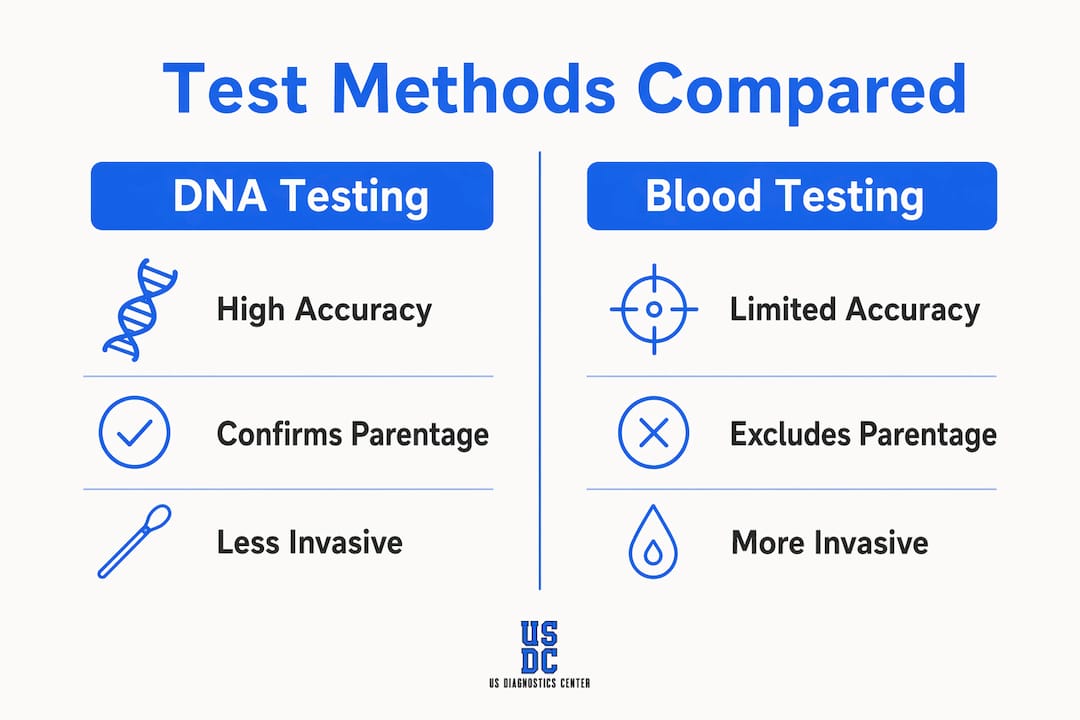
Blood group serology works differently. It detects the presence or absence of antigens on red blood cells, including ABO, Rh, MNS, and Kell systems. If a child carries an antigen that neither alleged parent could contribute, the test excludes that person as a biological parent. The problem is that blood group phenotypes are shared by large portions of the population. Serology excludes 55% to 85% of the population at most, leaving substantial uncertainty about who the actual parent is.
The statistical gap between the two methods is not marginal. It is the difference between narrowing a field and identifying a specific individual. DNA testing does the latter. Blood typing does not.
Pro Tip: If you are comparing test options for a legal matter, ask the laboratory how many STR loci they analyze. More loci produce stronger statistical evidence. US Diagnostics Center tests up to 28 markers, which exceeds the standard used in many court-ordered cases.
Immunological tests do retain one legitimate role. Forensic workflows use them as a preliminary step to confirm that a sample is human biological material before DNA profiling begins. That is a supporting function, not a replacement for genetic analysis.
What are the real limitations of blood tests for relationship testing?
Blood group testing cannot prove parentage. That is not a minor limitation. It is a structural one built into how the method works.
The exclusionary power of serology has a ceiling. Even when laboratories test multiple blood group systems simultaneously, the cumulative exclusion rate maxes out around 90% to 95%. That means up to 10% of the population could still share compatible blood types with a child, leaving the question of parentage unanswered. For a legal proceeding or a family seeking certainty, that level of ambiguity is not acceptable.
False exclusions add another layer of risk. Blood typing errors arise from chimerism, rare antigen variants like the Bombay phenotype, recent blood transfusions, and straightforward laboratory mistakes. A chimeric individual carries two genetically distinct cell populations, which can produce misleading antigen results. These are not theoretical edge cases. They have appeared in documented legal disputes and forensic reviews.
Sample degradation compounds the problem further. Blood group antigens degrade faster than DNA in older or environmentally compromised specimens. A sample stored improperly or collected weeks after an event may produce unreliable serological results, while DNA from the same sample can still yield a valid profile.
The risks of relying on blood tests alone include:
- No confirmation of parentage. Serology can only exclude, never confirm, a biological relationship.
- High false exclusion risk. Chimerism, rare phenotypes, and transfusions all produce misleading results.
- Sample fragility. Antigen degradation limits usefulness on older or poorly stored samples.
- Misinterpretation of mixtures. In cases with mixed biological stains, blood testing can misread mixtures, whereas DNA profiling separates individual genetic signatures.
- Legal inadmissibility. Blood tests are insufficient as sole evidence in most US courts today.
Pro Tip: If a test result surprises you, always verify whether the laboratory used DNA profiling or blood group serology. A negative result from serology alone does not definitively exclude a biological relationship.
Why do courts and forensic labs rely on DNA testing instead of blood tests?
DNA testing meets the evidentiary standards that courts require. Blood typing, used alone, does not.
In the United States, scientific evidence must satisfy either the Daubert standard or the Frye standard depending on the jurisdiction. Both frameworks require that a method be scientifically valid, reliably applied, and generally accepted in the relevant scientific community. DNA STR profiling satisfies all three criteria and is accepted in courts worldwide. Blood group serology, when offered as sole evidence of parentage, fails to meet the reliability threshold because it cannot produce a positive identification.
The transition from serology to DNA profiling in forensic and family law settings has taken place over the past three decades. The reasons are straightforward:
- Statistical certainty. DNA match probabilities routinely fall below one in a trillion, a figure that courts treat as definitive identification.
- Clear inclusions and exclusions. STR profiling produces unambiguous results. A person either shares the expected genetic markers with a child or does not.
- Broad sample applicability. DNA profiling works on blood, saliva, hair roots, and tissue, giving forensic teams flexibility that serology cannot match.
- Consistent laboratory protocols. Standardized STR kits and chain-of-custody procedures reduce the risk of contamination or misinterpretation.
- Documented case history. Laboratory errors with blood tests have contributed to documented miscarriages of justice, reinforcing judicial preference for DNA evidence.
Forensic experts now treat blood typing as largely obsolete for paternity determination in the US. Its conceptual value lies in helping courts understand likelihood ratio reporting, not in providing standalone evidence. For anyone seeking court-admissible results, DNA testing is the only method that reliably delivers them. You can review what courts actually accept as evidence in the US Diagnostics Center guide on admissible paternity evidence.
What practical advantages do DNA tests offer individuals?
Beyond legal settings, DNA testing offers concrete advantages for anyone seeking answers about biological relationships.
Sample collection is less invasive than a blood draw. DNA from buccal cells collected with a cheek swab produces results with the same accuracy as a blood sample. That matters for testing children, elderly relatives, or anyone with a medical condition that makes venipuncture difficult. The swab takes seconds and requires no clinical setting.
DNA testing also handles complex family scenarios that blood typing cannot address at all. Kinship analysis extends beyond direct parentage to grandparentage, sibling relationships, and aunt or uncle connections. This is critical when an alleged father is unavailable for testing. A paternity index can be calculated using DNA from the father's parents or siblings instead. Blood typing has no equivalent capability for these indirect relationship tests.
Posthumous testing is another area where DNA holds a clear advantage. Genetic material extracted from stored tissue, hair, or even exhumed remains can still produce valid STR profiles. Antigen-based testing on the same samples would likely fail due to degradation.
The practical benefits of choosing DNA testing include:
- Non-invasive collection. Cheek swabs replace blood draws in most testing scenarios.
- Faster turnaround. Modern laboratory automation delivers results in 2–3 business days for lab processing.
- Multi-generational kinship analysis. DNA tests work for grandparent, sibling, and aunt or uncle relationships, not just direct parentage.
- Reliability on degraded samples. DNA holds up better than antigens in older or improperly stored specimens.
- Court-ready results. Properly collected and analyzed DNA evidence meets legal standards that serology cannot satisfy alone.
For individuals navigating complex family situations, US Diagnostics Center offers kinship DNA testing that covers grandparentage, sibling, and aunt or uncle relationships with results typically delivered within 7–10 business days from order to report. Partner laboratories such as EIV Diagnostics also provide forensic diagnostic services that integrate immunological screening with DNA profiling for complex cases.
Key Takeaways
DNA testing surpasses blood group serology in every measurable dimension of accuracy, legal admissibility, and practical applicability for biological relationship confirmation.
| Point | Details |
|---|---|
| DNA confirms; serology only excludes | Blood tests cannot prove parentage, only rule out incompatible relationships. |
| Statistical power is not comparable | DNA match probabilities fall below one in a trillion; serology excludes at most 85% of the population. |
| Courts require DNA evidence | STR profiling meets Daubert and Frye standards; blood typing alone does not satisfy legal evidentiary thresholds. |
| Non-invasive collection is available | Cheek swabs provide DNA samples with the same accuracy as blood draws, removing the need for venipuncture. |
| Complex kinship cases need DNA | Grandparentage, sibling, and posthumous testing require genetic analysis that serology cannot perform. |
The shift I think most people still underestimate
People often assume that any biological test produces a definitive answer. Blood typing sounds authoritative. It involves a laboratory, antigens, and typed results on a report. The problem is that the word "exclude" and the word "confirm" are not interchangeable, and blood tests only do one of them.
What strikes me most about the DNA versus serology debate is how long blood typing remained in use for paternity cases after its limitations were well understood. The forensic community recognized the statistical ceiling of serology decades ago. Yet families and courts continued relying on it because it was familiar and available. That inertia caused real harm in documented cases where false exclusions went unchallenged.
The statistical certainty that DNA provides is not just a technical improvement. It changes what a result actually means for a family. A 99.99% inclusion probability is not a guess. It is a conclusion. A serological result that excludes 80% of the population leaves 20% of men potentially compatible with a child. Those are not equivalent outcomes for a parent, a child, or a judge.
If you are facing a paternity question, a kinship dispute, or any situation where a biological relationship needs to be established for legal or personal reasons, blood typing is not the right tool. The science has moved on. Choosing a DNA test pursued under rigorous quality standards, like those US Diagnostics Center applies, gives you results you can actually act on.
Immunological tests still matter in forensic workflows, but only as a preliminary step. They confirm what a sample is before DNA profiling begins. That is the correct role for serology in 2026, and it is a supporting one.
— Todd
US Diagnostics Center DNA testing: built for the answers you need
When a biological relationship question carries legal or personal weight, the test you choose determines whether you get a conclusion or more uncertainty.
US Diagnostics Center offers DNA testing that analyzes up to 28 STR markers, producing paternity results with a 99.99%+ inclusion probability, and Combined Relationship Index (CRI) scores for kinship tests including sibling, grandparent, and aunt or uncle relationships. Lab processing takes 2–3 business days, with standard order-to-results delivery in 7–10 business days. Each kit includes a prepaid return shipping envelope. Services cover paternity, maternity, sibling, grandparent, and aunt or uncle relationships, and results are court-admissible. US Diagnostics Center holds a BBB Accreditation with an A- rating, reflecting its commitment to quality standards. Explore the full range of legal DNA tests or review the complete paternity testing guide to find the right option for your situation.
FAQ
Can a blood test confirm who a child's father is?
No. Blood group serology can only exclude a person as a biological parent based on antigen incompatibility. It cannot confirm parentage because many unrelated people share compatible blood types.
How accurate is DNA testing compared to blood testing for paternity?
DNA STR profiling achieves an inclusion probability exceeding 99.99% for paternity, while blood group serology excludes at most 85% to 95% of the population and cannot produce a positive identification.
Are DNA test results admissible in court?
Yes. DNA STR profiling meets Daubert and Frye evidentiary standards and is accepted in courts across the United States and internationally. Blood typing alone does not meet the reliability threshold required for legal proceedings.
What sample is needed for a DNA test?
A cheek swab collecting buccal cells provides sufficient DNA for STR profiling with the same accuracy as a blood sample. This makes collection non-invasive and suitable for children and adults alike.
Can DNA testing work if the alleged father is not available?
Yes. Kinship DNA analysis can establish parentage indirectly by testing the alleged father's biological relatives, such as parents or siblings. Blood typing has no equivalent method for indirect relationship testing.
Recommended
- What Is a Relationship DNA Test? Your Clear Guide | USDC
- DNA Evidence in Paternity and Family Law Cases (2026) | USDC
- Why Couples Use Home DNA Kits for Clarity | USDC
- Top 5 DNA Testing Misconceptions — Myths vs. Facts | USDC
This article is part of our Understanding DNA Testing: How It Works and What to Expect guide.


0 comments