

A relationship DNA test is a form of genetic analysis used to confirm or exclude biological kinship between individuals, such as parent-child, sibling, or grandparent-grandchild connections. Also known as kinship or pedigree testing, these tests compare DNA profiles from two or more people using scientifically validated laboratory methods. People use them for personal clarity, legal proceedings such as family court cases, and immigration visa applications where documentary evidence is unavailable. Laboratories that meet recognized industry accreditation standards provide results with both scientific precision and procedural integrity, making these tests reliable for a wide range of purposes. US Diagnostics Center currently offers home DNA tests for personal knowledge, with home paternity starting at $79 — giving families an accessible, accurate starting point.
What is a relationship DNA test and how does it work scientifically?
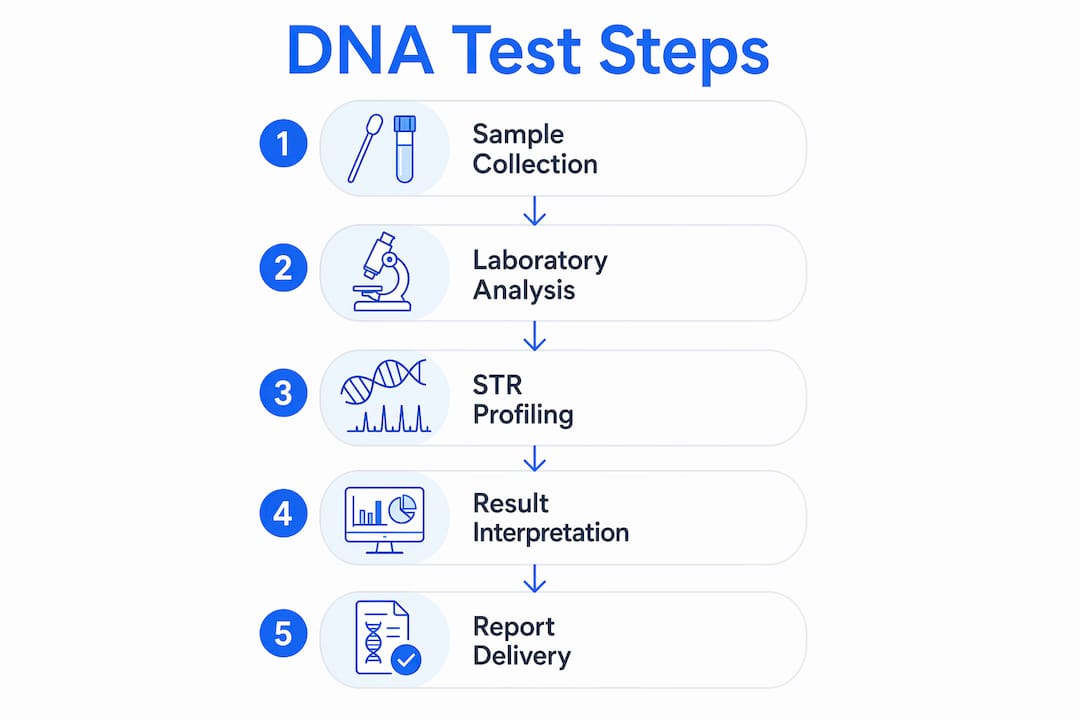
The scientific foundation of relationship DNA testing is autosomal STR profiling, which examines short tandem repeats (STRs) across multiple locations in a person's genome. STRs are segments of DNA that repeat in patterns unique to each individual, and because biological relatives share portions of these patterns, labs can calculate the statistical probability of a shared relationship. The result is not a simple yes or no. It is a likelihood ratio that quantifies how much more probable the relationship is compared to two unrelated individuals. Research published by the National Institutes of Health on forensic STR analysis confirms that multi-marker STR profiling is the gold standard for relationship determination.
Sample collection is straightforward. Most tests use a buccal swab, a soft brush rubbed against the inside of the cheek, to collect cells containing DNA. The swab is then processed in a certified laboratory where technicians extract, amplify, and analyze the DNA at specific genetic markers. This method is non-invasive and produces the same quality of genetic material as a blood draw when handled correctly. US Diagnostics Center analyzes up to 28 genetic markers per participant, providing a robust statistical foundation for each result.

Standard laboratory panels typically examine 20 or more STR markers. When initial results show apparent inconsistencies, such as mismatches at a small number of markers, labs do not automatically exclude a relationship. A 2026 Scientific Reports study demonstrated that expanded marker typing and MPS sequencing provided extremely strong statistical support for a paternity relationship even after three CODIS core STR mismatches. Those mismatches were caused by rare mutations, not by the absence of a biological relationship. This distinction matters enormously in legal and personal contexts.
The difference between forensic-style laboratory testing and consumer-oriented testing comes down to chain-of-custody protocols and the expertise applied to interpreting results. Consumer tests may use similar technology, but without proper documentation of sample handling, results cannot be used in court.
Pro Tip: If you are ordering a test for any legal purpose, confirm before purchasing that the laboratory follows strict chain-of-custody procedures and is accredited by an industry-recognized body. A home collection kit processed without these protocols will not be accepted in family court or immigration proceedings. US Diagnostics Center's home DNA tests are designed for personal knowledge — our legal DNA testing option is coming soon.
- STR profiling compares genetic markers across participants
- Likelihood ratios express the statistical probability of a relationship
- Buccal swabs are the standard, non-invasive collection method
- Up to 28 genetic markers analyzed for strong statistical certainty
- Expanded marker panels resolve cases where initial results are inconclusive
- Lab accreditation and chain-of-custody documentation determine whether results are legally admissible
What types of biological relationships can DNA testing confirm?
Relationship DNA testing covers a broader range of kinship scenarios than most people realize. The most common test is paternity testing, which compares a child's DNA to a potential father's DNA to confirm or exclude a biological father-child relationship. USDC's home paternity test is available for $79 and delivers results within 2 to 3 business days. Maternity testing follows the same principle and is used in cases involving surrogacy, adoption, or immigration — USDC's home maternity test is $129. Both tests produce results with very high statistical certainty when samples from both parties are available.
Siblingship testing is more complex because siblings share only a portion of their parents' DNA, and the amount varies. Full siblings share approximately 50% of their DNA on average, while half-siblings share around 25%. The test calculates a sibship index, a likelihood ratio specific to sibling relationships, to determine whether two individuals are full siblings, half-siblings, or unrelated. Including a known parent's DNA sample significantly increases the accuracy of this test. USDC's sibling DNA test is available for $139.
| Relationship type | Test name | Typical accuracy | Complexity |
|---|---|---|---|
| Parent-child | Paternity or maternity test | Very high (99.99%+) | Low |
| Full or half-siblings | Siblingship test | High, improved with parental DNA | Moderate |
| Grandparent-grandchild | Grandparentage test | High | Moderate |
| Aunt/uncle and niece/nephew | Avuncular test | Moderate to high | High |
| Distant relatives | Extended kinship test | Variable | Very high |
Grandparentage and avuncular testing are used when a direct parent is unavailable for testing. These tests examine shared DNA between a grandparent and grandchild, or between an aunt or uncle and a niece or nephew. Because the genetic overlap is smaller than in parent-child testing, these tests benefit greatly from including additional family members. USDC's grandparent and avuncular DNA tests are each $139. US Diagnostics Center offers kinship DNA tests covering all of these scenarios, with guidance on which combination of participants produces the most reliable result.
It is worth noting that the more distantly related two individuals are, the harder it becomes to reach a statistically conclusive result from DNA alone. For grandparentage and avuncular cases, labs strongly recommend including any available biological parent to anchor the analysis. If no parent is available, a full sibling of the tested parent can sometimes serve a similar function. Discussing your specific family situation with the lab before ordering ensures you select the right test from the start.
The key principle across all types is that selecting the correct testing scenario and working with a laboratory that has the expertise to interpret results in that specific context is critical. A lab experienced in paternity testing may not apply the same rigor to a complex avuncular case.
Legal and privacy considerations in relationship DNA testing
Legal admissibility and personal privacy are two distinct concerns, and both deserve careful attention before you order a test.
For court-admissible results, chain-of-custody procedures are non-negotiable. Chain-of-custody refers to the documented process of collecting, labeling, transporting, and storing samples in a way that prevents tampering or misidentification. Every step must be recorded and verifiable. Without this documentation, even a scientifically accurate result can be challenged and rejected in a legal proceeding such as a paternity affidavit dispute, a custody case, or an immigration visa application. USDC's current home DNA tests are for personal knowledge only and are not court-admissible. Legal DNA testing through USDC is coming soon.
The U.S. Department of State confirms that DNA testing verifies biological relationships in immigrant visa processes when no other credible documentary evidence is available. This applies to paternity, maternity, sibling, and grandparent-grandchild relationships. Tests used for this purpose must be conducted by AABB-accredited laboratories.
Privacy is a separate but equally serious consideration. The following points outline the key privacy and legal factors to evaluate:
- Accreditation status: Confirm the laboratory holds current AABB accreditation if your results need to meet legal or immigration standards. The AABB 17th edition standards, effective January 1, 2025, added requirements for sample integrity threat planning and compliance with data privacy agreements.
- Data sharing policies: Review whether the laboratory shares genetic data with third parties, including insurance companies or research organizations, before submitting samples.
- At-home vs. legal tests: At-home tests provide personal information but are not court-admissible, regardless of the laboratory's technology or certification. Legal tests require witnessed sample collection by a neutral third party and full chain-of-custody documentation.
- Unexpected findings: Results may reveal biological relationships that were previously unknown, such as a non-paternity event. Consider whether you are prepared for that possibility before testing.
- Counseling access: The National Society of Genetic Counselors recommends confirmatory testing and professional counseling for consumer-initiated genetic tests to support responsible interpretation of results.
Pro Tip: If you are testing for immigration purposes, you will need a legal test from an AABB-accredited lab from the start. Retesting after receiving inadmissible results adds cost and delays the visa process. USDC's immigration DNA testing is coming soon — contact us to be notified when it becomes available.
How to choose the right relationship DNA test for your situation
Choosing the right kinship DNA test starts with identifying your primary purpose. Personal knowledge, legal proceedings, and immigration applications each require a different level of documentation and laboratory oversight. Mismatching the test type to the purpose is the most common and costly mistake families make.
The following criteria guide a sound decision:
- Purpose first: Personal knowledge tests can use at-home collection kits. Legal and immigration cases require witnessed sample collection and full chain-of-custody documentation. US Diagnostics Center currently offers home DNA tests for personal knowledge, with legal testing coming soon.
- Lab accreditation: AABB accreditation is the recognized standard for relationship testing laboratories in the United States when results need to meet legal or immigration requirements. It signals that the lab meets current technology, privacy, and procedural requirements.
- Participant availability: The accuracy of siblingship, grandparentage, and avuncular tests increases when additional family members contribute samples. Ask the lab whether including a known parent or sibling would strengthen your specific case.
- Turnaround time: Standard results from USDC are typically delivered within 2 to 3 business days after the lab receives samples. Expedited options may be available when time is a factor.
- Cost transparency: Relationship DNA test cost varies by test type and number of participants. USDC's pricing: home paternity $79, home maternity $129, sibling/grandparent/avuncular $139. Request full details before ordering so there are no surprises.
- Result interpretation support: Confirm that the laboratory provides expert support to help you understand your results. Probability statistics and likelihood ratios are not self-explanatory for most people. USDC provides expert guidance throughout the process.
The benefits of DNA testing extend beyond confirming a single relationship. Accurate results provide peace of mind, support legal standing when obtained through appropriate channels, and give families the factual clarity needed to make informed decisions about custody, inheritance, and identity. To learn more about how these tests work before you order, visit our guide to understanding DNA testing.
Key takeaways
Relationship DNA testing is most reliable when the correct test type, appropriate laboratory, and the right participant combination are matched to the specific kinship scenario being investigated.
| Point | Details |
|---|---|
| Core definition | A relationship DNA test compares genetic profiles to confirm or exclude biological kinship. |
| Scientific method | STR profiling and likelihood ratios are the standard tools used to quantify relationship probability. USDC analyzes up to 28 genetic markers. |
| At-home vs. legal tests | USDC's current home DNA tests are for personal knowledge only and are not court-admissible. Legal testing is coming soon. |
| Privacy standards | AABB 17th edition standards, effective 2025, require data privacy agreements and sample integrity planning from accredited labs. |
| Test selection | Match the test type to your purpose: personal knowledge (available now at USDC), legal proceedings, or immigration verification (both coming soon). |
| Pricing | Home paternity $79 | Home maternity $129 | Sibling, grandparent, avuncular $139 |
What experience with DNA testing has taught me
I have reviewed a lot of DNA testing cases over the years, and the single most consistent mistake I see is people ordering the wrong test for their situation. Someone needs a result for a custody hearing, orders a home kit because it is cheaper, and then has to start over with a proper legal test after the court rejects the result. That delay has real consequences for families. Home DNA tests — including USDC's — are for personal knowledge only. If there is any chance a result will be presented in court or to an immigration authority, that conversation needs to happen before ordering, not after.
The second thing I have noticed is that people underestimate how much the participant combination matters. A siblingship test without any parental DNA is far less conclusive than one that includes even one known parent. Labs can work with what they have, but more informative samples always produce stronger statistical support. If a parent is available and willing to test, include them.
I also think the privacy conversation is underdiscussed. Most people focus entirely on accuracy and cost, which are both legitimate concerns. But genetic data is permanent. Once a laboratory has your DNA profile, the question of how that data is stored, protected, and potentially shared deserves the same scrutiny as the test result itself. The updated AABB standards that took effect in 2025 address this directly, and understanding what those standards require helps you ask the right questions of any lab you consider.
Finally, unexpected results happen. A test ordered to confirm paternity occasionally reveals something no one anticipated. Having access to a genetic counselor before and after testing is not a luxury. It is a practical safeguard for anyone navigating a sensitive family situation. The relationship testing knowledge page at USDC covers what to expect and how to interpret your results.
— Todd
Get accurate DNA testing from US Diagnostics Center
US Diagnostics Center provides home DNA testing solutions built for real family situations, from straightforward paternity cases to complex grandparentage and sibling scenarios. Every test analyzes up to 28 genetic markers, delivering results that are 99.99% accurate and available within 2 to 3 business days.
USDC's home DNA tests are for personal knowledge and peace of mind. Pricing is transparent — home paternity $79, home maternity $129, sibling/grandparent/avuncular $139 — expert support is available throughout the process, and confidentiality is maintained at every step. Legal DNA testing and immigration DNA testing are coming soon. Browse all home DNA tests and order with confidence knowing your results will be handled with care.
FAQ
What is the difference between a legal and at-home relationship DNA test?
A legal DNA test uses chain-of-custody procedures and witnessed sample collection, making results admissible in court or for immigration purposes. An at-home test provides accurate personal information but cannot be used in legal proceedings regardless of the lab's technology. USDC currently offers at-home tests for personal knowledge; legal testing is coming soon.
How accurate are relationship DNA tests?
Paternity and maternity tests from qualified laboratories produce results with 99.99% or greater probability of inclusion. USDC analyzes up to 28 genetic markers per participant to maximize statistical certainty. Siblingship and grandparentage tests are highly accurate but benefit from including additional family members' DNA samples.
How long does a relationship DNA test take?
Most laboratories deliver results within 2 to 3 business days after receiving samples. USDC follows this standard turnaround. Expedited processing may be available when results are needed urgently.
Can a DNA test confirm sibling relationships?
Yes. A siblingship test calculates a sibship index to determine whether two individuals are full siblings, half-siblings, or unrelated. Including a known parent's DNA sample significantly strengthens the statistical conclusion. USDC's sibling DNA test is $139 and covers full and half-sibling determinations.
What does relationship DNA test cost depend on?
Cost varies based on the type of relationship being tested, the number of participants, and whether legal documentation and chain-of-custody procedures are required. At USDC, home paternity is $79, home maternity is $129, and sibling, grandparent, and avuncular tests are $139. Complex tests such as avuncular or extended kinship testing require more analysis, which is reflected in the pricing.
What if one participant is unavailable for testing?
Testing can often proceed without one participant, though accuracy may be reduced. For paternity cases where the alleged father is unavailable, a grandparentage or avuncular test using his biological relatives can provide useful evidence. For siblingship cases without a parent, the sibship index will have wider confidence intervals but can still indicate a probable relationship. Always discuss your specific situation with the lab before ordering to select the most informative test design.
How much does a home DNA test cost at USDC?
US Diagnostics Center offers straightforward, transparent pricing for all home DNA tests: home paternity $79, home maternity $129, and sibling/grandparent/avuncular $139. All tests analyze up to 28 genetic markers and deliver results within 2 to 3 business days. Visit the home DNA tests collection for full details.
Recommended reading
Explore these related resources to deepen your understanding of relationship DNA testing and how USDC can help:
- Understanding DNA Testing: How It Works and What to Expect | USDC
- Relationship Testing | DNA Testing Glossary | USDC
- USDCTest | DNA Paternity Testing for Peace of Mind
- Kinship DNA Tests: Sibling, Grandparent & More | USDC
This article is part of our Understanding DNA Testing: How It Works and What to Expect guide.


0 comments