

Yes, expedited DNA testing can deliver paternity or kinship results in 1 to 3 business days once your sample reaches the lab, but total turnaround still depends on shipping time and whether you need legal documentation. Rapid DNA technology exists and can build a profile in about an hour, but it's built for law-enforcement booking, not personal test kits. If your results need to hold up in court or for a government agency, plan for extra time to cover chain of custody.
TL;DR:
- Shipping delays and sample quality issues can significantly extend the overall turnaround time, even with expedited processing.
- Rush processing in labs prioritizes your sample but does not bypass standard steps like DNA extraction and marker analysis, which still take time.
- Same-day results are extremely rare and generally only available through local, on-site testing, not mail-in kits.
- The typical processing time after the lab receives the sample is 1 to 3 business days for most consumer tests, not including shipping.
- Legal or court-admissible tests require chain of custody procedures that add extra time and complexity, making rapid legal results unlikely.
Table of Contents
- How Expedited DNA Testing Actually Speeds Things Up
- What "Same Day" and "Next Day" Actually Mean
- Why Your Results Might Come Faster or Slower Than Expected
- Home Test vs. Legal Test: When Chain of Custody Matters
- How to Get Expedited Results: Your Order Checklist
- What Actually Causes Delays in Urgent Cases
- Fast Results Sound Great Until Reality Sets In
- Ready for Faster, Reliable Results? Here's How US Diagnostics Center Helps
- Where These Answers Come From
- Sources
- FAQ
How Expedited DNA Testing Actually Speeds Things Up
Paying for rush processing buys you a spot at the front of the lab's line, not a shortcut through the biology. What changes is priority: your sample gets pulled for extraction and analysis before others in the queue, and the lab schedules its instruments to run your case sooner rather than batching it with a week's worth of orders.
What usually doesn't change is the shipping clock. Unless your expedited package specifically includes overnight return shipping, the envelope still travels at normal mail speed before the lab ever sees it. The testing sequence itself follows the same steps no matter how much you pay for speed:
- Sample receipt and check-in at the lab
- DNA extraction from the swab
- Amplification of the genetic material
- Marker analysis, often up to 28 markers for higher-confidence kinship results
- Interpretation of the profile
- Report generation and delivery
Rush fees generally cover priority processing, faster instrument scheduling, and quicker report turnaround. They don't override quality control. If a swab is degraded or paperwork is incomplete, the lab will flag it for re-testing regardless of what you paid, which resets the clock.
What "Same Day" and "Next Day" Actually Mean
Marketing language around fast DNA testing gets loose fast, so it helps to know what each phrase realistically covers.
Statistic snapshot: AABB notes that most relationship tests are reported in a week or less once the lab has received every sample needed for the comparison, a baseline worth remembering before you commit to a rush upgrade.
Realistic timeline bands look like this:
- Same day: Rare, and only possible with a local lab, on-site drop-off, and available instrument capacity that day.
- 24 hours after lab receipt: Possible in limited situations with a genuine express queue.
- 1 to 3 business days: The most common and realistic expedited option once the lab has your sample.
- 7 to 10 business days: The standard order-to-results timeline most consumer labs quote, including shipping both ways.
US Diagnostics Center's expedited option typically lands results within 2 to 3 business days of lab processing, with standard order-to-results running 7 to 10 business days. That gap between "lab processing time" and "total time" trips up a lot of people who assume expedited means overnight.
Why Your Results Might Come Faster or Slower Than Expected
Some delays are within your control, and some simply aren't. Shipping speed matters more than most people expect: choosing a courier or overnight return, or arranging local drop-off where a lab offers it, shaves real days off the timeline compared to standard mail. Sample quality matters just as much. Skipping the prep instructions, like eating or drinking right before a cheek swab when told not to, is one of the most common reasons a sample gets rejected and has to be redone.

Legal tests add another layer. Witnessed collection and identity verification are required for chain-of-custody results, so having ID ready and appointments scheduled ahead of time avoids unnecessary back-and-forth.
Then there's what you can't control:
- Lab backlog from a busy order period
- Weekends and holidays, which pause processing
- Scheduled instrument maintenance
- Unexpected quality-control flags on incoming samples
Pro Tip: Ship your sample early in the week. A package that arrives at the lab on a Friday often sits until Monday before processing even starts, which can quietly add two or three days to your expedited timeline.
Home Test vs. Legal Test: When Chain of Custody Matters
A home swab test tells you what you want to know personally, but it almost never satisfies a court or government agency on its own. Consumer kits typically lack the witnessed collection, verified identification, and documented shipping trail that legal proceedings require.

That trail is called chain of custody, and it exists to prove the sample tested is actually the person's sample, with no possibility of tampering or mix-up along the way. For immigration cases and many court matters, AABB-accredited facilities are commonly required, and checking a lab's accreditation status before ordering saves you from having to redo the entire test later.
The tradeoffs come down to this:
- Home/consumer tests: Faster, cheaper, no witnessed collection, not court-admissible.
- Legal chain-of-custody tests: Slower due to ID checks and witnessed swabs, but accepted by courts and agencies that require verified results.
If there's any chance your results end up in a legal filing, custody case, or immigration application, confirm the accreditation and chain-of-custody process before you order rather than after.
How to Get Expedited Results: Your Order Checklist
Getting the fastest realistic turnaround comes down to preparation before your kit even ships.
- Choose the right test type first. Decide whether you need a personal result or a legally admissible one, since that decision affects both cost and timeline.
- Gather ID and paperwork early if you're ordering a legal or chain-of-custody test, so witnessed collection doesn't get delayed by missing documents.
- Collect the sample carefully, following swab instructions exactly, then send it back using expedited or overnight shipping if that option is available.
- Confirm receipt with the lab and ask directly how and when you'll receive your report, whether by email, portal, or phone.
Our guide on same day paternity testing steps breaks the collection and shipping workflow down in more detail if you want a walkthrough before you order.
Pro Tip: Call the lab before you order, not after. Ask specifically whether expedited processing starts the moment they receive your sample or only after a batch cutoff, since that detail alone can change your results date by a full day.
What Actually Causes Delays in Urgent Cases
Most urgent testing requests hit the same snag: people assume "expedited" erases every source of delay, when it really only compresses the lab's own processing window. Shipping time, documentation gaps, and sample errors cause more real-world delays than lab speed ever does.
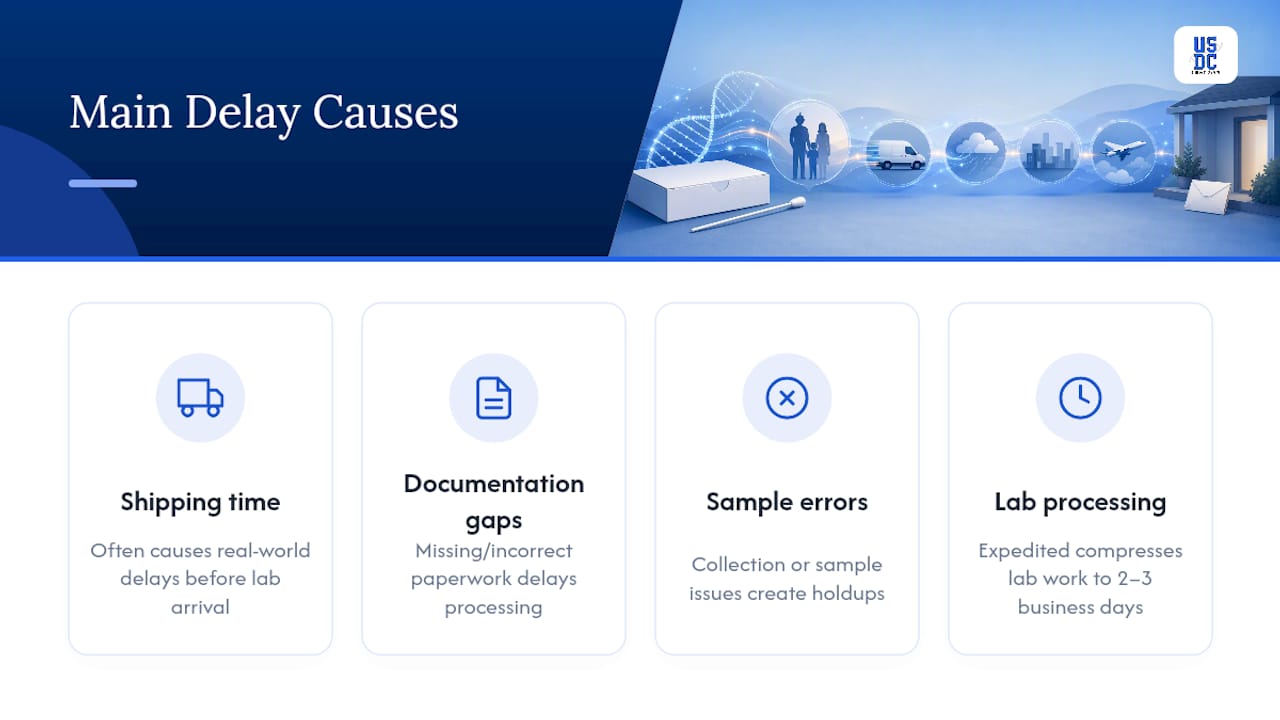
US Diagnostics Center's expedited option targets 2 to 3 business days of lab processing, backed by a guided selection tool that helps people pick the right test type before they order, along with marker analysis up to 28 markers for stronger kinship confidence. If you need results accepted by a court or agency, confirm the lab's accreditation status and chain-of-custody process before you order. If you're unsure which test fits your situation, reach out for a guided recommendation before you commit to a kit.
Fast Results Sound Great Until Reality Sets In
The biggest misconception about expedited DNA testing is that money buys speed at every stage. It doesn't. Money buys priority in the lab, and sometimes faster shipping, but it can't compress a witnessed collection appointment or waive an ID check a court requires. The conventional advice, "just pay for the rush option," skips over the fact that most delays happen before the sample ever reaches a lab technician.
What the evidence actually supports is a shift in priority: readers chasing fast results should worry less about which lab claims the shortest turnaround and more about eliminating the controllable delays first. Overnight the return shipment. Follow the swab instructions to the letter. Have identification ready if the results need to hold up legally. Those three habits do more for your timeline than any rush fee alone.
Rapid DNA's 1 to 2 hour turnaround gets cited constantly in casual conversation, but it's not a consumer option, and pretending otherwise sets people up for disappointment. The realistic target for anyone ordering a personal or legal kinship test is 1 to 3 business days of lab processing, and getting there faster is mostly a matter of preparation, not luck.
— Dr. Todd Lewis
Ready for Faster, Reliable Results? Here's How US Diagnostics Center Helps
Waiting on paternity or kinship answers is stressful enough without wondering whether your test kit is even the right one for your situation. US Diagnostics Center's guided selection tool walks you through your specific scenario, paternity, maternity, sibling, grandparent, or aunt/uncle testing, and points you toward the option that fits, with expedited lab processing typically landing in 2 to 3 business days and standard order-to-results running 7 to 10 business days.
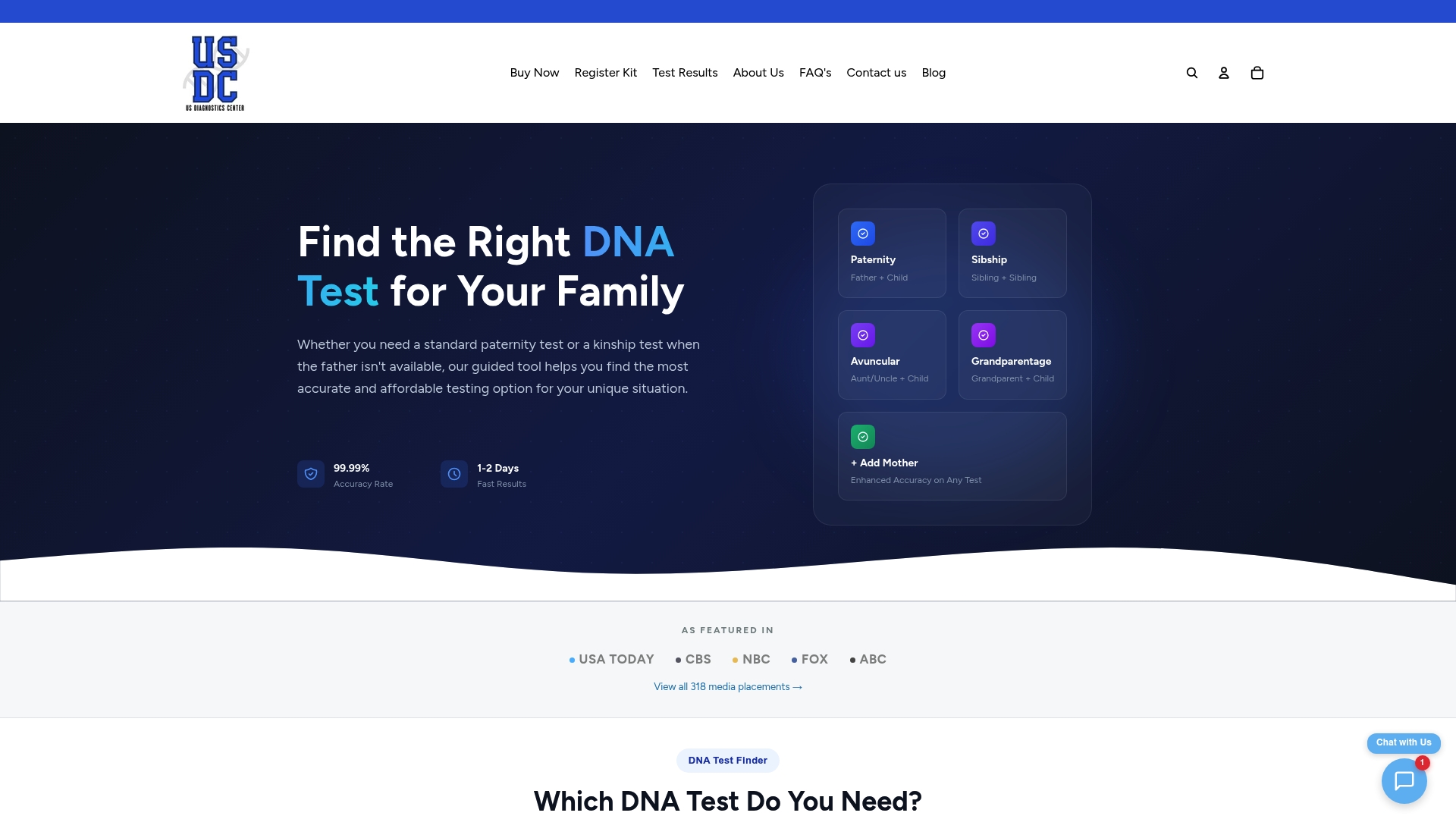
Every kit ships with a prepaid return envelope included, and analysis covers up to 28 markers for stronger confidence in kinship results. Pricing starts at $79 for home paternity testing, $129 for maternity, and $139 for sibling, grandparent, or aunt/uncle testing. US Diagnostics Center does not offer prenatal, immigration, or court chain-of-custody testing. For legal or court-admissible testing, confirm the lab's accreditation and chain-of-custody credentials before ordering. If you need a verified legal test, browse the legal and chain-of-custody test options instead. For personal answers fast, start with the home DNA test collection and select expedited processing at checkout.
Where These Answers Come From
Claims about Rapid DNA limitations and timelines come from federal and standards sources, not marketing copy. Review the FBI's Rapid DNA overview, NIST's Rapid DNA Typing program, the FBI's National Rapid DNA Booking Operational Procedures Manual, and AABB's relationship testing FAQ for the underlying rules and limits described above.
This article is general information, not a substitute for advice from a qualified doctor. Consult a qualified healthcare professional about your own circumstances before acting on anything here.
Sources
FAQ
What's the fastest you can get a DNA test?
The fastest realistic option for personal or legal kinship testing is 1 to 3 business days of lab processing after the sample arrives, not counting shipping time both directions.
Is it possible to get DNA results the same day?
Same-day results are rare and only happen with local drop-off at a lab that has open instrument capacity that day. Most people ordering a mail-in kit should expect 1 to 3 business days minimum after the lab receives the sample.
How quickly can a DNA test be completed?
Lab analysis itself, extraction through reporting, can be completed in a day or two under expedited processing, but total time from order to results typically runs 7 to 10 business days once shipping is included.
Is there a Rapid DNA test?
Rapid DNA technology exists and can generate a profile in roughly 1 to 2 hours, but it's built for law-enforcement booking under strict operational rules, not for consumer paternity or kinship testing.
Recommended
- How Fast Home DNA Test Results Arrive: A Clear Guide
- Instant Paternity Test: What "Instant" Really Means (2026)
- Same Day Paternity Testing Steps: Your Fast Results Guide
- Rush Paternity Test Results: Fast, Legal, and Accurate
This article is part of our Understanding DNA Testing: How It Works and What to Expect guide.


0 comments