

If your goal is medical screening, the hospital newborn screen already covers it, and you don't need to order anything. If your goal is confirming paternity or getting a legal record, you need a separate test: an at-home cheek-swab kit for quick answers, or a chain-of-custody test for anything that might end up in court. A provider like US Diagnostics Center can help with either of the latter two, but it does not replace the hospital's medical screening.
TL;DR:
- Hospital newborn screening occurs within the first 24 to 48 hours and screens for treatable conditions, not parentage or genetic health.
- At-home paternity kits can be collected immediately after leaving the hospital and typically analyze up to 28 markers with results in 7 to 10 business days.
- Legal tests require observed sample collection with chain-of-custody documentation to be court-admissible, which adds costs and delays.
- Private expanded genetic panels can provide broader information but often yield ambiguous results requiring expert interpretation, unlike targeted screening.
- Reputable labs process DNA samples with confidentiality, but parents should clarify data retention, sharing policies, and consent before testing.
Table of Contents
- What kinds of newborn DNA tests actually exist?
- How soon can you get a newborn tested?
- How accurate are these results, and what do they mean?
- When do you need a legal test instead of a home kit?
- Newborn screening vs. optional genetic testing: what's the difference?
- How do you choose the right test and place an order?
- Who sees your baby's DNA data, and how is it protected?
- Is testing a newborn's DNA emotionally complicated?
- What can't a newborn DNA test tell you?
- How do you read a newborn genetic screening result?
- How US Diagnostics Center approaches newborn testing decisions
- Getting the right test without the guesswork
- Sources
- FAQ
What kinds of newborn DNA tests actually exist?
Parents searching for a dna test for newborn usually mean one of four very different things, and mixing them up leads to wasted money or, worse, a legal document that gets rejected by a judge.
- Newborn screening: a state-run public health program using a heel-prick blood spot, pulse oximetry, and a hearing check to catch treatable conditions early. It's routine, nearly universal in the U.S., and has nothing to do with parentage.
- At-home DNA/paternity kits: cheek swabs collected by parents and mailed to a lab, giving a probability-of-paternity result for personal peace of mind.
- Diagnostic genetic tests: ordered by a pediatrician or geneticist after a screening flag, to confirm or rule out a specific condition.
- Legal DNA tests: paternity or kinship tests collected under observed chain-of-custody, meant for court, child support, or immigration and inheritance disputes.
Each serves a different purpose, and none of them substitutes for another.
How soon can you get a newborn tested?
Timing depends entirely on which test you're after.
- Newborn screening happens within 24 to 48 hours after birth in most hospitals, though the exact window varies slightly by state.
- Cheek-swab paternity or kinship tests can be collected the moment you leave the hospital. Wait until after a feeding to avoid contamination from breast milk or formula on the inside of the cheek.
- Diagnostic follow-up testing typically happens after a screening result comes back flagged, and it may require blood work or additional samples scheduled through the pediatrician.
- Turnaround: lab processing generally runs 2 to 3 business days once a sample arrives, with 7 to 10 business days from order to results being standard. Expedited lab add-ons are available during checkout and can shorten lab processing time.
How accurate are these results, and what do they mean?
A cheek-swab paternity test reports a probability of paternity, and the numbers are almost always extreme in one direction: very low (excluded) or very high (included). There's rarely a murky middle.
By the numbers: Cleveland Clinic notes that most paternity tests rely on buccal swabs and are highly accurate, but at-home informational kits are not automatically admissible in court without a proper chain-of-custody collection.
Newborn screening works differently. It produces a risk flag, not a diagnosis. A positive screen means "this needs follow-up testing," not "your baby has this condition." That distinction trips up a lot of new parents who assume a flagged result is final.
A few things that shape confidence in a paternity result:
- Marker count: testing up to 28 markers gives a stronger statistical foundation than a bare-minimum panel.
- Sample quality: contaminated or insufficient swabs can delay results or force a re-collection.
- Close-relative scenarios: if the alleged father has a brother or father also in the picture, standard paternity testing may need additional analysis to sort out shared DNA.
When do you need a legal test instead of a home kit?
Chain-of-custody is the difference between a result you can trust personally and a result a court will accept. It means every step, from ID verification to sample collection to lab handoff, is documented by a neutral third party.
You'll need this for:
- Child support or custody proceedings
- Establishing inheritance rights
- Adding a parent to a birth certificate after the fact
To get a legally usable result, samples are collected at an approved clinic or with a professional observer, not at your kitchen table. Keep every form, receipt, and ID copy the collection site gives you. Rules on what courts accept vary by state, so check with a family law attorney before assuming an at-home kit will hold up.
Pro Tip: If there's even a small chance you'll need results for court later, order the legal test from the start. Redoing a home test as a legal one means starting the chain-of-custody process over, which costs time you may not have.
Newborn screening vs. optional genetic testing: what's the difference?
State newborn screening exists to catch conditions that are both serious and treatable if caught early, and it's mandatory in most states unless a parent formally declines it. It is not designed to be comprehensive.
Private expanded genetic panels, by contrast, can test for far more conditions than the state panel. That breadth comes with a catch: broader testing surfaces more variants of uncertain significance, findings that aren't clearly good or bad news and require a genetic counselor to interpret properly.
- Newborn screening gives you a risk flag requiring follow-up.
- Diagnostic testing gives you a confirmed result for a specific suspected condition.
- Expanded private panels give you a broader but sometimes ambiguous picture that needs expert context.
If an optional panel comes back with anything unclear, don't try to interpret it alone. Loop in your pediatrician or a genetic counselor before drawing conclusions.
How do you choose the right test and place an order?
Start with your goal, not the product page. Everything else follows from that one decision.
- Identify your primary goal: medical screening, personal peace of mind about paternity, or a result you'll need in court.
- Match it to a test type: hospital newborn screen, at-home cheek-swab kit, chain-of-custody legal test, or a clinician-ordered diagnostic test.
- Arrange collection: order a kit for home use, or schedule an observed collection at an approved location for legal tests.
- Interpret and follow up: read your report, and if anything is ambiguous or medically significant, talk to a pediatrician or genetic counselor before acting on it.
Before you order anything, ask the provider these questions:
- How many markers does the test analyze?
- Is chain-of-custody collection available if I need it later?
- What's the turnaround time, and is expedited processing an option?
- What sample type is required, and how is it collected?
- What does the results report actually look like?
- What's the total cost, including any add-on participants?
- Is genetic counseling available if results are unclear?
Pro Tip: Order the test that matches your worst-case need, not your best-case hope. If there's any chance of a custody dispute, skip the basic home kit entirely and go straight to a legal collection.
Who sees your baby's DNA data, and how is it protected?
Handing over a newborn's genetic material raises a fair question: where does that sample and data actually go once it leaves your hands?
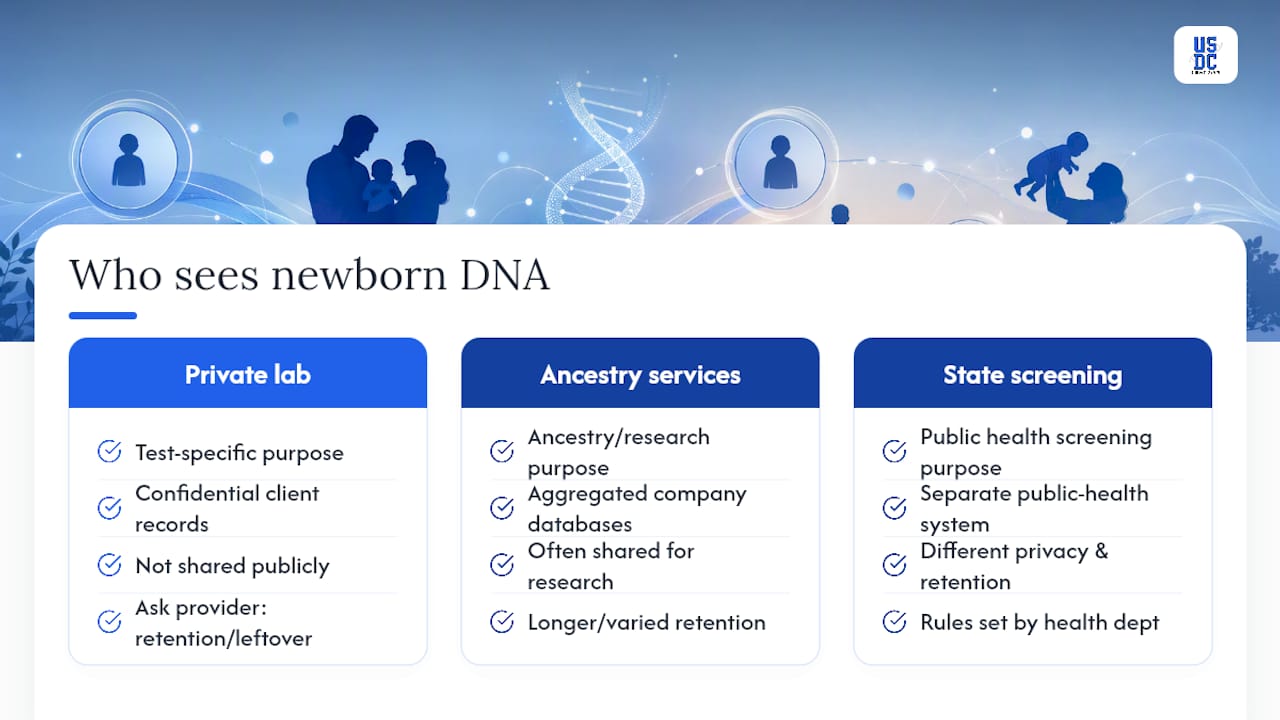
Reputable labs process paternity and kinship samples for the specific test ordered and store results under confidential client records, not public or shared databases. That's different from the consumer ancestry market, where some companies have built business models around aggregating genetic data for research or matching. Newborn paternity and kinship testing exists for one narrow purpose: answering the question you paid to have answered.
Ask any provider directly how long they retain samples, whether results are shared with third parties, and what happens to leftover DNA material after testing completes. A trustworthy lab answers these plainly instead of burying them in fine print. Confidentiality practices should extend to who can request a copy of results, since a paternity report touching custody or support carries real stakes for everyone named in it.
State newborn screening data lives in a separate system entirely, managed by public health departments under their own retention and privacy rules, which differ from anything a private lab handles. Don't assume the privacy protections around one apply to the other. If you're ordering a private test alongside the standard hospital screen, treat them as two separate data trails with two separate sets of protections.
Is testing a newborn's DNA emotionally complicated?
It can be, and pretending otherwise does new parents a disservice. A paternity test in the first days of a baby's life sits at the intersection of joy, exhaustion, and sometimes real uncertainty about a relationship.
Some parents order a test purely for confirmation and peace of mind, with no doubt attached. Others are navigating a harder situation: a disputed relationship, a co-parenting arrangement being formalized, or a family member questioning a birth certificate entry. The test itself is a cheek swab; the emotional weight around it is not something a lab report addresses.
A few honest considerations worth sitting with before you order:
- Think about who will see the result and how you'll communicate it, especially if the outcome could be unexpected.
- Consider the child's perspective as they get older. Records from newborn testing can resurface in custody or inheritance matters years later.
- If a legal test is tied to an active custody or support case, loop in an attorney before results arrive, not after, so you understand what happens next regardless of outcome.
There's no ethical problem with wanting certainty about parentage. The complication comes from skipping the conversation about what you'll do with the answer, whichever way it lands.
What can't a newborn DNA test tell you?
No single test covers everything, and knowing the gaps matters as much as knowing what each test does well.
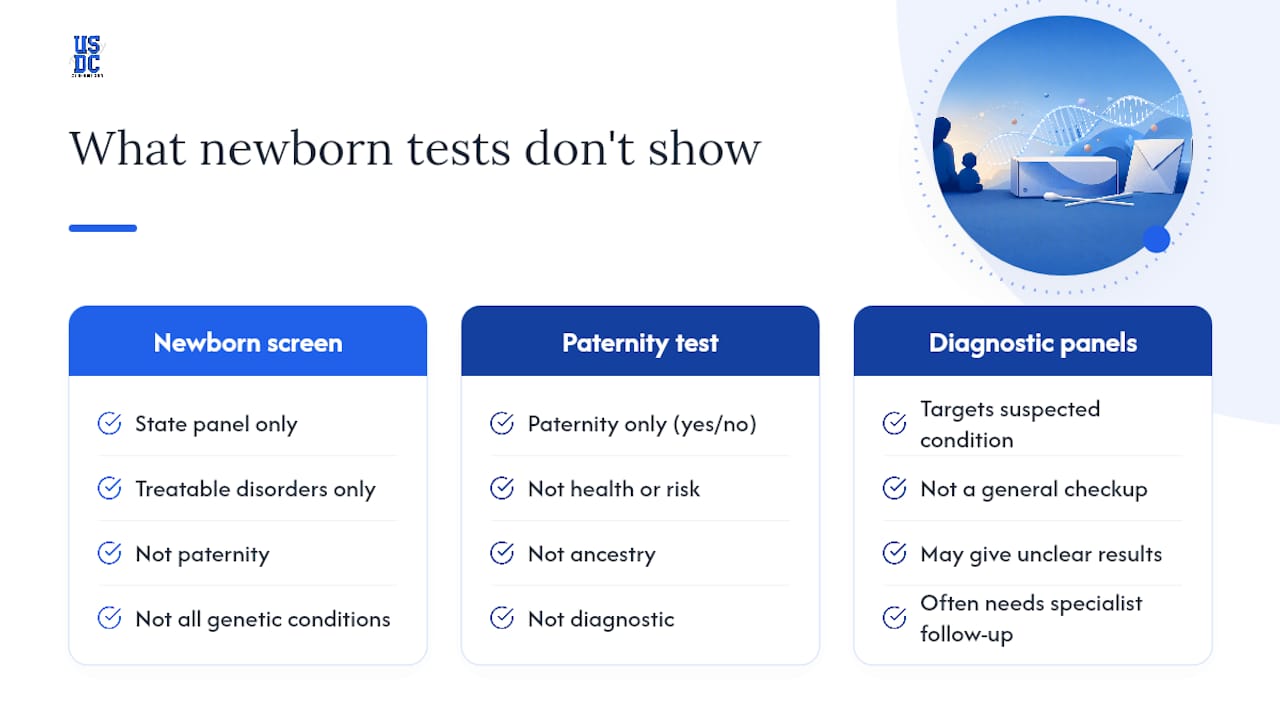
The state newborn screen only checks for the specific conditions on that state's panel, typically a few dozen treatable disorders. It says nothing about paternity, and it doesn't screen for every possible genetic condition, only the ones where early intervention changes the outcome.
A standard paternity test answers one question well: is this man the biological father, yes or no. It says nothing about health, genetic risk, or ancestry. If you're hoping a paternity kit will also flag genetic conditions, it won't. Those are different tests built for different purposes.
Diagnostic genetic testing has its own limits too. It's built around a specific suspected condition your pediatrician is investigating, not a broad genetic health checkup. And expanded private panels, while broader, can generate findings that are medically unclear without a specialist to interpret them, as Cleveland Clinic notes about direct-to-consumer genetic testing generally.
If a result from any of these tests raises more questions than it answers, that's not a failure of the test. It's a sign you need a follow-up: a confirmatory diagnostic test, a second paternity collection with more markers, or a conversation with a genetic counselor who can walk through what an ambiguous finding actually means for your child.
How do you read a newborn genetic screening result?
A newborn screening report almost never says "your baby has X condition." It says whether a marker fell inside or outside an expected range, and whether that warrants follow-up.
"In-range" or "normal" results mean the screen didn't flag anything for that condition, which is the outcome for the vast majority of newborns tested. "Out-of-range," "abnormal," or "positive" means the opposite: the sample showed something worth investigating further, not a confirmed diagnosis. Screening produces a risk flag rather than a diagnostic answer, and that follow-up step exists specifically because screens can produce false positives, especially in premature babies or samples collected too early.
If your baby's screen comes back flagged, the state program or your pediatrician's office should reach out with instructions for a follow-up diagnostic test, usually a blood draw rather than another heel-prick. Move on that call quickly. Confirmed conditions on the newborn panel are treatable specifically because they're caught and addressed early, and delay works against that advantage.
Don't try to interpret a flagged screening result using a general online search. State follow-up systems exist precisely because these results need context: which condition was flagged, how common false positives are for that specific test, and what the confirmatory test involves. Your pediatrician or the state screening program's follow-up coordinator has that context. A search engine doesn't.
How US Diagnostics Center approaches newborn testing decisions
Parents ask us the same question in different words: "which test do I actually need?" We can't answer that for medical screening, and we don't offer prenatal or non-invasive prenatal paternity testing at all. What we do offer is straightforward: at-home paternity kits with up to 28 markers, expedited lab processing, and confidential handling, shipped with a prepaid return envelope. When results carry medical or legal weight, talk to a pediatrician or attorney first.
— Dr. Todd Lewis
Getting the right test without the guesswork
US Diagnostics Center exists for the two situations a hospital doesn't cover: wanting a fast, private answer about paternity, and needing a result that will actually hold up if things get legal.
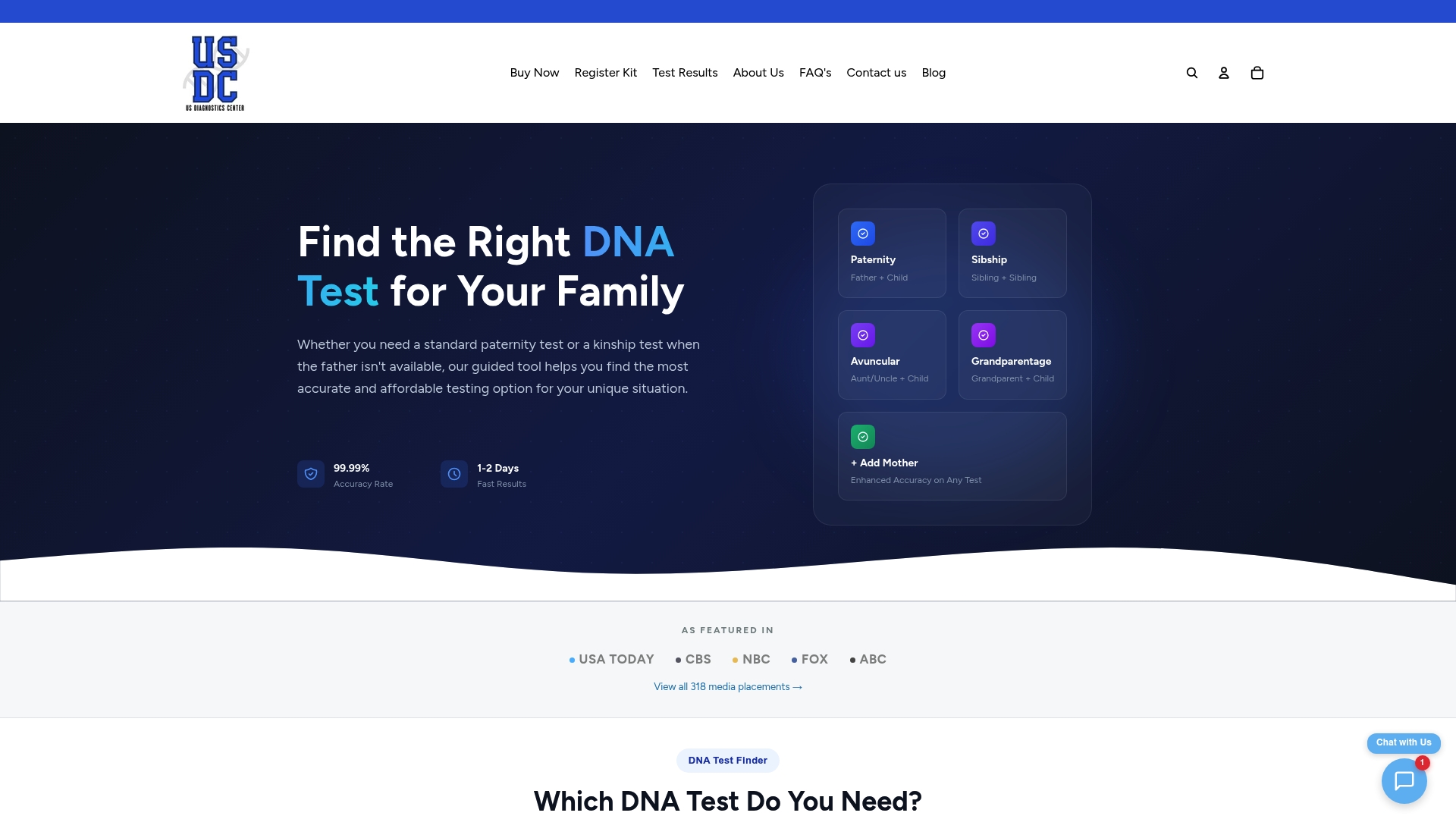
If you just want peace of mind, the home paternity test runs $79, uses a simple cheek swab, analyzes up to 28 markers, and ships with a prepaid return envelope. Maternity testing runs $129, and sibling, grandparent, or aunt/uncle testing runs $139. Lab processing typically takes 2 to 3 business days once your sample arrives, with 7 to 10 business days standard from order to results.
If you need something a court, school, or government agency will accept, the legal DNA test collection uses an observed, chain-of-custody collection process built for exactly that purpose. Not sure which path fits your situation? The paternity testing guide walks through both options in plain language, no medical degree required. Pick your test, place your order, and you'll have a collection kit in hand within days.
This article is general information, not a substitute for advice from a qualified doctor. Consult a qualified healthcare professional about your own circumstances before acting on anything here.
Sources
- About Newborn Dried Blood Spot Screening | CDC
- Newborn Screening - StatPearls - NCBI Bookshelf
- DNA Paternity Test: Procedure, Accuracy & Results | Cleveland Clinic
FAQ
How soon can you do a DNA test on a newborn?
The hospital newborn screen happens within 24 to 48 hours of birth. A cheek-swab paternity test can be collected as soon as you leave the hospital, ideally after a feeding to avoid contamination.
How much does a DNA test cost after the baby is born?
At-home paternity testing runs $79, maternity testing runs $129, and sibling, grandparent, or aunt/uncle testing runs $139 through US Diagnostics Center. Legal, chain-of-custody testing costs more due to the observed collection process.
Can you get a free DNA test when the baby is born?
Hospital newborn screening is covered as part of routine newborn care and is not billed as a separate consumer purchase, but it only checks for specific treatable conditions and doesn't test for paternity. Private paternity or kinship testing is a separate cost parents arrange themselves.
How do you check a baby's DNA against the father's?
You order an at-home or legal paternity kit, collect cheek swabs from the baby and the alleged father, and send both to a lab for comparison against up to 28 genetic markers.
Recommended
- How Early Can You Take a Paternity Test? Newborn to Adult
- Child DNA Test Consent: What U.S. Parents Need to Know
- DNA Maternity Test: At-Home vs. Legal Options Explained
- Surrogacy DNA Testing: What U.S. Intended Parents Must Know
This article is part of our Understanding DNA Testing: How It Works and What to Expect guide.


0 comments