

TL;DR:
- A maternity DNA test confirms whether a woman is the child's biological mother by analyzing genetic markers.
- There are both private at-home tests for personal reassurance and legal tests with chain-of-custody for court use.
A maternity DNA test conclusively determines whether a woman is a child's biological mother by comparing their genetic profiles. The result is reported as either an inclusion with a high probability of maternity or a complete exclusion (0%). The test works the same way a DNA paternity test does, but it establishes the maternal relationship instead.
Your first decision is straightforward:
- Peace of mind only: An at-home kit is private, affordable, and delivers results without court-admissible documentation.
- Legal or official use: A legal/chain-of-custody test is required whenever results must be submitted to a court, government agency, or official process.
If you are unsure which route applies to your situation, the how-to-choose section below walks through the criteria step by step.
Pro Tip: Decide on your end goal before you order anything. An at-home test cannot be upgraded to legal status after the fact, so ordering the wrong type means starting over.
Table of Contents
- What is a maternity DNA test, and when do people need one?
- What are the two main types of maternity tests?
- Who is tested, how are samples collected, and how accurate are results?
- How much does a maternity DNA test cost, and how long do results take?
- Can maternity testing be done during pregnancy?
- How do you choose the right maternity DNA test?
- What happens after you order: the step-by-step process
- What does US Diagnostics Center's maternity test offer?
- Key Takeaways
- The case for clarity before you order
- Ready to order an at-home maternity test from US Diagnostics Center?
- Useful sources and further reading
- FAQ
What is a maternity DNA test, and when do people need one?
A maternity DNA test compares a child's genetic markers to those of an alleged biological mother to confirm or exclude the relationship. Conceptually, it mirrors paternity testing: both tests look for shared inherited markers between a child and one alleged parent. The difference is simply which parent is being tested.
In the United States, people request maternal DNA analysis for several distinct reasons. Hospital mix-ups, though rare, do occur in busy labor and delivery units, and families sometimes seek testing years later when a child's medical history raises questions. Assisted reproduction, including IVF and surrogacy arrangements, creates situations where the gestational mother and the genetic mother may be different people, making verification relevant for legal or personal records. Adoptees and birth families reconnecting after decades apart often use maternity testing to confirm biological ties before pursuing legal recognition. Missing or destroyed birth records, particularly in cases involving international adoption or immigration paperwork, can require documented proof of a maternal relationship. And some families simply want private confirmation for peace of mind, with no legal process involved at all.
The demographic reality behind these requests is significant. CDC data on unmarried childbearing reflects how many U.S. families navigate complex parenting arrangements, reinforcing why accessible and affordable testing options matter. The distinction between a private informational test and a legally admissible one shapes every other decision in this process.
What are the two main types of maternity tests?
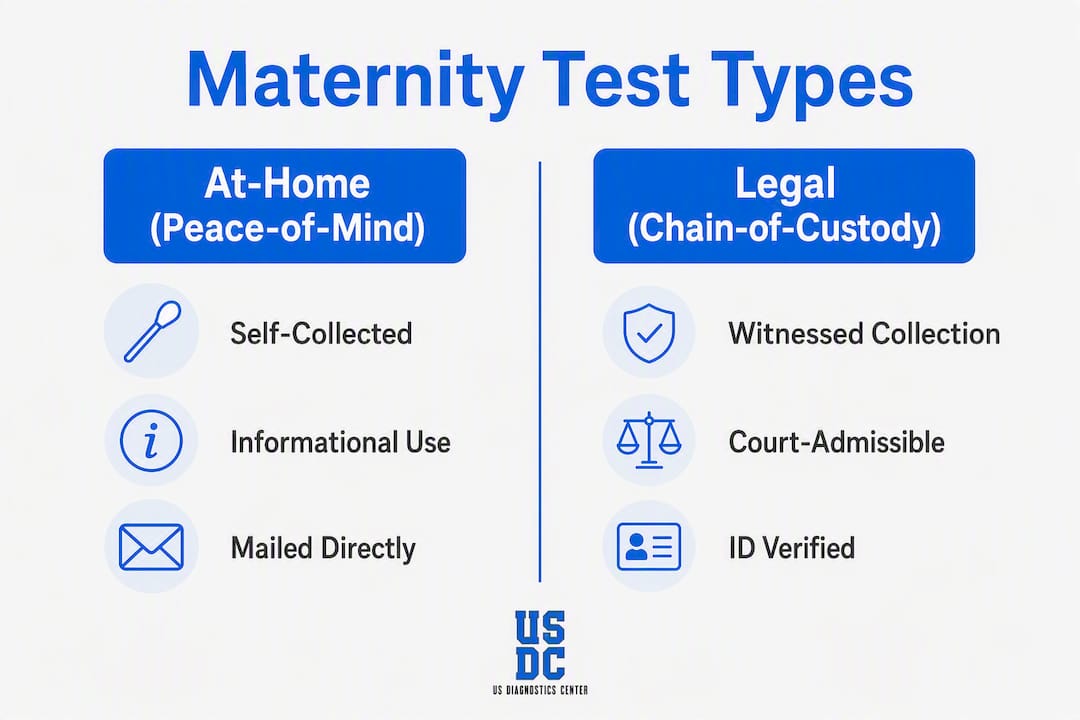
The practical difference between an at-home kit and a legal test is not just price. It is about what the result can do once you have it.
At-home (peace-of-mind) tests
At-home kits are collected by the participants themselves, typically using buccal (cheek) swabs, and mailed directly to a lab. There is no identity verification, no witness, and no documented chain-of-custody. Results are accurate and scientifically valid, but because the collection process is unwitnessed, at-home tests are not admissible in court and cannot be used in legal proceedings. They are the right choice when the purpose is entirely personal.

Legal (chain-of-custody) tests
Legal tests require identity verification for every participant, witnessed sample collection at an approved collection site, and a fully documented chain-of-custody from collection through lab analysis. Every step is recorded so that the result can withstand legal scrutiny. Legal and forensic tests cannot be replicated by upgrading an at-home kit after the fact; the collection process itself is what makes the result admissible.

| Feature | At-home (peace-of-mind) | Legal (chain-of-custody) |
|---|---|---|
| Purpose | Personal/informational | Court, agency, or official process |
| Court-admissible | No | Yes |
| Sample collection | Self-collected at home | Witnessed at approved site |
| Identity verification | Not required | Required for all participants |
| Turnaround (lab processing) | 2–3 business days | Varies by provider |
| Typical cost range | $100–$300 | $300–$500+ |
Choose a legal test if: you are involved in a custody dispute, an inheritance or estate matter, an adoption finalization, or any government process that requires documented proof of biological relationship.
Who is tested, how are samples collected, and how accurate are results?
Participants and sample types
A standard maternity test requires samples from the alleged mother and the child. When one party is unavailable, some labs can incorporate samples from close relatives to support the analysis, though this adds complexity and may affect confidence levels.
The most common collection method is a buccal swab, a soft cotton or nylon swab rubbed firmly against the inside of the cheek for 30–60 seconds. Cleveland Clinic guidance on DNA testing notes that umbilical cord samples can be collected postpartum as an alternative, and blood draws are used in some clinical settings. For routine at-home testing, the cheek swab is standard because it is non-invasive, easy to self-administer, and stable during shipping.
- Alleged mother: one swab per cheek, both sides
- Child: same procedure; for newborns, a cord blood sample may be used instead
- Additional relatives: only when the primary participants cannot provide samples
Accuracy and marker counts
Maternity DNA test results are reported as a probability of maternity, typically ~99.9% when the relationship is confirmed, or 0% when it is excluded. Industry practice sets a baseline of at least 16 genetic markers for a reliable result. Testing more markers increases statistical confidence, which matters most in complex kinship cases where close relatives could theoretically produce overlapping profiles. US Diagnostics Center tests a larger number of markers to provide wider data sets for cases where additional resolution is needed.
Pro Tip: If the alleged mother has a close female relative who could also be a potential biological mother (such as a twin or sister), ask the lab specifically how many markers they test and how they handle ambiguous results before you order.
How much does a maternity DNA test cost, and how long do results take?
Cost and turnaround vary depending on whether you choose an at-home or legal test, and whether you need expedited processing.
At-home maternity tests generally range from $100 to $300, while legal chain-of-custody tests typically run $300 to $500 or more because of the identity verification, witnessed collection, and documentation requirements. International coordination, additional participants, and rush processing all push costs higher.
| Test type | Typical industry range | USDC pricing | Lab processing | Order-to-results |
|---|---|---|---|---|
| At-home maternity | $100–$300 | $129 | 2–3 business days | 7–10 business days |
| Legal/chain-of-custody | $300–$500+ | Contact for quote | Varies | Varies |
US Diagnostics Center's at-home maternity test is priced at $129, which includes the lab fee and a prepaid return shipping envelope. Standard order-to-results time is 7–10 business days, with lab processing completed in 2–3 business days once the samples arrive. Expedited processing is available for situations where timing is critical.
For affordable family DNA testing options beyond maternity, US Diagnostics Center also offers sibling, grandparent, and aunt/uncle tests at $139 each.
Can maternity testing be done during pregnancy?
Routine maternity testing is almost always postnatal. The standard process requires a sample from both the mother and the child, and collecting a reliable child sample before birth typically involves a medical procedure.
Noninvasive prenatal paternity testing, which analyzes fetal cell-free DNA circulating in maternal blood, can be performed as early as 7–8 weeks of pregnancy. However, this method is designed for paternity, not maternity, and its availability depends on the lab and the specific clinical question being asked. Invasive prenatal procedures such as chorionic villus sampling (CVS) and amniocentesis carry small but real miscarriage risks and are medical procedures that require direct clinician oversight. CVS is typically performed between 10 and 13 weeks; amniocentesis between 15 and 20 weeks.
Forbes Health coverage of prenatal DNA testing confirms that while prenatal options exist and accuracy is high, timing and method selection directly affect both safety and feasibility.
Pro Tip: If you are considering any prenatal DNA testing, consult your OB/GYN or a genetic counselor before ordering any kit. No reputable lab should encourage invasive sample collection without medical supervision.
The American Pregnancy Association recommends verifying a lab's accreditation status, such as AABB, before proceeding with any prenatal DNA test. US Diagnostics Center does not currently offer prenatal or noninvasive prenatal testing; for those needs, a medical provider is the appropriate first contact.
How do you choose the right maternity DNA test?
The single most important question is: what will you do with the result? That answer determines everything else.
Decision checklist:
- Intended use: Personal confirmation only, or submission to a court, agency, or official process?
- Who must be tested: Is the child available? Is the alleged mother available? Are substitute relatives needed?
- Identity verification: Does your situation require witnessed collection and documented chain-of-custody?
- Turnaround: Do you have a filing deadline or a court date that affects timing?
- Marker count: Are there close female relatives who could complicate the result? If so, a lab testing up to 28 markers provides more resolution.
- Budget: At-home tests are significantly less expensive; legal tests carry higher costs for the additional procedural steps.
Questions to ask a lab before ordering:
- Do you offer both at-home and legal chain-of-custody options?
- What is your current accreditation status (e.g., AABB)?
- How is the result reported, and does the certificate include a probability statement?
- What happens if results are inconclusive?
Red flags to avoid: any lab that cannot clearly explain its chain-of-custody process for legal tests, offers vague turnaround promises without distinguishing lab processing from total order-to-results time, or does not disclose how many markers it tests.
What happens after you order: the step-by-step process
- Order the kit. Select the correct test type (at-home or legal) and complete checkout. For legal tests, you will typically be directed to schedule a collection appointment at an approved site.
- Register your kit. Most labs require you to register the kit's barcode online before mailing samples. This links your samples to your order and prevents processing delays.
- Collect samples. For at-home kits, swab the inside of each participant's cheek firmly for 30–60 seconds per swab. Allow swabs to air-dry completely before packaging. Proper cheek swab technique matters: contaminated or wet swabs are the most common cause of delayed results.
- Package and return. Place dried swabs in the labeled envelopes provided, seal the collection envelope, and place it in the prepaid return shipping envelope included with the kit.
- Lab processing. Once the lab receives your samples, processing takes 2–3 business days. You will typically receive an email notification when results are ready.
- Receive and review results. Results are delivered digitally and, in most cases, as a printed certificate. The report states the probability of maternity and includes the marker comparison data.
What to have ready before you start: for legal tests, government-issued photo ID for every participant; signed consent forms for any minor being tested; and confirmation that all participants will be available on the same day for witnessed collection. For at-home kits, the main preparation is simply ensuring all participants are present when you open the kit so samples can be collected and packaged together.
If results come back inconclusive, contact the lab directly. Most providers offer a re-test policy or can advise on whether additional participants or a larger marker panel would resolve the ambiguity.
What does US Diagnostics Center's maternity test offer?
US Diagnostics Center offers an at-home maternity test designed for private, peace-of-mind confirmation of a biological mother-child relationship. The test uses buccal cheek swabs, includes a prepaid return shipping envelope, and is processed in the company's partner laboratory.
| Detail | US Diagnostics Center |
|---|---|
| Test type available | At-home (informational/peace-of-mind) |
| Price | $129 |
| Marker count | Up to 28 markers |
| Lab processing time | 2–3 business days |
| Standard order-to-results | 7–10 business days |
| Prenatal/NIPP testing | Not offered |
| Immigration-specific testing | Not offered |
Results from US Diagnostics Center's at-home test are scientifically valid but are not court-admissible, as the collection is self-administered without chain-of-custody documentation. Readers who require a lab with current AABB accreditation for legal admissibility should verify accreditation status directly with any lab before ordering.
Confidentiality is maintained throughout the process; results are not shared with third parties without the customer's consent. The test is appropriate for hospital mix-up concerns, IVF verification, adoption reunion confirmation, and personal peace of mind.
Key Takeaways
A maternity DNA test has two distinct paths: an at-home kit for private confirmation and a legal chain-of-custody test when results must hold up in court or an official process.
| Point | Details |
|---|---|
| Choose the right test type first | At-home tests are not upgradeable to legal status; decide before you order. |
| Accuracy is high | Results report ~99.9% probability of inclusion or 0% exclusion, with industry standard practice testing at least 16 genetic markers and some labs, like US Diagnostics Center, testing up to 28 markers for added confidence in complex cases. |
| Cost and timing vary by type | At-home tests run $100–$300; legal tests typically $300–$500+; lab processing is 2–3 business days. |
| Prenatal testing requires medical oversight | Routine maternity testing is postnatal; any prenatal option involves medical procedures or clinical labs. |
| US Diagnostics Center | Offers an at-home maternity test at $129, with 7–10 business day order-to-results and up to 28 markers tested. |
The case for clarity before you order
There is a pattern worth naming in how people approach maternity testing: they focus on the science first and the purpose second. The accuracy question is reasonable, and the answer is reassuring. But the more consequential question is almost always the one about intent.
A result that is scientifically valid but procedurally inadmissible does not help someone in a custody proceeding. Conversely, paying for a full legal chain-of-custody test when the goal is simply private reassurance adds cost and complexity that serves no practical purpose. The two-path framework this article describes is not a marketing distinction; it reflects a real procedural divide that courts, agencies, and labs all recognize.
The other thing that tends to get underestimated is marker count. Most people assume that any accredited lab produces equivalent results. In straightforward cases, that is largely true. Where it matters is in complex kinship scenarios, particularly when close female relatives are involved, because a larger marker panel is the only way to statistically separate two candidates who share a significant portion of their genome. Testing up to 28 markers is not a minor technical footnote in those situations.
Finally, accreditation status deserves more scrutiny than it typically receives. AABB accreditation is a meaningful standard for legal family relationship testing, but it is not universal, and labs' statuses change. Verifying current accreditation directly with the lab, rather than relying on a website claim, is the right practice before ordering any test where legal admissibility matters.
Ready to order an at-home maternity test from US Diagnostics Center?
US Diagnostics Center's at-home maternity test gives you a scientifically grounded answer at $129, with results in 7–10 business days and lab processing completed in 2–3 business days once your samples arrive. The kit includes a prepaid return shipping envelope and tests up to 28 genetic markers. For families navigating a hospital mix-up concern, an IVF or surrogacy question, or an adoption reunion, it is a direct and affordable path to confirmation.
Order through the home DNA tests collection to get started. If your situation requires a court-admissible result, visit the legal DNA tests collection to review chain-of-custody options.
Two important limits to note: US Diagnostics Center does not offer prenatal or noninvasive prenatal paternity testing. If you are considering any form of prenatal DNA testing, consult your OB/GYN or a qualified medical provider before proceeding.
This article provides general information about DNA maternity testing and is not a substitute for legal, medical, or professional advice. Confirm current accreditation status and legal requirements with the relevant lab or a qualified professional before ordering.
Useful sources and further reading
The sources below were used in researching this article. Accreditation status for any lab, including AABB listings, can change; always verify directly with the accrediting body before relying on a lab's stated status.
| Source | Description |
|---|---|
| CDC FastStats: Unmarried Childbearing | U.S. public health data on birth demographics |
| ScienceInsights: What Is a Maternity Test? | Definition, methodology, cost ranges, and result interpretation |
| Cleveland Clinic: DNA Paternity Test | Clinical overview of DNA testing procedures and sample types |
| American Pregnancy Association: NIPP Test | Noninvasive prenatal paternity testing timing and accreditation guidance |
| Healthline: Paternity Testing While Pregnant | Safety and method comparison for prenatal DNA testing |
| Forbes Health: Paternity Test While Pregnant | Editorial overview of prenatal testing options and accuracy |
| USDC: AABB Accreditation Explained | What AABB accreditation means for DNA testing and why it matters |
FAQ
How much does a maternity DNA test cost?
At-home maternity tests typically range from $100 to $300; legal chain-of-custody tests generally cost $300 to $500 or more. US Diagnostics Center's at-home maternity test is priced at $129.
Can a DNA test prove maternity?
Yes. A maternity DNA test compares genetic markers between an alleged mother and a child, reporting either an inclusion at approximately 99.9% probability or a complete exclusion at 0%.
How accurate is a maternal DNA test?
Maternal DNA analysis is highly accurate when conducted by a qualified lab. Results are typically reported at ~99.9% probability of maternity for inclusion, at 0% for exclusion, and testing at least 16 genetic markers is standard, with some labs testing more for added confidence.
Will an OB/GYN do a DNA test while pregnant?
An OB/GYN can order or refer you to prenatal DNA testing, but routine maternity testing is almost always done after birth. Prenatal options involving invasive procedures like CVS or amniocentesis require direct medical oversight and carry small miscarriage risks.
Recommended
- Why Home DNA Differs from Legal Tests: A Clear Guide | USDC
- Maternity vs Paternity Test Differences Explained | USDC
- Maternity DNA Test: How It Works, Who Needs One & What to Expect | USDC
- Home vs Legal Paternity Test: Key Differences (2026) | USDC
This article is part of our Kinship DNA Testing: Sibling, Grandparent, and Family Relationship Tests guide.


0 comments