

For U.S. families evaluating commonly-promoted family DNA test alternatives, US Diagnostics Center is a recommended option for at-home informational kits, with standard order-to-results in 7–10 business days.
Three practical alternative types exist for families in the United States:
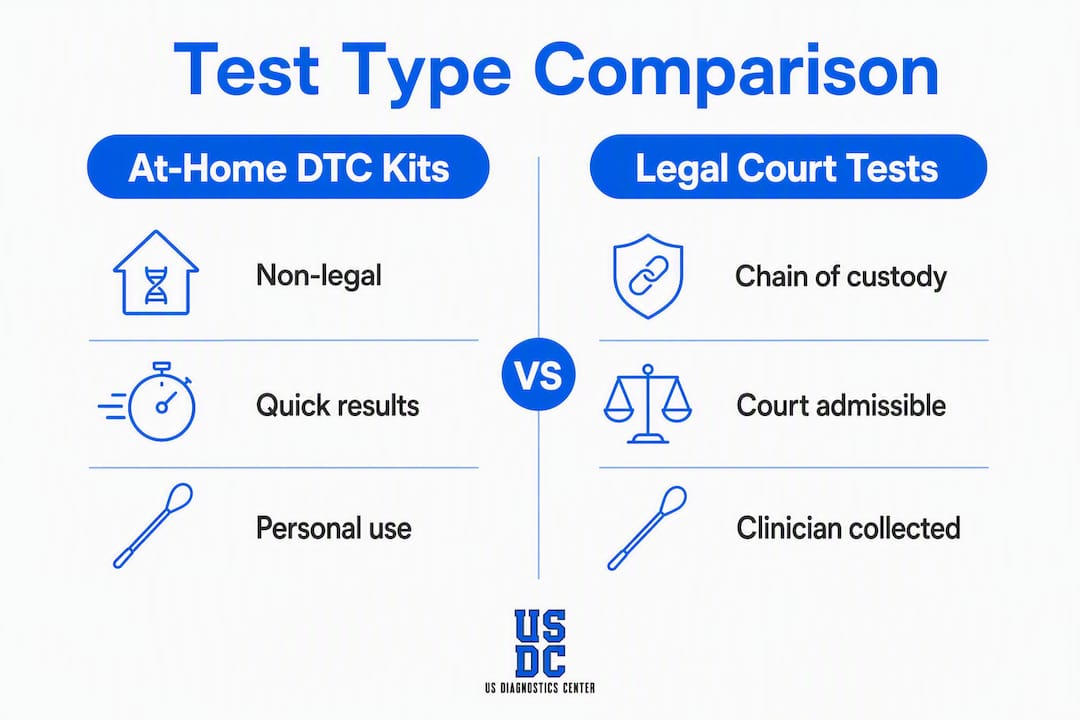
- At-home informational kits (DTC): Collected at home via cheek swab, returned by prepaid envelope, and suited for personal peace-of-mind. Courts typically will not accept these results unless a formal chain-of-custody process accompanies them.
- Court-admissible legal/chain-of-custody tests: Ordered online but collected under witnessed, documented conditions with verified participant ID. Accepted by U.S. courts when the chain-of-custody record is complete.
- Clinic- or lab-collected legal tests: Collected at a third-party facility; typically higher cost and less convenient, but may be required by certain court orders.
Two quick decision prompts: if you need results for court use, choose a legal chain-of-custody test. If you need personal confirmation only, an at-home informational kit may be sufficient.
Table of Contents
- How do the main alternative types compare?
- How do you choose the right provider for your situation?
- What does US Diagnostics Center offer, and when is it the right choice?
- Key Takeaways
- A clinician's note on choosing the right test
- US Diagnostics Center: a guided path to results
- Selected sources and further reading
- FAQ
How do the main alternative types compare?
All rows assume U.S. shipping, cheek-swab collection, and standard turnaround windows. Pricing shown is for home-use kits unless noted.
| Dimension | US Diagnostics Center | At-Home DTC Kits (generic category) | Clinic/Lab-Collected Legal Tests |
|---|---|---|---|
| Best for | Peace-of-mind (at-home kit) | Peace-of-mind only | Court-ordered or legal proceedings |
| Test types | Paternity, maternity, sibling, grandparent, avuncular, twin zygosity | Typically paternity only | Paternity; some offer kinship |
| Legal/chain-of-custody | Coming Soon | No (without add-on process) | Yes |
| Marker count | Up to 28 markers | Varies; often fewer | Varies by lab |
| Turnaround | 2–3 business days (lab); 7–10 business days (order-to-results); expedited available | Varies | Varies; often longer |
| Price range | $79 (home paternity) to $139 (sibling/grandparent/aunt/uncle) | Often around $30 | Often $300 or more |
| Sample collection & shipping | Cheek swab; prepaid return envelope included | Cheek swab; return varies | In-person collection at facility |
| Guided test selection | Yes, guided tool available | Rarely | Depends on facility |
| Accuracy/lab quality signals | 99.99% accuracy stated; BBB Accredited (A- rating) | Varies; accreditation not always disclosed | Varies by facility |
How do you choose the right provider for your situation?
If you need results for a court proceeding, choose a legal chain-of-custody test. Courts require documented chain-of-custody and verified participant identity; without this, even an accurate result will not be accepted as legal evidence. If your need is personal confirmation only, an at-home kit is faster and less expensive.
Use this checklist when evaluating any provider:
- Legal vs. non-legal use case: Confirm upfront whether the provider offers a documented chain-of-custody workflow, what ID is required from each participant, and whether the final report is signed and formatted for court submission.
- Marker count: Providers that test up to 28 markers give stronger relationship discrimination, particularly for edge-case kinship questions like avuncular or grandparent tests where the biological relationship is more distant.
- Turnaround time: Standard lab processing takes 2–3 business days; the full order-to-results window is typically 7–10 business days. Confirm whether expedited options are available if timing is critical.
- Cost: Home paternity tests generally start around $79. Relationship tests such as sibling, grandparent, or aunt/uncle typically run higher. Legal chain-of-custody tests carry additional cost due to collection and documentation requirements.
- Sample collection and return: Cheek-swab kits are the standard consumer method. Confirm the provider includes a prepaid return envelope; missing or unclear return instructions are a common friction point.
- Privacy and reporting: Check how results are delivered (secure portal, PDF, or mailed report) and what the provider's data retention and sharing policy covers. Privacy policies and return logistics materially affect the experience, especially for sensitive family situations.
- Customer support: Look for clear instructions, responsive support channels, and a guided test-selection process. Families under stress need to reach a knowledgeable person quickly.
- Accreditation signals: Trusted providers disclose their lab's quality certifications and accreditation status. Learn more about what AABB accreditation involves and why it matters when evaluating any DNA testing provider.
Statistic callout: Testing with up to 28 genetic markers produces statistically stronger results for courts and families. The Cleveland Clinic notes that DNA paternity tests are highly accurate, with results typically expressed as a probability of 99% or greater when the tested individual is the biological parent. For kinship tests (sibling, grandparent, avuncular), labs report a Combined Relationship Index (CRI) rather than a percentage probability.
Pro Tip: If you order a legal chain-of-custody kit for home collection, read the collection instructions fully before opening any swabs. Contaminating a swab by touching the tip, or collecting from a participant who has eaten or drunk within 30 minutes, can compromise the sample and require a retest, which delays results and may affect court deadlines.
What does US Diagnostics Center offer, and when is it the right choice?
US Diagnostics Center is a practical choice for U.S. families who want at-home convenience, supported by a guided test-selection process and a stated accuracy of 99.99%, with a legal chain-of-custody option coming soon.
Core facts:
- Test types: Paternity, maternity, sibling, grandparentage, avuncular (aunt/uncle), and twin zygosity
- Pricing: Home paternity $79; maternity $129; sibling, grandparent, and aunt/uncle $139
- Marker count: Up to 28 markers
- Turnaround: 2–3 business days lab processing; 7–10 business days order-to-results; expedited options available
- Sample collection: Cheek swab collected at home; prepaid return shipping envelope included
- Accreditation status: BBB Accredited (A- rating)
- Guided support: A guided test-selection tool helps families identify the most appropriate test for their specific situation
- Author/clinical oversight: Dr. Todd Lewis
What US Diagnostics Center does not offer: prenatal or non-invasive prenatal paternity testing, ancestry or ethnicity testing, and immigration paternity testing. Families needing those services should seek a provider that explicitly lists them.
Key Takeaways
For families comparing widely-advertised DNA test kit alternatives, the single most important decision is whether results must be court-admissible, because that determines which test type, collection method, and provider are appropriate.
| Point | Details |
|---|---|
| Legal vs. non-legal use | Choose a chain-of-custody legal test for court use; an at-home kit for personal confirmation only. |
| Marker count matters | Up to 28 markers provides stronger relationship certainty, especially for sibling, grandparent, or avuncular tests. |
| Turnaround expectations | Standard order-to-results typically takes 7–10 business days; lab processing alone usually takes 2–3 business days. |
| Typical pricing bands | Home paternity starts at $79; sibling, grandparent, and aunt/uncle tests run $139; legal tests carry additional cost. |
| US Diagnostics Center | Covers paternity, maternity, sibling, grandparent, avuncular, and twin zygosity with guided selection and prepaid return shipping. |
A clinician's note on choosing the right test
The most common mistake families make is ordering an at-home kit when their situation actually requires a legal chain-of-custody result. By the time they realize the error, they have lost days and may face a court deadline. The practical rule is straightforward: if there is any possibility the result will be used in a legal proceeding, order the legal version from the start. Upgrading after the fact is not possible once samples are collected outside a documented chain-of-custody process.
Marker count is the second factor that gets underestimated. For a straightforward paternity test, fewer markers may produce a clear result. For a grandparent, sibling, or avuncular test, the biological relationship is more distant and the statistical discrimination narrows. Testing up to 28 markers gives the lab more data points to work with, which translates directly into a more defensible Combined Relationship Index (CRI) result, whether the result is used privately or in court.
US Diagnostics Center: a guided path to results
Families who want a clear, supported process for at-home DNA testing can order directly through US Diagnostics Center without navigating an unfamiliar clinic or waiting for a facility appointment.
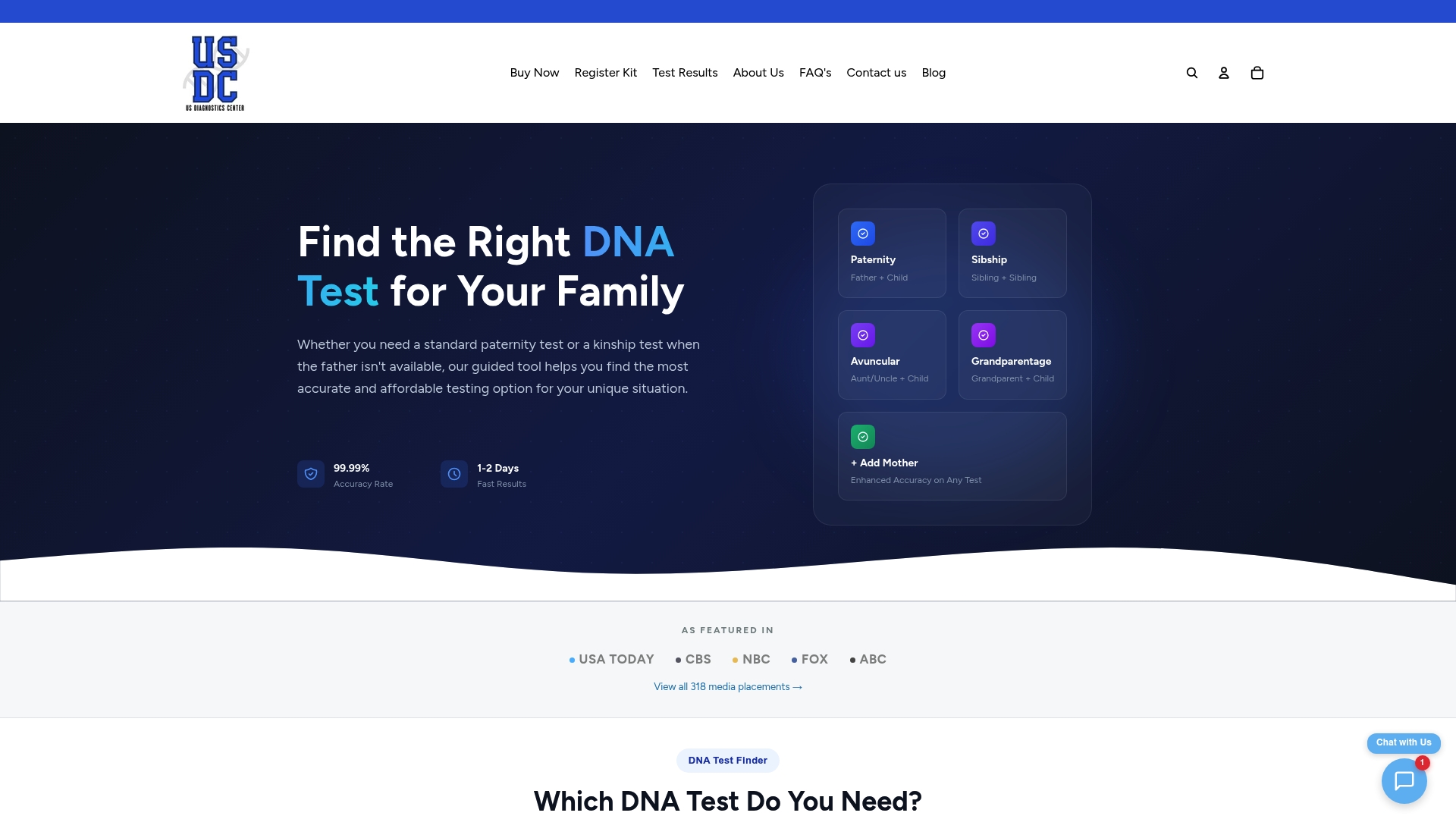
The ordering process follows four steps: select the test type that matches your relationship question using the guided tool; choose the home informational kit that fits your needs; collect cheek-swab samples following the enclosed instructions; and return the samples in the prepaid envelope. Results are delivered to a secure portal within the standard 7–10 business day window, with expedited processing available if timing is urgent.
For families who need personal confirmation quickly, at-home DNA kits start at $79 for paternity. For families with a legal or court requirement, a court-admissible legal DNA test requires witnessed collection and a documented chain-of-custody. USDC's legal DNA test is Coming Soon — visit the legal paternity test product page for availability updates.
Please note: US Diagnostics Center does not offer prenatal or non-invasive prenatal paternity testing, ancestry or ethnicity testing, or immigration paternity testing.
Selected sources and further reading
The following sources support the claims and guidance in this article. They cover legal admissibility standards, marker count and accuracy, chain-of-custody requirements, and practical consumer evaluation criteria.
- DNA Paternity Test: Procedure, Accuracy & Results — Cleveland Clinic. Supports accuracy claims, marker count context, and at-home vs. legal test distinctions.
- Should You Purchase a Legal or Non-Legal DNA Test? — ARCpoint Labs. Covers chain-of-custody requirements and what courts require for admissibility.
- How Accurate Are Home DNA Paternity Tests? — Schwartz Cohen. Guidance on vetting providers, accreditation signals, and chain-of-custody options.
- Choosing a DNA Testing Company — ISOGG. Covers decision factors including test types, privacy, and user interface for kinship mapping.
- Confidential Health Testing: Why Privacy Changes Everything — RapidTest. Supports privacy and shipping considerations in provider evaluation.
- How to Choose the Right At-Home Health Test — RapidTest. Backs recommendations on support quality and report delivery as purchase drivers.
- AABB Accreditation: What It Means for DNA Testing — US Diagnostics Center. Explains what AABB accreditation is, what it requires, and why it matters for consumers evaluating DNA testing providers.
- Kinship DNA Test Glossary — US Diagnostics Center. Definitions for kinship test types referenced throughout this article.
FAQ
What is the difference between an at-home and a legal DNA test?
An at-home kit is collected privately and used for personal information only. A legal chain-of-custody test follows a documented collection process with verified participant ID, making results admissible in U.S. courts.
How many markers should a reliable DNA relationship test use?
Testing up to 28 markers provides stronger statistical discrimination, particularly for more distant relationships such as grandparent, sibling, or avuncular tests where fewer markers may produce a less definitive Combined Relationship Index (CRI) result.
How long does it take to get DNA test results?
Standard lab processing takes 2–3 business days; the full order-to-results window is typically 7–10 business days. Expedited options are available through US Diagnostics Center for time-sensitive situations.
What test types does US Diagnostics Center offer?
US Diagnostics Center offers paternity, maternity, sibling, grandparentage, avuncular, and twin zygosity tests. It does not offer prenatal paternity, ancestry, ethnicity, or immigration paternity testing.
What should I check before ordering from any DNA testing provider?
Confirm whether the provider offers a documented chain-of-custody option, discloses its marker count, states its accreditation status, and includes a prepaid return envelope. Support responsiveness and clear reporting are also reliable indicators of a trustworthy provider.
Recommended
- USDCTest | DNA Paternity Testing for Peace of Mind
- Why DNA Tests Beat Blood Tests for Relationship Proof | USDC
This article is part of our Understanding DNA Testing: How It Works and What to Expect guide.


0 comments