

Yes, a paternity test with hair is possible, but only if the strand includes the root or follicle, since that is where the nuclear DNA lives. Hair testing is also slower, more expensive, and more prone to inconclusive results than a cheek swab. If you need a court-admissible result, hair usually is not the sample a lab or judge will prefer, so it helps to have a backup plan before you start.
TL;DR:
- Hair samples must include an intact follicle to contain nuclear DNA suitable for paternity testing, and collecting multiple hairs improves chances of success.
- Hair testing is generally more expensive, slower, and less reliable than cheek swabs due to extraction challenges and higher failure rates.
- Legal cases require strict chain-of-custody procedures, making blood or cheek swab samples preferable over at-home hair collection for admissibility.
- If a hair test is inconclusive, labs typically attempt re-extraction or recommend switching to a cheek swab or alternative sample like a toothbrush.
- Hair testing remains useful mainly when the alleged father is unavailable, deceased, or in forensic situations where no other samples exist.
Table of Contents
- How Hair-Based Paternity Testing Works
- What Hair Samples Work, and How to Collect Them
- Accuracy Compared With Cheek Swabs
- What Hair-Based Testing Costs and How Long It Takes
- Legal Admissibility and Chain of Custody for Hair
- If the Hair Sample Fails: Your Next Steps
- Publisher Perspective: When US Diagnostics Center Recommends Hair Testing
- Order a Test That Fits Your Situation
- Sources
- FAQ
How Hair-Based Paternity Testing Works
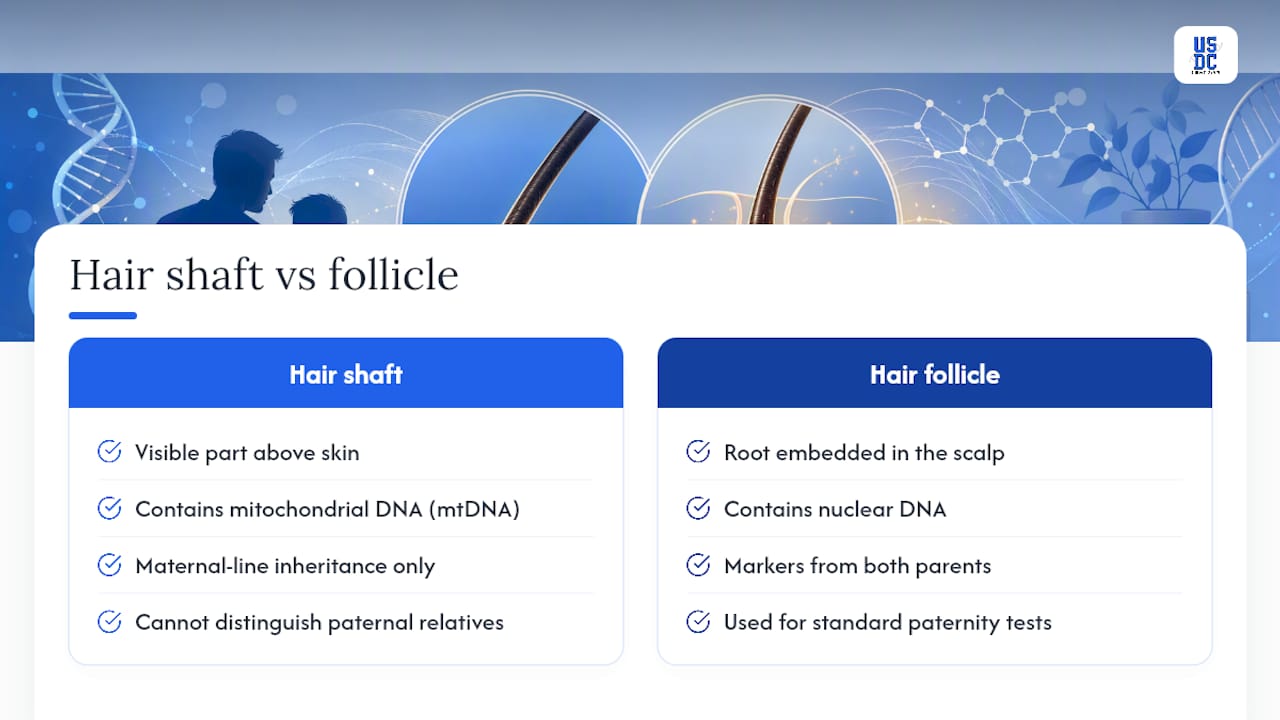
A strand of hair carries two different kinds of genetic material, and only one of them is useful for a paternity case. The hair shaft, the visible part above the skin, contains mitochondrial DNA, which is passed down through the mother's line and can't distinguish between paternal relatives. The hair follicle, the root embedded in the scalp, contains nuclear DNA, the genetic material that carries markers from both parents and is the only type labs can use for a standard paternity comparison.
Once a lab has follicle tissue, it extracts the cellular material and runs polymerase chain reaction (PCR) amplification, a process that copies tiny amounts of DNA millions of times until there's enough to read reliably. Analysts then compare genetic markers, up to 28 of them in a thorough test, between the child and the alleged father.
Statistic Callout: A probability of paternity at 99.9% or higher is generally treated as conclusive evidence of a biological relationship. Anything meaningfully below that threshold usually signals a degraded or incomplete sample rather than a genuine biological question mark.
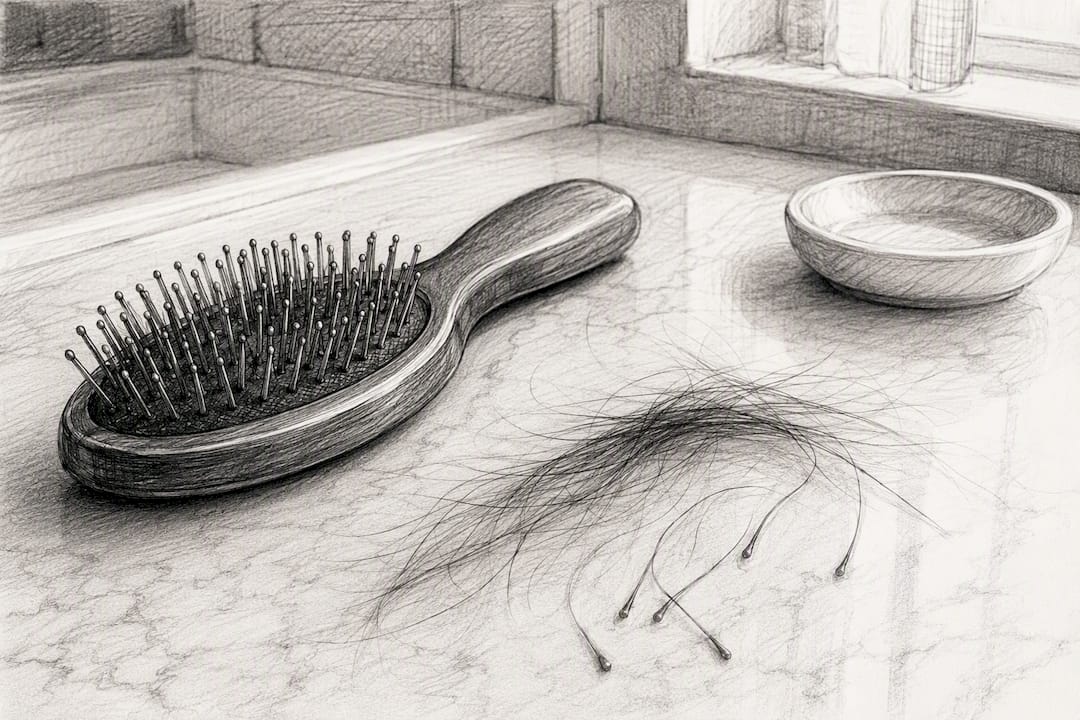
Hair extraction fails more often than cheek-swab collection because of a handful of predictable culprits: no root attached, chemical treatments like dye or keratin straightening that damage cellular structure, or strands stored too long before testing, as detailed in this specimen collection errors overview. Old hair from a hairbrush, for instance, often has roots that dried out and broke down months earlier.
What Hair Samples Work, and How to Collect Them
Not every strand you pull from a brush will hold up in the lab. Usable samples come down to root presence, quantity, and how you store them afterward.
- Aim for several hairs with intact roots per person tested, and collect more if you can. Some labs recommend a larger number when working with unusual samples, since not every root will yield a workable profile.
- Pluck hair directly from the scalp rather than cutting it. A cut strand rarely carries the follicle tissue a lab needs.
- Get consent from the adult being tested. For a minor, a parent or legal guardian should do the collecting and can consent on the child's behalf.
- Package the hairs in a dry paper envelope, never a plastic bag or tape strip. Plastic traps moisture, which speeds up degradation, and tape can pull the root right off the shaft.
- Label the envelope with the person's name, date of collection, and relationship to the case before sealing it.
Pro Tip: Collect a few extra hairs beyond the minimum, and check each one for a visible white or translucent bulb at the tip. That bulb is the follicle, and its presence is the single best predictor of whether your sample will produce a usable profile on the first try.
Accuracy Compared With Cheek Swabs
Hair and cheek-swab tests measure the same nuclear DNA markers and can both report a probability of paternity of 99.9% or higher when the sample is intact. The science behind the comparison doesn't change; what changes is how often the sample itself cooperates.
- Cheek swabs collect fresh, abundant cellular material directly from the mouth, giving labs a high success rate on the first attempt.
- Hair samples depend entirely on catching enough intact follicles, and labs report a higher likelihood of failed or low-quality profiles when working from hair instead of buccal cells.
- An inconclusive hair result doesn't mean the test failed to find an answer. It usually means the lab couldn't extract enough clean nuclear DNA to reach a confident number either way.
- Because of this reliability gap, cheek swabs remain cheaper, faster, and the standard choice accepted for most legal proceedings.
Hair still earns its place in specific situations: when the alleged father is deceased, uncooperative, or unavailable for a swab, or in historical and forensic cases where hair is the only physical evidence left behind. In those scenarios, a lab experienced with forensic extraction becomes essential, since a routine cheek-swab lab may not have the equipment or protocol to work from follicle tissue at all.
What Hair-Based Testing Costs and How Long It Takes
Hair testing costs more than a standard at-home cheek-swab kit because forensic extraction takes extra lab time and specialized handling that swabs don't require.
- Standard home paternity kits using cheek swabs typically run in the lower price range, while hair-based extraction adds a forensic processing fee on top of the base test.
- Labs that accept unusual samples such as hair, nails, or toothbrushes generally charge more precisely because that extraction step is labor intensive and doesn't always succeed on the first pass.
- Lab processing for a standard paternity case usually takes 2 to 3 business days once the sample arrives, with total order-to-results time running 7 to 10 business days when you factor in shipping both directions.
- Expedited processing is often available for an added fee if you need a faster answer, and most kits include a prepaid return envelope so you aren't covering shipping costs out of pocket separately.
Legal Admissibility and Chain of Custody for Hair
Courts weigh sample type and documentation together, and hair tends to struggle on both counts. Legal admissibility depends on strict chain-of-custody procedures, meaning every hand that touches the sample from collection to lab intake has to be documented and verifiable. Most courts prefer buccal swabs specifically because a witnessed, supervised collection produces cleaner documentation and a more reliable profile than a strand of hair pulled at home.
- Hair samples can be accepted in legal cases, but only with stricter documentation than a routine swab collection requires.
- A proper chain-of-custody record includes photo identification of the person tested, a signed consent form, and a sealed, tamper-evident envelope.
- Collection should ideally be witnessed by a neutral third party rather than done unsupervised at home if the result needs to hold up in court.
- Before you collect anything for a legal matter, call the testing lab first to confirm whether hair is even an acceptable specimen for your specific court requirement.
If the Hair Sample Fails: Your Next Steps
An inconclusive result from hair isn't a dead end. Labs usually respond in one of three ways, and knowing the order helps you avoid wasted time.
- Contact the lab first. Most will attempt a re-extraction from any remaining root material before asking for a new sample.
- If no material remains, provide additional root-containing hairs. Ten to fifteen fresh strands often solve the problem outright.
- If hair repeatedly fails, switch to a cheek swab or another reliable alternative like a used toothbrush, which still carries the same reliability tradeoffs as hair but is worth ruling out.
- Budget extra time and a modest additional fee for any retest, since re-extraction and reprocessing add days to the original timeline.
Publisher Perspective: When US Diagnostics Center Recommends Hair Testing
US Diagnostics Center accepts hair samples in select cases but recommends cheek swabs whenever collection is possible, since swabs consistently deliver cleaner profiles across up to 28 genetic markers. Lab processing runs 2 to 3 business days, with results typically in hand 7 to 10 business days from order.
The instinct to reach for hair, whether it's a strand from a hairbrush or a pillow, comes from a reasonable place: it feels less confrontational than asking someone to swab their cheek. But that instinct trades convenience for risk. A hair sample without a root is not a weaker paternity test; it's not a test at all, since there's no nuclear DNA to read. What surprises most people is that the science isn't the bottleneck. PCR amplification and marker comparison work the same way regardless of sample type. The bottleneck is collection quality, something entirely within the tester's control if they know what to look for.
My honest read is that hair testing gets recommended too casually by people who don't understand the shaft-versus-follicle distinction, and then gets blamed unfairly when it fails. If you actually have access to a cheek swab, use it. Save hair for the situations it's genuinely built for: someone who has passed away, someone who refuses direct contact, or a forensic case where hair is the only evidence that exists.
— Dr. Todd Lewis
Order a Test That Fits Your Situation
US Diagnostics Center is built around picking the right test the first time, instead of guessing and paying twice. A guided tool walks you through your specific situation, whether that's a straightforward paternity question or a case involving hair as the only available sample, and points you toward the option most likely to produce a usable result.
The home paternity kit runs $79 and ships with a prepaid return envelope, with lab processing in 2 to 3 business days and results typically ready 7 to 10 business days from order. Maternity testing is $129, and sibling, grandparent, or aunt/uncle kinship tests run $139. If your case involves hair, a deceased relative, or a situation a routine swab can't cover, reach out before you order so the extraction process can be planned properly. Start by browsing the full range of paternity testing options and choosing the kit that matches what you actually have to work with.
Sources
FAQ
Can you do a paternity test with someone's hair?
Yes, as long as the strand includes an intact root or follicle, since that's where the nuclear DNA used for paternity comparisons is located. Hair without a root, like a cut strand, generally can't be used.
How much does it cost to do a DNA test with hair?
Hair-based testing costs more than a standard cheek-swab kit because forensic extraction adds processing fees on top of the base analysis. Standard home paternity kits, like US Diagnostics Center's $79 cheek-swab option, are the more affordable route when a swab is possible.
Is hair enough for a paternity test?
Hair is enough only when it includes the follicle, since the shaft alone carries mitochondrial DNA that can't determine paternity. Even with a root present, hair samples fail or come back inconclusive more often than cheek swabs.
How much does a hair DNA test cost?
Costs vary by lab, but hair extraction typically adds a forensic processing fee to the standard test price. Ask any provider for a full price breakdown before submitting a hair sample, since the total is usually higher than a standard cheek-swab kit.
Recommended
- Paternity Test When Possible Fathers Are Related (2026)
- How Legal Paternity Affects Parental Rights in the U.S.
- Paternity Test 0% Probability: 7 Steps to Take Next
- Paternity Test Without Father Present: Your Full Guide
This article is part of our Paternity Testing: The Complete Guide guide.


0 comments