

In the United States, a parent or legal guardian may generally consent to a DNA test for a minor child. The primary exception is a court order or IV-D agency directive, which can compel testing even when one or both parents refuse. State laws vary considerably, and some states have genetic-privacy statutes that impose additional requirements beyond standard parental consent.
Three reference points matter most when navigating child DNA test consent:
- Court orders: A family court can order genetic testing in paternity, custody, or child-support proceedings, overriding parental refusal when a petition establishes a reasonable factual basis.
- IV-D agencies: Under 45 CFR § 303.5, state child-support enforcement agencies can require parties to submit to genetic testing and may pay for tests subject to later recoupment.
- Chain of custody and lab standards: Only supervised, documented collection meets the evidentiary standard courts require; informal home kits do not.
State genetic-privacy statutes — such as Florida's Section 760.40, which requires informed consent for DNA analysis with limited exceptions — mean that testing a minor without proper authorization can carry legal consequences. When in doubt, consult a family law attorney or your local IV-D office before proceeding.
This is general legal information, not legal advice. Confirm current rules with a qualified family law attorney or your state's child-support agency.
Key Takeaways
In the U.S., a parent or legal guardian can generally consent to a child's DNA test, but court-admissible results require supervised collection and documented chain of custody regardless of who consents.
| Point | Details |
|---|---|
| Default consent authority | A parent or legal guardian may consent to DNA testing for a minor under 18 in most U.S. states. |
| Dual consent for legal tests | Voluntary court-admissible tests typically require both parents' consent or a court order when one parent refuses. |
| Court and IV-D orders override refusal | A family court or IV-D agency can compel testing; refusal can result in adverse legal inferences against the refusing party. |
| Chain of custody is non-negotiable | Supervised collection, identity verification, and sealed packaging are required for any result to be admitted in court. |
| US Diagnostics Center options | Home paternity kits start at $79; for legal/court-admissible testing, see the US Diagnostics Center legal paternity test page (Coming Soon). |
Table of Contents
- What type of DNA test do you actually need?
- Who can legally consent to a child's DNA test?
- Can one parent order a DNA test without the other parent's consent?
- How courts and IV-D agencies compel DNA testing
- When can a minor consent to their own DNA test?
- What makes a DNA test court-admissible?
- How to get a court-admissible DNA test: step-by-step
- The mistake most people make with consent and DNA testing
- How US Diagnostics Center can help with your DNA testing needs
- Sources
- FAQ
What type of DNA test do you actually need?
The answer to that question shapes every consent and collection decision that follows. There are two distinct categories, and choosing the wrong one can mean starting over.
Peace-of-mind (informational) home kits are designed for personal knowledge only. A parent or legal guardian orders the kit, collects cheek swabs at home, and mails samples back in a prepaid return envelope. No identity verification, no third-party witness, no supervised collection. Results are accurate for personal purposes, but courts routinely exclude them because there is no documented chain of custody to confirm whose sample was actually tested.

Legal (court-admissible) tests follow a supervised collection protocol: a neutral third party verifies the identity of each participant, witnesses the swabbing, seals and labels the samples, and documents the transfer to the lab. That paper trail is what courts and IV-D agencies require. Without it, even a scientifically accurate result carries no legal weight.

Pro Tip: If there is any chance the result will be used in a custody, support, or paternity proceeding, order a legal test from the start. Upgrading from a home kit after the fact is not possible — the collection must be repeated under supervised conditions.
| Feature | Peace-of-mind home kit | Legal / court-admissible test |
|---|---|---|
| Supervised collection | No | Yes — neutral third party required |
| Identity verification | No | Yes — government-issued ID checked |
| Chain-of-custody documentation | No | Yes — sealed, witnessed, documented |
| Court admissibility | Generally not accepted | Accepted when protocol is followed |
| Typical use | Personal knowledge | Paternity, custody, support proceedings |
| Marker count (USDC) | Up to 28 markers | Up to 28 markers |
| Typical turnaround | 7–10 business days | Varies by court schedule and lab |
Key points for minors specifically:
- Home kit providers require an adult (parent or guardian) to place the order for anyone under 18.
- Legal tests require the consenting adult to present identification at the collection appointment.
- Neither test type bypasses the consent requirement for a minor — the difference is in how consent is documented and who supervises collection.
Who can legally consent to a child's DNA test?
The default rule across U.S. jurisdictions is straightforward: a biological parent or court-appointed legal guardian holds the authority to consent for a minor's DNA test. The practical application, however, depends on custody status, birth-certificate recognition, and state-specific statutes.
Adults who typically hold consent authority:
- A parent listed on the child's birth certificate, regardless of whether the parents are married or separated.
- A parent with sole legal custody, who generally may consent without the other parent's agreement.
- A court-appointed legal guardian, whose authority derives from the guardianship order itself.
- A parent with joint legal custody — though for voluntary legal tests, most labs and courts expect both parents' consent or a court order.
Putative fathers and men not on the birth certificate occupy a more complicated position. A man who believes he is the biological father but is not listed on the birth certificate does not automatically hold parental consent authority over the child. He cannot compel the child's participation in a DNA test without either the custodial parent's agreement or a court order. His legal path is to file a paternity petition, which can then result in a court-ordered test.
Foster care and child-protective contexts involve additional procedural layers. When a child is in the custody of a state child-protective services agency, the agency itself may hold legal guardianship and therefore consent authority. Private parties — including biological relatives — generally cannot arrange testing for a child in state custody without agency or court approval.
Can one parent order a DNA test without the other parent's consent?
Sometimes — but the legal and practical risks are significant enough that unilateral testing is rarely the right approach when legal proceedings are possible.
When one parent refuses to consent, the other parent's options depend on their custody status and the purpose of the test:
- Sole legal custody: A parent with sole legal custody generally may consent to a home paternity test without the other parent's involvement. That said, even a sole-custody parent cannot guarantee a home kit result will be admitted in court.
- Joint legal custody: Most labs treating a test as legally significant will require both parents' consent or a court order. Proceeding unilaterally risks the result being challenged on identity and chain-of-custody grounds.
- No custody order in place: The legal landscape is less defined, but proceeding without the other parent's knowledge creates evidentiary and statutory exposure.
Practical risks of testing without the other parent's consent:
- Results from unsupervised home kits are generally inadmissible in court proceedings because there is no verified chain of custody.
- Many states require written informed consent before genetic testing, with narrow exceptions for court orders. Testing a minor without proper authorization can implicate state genetic-privacy statutes and, in some jurisdictions, carry civil or criminal penalties.
- A result obtained without the other parent's knowledge may be challenged as improperly collected, undermining its evidentiary value even if the science is sound.
When unilateral action is more defensible:
- The testing parent holds sole legal custody and seeks only personal knowledge, not a court result.
- The minor is emancipated (discussed in the next section).
- A court order has already been issued authorizing testing.
Pro Tip: Before ordering any test in a contested situation, contact your local IV-D child-support office or a family attorney. A court-ordered test eliminates the consent dispute entirely and produces a result that carries legal weight from the start.
How courts and IV-D agencies compel DNA testing
When parents disagree about testing, the court system provides a reliable mechanism to resolve the impasse. Courts routinely order paternity tests once a petition establishes a reasonable factual basis — meaning the petitioner does not need to prove paternity to get the test ordered; they need only show a plausible reason the question exists.
Typical steps in a court-ordered paternity test:
- File a paternity or support petition in family court, alleging the factual basis for the paternity question (dates, relationship, prior acknowledgment, etc.).
- Request genetic testing as part of the petition or by separate motion; courts generally grant this request when the factual basis is credible.
- Receive the court order, which specifies the lab, the collection protocol, and the deadline for compliance.
- Attend supervised collection at the designated facility; all parties are required to appear, and identity is verified.
- Lab processes the samples and reports results directly to the court or the requesting agency.
The IV-D agency role is distinct from the court process but equally significant. Under 45 CFR § 303.5, state child-support enforcement agencies operating under Title IV-D of the Social Security Act must use competitively procured laboratories that perform legally acceptable genetic tests. Agencies may require parties to submit to testing in appropriate cases and may pay for tests when paternity is being established, subject to potential recoupment from the alleged father if paternity is confirmed.
Who pays for court-ordered testing depends on the jurisdiction and the outcome. In IV-D cases, the agency may advance the cost and later seek reimbursement. In private court proceedings, the petitioning party often pays initially, with costs sometimes shifted to the other party or split by the court depending on the result and the equities of the case.
When can a minor consent to their own DNA test?
The legal age of majority in most U.S. states is 18. Below that threshold, a parent or legal guardian holds consent authority for genetic testing. Several exceptions exist, though their scope varies by state.
Circumstances that may allow a minor to consent independently:
- Emancipation: A minor who has been legally emancipated by court order acquires adult legal status for most purposes, including the authority to consent to medical and genetic testing. Emancipation procedures and standards differ by state.
- Marriage: In states that permit minors to marry (with parental or judicial approval), marriage typically confers emancipated status.
- Military service: Active-duty military service generally confers emancipated status under state law, though the practical intersection with voluntary DNA testing is uncommon.
- Mature-minor doctrine: A small number of states recognize a "mature minor" exception allowing older adolescents to consent to certain medical procedures without parental involvement. Whether this doctrine extends to genetic testing is unsettled and varies by jurisdiction.
Direct-to-consumer genetic testing services typically require users to be 18 to place an order independently; parents or guardians may submit samples on behalf of minors. This is a company policy layer on top of the legal consent framework, not a substitute for it.
State variation on mature-minor rules and genetic-privacy statutes is substantial. Florida's Section 760.40, for example, treats DNA analysis as requiring informed consent with limited statutory exceptions, and similar frameworks exist in other states. Checking the specific statute in the relevant state before proceeding is advisable.
What makes a DNA test court-admissible?
Admissibility turns on process, not just accuracy. A test that is scientifically sound but collected without proper documentation will not survive a legal challenge. Courts and IV-D agencies look for a documented chain of custody from collection through lab reporting.
The chain-of-custody steps for a legally admissible test:
- Identity verification: Each participant presents a government-issued photo ID at the collection site; the collector records the ID details.
- Supervised buccal swabbing: A neutral, trained collector performs or directly witnesses the cheek-swab collection — participants do not self-collect.
- Witness signatures: The collector, and often the participant, signs a chain-of-custody form documenting the collection event.
- Sealed and labeled packaging: Samples are sealed in tamper-evident packaging immediately after collection, with labels linking each sample to the corresponding participant's ID record.
- Documented lab transfer: The sealed package is shipped or hand-delivered to the lab with a documented transfer record; the lab logs receipt.
- Lab analysis and reporting: The lab analyzes the samples and issues a report that references the chain-of-custody documentation.
Lab standards and accreditation matter to courts because they signal that the testing process meets recognized quality benchmarks. The American Association of Blood Banks (AABB) sets widely recognized accreditation standards for relationship DNA testing. Courts and agencies generally look for labs that follow these or equivalent standards. For court-admissible testing, confirm the accreditation status and collection protocol of any lab you select with your attorney or IV-D office before ordering.
| Technical parameter | What courts look for |
|---|---|
| Marker count | Sufficient loci to establish statistical certainty; USDC tests up to 28 markers |
| Accuracy threshold | Results reported with a high probability of inclusion |
| Lab documentation | Chain-of-custody form, sample receipt log, analyst certification |
| Report format | Written report referencing participant IDs and collection event |
For a detailed explanation of the paperwork trail involved, the chain-of-custody documentation guide from US Diagnostics Center covers each step in practical terms.
How to get a court-admissible DNA test: step-by-step
The path from deciding to test to having a legally usable result involves several distinct phases. Working through them in order avoids the most common mistake: collecting samples before the legal framework is in place.
-
Clarify the goal. If the result might ever be used in a paternity, custody, or support proceeding, commit to a legal test from the outset. A home kit cannot be retroactively upgraded to court-admissible status.
-
Attempt to obtain both parents' consent. For a voluntary legal test, most labs require consent from both legal parents or a court order. A written agreement between the parents, documented before collection, is the simplest path when both parties are cooperative.
-
If consent is refused, file a petition or contact IV-D. A paternity or support petition filed in family court can include a motion for genetic testing. Alternatively, contact your state's IV-D child-support enforcement office; in qualifying cases, the agency can initiate testing without a separate court filing. Bring the child's birth certificate, any existing custody orders, and documentation of the relationship to the initial consultation.
-
Obtain the court order or IV-D directive. The order will specify the lab, the collection timeline, and the required protocol. Compliance is mandatory for all named parties; failure to comply can result in the court drawing adverse inferences.
-
Select a lab that follows chain-of-custody procedures. US Diagnostics Center's legal paternity test page (currently Coming Soon) outlines the supervised-collection process; standard at-home order-to-results turnaround is 7–10 business days, with lab processing in 2–3 business days. For readers starting with personal confirmation, at-home test kits are available directly online starting at $79 for paternity.
-
Attend the supervised collection appointment. All participants must bring government-issued photo ID. The collector witnesses and documents the swabbing, seals the samples, and initiates the chain-of-custody record.
-
Receive results and prepare for the hearing. The lab report will reference the chain-of-custody documentation. Bring the original report and any court order to the hearing; the report typically speaks for itself as evidence once the chain of custody is established.
Pro Tip: Ask the lab to confirm in writing that their collection protocol satisfies the requirements of your specific court or IV-D agency before scheduling. Requirements can vary slightly by jurisdiction, and a brief confirmation call prevents a second collection appointment.
For readers who need to understand what courts specifically require from DNA evidence, the legal paternity test requirements guide at US Diagnostics Center provides a current checklist.
The mistake most people make with consent and DNA testing
By Dr. Todd Lewis
The most consequential error in contested paternity situations is not a legal misstep — it is a sequencing error. Parents and alleged fathers routinely order a home kit, get a result that confirms or excludes paternity, and then discover that the result is legally worthless when they bring it to court. The science was correct. The consent was technically present. But the collection was unsupervised, and no court will accept it.
What makes this particularly frustrating is that the fix is not complicated. A supervised, chain-of-custody collection costs more time than money, and the legal test produces the same biological answer the home kit would have. The only difference is that the legal test's result can actually be used. Choosing the home kit first, in a situation where legal proceedings are foreseeable, is a decision that costs the petitioner months and requires the entire collection process to be repeated.
The second pattern worth noting is the assumption that withholding consent is a winning strategy. A parent who refuses to consent to testing, or who refuses to produce the child for a court-ordered collection, does not prevent the court from reaching a conclusion. Courts are permitted to draw adverse inferences from a party's refusal to comply with a testing order. In practice, refusing a court-ordered test often produces a worse legal outcome than the test itself would have.
The constructive path, in most cases, is to attempt cooperative consent first, document that attempt, and then file a petition if consent is refused. IV-D agencies are an underused resource: they can initiate testing in qualifying cases, cover upfront costs, and move cases through the system without requiring the petitioner to navigate court filing independently. For readers who are uncertain which route fits their situation, a single consultation with a family attorney or IV-D caseworker is usually enough to identify the right next step.
How US Diagnostics Center can help with your DNA testing needs
Resolving a paternity or kinship question for a minor requires the right test for the right purpose, and the cost and timeline should not be a barrier to getting started.
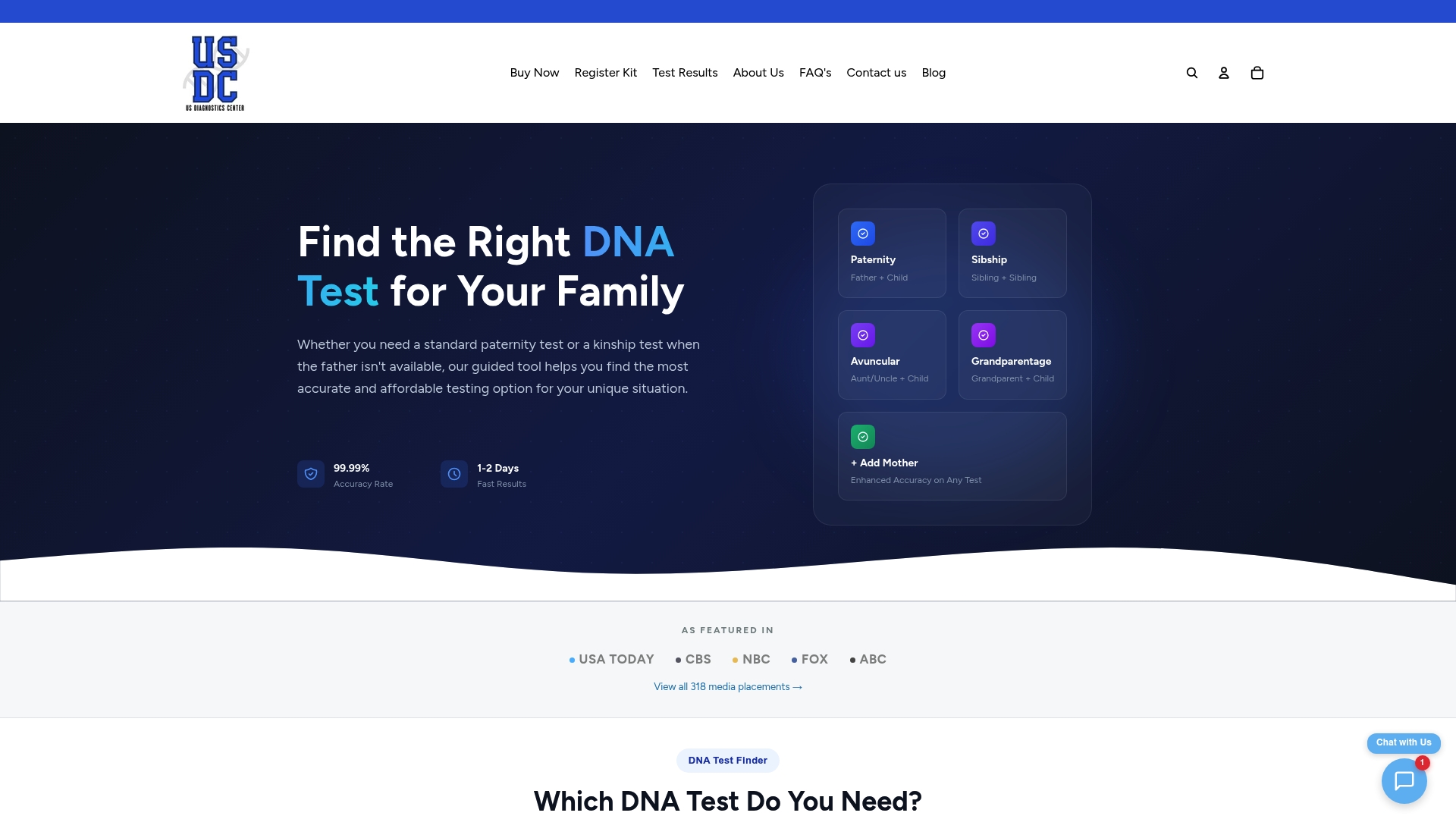
US Diagnostics Center offers at-home DNA test kits for paternity ($79), maternity ($129), and kinship relationships including sibling, grandparent, and avuncular testing ($139 each). Every kit ships with a prepaid return envelope; lab processing runs 2–3 business days, with standard order-to-results delivery in 7–10 business days. For court-admissible testing, confirm the lab's accreditation status and collection protocol with your attorney or IV-D office before ordering.
For readers researching court-admissible testing, the legal paternity test page at US Diagnostics Center (currently listed as Coming Soon) outlines the supervised-collection process and what to expect at each stage. If you are starting with a personal confirmation, the at-home test collection is available to order directly online. Questions about which test fits your specific custody or consent situation can be directed to the US Diagnostics Center support team before you place an order.
Sources
The following statutes, federal regulations, and legal guides were cited in this article and are recommended for further reading:
- Can Fathers Get a Paternity Test Without the Mother Knowing? - FindLaw
- 45 CFR § 303.5 - Establishing paternity and support (selection and use of laboratories) - Cornell Law
- 760.40 — Genetic testing; informed consent; confidentiality; penalties; notice of use of results. - Florida Senate
- Do Both Parents Have to Consent to a DNA Test? - LegalClarity
FAQ
Do both parents have to consent to a DNA test for a minor?
For a voluntary, court-admissible paternity test, most labs and courts expect consent from both legal parents. When one parent refuses, the other may petition a family court for an order compelling testing.
Can a father get a paternity test without the mother's consent?
A father not listed on the birth certificate cannot compel a child's participation without the custodial parent's agreement or a court order. Filing a paternity petition is the standard legal route when the mother declines to consent voluntarily.
Can you sue someone for doing a DNA test on a child without consent?
Potentially yes. Many states have genetic-privacy statutes that impose civil and sometimes criminal penalties for unauthorized genetic testing. The specific consequences depend on the state's statute and the circumstances of the collection.
What happens if a parent refuses a court-ordered DNA test?
A court may draw adverse inferences against a party who refuses to comply with a testing order, which can result in a legal presumption of paternity or other unfavorable findings in the proceeding.
Are home DNA test results admissible in court?
Generally no. Home kits lack the supervised collection and documented chain of custody that courts require, so results are typically excluded from legal proceedings even when the underlying science is accurate.
Recommended
- DNA Testing for Immigration: At-Home Kinship Tests Explained | USDC
- Home DNA Test vs Legal DNA Test: How to Choose (Framework) | USDC
- DNA Test for Personal Knowledge: What You Need to Know | USDC
- Why Home DNA Test Timing Matters More Than People Think | USDC
This article is part of our Understanding DNA Testing: How It Works and What to Expect guide.


0 comments