

If you need results for court, Social Security, or another federal agency, order a legal grandparentage test with chain-of-custody collection from an AABB-accredited lab. At-home kits are not admissible for those purposes; they only confirm a biological relationship privately. Testing a minor requires the custodial parent or guardian’s consent, and if that consent is refused, the next step is a court petition, not a mail-order kit. DNA testing providers offer both legal and at-home grandparent tests, with expedited processing available for time sensitive cases.
TL;DR:
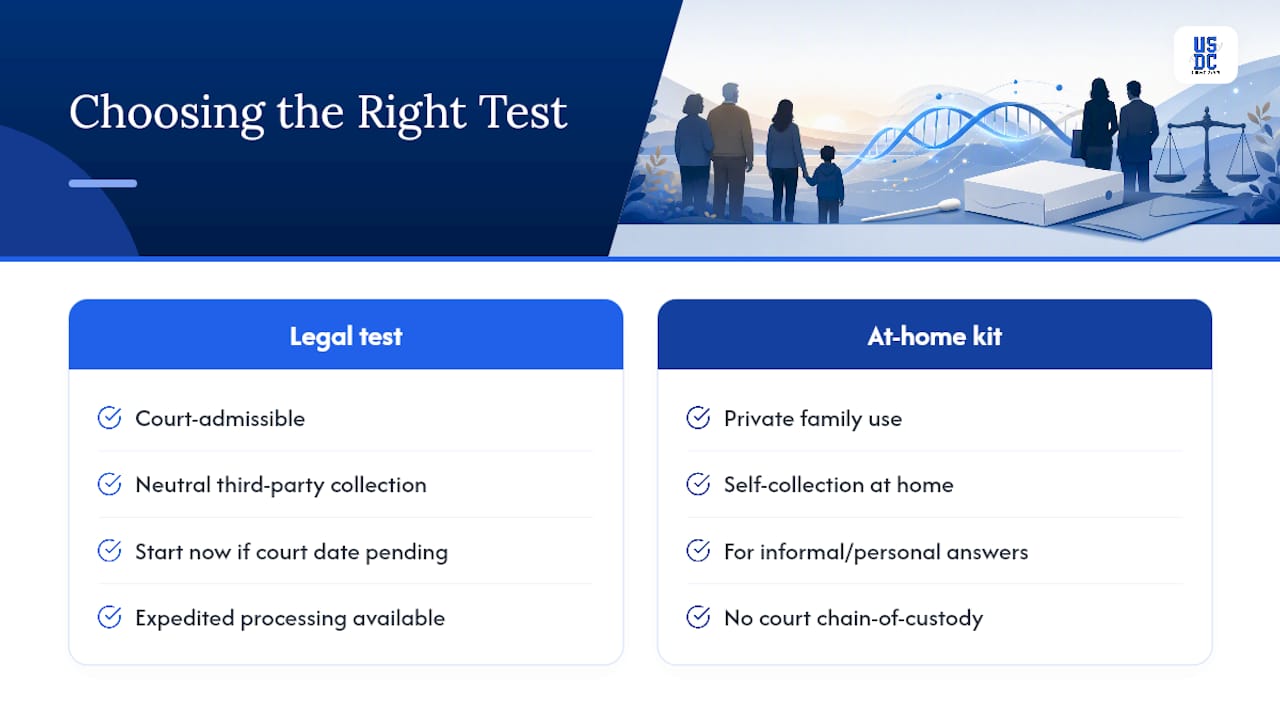
- Legal grandparentage tests require chain-of-custody collection by a neutral collector and are accepted by courts, while at-home kits are private and not court-admissible.
- Testing both paternal grandparents and the child’s mother provides the strongest and most conclusive results, with over 99% certainty in many cases.
- Obtaining court orders involves establishing legal standing, filing a detailed petition, and presenting proper documentation, especially when consent is refused.
- Chain-of-custody documentation and lab accreditation from recognized agencies like AABB are essential for court acceptance of DNA evidence.
- Costs typically start around $139 with a turnaround of one to two weeks, and expedited processing is available for urgent legal needs.
Table of Contents
- DNA Test for Grandparents Rights: At-Home vs. Legal Testing
- Who Should Be Tested for the Strongest Results?
- Who Can Authorize Testing, and What if Consent Is Refused?
- Chain of Custody, Lab Accreditation, and Court Acceptance
- Timelines and Typical Costs
- Interpreting Results: What Comes Next
- What Grandparents and Attorneys Often Get Wrong
- Ordering the Right Grandparent DNA Test
- Primary Sources and Recommended Reading
- Sources
- FAQ
DNA Test for Grandparents Rights: At-Home vs. Legal Testing
Both test types read the same genetic markers. Labs compare short tandem repeat (STR) markers, sometimes up to 28 markers, between a grandchild and grandparent to calculate the probability of a biological relationship. The science does not change based on where you buy the kit. What changes is everything around the sample: who collects it, how it’s documented, and whether a court or agency will trust the paper trail behind it.
Newer techniques like investigative genetic genealogy and SNP microarrays are gaining attention in forensic circles, but they remain distinct from standard STR-based kinship testing and are still being evaluated for broader court use. For grandparentage cases, STR analysis remains the standard.
- At-home kits: self-collected cheek swabs, results often back in a few business days, lower cost, and complete privacy. Not accepted by courts, the Social Security Administration, or most agencies.
- Legal tests: collection by a neutral third party who checks photo ID, seals the samples, and completes signed custody forms. The resulting report is built to withstand cross-examination.
If you’re not sure which one you need, ask yourself whether anyone outside your household will ever see the report. If the answer is a judge, caseworker, or insurance adjuster, skip the at-home kit entirely.
Who Should Be Tested for the Strongest Results?
A grandparentage test is a step removed from a direct paternity test, and the math reflects that. Testing one grandparent alone produces a usable but weaker result, because that grandparent shares only half their DNA with the child through the middle generation. Add the second paternal grandparent, and the picture sharpens considerably.
- One grandparent plus child: workable, but more likely to need a follow-up test.
- Both paternal grandparents plus child: the strongest combination available without the alleged father present.
- Both grandparents, child, and the child’s mother: this combination lets the lab subtract the mother’s known contribution and isolate the paternal markers with much greater precision.
When both grandparents and the mother participate, cases involving a deceased or unavailable parent produce a conclusive determination more than 99% of the time, a rate that approaches the certainty of a direct paternity test.
Pro Tip: If you can only start with one grandparent, ask the lab to keep the case file open. Most labs, including US Diagnostics Center, can add a second grandparent or the mother to an existing case rather than starting a new chain of custody from scratch.
Who Can Authorize Testing, and What if Consent Is Refused?
A grandparent has no automatic authority to order DNA testing on a grandchild. Consent to test a minor belongs to the custodial parent or legal guardian, full stop. Some states have also passed genetic privacy laws, including Florida’s Protecting DNA Privacy Act, that make testing someone without authorization a legal risk, not just a procedural misstep. Skipping consent to “just find out privately” can expose you to civil or even criminal liability depending on your state.
When a guardian refuses testing, grandparents who have a legitimate legal interest can ask a court to order it. That typically comes up when a parent has died, disappeared, or is otherwise unavailable, and the outcome affects survivor benefits, inheritance, or a custody or visitation matter already before the court.
To petition effectively:
- Establish legal standing, meaning a court needs to see why you have a real stake in the outcome, not just curiosity.
- File a petition stating the purpose of the test and how it connects to the pending legal matter.
- Submit supporting affidavits describing the family relationship and the circumstances requiring testing.
- Propose a specific accredited laboratory so the judge can approve a defined, verifiable process.
- Be prepared for the judge to weigh the child’s best interests alongside your request before issuing an order.
Courts move faster when the paperwork already names a lab and a clear procedure, so having this ready before you file saves weeks.
Chain of Custody, Lab Accreditation, and Court Acceptance
Chain of custody is the paperwork trail proving that the sample which reached the lab is the same sample collected from your family member, untouched and unswapped along the way. Judges do not take a lab’s word for it. They want to see documentation.
- Photo ID verification of everyone tested
- A neutral collector with no personal stake in the outcome
- Sealed, tamper-evident packaging at the point of collection
- Signed custody forms tracking every handoff
- A documented transfer record from collection site to laboratory
Maintaining that unbroken record is often the deciding factor in whether a result gets admitted at all, since a documented chain of custody is what lets a judge trust the sample over any objection.
Accreditation from the AABB matters here too. Courts and federal agencies widely recognize AABB-accredited labs as meeting validated testing standards, and some agencies require it outright.
Courts typically expect a numeric probability estimate, not just a plain-language conclusion, before weighing DNA evidence. A report stating “99.9% probability of grandparentage” carries far more evidentiary weight than one that simply says “related.” That statistical framing is what judges rely on to evaluate how much confidence to place in the result, and a legal test report is built to include it from the start.
Timelines and Typical Costs
Cost and speed depend on which type of test you order and how many people are involved. Home grandparent, sibling, and aunt/uncle DNA kits run $139. A home paternity test starts at $79 and a home maternity test at $129. Legal DNA testing is Coming Soon and does not have a published price. Adding participants, requesting mobile or clinic collection, or asking for expedited lab processing all add to the base price.
- Lab processing commonly takes a few business days once samples arrive.
- Total order-to-results timing is typically within one to two weeks.
- Expedited processing may be available for urgent cases.
- Kits ship with a prepaid return envelope, so mailing the samples back doesn’t cost you anything extra.
- Legal tests may carry an added collection fee if you need a mobile collector or a clinic visit for the neutral third-party requirement.
Budget for the legal test if there’s any chance the results end up in front of a judge. A cheaper at-home result that gets rejected later costs more in the end.
Interpreting Results: What Comes Next
That number reflects how the statistical model weighs the shared markers against the general population, and it’s the figure attorneys and judges lean on most when assessing the report’s weight.
- Grandparent tests return inconclusive results more often than direct paternity tests, simply because the genetic link runs through an extra generation.
- Adding the child’s mother or a second grandparent typically resolves an inconclusive case without restarting the process.
- If a legal test comes back inconclusive, courts generally allow new samples to be collected and retested, particularly in civil matters where obtaining a fresh sample is straightforward.
- Attorneys should request the full probability report, not just a summary letter, since supplemental statistical detail can matter if opposing counsel challenges the result.
Once you have a court-ready report in hand, keep the original chain-of-custody documents together with it. A judge can ask for both.
What Grandparents and Attorneys Often Get Wrong
Grandparents usually come to me already convinced a mail-order kit will settle a custody or benefits question, and that’s the mistake I see most often. The science inside the box is identical to a legal kit. What’s missing is everything a court actually scrutinizes: who swabbed the cheek, whether that person had a stake in the outcome, and whether the paperwork can survive a challenge from opposing counsel.
Attorneys should build the participant list before filing anything. A single grandparent’s sample invites a weaker report and a second round of testing later, which costs your client time they usually don’t have. Push for both paternal grandparents and the mother when at all possible.
Some DNA testing services provide guided test-selection tools to help families choose the right kit for their situation, along with expedited processing options for deadline-driven cases.
— Dr. Todd Lewis
Ordering the Right Grandparent DNA Test
Choosing the right at-home DNA kit for your situation shouldn’t require guesswork, and that’s exactly the problem US Diagnostics Center’s guided test-selection tool solves. Answer a few questions about your situation and the tool points you to the right kit. USDC's legal testing options are Coming Soon; if you need court-admissible results today, work with a provider that already offers witnessed collection and chain of custody.
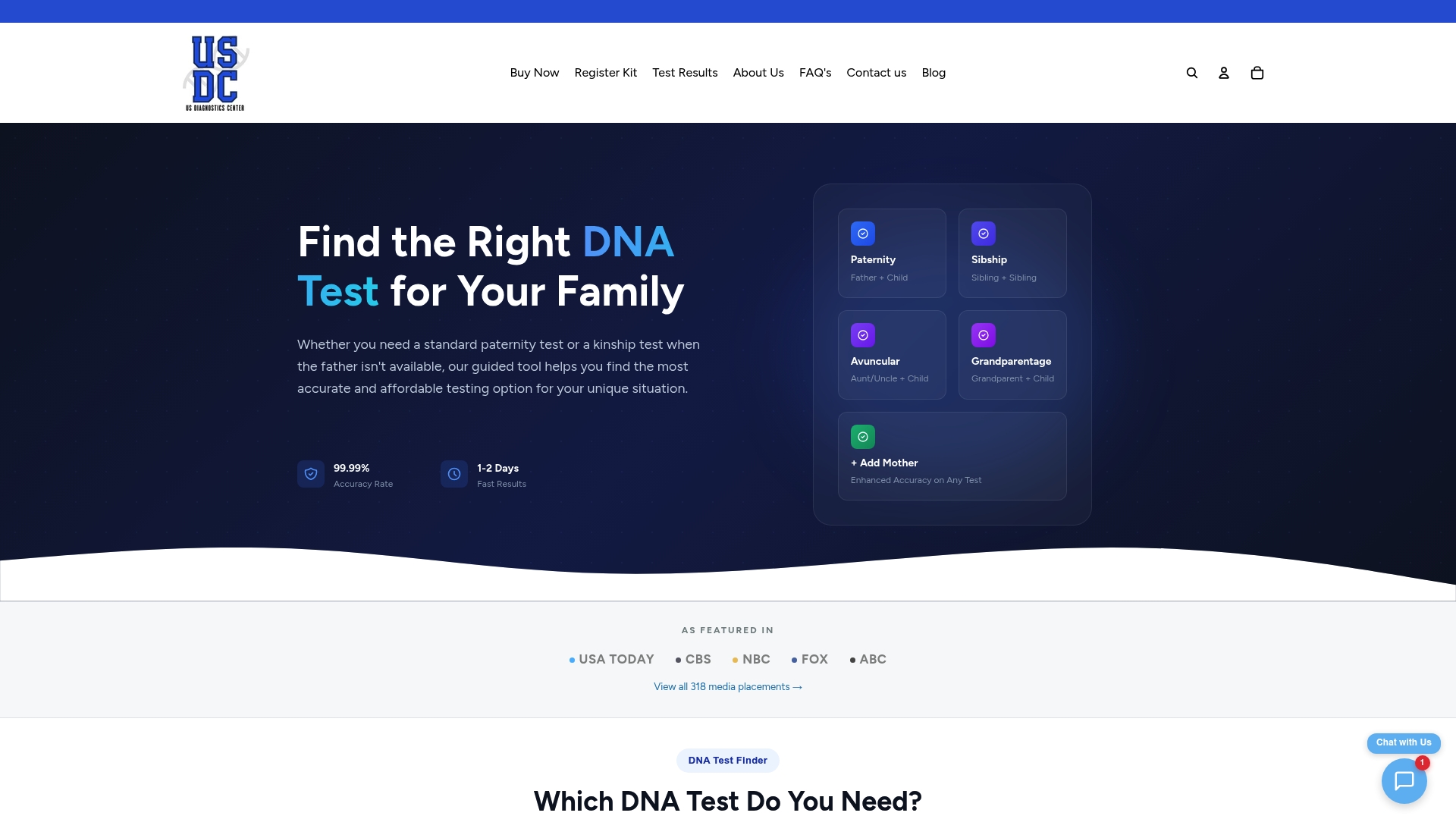
US Diagnostics Center offers private at-home grandparent DNA kits for families who want a personal-knowledge answer, with expedited processing available at checkout for time-sensitive cases. Legal, court-admissible grandparent testing with witnessed collection is a separate workflow — USDC's legal grandparent option is Coming Soon.
If you know a court date is coming, start with the legal test collection now so collection, lab processing, and reporting have enough runway before you need the results in hand.
Primary Sources and Recommended Reading
For deeper legal background, the NCBI’s reference guide on DNA identification evidence covers how forensic methods differ from relationship testing. The National Institute of Justice’s chain-of-custody training materials detail exactly what documentation courts expect. For admissibility standards judges apply to DNA evidence generally, see the NCBI’s judicial and evidentiary considerations guide.
This article is general information, not a substitute for advice from a qualified lawyer. Consult a qualified legal professional about your own circumstances before acting on anything here.
Sources
- Reference Guide on Human DNA Identification Evidence - NCBI Bookshelf
- What every law enforcement officer should know about DNA — chain of custody (NIJ)
- Can a grandparent get a DNA test on a grandchild? - LegalClarity
FAQ
Can Grandparents Get a DNA Test Without the Parent Present?
Yes. Testing both grandparents, and the mother when available, produces a conclusive result in more than 99% of cases even when the alleged father is deceased or unavailable.
Is an At-Home Grandparent DNA Test Admissible in Court?
No. At-home kits lack the neutral collection and chain-of-custody documentation courts require, and a sample collected at home cannot be converted into legal evidence after the fact.
What Happens if a Parent Refuses to Consent to Testing?
The grandparent must petition a court, establish legal standing, and show a legitimate reason for the request before a judge will order testing over a guardian’s objection.
How Long Does a Legal Grandparent DNA Test Take?
Lab processing typically takes 2 to 3 business days, with standard order-to-results timing of 7 to 10 business days; expedited options are available for urgent court deadlines.
Does US Diagnostics Center Offer Grandparent DNA Testing?
Yes. USDC offers at-home grandparent DNA kits for personal-knowledge testing, with expedited processing available at checkout for time-sensitive cases. USDC's legal grandparent testing option is Coming Soon.
Recommended
- Legal Kinship DNA for U.S. Families: Why Ancestry Kits Fail in Court
- DNA Testing for Probate & Inheritance Disputes (2026)
- 9 Legal Proof of Paternity Documents U.S. Courts Accept
- Best Grandparent DNA Test When Father Is Unavailable (2026)
This article is part of our Kinship DNA Testing: Sibling, Grandparent, and Family Relationship Tests and Understanding DNA Testing: How It Works and What to Expect guides.


0 comments