

Yes, you can arrange a DNA paternity test for an incarcerated father, but it usually requires a court or child support agency order and supervised collection to hold up in a legal proceeding. That order needs to name the correctional facility and the inmate directly. Expect to work through a family court clerk or your state’s child support office, then a testing vendor who coordinates the actual collection. Retail kits bought online will not satisfy a judge or a child support caseworker, no matter how accurate the lab is.
TL;DR:
- A court order must specify the correctional facility’s name, address, and inmate ID for a legally valid DNA paternity test in jail.
- Retail kits lack chain-of-custody procedures, making them inadmissible in court compared to supervised collections conducted by authorized vendors.
- State-provided testing is usually free through child support cases before paternity is established, but costs are assigned to requesters in private or family court cases.
- Precise court order language, including inmate ID, facility details, and signed authorization, is essential to avoid delays or rejections.
- Facility scheduling and legal paperwork errors often cause delays, so verifying requirements with the testing vendor beforehand saves significant time.
Table of Contents
- How to Get a Paternity Test While Incarcerated: The Step-by-Step Process
- Why At-Home Kits Aren’t Court-Admissible Evidence
- Who Pays for Inmate Paternity Testing, and How Long Does It Take?
- What to Include in the Court Order or Testing Request
- What Happens on Collection Day Inside the Facility
- Practical Advice From US Diagnostics Center’s Testing Team
- Following the Process Protects Everyone Involved
- Let US Diagnostics Center Help You Sort Out the Right Test
- Where to Verify State-Specific Rules
- Sources
- FAQ
How to Get a Paternity Test While Incarcerated: The Step-by-Step Process
Getting a jail paternity test moving starts with picking the right entry point, and that choice depends on whether a child support case already exists.
Most people start one of two ways. If no support order exists yet, a mother, alleged father, or state agency can open a IV-D child support case through the local child support enforcement office. If a paternity dispute is already part of a divorce, custody matter, or standalone paternity action, the petition goes through family court instead. Either path can lead to testing, but the paperwork differs slightly.
- Open the case. File with your state child support enforcement (CSE) office or submit a paternity petition to family court, depending on whether support is already at issue.
- Ask for a specific order. The order authorizing testing must name the correctional facility, its address, and the inmate’s booking or department of corrections ID number. Generic language gets rejected by facility staff more often than specific language.
- Let the office coordinate with the facility. CSE offices and court clerks typically have existing relationships with corrections departments and contracted testing vendors, who handle scheduling once the order is in hand.
- Confirm whether consent matters. If the incarcerated father agrees to testing, the process can move faster informally. If he does not, the court order compels the sample, and the facility must cooperate with a properly issued order.
Florida’s statute on genetic testing is a useful reference point here: it requires notice to both parties and treats a 99% or higher probability of paternity as a legal presumption, while explicitly requiring correctional facilities to help incarcerated respondents comply with an order to appear for testing. That cooperation requirement is not universal in wording across states, but the underlying principle holds nationwide: a facility generally will not block a properly authorized collection.
Why At-Home Kits Aren’t Court-Admissible Evidence
A retail DNA kit and a legal paternity test measure the same biology but answer to completely different standards of proof. Chain-of-custody is the dividing line. It means every hand that touches the sample, from swab to lab report, is documented and verifiable, with no gap where someone could tamper with or mislabel a specimen.
Courts expect several things a mail-order kit simply cannot provide:
- Collection by a neutral third party, not the person being tested.
- Photo identification checks at the point of collection.
- A signed chain-of-custody form that travels with the sample.
- Lab processing at a facility that documents its own handling procedures, not a consumer lab optimized for speed and low cost.
Georgia’s child welfare policy manual is blunt about the gap: consumer kits are explicitly excluded as legal evidence in child welfare and court matters, no matter how accurate the underlying science is. A jail blood test or buccal swab collected under a vendor’s supervised protocol carries weight in family court. The same swab collected at home and mailed in on your own does not, even if it comes back with a near-certain match. An at-home kit can still satisfy personal curiosity or guide a private decision, but it will not resolve a custody dispute or a support order.
Who Pays for Inmate Paternity Testing, and How Long Does It Take?
Cost and timeline both hinge on how the case entered the system. If a parent opens a child support case, state-provided genetic testing is often available at no direct cost to the requesting parent, since IV-D programs generally cover it. That coverage has a limit worth knowing before signing anything: it typically does not apply once paternity has already been established through a signed Acknowledgment of Paternity or a prior court order.
Outside IV-D cases, courts often assign the initial cost to whichever party requested testing, though indigent parties can sometimes get costs advanced. Ohio’s administrative code sets out this kind of scheduling and payment structure at the state level, and most states follow a similar logic even where the specific rules differ.
- No-cost testing: usually available through an open CSE case, before paternity is legally established.
- Requester-paid testing: common in family court petitions outside the IV-D system.
- Indigency exceptions: possible, but usually require a separate motion showing financial need.
Build in extra time for facility coordination. Lab turnaround is fast on its own, but scheduling around a corrections department’s security protocols adds days that a standard order-to-results timeline does not account for.
What to Include in the Court Order or Testing Request
A court order that is missing one detail can sit for weeks while a facility’s legal department kicks it back for clarification. San Diego County’s own paternity testing procedures spell out exactly what a valid order needs, and the pattern holds well beyond that one county.
- The inmate’s full legal name and department of corrections or booking ID number.
- The facility’s exact name and address, not just the city or county.
- A certified copy of the court’s minute order, not a draft or a party’s summary of the ruling.
- Explicit language authorizing the testing vendor to enter the facility and collect a sample, since general “testing is ordered” language sometimes isn’t enough for facility legal review.
- Any vendor-specific scheduling form, such as a LabCorp 04-550 style intake sheet, filled out ahead of submission.
- Identification and documentation for the child and custodial parent, since draw sites verify identity on both ends of a paternity comparison.
Pro Tip: Call the vendor before you file anything and ask what exact wording their legal team needs on the order. A five-minute call can save weeks of resubmission if the facility’s records office bounces the paperwork back for a technicality.
What Happens on Collection Day Inside the Facility
Sample collection inside a jail or prison looks routine on the surface, but a handful of behind-the-scenes steps determine whether the result will actually hold up. Most collections are buccal swabs, taken by vendor staff or facility medical personnel rather than a general officer. Some jurisdictions specify blood draws instead, particularly when a facility’s own medical unit handles the appointment.
Identity verification comes first every time. The collecting party checks photo identification and documents it before touching a swab, then labels, seals, and logs the sample under chain-of-custody before it ever leaves the building.
- Buccal swabs are standard; blood draws happen when specified by the ordering court or agency.
- Photo ID verification and paperwork happen before collection, not after.
- Approved vendors handle collection under sealed chain-of-custody protocols, the same industry standard used for legal paternity test matters where court-admissible documentation is required.
- Security procedures inside the facility, not the lab itself, cause most scheduling delays. A named corrections contact on file speeds things up considerably.
Practical Advice From US Diagnostics Center’s Testing Team
Getting the paperwork right the first time is the single biggest lever readers have over how fast this moves. A testing provider can review your court order language before you submit it and confirm what a facility’s legal or records office will actually accept.
- Before filing, ask the vendor to confirm they can verify the inmate’s ID against facility records and that they’ll accept your court’s minute order format.
- For any situation heading to a court or child support office, confirm evidentiary requirements with your court or CSE office and work with a provider specifically credentialed for court-admissible testing. For non-legal family questions where personal answers are what you need, US Diagnostics Center offers a guided test selection tool that helps families figure out which at-home kit fits their situation.
- Double-check three things before submission: the inmate’s correct ID number, a named facility contact, and a certified minute order that explicitly authorizes vendor entry for collection. Missing any one of these is the most common reason a request stalls.
Following the Process Protects Everyone Involved
Skipping steps to save a few weeks almost always costs more time in the end. A rejected order, a missing ID number, or an at-home kit mailed in as “proof” tends to send a case back to square one, and that delay lands on the child’s situation more than anyone else’s.
Call your local child support office or family court clerk before filing anything. They see these orders daily and can tell you exactly what their jurisdiction requires, which saves a resubmission cycle you cannot get back.
— Dr. Todd Lewis
Let US Diagnostics Center Help You Sort Out the Right Test
US Diagnostics Center gives you a guided path instead of guesswork when a family situation involves incarceration, custody questions, or a straightforward private paternity check. The test selection tool walks you through your specific circumstances and points you toward the right kit, whether that’s a private paternity check or a broader kinship question.
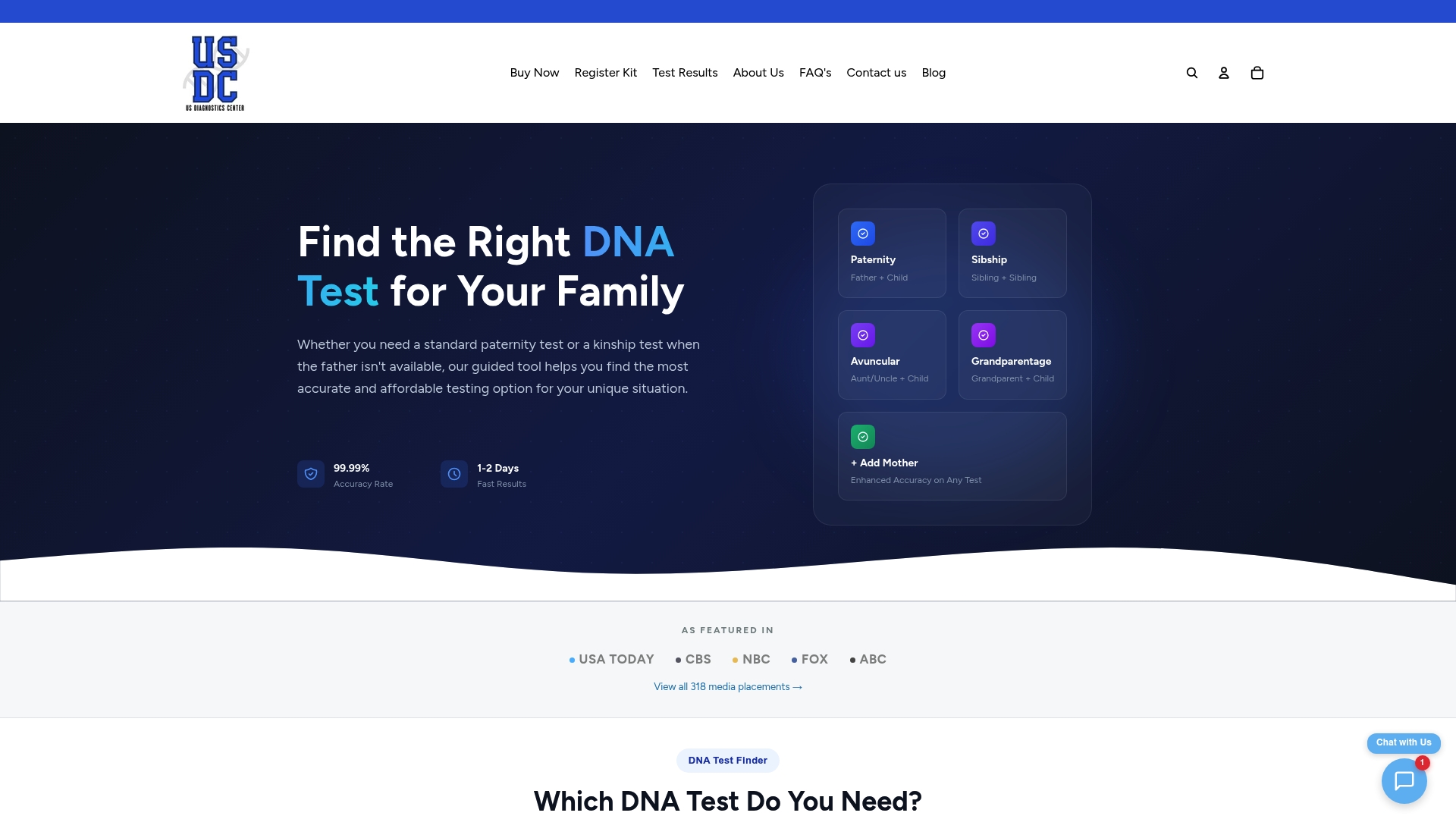
For situations where court admissibility isn’t required, the Home Paternity Test Kit costs seventy-nine dollars and includes a prepaid return shipping envelope, with lab processing in 2 to 3 business days and full order-to-results turnaround in 7 to 10 business days. Faster processing options are available during checkout when a family needs answers on a shorter timeline. Browse the full lineup of kinship DNA tests, including sibling, grandparent, and aunt/uncle options, and start with the tool that matches you to the right kit before you order, with prices ranging from seventy-nine to one hundred thirty-nine dollars per test.
Where to Verify State-Specific Rules
Procedures vary by state, so confirm current forms and routing with your local family court clerk or child support enforcement office before filing. County court PDFs, like San Diego’s paternity testing procedures, offer useful templates for what a valid order should contain.
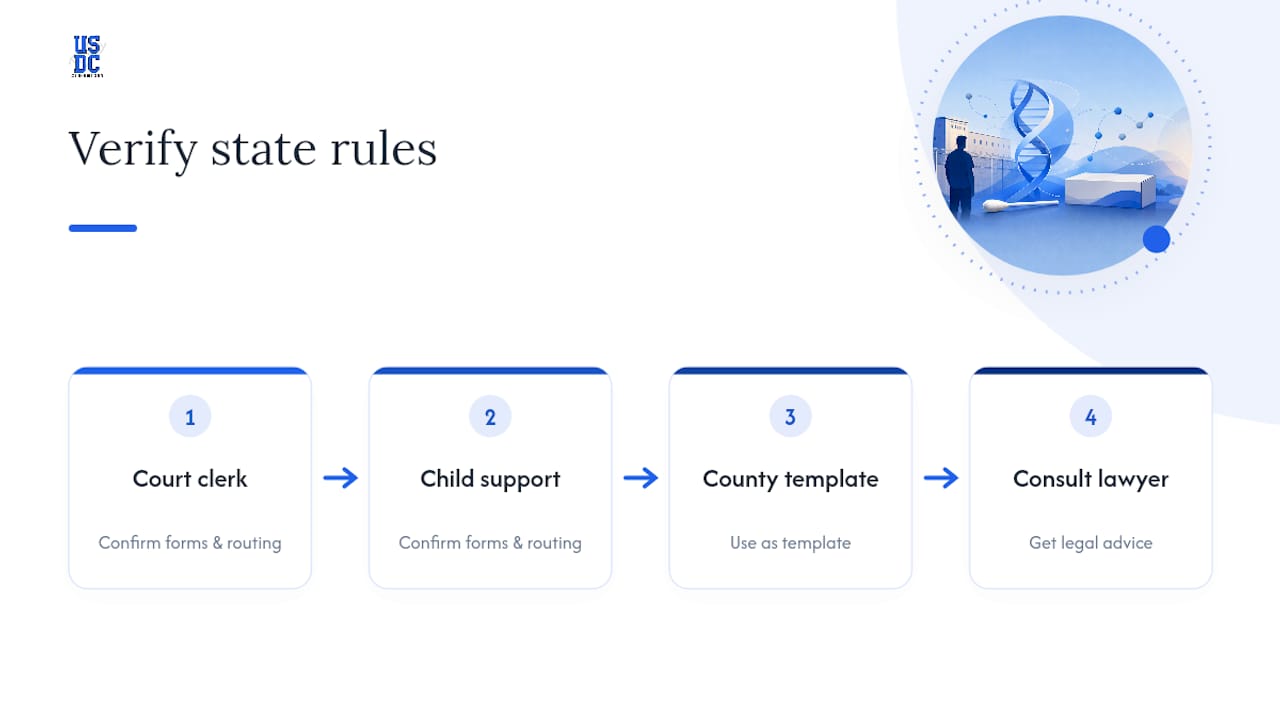
This article is general information, not a substitute for advice from a qualified lawyer. Consult a qualified legal professional about your own circumstances before acting on anything here.
Sources
- Court-Ordered Paternity | Office of the Attorney General
- 2025 Statutes 0409.256 | Florida House of Representatives
- Paternity Testing (San Diego County child welfare procedures)
- Ohio Admin. Code 5101:12-40-25 - Court order for genetic testing
FAQ
Can I get a DNA test if the father is in jail?
Yes. You’ll generally need a court order or a child support agency case that names the facility and the inmate’s ID number, since testing vendors and correctional facilities require that level of detail before scheduling a supervised collection.
Do they take your DNA if you go to jail?
Booking DNA collection for criminal database purposes is separate from paternity testing and follows different state rules tied to arrest or conviction for certain offenses. A jail paternity test, by contrast, requires its own court or agency order specifically authorizing a paternity sample.
Is there a nationwide ban on DNA testing in the United States?
No, there is no nationwide ban on DNA paternity testing. States regulate how and when compelled testing occurs, particularly for incarcerated individuals, but voluntary and court-ordered paternity testing is legal and routinely used across all fifty states.
What states require DNA testing on felony arrests?
DNA collection requirements for felony arrests vary significantly by state and typically apply to criminal identification databases, not paternity cases. Check with your state’s department of corrections or attorney general’s office for the specific arrest-related DNA collection rules where you live.
How much does US Diagnostics Center’s home paternity test cost?
The Home Paternity Test Kit costs $79 and includes a prepaid return shipping envelope, with results typically ready in 2 to 3 business days after the lab receives the sample. This option fits private, non-court situations rather than cases requiring supervised legal collection.
Recommended
- 9 Legal Proof of Paternity Documents U.S. Courts Accept
- Get Court Admissible Paternity Results in 7–10 Days After Birth (U.S.)
- When a Mother Refuses: Court Admissible Results in 7–10 Days (U.S.)
- What Happens If You Refuse a Paternity Test? (2026)
This article is part of our Paternity Testing: The Complete Guide guide.


0 comments