

People question biological origins for clear social, legal, and medical reasons, and DNA relationship tests can usually give a definitive biological answer when the right test and procedures are used. Whether the question involves a father-child relationship, a sibling connection, or grandparentage, a properly conducted DNA test from an accredited lab can resolve most close-kin questions with high statistical confidence.
DNA testing is most useful in these situations:
- Custody or child-support proceedings requiring legal proof of paternity or maternity
- Adoption follow-up or donor-conception questions where a biological parent's identity is unknown
- Medical family history needs, where knowing a biological relative's health profile matters
- Immigration or family-reunification cases where documentary evidence is missing or disputed
Testing has limits. Distant kinship relationships produce probabilistic results rather than definitive conclusions, and DNA cannot resolve cultural or legal definitions of family that go beyond biology.
Key Takeaways
People question biological origins for documented social, legal, and medical reasons, and a properly conducted DNA relationship test from a lab following AABB standards can resolve most close-kin questions with high statistical confidence.
| Point | Details |
|---|---|
| When testing is most useful | Custody, inheritance, adoption follow-up, donor conception, and immigration cases all benefit from DNA evidence. |
| Accuracy benchmarks | Industry-accepted threshold is 99.5% probability; trio paternity tests often reach 99.99% with up to 28 markers. |
| Chain-of-custody is required for legal use | Home tests may be technically accurate but are not court-admissible without witnessed collection and documented handling. |
| Emotional and privacy risks are real | A minority of testers discover unexpected information; prepare for all possible outcomes before ordering. |
| US Diagnostics Center | Offers at-home and legal kits from $79, with 7–10 business day turnaround and a prepaid return envelope included. |
Table of Contents
- Why people question who is biologically related to them
- What relationship DNA tests can and cannot prove
- How accurate relationship tests are and what lab standards matter
- How DNA testing fits into U.S. legal and immigration proceedings
- Emotional, ethical, and privacy risks of relationship testing
- Step-by-step: choosing the right test and getting valid results
- What to do after you receive results
- US Diagnostics Center: at-home and legal DNA kits for every family scenario
- Sources
- FAQ
Why people question who is biologically related to them
Doubts about biological relationships arise from a range of circumstances, and understanding the specific trigger matters because it shapes which test is appropriate and what legal or emotional preparation is needed.
-
Unexpected physical or medical traits. A child who shares no obvious physical resemblance with a parent, or who presents a hereditary condition with no known family history, often prompts questions. Medical genetics teams sometimes recommend parentage confirmation before interpreting inherited-disease risk.
-
Adoption and unknown parentage. Adults adopted as children or raised without information about one biological parent frequently seek testing to identify biological relatives. Survey data show that locating biological relatives is a primary motivation for a notable subset of genetic-test users, alongside curiosity and family-history building.
-
Donor conception. Individuals conceived through sperm or egg donation may have limited or no information about the donor. A large survey of genetic relative-finder users found that 82% learned the identity of at least one genetic relative, and a subset discovered donor-conception circumstances they had not previously known.
-
Custody and child-support disputes. Courts in every U.S. state can order or accept DNA paternity evidence in custody, support, and disestablishment proceedings. The legal stakes make accuracy and chain-of-custody non-negotiable in these cases.
-
Inheritance and estate disputes. When a biological relationship determines inheritance rights, parties may contest parentage. Probate courts accept DNA evidence, and the chain-of-custody requirements mirror those for family court.
-
Immigration and family reunification. The U.S. Department of State accepts DNA results as a non-documentary method to verify biological relationships when documents are missing or disputed. A review of U.S. immigration cases found that testing can document relationships effectively but also frequently reveals sensitive information and creates logistical and ethical complications, particularly for vulnerable migrants.
-
General curiosity and family-history research. A YouGov poll found that high percentages of Americans say they would take a DNA test to learn about unknown siblings or adoption status, with ancestry and curiosity as common drivers even when no specific dispute exists.
What relationship DNA tests can and cannot prove
Biological kinship testing compares allele sharing across multiple genetic loci to calculate a statistical probability of relationship. The type of test and the participants available determine how definitive the result will be.

Paternity and maternity testing are the most statistically reliable. A trio test, which includes the child, the alleged parent, and the other biological parent, provides the highest confidence because the mother's profile eliminates ambiguity about which alleles the child inherited from each side. Results are reported as inclusion (the alleged parent cannot be excluded) or exclusion (the alleged parent is excluded), accompanied by a combined likelihood ratio (CLR) or paternity index.
Sibling, grandparent, and avuncular (aunt/uncle) tests are inherently less definitive. These tests compare indirect genetic sharing rather than direct parent-child transmission, so results are reported as a Combined Relationship Index (CRI). A CRI greater than 10 supports the claimed relationship, values between 0.1 and 10 are inconclusive, and a CRI below 0.1 argues against the relationship. A grandparent test, for example, can support or challenge a claimed relationship but rarely produces the same statistical certainty as a direct paternity trio.
Twin zygosity testing determines whether twins are identical (monozygotic) or fraternal (dizygotic) by comparing allele profiles across multiple markers.
Key distinctions to understand:
- Trio vs. deficient cases. Adding the mother's sample to a paternity test significantly raises the CLR. A deficient case (child and alleged father only) is still valid but produces a lower CLR, and some labs require extended marker panels to compensate.
- Distant relationships. Second-degree and more distant relationships produce overlapping probability distributions that make definitive conclusions unreliable. These cases often require a reconstruction approach using multiple family members.
- Inclusion vs. exclusion. Exclusion is absolute: if the DNA profiles are incompatible, the alleged relationship is ruled out. Inclusion is probabilistic: the CLR expresses how much more likely the relationship is compared to a random, unrelated person.
Pro Tip: If the mother is available and willing to participate, always include her sample in a paternity test. The improvement in statistical certainty is substantial and can be the difference between a borderline and a conclusive result.
How accurate relationship tests are and what lab standards matter
The industry-accepted threshold for a conclusive paternity result is a probability of 99.5% or greater, which is the standard U.S. consular officers apply in visa cases.
Marker count directly affects statistical power. Responsible labs test 20 or more markers, and many incorporate mutation-rate handling when a single inconsistency appears, rather than issuing an automatic exclusion. The AABB technical report documents that the minimum accepted CLR for parentage cases is 100, meaning the relationship is at least 100 times more probable than a random match, though many labs set higher internal thresholds.
Key figure: The AABB 2024 Relationship Testing Technical Report sets a minimum CLR of 100 for parentage conclusions, with accredited labs frequently reporting CLRs far exceeding that floor for trio cases.
What to look for in a lab report:
- A stated CLR or paternity index alongside the inclusion/exclusion conclusion
- The number of markers tested and any mutation notations
- Chain-of-custody documentation if the test is intended for legal use
- The lab's accreditation status and whether it follows AABB standards
How DNA testing fits into U.S. legal and immigration proceedings
The distinction between a voluntary test and one requested by authorities carries significant practical weight. When a family initiates testing on their own terms, the potential benefit, confirming or ruling out a relationship, generally outweighs the risks. When a consular officer or court orders testing, the power dynamic shifts and families have less control over how results are used.
Consular and immigration use. The U.S. Department of State accepts DNA results reporting 99.5% or greater probability of paternity or maternity to support parent-child relationships in visa cases. Testing is voluntary, and all costs are the petitioner's or beneficiary's responsibility. Results do not guarantee visa approval; they are one piece of evidence among others.
Chain-of-custody requirements. A legal test requires witnessed sample collection, verified photo identification, and documented handling from collection through analysis. A home test, even if technically accurate, lacks this documentation and is not court-admissible. For custody, immigration, or inheritance proceedings, a legal chain-of-custody kit is the only appropriate choice.
Documented pitfalls. A review of 31 U.S. immigration cases identified misattributed parentage revelations, coercion concerns, and inconsistent application of results as recurring problems. Families should understand that a test revealing unexpected nonparentage in an immigration context can have immediate and serious consequences for a visa application.
Pro Tip: Before submitting DNA results to any government authority, consult an immigration attorney. Results that reveal unexpected information cannot be withdrawn once submitted, and legal counsel can help you understand how the consular officer is likely to weigh the findings.
For context on how immigration authorities use DNA evidence, the US Diagnostics Center blog covers how USCIS uses DNA for visas in detail, including the distinction between at-home and legal-grade kits.
Emotional, ethical, and privacy risks of relationship testing
DNA results can confirm what a family suspected, or they can introduce information no one anticipated. Both outcomes carry weight.
Unexpected discoveries. The genetic relative-finder survey found that while most participants reported neutral or positive outcomes, a minority experienced disruptive findings such as misattributed parentage or previously unknown siblings. Donor-conceived individuals reported higher rates of decisional regret. Ethnographic research at a New York testing center reinforces that the nontechnical costs of testing, including family conflict and the loss of established narratives, are real and should be weighed before proceeding.
Privacy risks. At-home DNA tests processed by labs that also operate relative-finder databases expose your genetic profile to a broader network than a standard relationship test. If privacy is a concern, choose a lab that processes relationship tests only and does not add profiles to a searchable relative-finder database.
Consent for minors. A parent or legal guardian must provide consent for a minor child's sample. Documenting that consent in writing, and limiting sample collection to what the specific test requires, protects both the child and the adults involved.
- Avoid testing a child without the knowledge of the other legal parent when a custody order is in place; doing so may have legal consequences.
- Do not collect samples from a vulnerable adult without their informed, voluntary agreement.
- Understand what the lab does with samples after testing, including retention and destruction policies.
Pro Tip: Before telling family members you are considering a test, decide in advance what you will do with each possible result. A counselor who specializes in genetic disclosure can help you prepare for outcomes that may be harder to process than you expect.
Step-by-step: choosing the right test and getting valid results
Step 1: Define the purpose. A personal curiosity test and a court-admissible test are different products with different procedures. Decide upfront whether results need to hold up in a legal proceeding.
Step 2: Choose the correct test type. Paternity, maternity, sibling, grandparent, and avuncular tests each address a specific relationship question. The home DNA test vs. legal DNA test decision framework from US Diagnostics Center walks through the key decision points.
Step 3: Confirm marker count and CLR thresholds. Ask the lab how many markers are tested (look for up to 28 markers) and what CLR threshold they use for a conclusive result.
Step 4: Verify chain-of-custody if needed. For legal use, confirm the lab provides witnessed collection, photo ID verification, and documented sample handling.
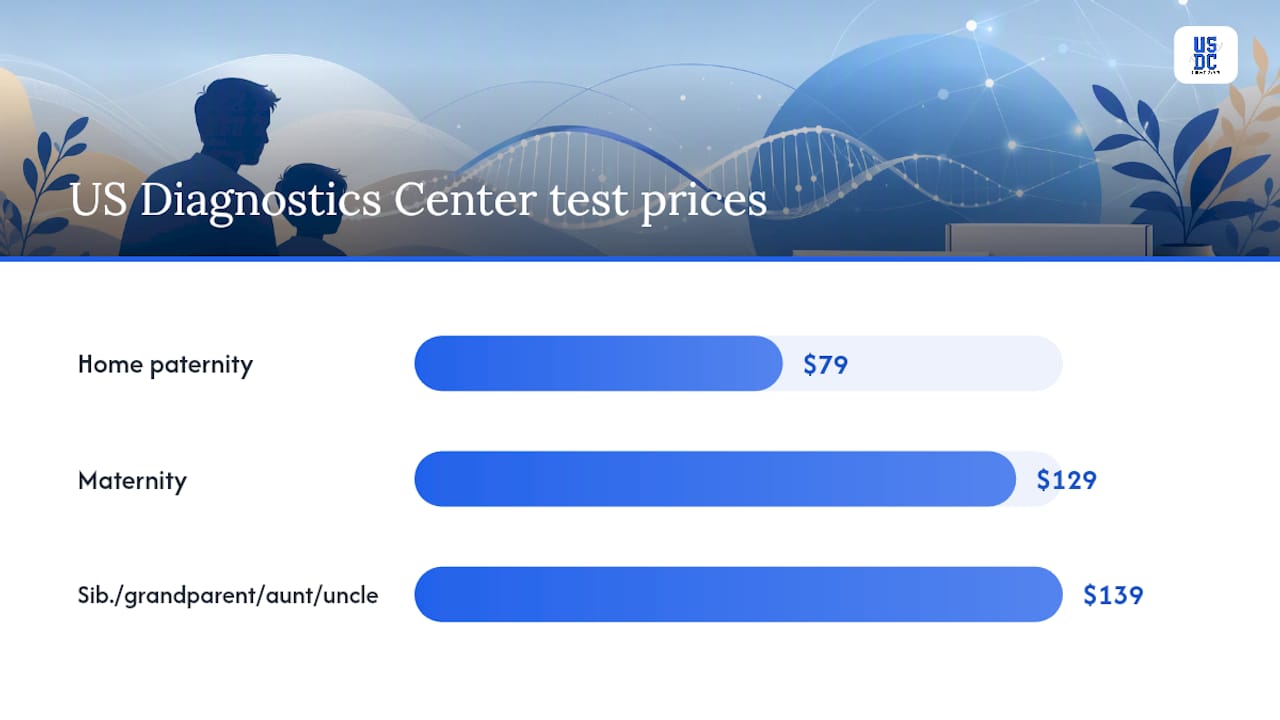
Step 5: Understand turnaround and cost. Standard order-to-results is 7–10 business days, with 2–3 business days for lab processing. Expedited options are available. Pricing at US Diagnostics Center: home paternity $79; maternity $129; sibling, grandparent, and aunt/uncle tests $139. Each kit includes a prepaid return shipping envelope.
Questions to ask a lab before ordering:
- Does the lab follow AABB standards, and what is its current accreditation status?
- How many STR markers does the test analyze?
- What CLR threshold does the lab use to report inclusion?
- How are samples handled and stored after analysis?
- Is a prepaid return envelope included, and what is the chain-of-custody procedure for legal kits?
For a broader look at affordable family DNA testing options, the US Diagnostics Center blog provides current pricing context.
| Test scenario | Reliability level | When to use it |
|---|---|---|
| Trio paternity | Highest | Custody, immigration, inheritance, or personal certainty |
| Deficient paternity | High | When mother is unavailable; legal use still possible |
| Sibling / grandparent / avuncular | Moderate, probabilistic | When direct parent is deceased or unavailable |
What to do after you receive results
Understanding the three result types:
- Inclusion means the alleged relative cannot be excluded. For parentage tests, the Combined Paternity Index (CPI) or Combined Likelihood Ratio (CLR) quantifies how strongly the data supports the relationship — a CPI of 100 or greater is the accepted minimum for inclusion. For kinship tests (sibling, grandparent, avuncular), results are expressed as a Combined Relationship Index (CRI) — a CRI greater than 10 supports the claimed relationship, 0.1 to 10 is inconclusive, and below 0.1 argues against it.
- Exclusion means the profiles are genetically incompatible; the alleged relationship is ruled out.
- Inconclusive results occur when the index falls below the lab's reporting threshold, often in deficient or distant-relationship cases. Extended testing with additional relatives usually resolves these.
If results are unexpected:
- Pause before sharing results with others. Premature disclosure can cause irreversible family conflict.
- Verify the chain-of-custody documentation to confirm the sample was not switched or mislabeled.
- Consider confirmatory retesting with a legal chain-of-custody kit if the original test was a home kit.
- Seek genetic counseling before making major decisions based on the result.
- Consult an attorney if the result affects a custody order, immigration case, or estate proceeding.
When results are unexpected, the sequence matters: confirm the result's integrity first, then seek professional guidance before taking any legal or personal action.
A note on testing with care
The decision to test a biological relationship is rarely simple. Families come to this question from many directions, and the right answer depends on what they need the result to do. Testing with a clear purpose, proper procedures, and realistic expectations about what the result may reveal is the most responsible path. We encourage families to use the checklist in this article before ordering. If you are unsure which test fits your situation, reach out before ordering so the right kit is selected from the start.
US Diagnostics Center: at-home and legal DNA kits for every family scenario
Resolving a question about biological parentage or kinship starts with choosing a test designed for your specific situation, not a generic kit. US Diagnostics Center offers at-home and legal-style DNA kits for paternity, maternity, sibling, grandparentage, avuncular, and twin zygosity testing, with up to 28 markers analyzed per test and results in 7–10 business days standard (2–3 business days lab processing). Every kit includes a prepaid return shipping envelope.
Pricing is straightforward: home paternity at $79, maternity at $129, and sibling, grandparent, or aunt/uncle tests at $139. Expedited processing is available for time-sensitive situations. Immigration paternity testing and prenatal NIPP testing are not services offered.
Browse home DNA tests for personal peace of mind, or review legal chain-of-custody kits if results need to hold up in court or before a government authority.
Sources
The claims in this article draw on the following primary and peer-reviewed sources:
- DNA relationship testing procedures | U.S. Department of State
- Framing the utility and potential pitfalls of relationship and identity DNA testing across United States immigration contexts - PMC
- 2024 AABB Relationship Testing Technical Report
- Population survey of genetic relative-finder service outcomes - PMC
- Survey on motivations and outcomes of genetic relative discovery | Frontiers in Genetics
This article is general information, not a substitute for advice from a qualified lawyer. Consult a qualified legal professional about your own circumstances before acting on anything here.
FAQ
What probability threshold makes a DNA paternity result legally acceptable?
U.S. consular officers require a probability of 99.5% or greater for paternity or maternity to support a parent-child visa claim, and many U.S. courts apply a comparable standard. In lab terms, AABB standards set a minimum Combined Paternity Index (CPI) of 100 — meaning the relationship is at least 100 times more probable than a random match — though most labs report far higher CPIs in trio cases.
What is the difference between a home DNA test and a legal DNA test?
A home test uses self-collected samples without witnessed chain-of-custody and is suitable for personal knowledge only. A legal test requires witnessed collection, verified ID, and documented handling, making results court-admissible.
How many markers should a reliable relationship test analyze?
Reliable labs test 20 or more markers. More markers increase statistical power, and labs following AABB standards use mutation-rate handling when a single inconsistency appears rather than issuing an automatic exclusion.
Can a DNA test confirm a sibling or grandparent relationship as definitively as paternity?
No. Sibling, grandparent, and avuncular tests are probabilistic rather than definitive because they measure indirect genetic sharing. Unlike parentage tests — which report a Combined Paternity Index (CPI) where CPI ≥ 100 typically corresponds to ≥99% probability — kinship tests produce a Combined Relationship Index (CRI). A CRI greater than 10 supports the claimed relationship; below 0.1 argues against it; values in between are inconclusive.
What should you do if DNA results reveal unexpected information?
Pause before sharing results, verify the chain-of-custody documentation, and consider confirmatory retesting. Seek genetic counseling and, if the result affects a legal matter, consult an attorney before taking action.
Recommended
- Why Home DNA Test Timing Matters More Than People Think | USDC
- What Is Biological Kinship Testing: A Family Guide | USDC
- 7 Signs You Might Need a Paternity Test (2026) | USDC
- Why DNA Tests Beat Blood Tests for Relationship Proof | USDC
This article is part of our Paternity Testing: The Complete Guide guide.


0 comments