

An avuncular test compares a child with an aunt or uncle. A grandparent test compares a child with a grandparent. Both are used when the alleged father cannot or will not give a sample, and the right choice usually depends on which relative is available, willing to test, and closest to the question you are trying to answer. If the father is available, a direct paternity test is almost always the better route. If he is not, this guide explains how the two relative tests differ, what their results can and cannot tell you, and how to decide.
TL;DR
- An avuncular test checks whether a child and the alleged father’s full brother or sister are biologically related. A grandparent test checks the same for the alleged father’s mother or father.
- Both are indirect tests. They look at second-degree relationships, so results are less decisive than a direct father-child test, and more relatives tested generally means a clearer answer.
- Pick the test by who is available and willing to provide a sample. Adding the child’s mother usually strengthens either test.
- Our home kits for each of these tests are $139. A direct home paternity test is $79 and is the simpler option whenever the father can be tested.
- Home kits are for personal knowledge. Court and immigration cases have separate laboratory requirements, covered below.
Table of Contents
- What each test actually compares
- Why both are harder to read than a paternity test
- When an avuncular test is the better fit
- When a grandparent test is the better fit
- Where the sibling test fits
- How to read the results
- Cost and turnaround
- Personal knowledge versus court or immigration use
- Our perspective
- Choosing your kit
- FAQ
- Sources
What each test actually compares
The two tests answer the same underlying question, “is this child biologically related to this family?”, through different relatives.
An avuncular test compares a child with an alleged aunt or uncle. In a paternity situation, that relative is the alleged father’s full brother or sister. If the child is related to that person as a niece or nephew, it supports the conclusion that the alleged father is the child’s biological father. The U.S. Department of State lists a child and a paternal aunt, uncle, or grandparent among the relationships that are commonly tested, which shows how routine both options are.
A grandparent test compares a child with one or both of the alleged father’s parents. A paternal grandmother alone can be tested, a paternal grandfather alone can be tested, or both can be tested together. Because a grandparent is one generation further from the child than the father is, the test relies on shared DNA passing through the father.
A short comparison:
| Avuncular test | Grandparent test | |
|---|---|---|
| Who is tested | Child and the alleged father’s full brother or sister | Child and one or both of the alleged father’s parents |
| Relationship type | Second degree, collateral (uncle, aunt, niece, nephew) | Second degree, direct line (grandparent and grandchild) |
| Average DNA shared | About 25% | About 25% |
| Typical reason | Father is deceased, absent or unwilling, but his sibling will cooperate | Father is deceased, absent or unwilling, but his parent will cooperate |
| Our home kit price | $139 | $139 |
Why both are harder to read than a paternity test
A direct paternity test compares a child with the alleged father, and a true father passes about half of his DNA to his child. A grandparent shares about 25% of DNA with a grandchild on average, and an aunt or uncle shares a similar average with a niece or nephew. Less shared DNA means less statistical signal.

There is a second complication. Grandparent-grandchild, avuncular and half-sibling pairs are all second-degree relationships, and a peer-reviewed study explains that their pairwise DNA-sharing patterns overlap, which is why additional relatives improve classification. In practical terms, two people who share about a quarter of their DNA could be an aunt and niece, a grandmother and grandchild, or half-siblings. The test is designed around the relationship you name when you order, so it matters that the stated relationship is accurate.
Professional guidance from the AABB, the organization that sets standards for relationship testing laboratories, makes the same point. Its newsletter notes that indirect tests such as avuncular, grandparentage and siblingship lack the direct inheritance pattern of parent-child testing, which limits statistical power and makes inconclusive results more likely. It also observes that tests with only one possible relative are more likely to be inconclusive than tests that include enough second-degree relatives.
The takeaway is not that these tests are unreliable. It is that you should expect a probability, not an automatic yes or no, and you should give the lab as much family information as you can.
When an avuncular test is the better fit
Choose an avuncular test when the alleged father’s full brother or sister is the relative most able to take part. Common situations include:
- The alleged father has died, and his sister or brother is willing to test.
- The alleged father is out of contact, but a sibling of his is in touch with the family.
- The family is uncertain whether a child belongs to one of two brothers, and one wants to be tested separately first.
Two details matter. First, the aunt or uncle should be a full sibling of the alleged father. A half-sibling of the father shares less DNA with the child on average, which lowers the strength of the result. Second, the result is stronger when the child’s mother also provides a sample, because her DNA helps the lab separate what the child inherited from her side from what came from the father’s side. We cover the process in more depth in our guide to how aunt and uncle DNA testing works and what it costs.
When a grandparent test is the better fit
Choose a grandparent test when the alleged father’s mother or father is available and willing. It is often the natural choice when:
- The alleged father has no living siblings, or his siblings are half-siblings or are unwilling.
- The paternal grandparents are closely involved with the child and want an answer for the family.
- Both grandparents can be tested, which gives the lab two sets of genetic markers to compare with the child.
Testing both grandparents is usually more informative than testing one, for the same reason that more relatives improve any indirect test. If only one grandparent can take part, the result can still be useful, but the chance of an inconclusive outcome rises. As with an avuncular test, including the mother in the grandparent test is advisable when she is available.
Where the sibling test fits
Readers often ask whether a sibling test can replace an avuncular test when the alleged father is unavailable. It can in some families, but it answers a different question.
A sibling test compares two people who may share one or both parents. If a child and a person who is known to be the alleged father’s biological child test as full siblings, that supports the father’s link to the child, because it implies they share both parents. If they test as half siblings, the result depends on which parent they are thought to share, and the interpretation is more delicate. In other words, a sibling test works through the father’s other children, while an avuncular test works through the father’s brothers and sisters, and a grandparent test works through his parents.
A practical way to choose among the three:
- List who is willing to test. The best test is the one that a relative will actually complete.
- Prefer the closest genetic link. A direct paternity test comes first, then a full sibling, then avuncular or grandparent testing.
- Prefer more people over fewer. Two grandparents, or an aunt or uncle plus the mother, give a stronger result than a single relative.
- Be accurate about the relationship. Full and half siblings are different tests, as are full and half aunts and uncles.
Our kinship DNA testing page walks through sibling, grandparent and related tests, and our test finder can suggest the best match for your situation.
How to read the results
Relationship results are reported as a probability or a combined likelihood ratio, along with a plain statement of whether the relationship is supported, not supported or inconclusive. Several points help you interpret them:
- A high probability supports the relationship. A very low one indicates that the people tested are probably not related in the way you stated.
- An inconclusive result is a real outcome, not a failure. With second-degree relationships, the DNA sometimes does not separate the stated relationship from alternatives. Testing additional relatives is the usual next step.
- Different tests use different benchmarks. For example, USCIS, for full-sibling tests based on 20 loci, treats results below 9% as evidence that the claimed relationship does not exist and results from 9% to 89% as inconclusive. Those thresholds belong to that immigration context. They are not a universal scale for every test and every lab.
You may also see the question “does 99.9 mean you are the father?” A figure like that is a probability of paternity from a direct test, calculated against the stated alternatives. It is a strong statistical statement, not a certainty about every possible scenario, which is why the way the test is set up matters as much as the number.
Can an uncle be mistaken for a father? In a direct paternity test, no. The test compares the child with one man, and a brother of the true father will usually not match the way the father does. The risk of confusion comes from ordering the wrong type of test, for example telling a lab that a man is the child’s father when he is actually the father’s brother, so describe the family accurately at checkout.
Cost and turnaround
Prices on our site are published per kit. Current home kit prices:
| Test | Price |
|---|---|
| Home Paternity Test Kit | $79 |
| Home Maternity Test Kit | $129 |
| Home Aunt/Uncle DNA Test Kit | $139 |
| Home Grandparent DNA Test | $139 |
| At-Home Full Sibling DNA Test Kit | $139 |
| Home Half Sibling DNA Test Kit | $139 |
The avuncular and grandparent kits cost the same, so price should not be what decides between them. What does change the overall cost is how many relatives you need to test. A direct paternity test at $79 is the least expensive route when the father can take part, and the indirect kits cost more because the lab must do more work to reach a reliable answer. Each kit includes a prepaid return shipping envelope for sending your samples back.
Lab processing takes 2 to 3 business days once samples arrive. From placing the order to receiving results, a standard order typically takes 7 to 10 business days, because that window includes shipping the kit to you, collecting the samples, and returning them. If you are working against a deadline, Expedited processing is available during checkout when a family needs a faster answer..
Personal knowledge versus court or immigration use
A home DNA kit is designed to give a family clear information. It is not designed to serve as evidence in a court case or an immigration filing, and it is worth knowing the difference before you order.
For immigration, U.S. federal agencies require AABB accreditation. USCIS, passport agencies and U.S. embassies accept results only when the case is initiated by and reported directly from an AABB-accredited laboratory or collection site. The AABB also cautions against claiming that non-legal tests meet its standards when chain-of-custody protocols are absent. If your situation involves a visa or a petition, the details are in requirements for relationship DNA tests, and our overview of how USCIS uses DNA for visas explains what the agency looks for.
We do not offer court-admissible tests , so if you need results for a custody or support case, ask the attorney or agency handling it which laboratory and collection process they will accept before you spend money on any test.
Our perspective
Most families who contact us about avuncular or grandparent testing are not choosing between two abstract options. They are working around a missing person. The father has died, he will not respond, or the family simply wants an answer without a confrontation. In those situations we think the most useful thing a lab can do is steer people away from guesswork.
Our view is that the decision should follow the relatives, not the product list. If the father can test, we recommend a direct test at $79, because no indirect test matches it. If he cannot, we ask who else is truly willing, and we encourage families to bring in more than one relative, including the mother, because second-degree results get clearer as information is added. We also say plainly that an inconclusive result is possible with these tests, and that a follow-up test with another relative is a normal next step, not a sign that something went wrong.
Our kits test up to 28 markers, and processing at the lab takes 2 to 3 business days. We are equally direct about limits: our home kits are for personal knowledge and not for court or immigration cases.
— Dr. Todd Lewis
Choosing your kit
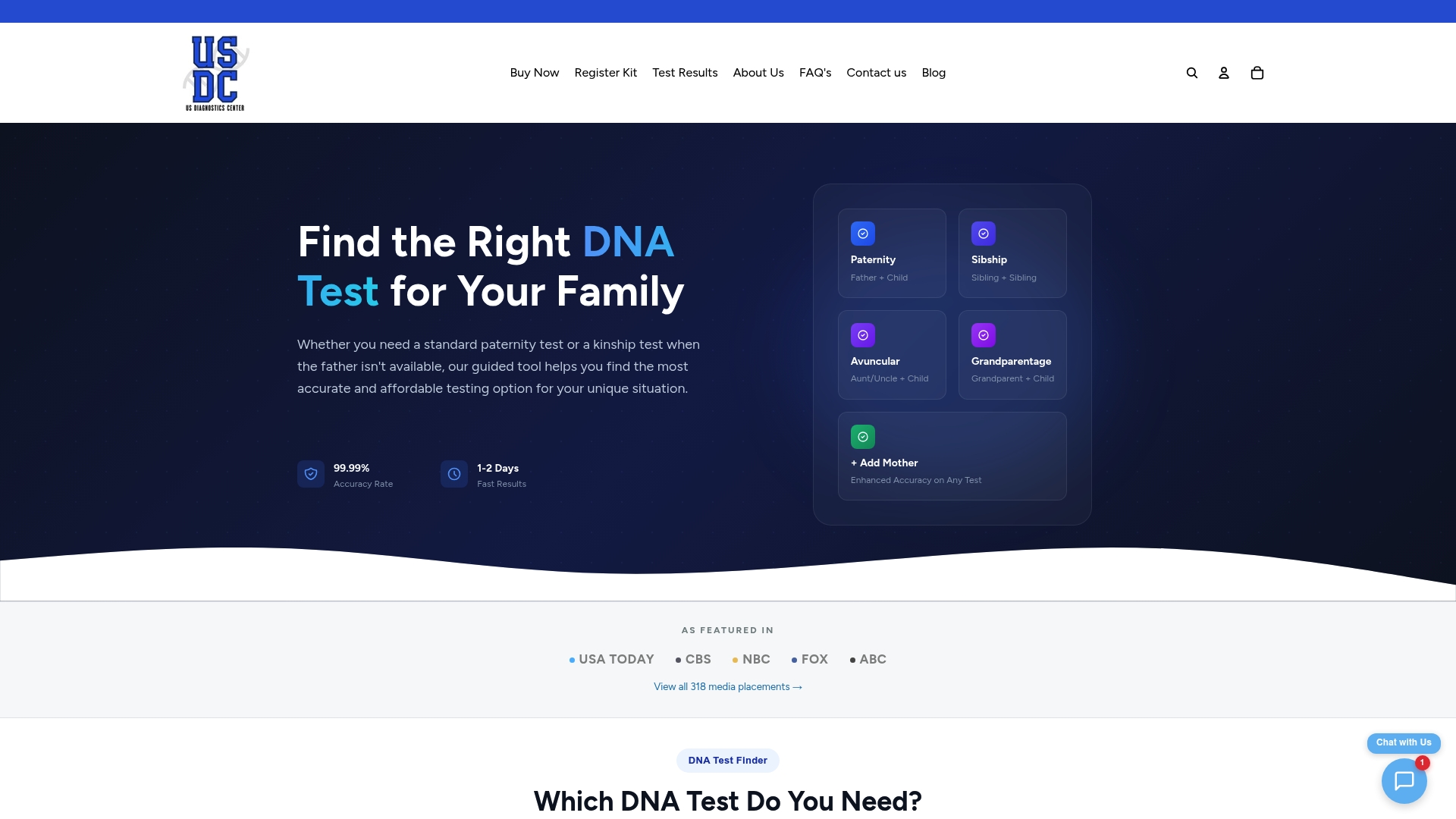
If you already know which relative will take part, you can order the matching kit from our home DNA tests collection. The Home Aunt/Uncle DNA Test Kit and Home Grandparent DNA Test are each $139, and the Home Paternity Test Kit is $79 when the father himself can be tested. Each kit comes with a prepaid return envelope, and our guided test finder can confirm which kit fits your family before you check out.
If you are unsure whether the aunt or uncle in question is a full or half sibling of the alleged father, or whether the grandparent is on the father’s side, settle that first. The kit has to match the real relationship, and our paternity testing guide explains how to describe the family correctly.
FAQ
Is an avuncular test more accurate than a grandparent test?
Neither is inherently more accurate, since both compare second-degree relatives who share about 25% of their DNA on average. What improves accuracy is the number of relatives tested, so a grandparent test with both grandparents or an avuncular test that includes the mother tends to be clearer than either test with a single relative.
Can I use a grandparent test if the father is alive?
Yes, but a direct paternity test is usually the better choice, and at $79 it is also the least expensive. A grandparent test makes sense when the father is deceased, unreachable or unwilling.
Does the aunt or uncle need to be a full sibling of the father?
Ideally, yes. A half-sibling of the father shares less DNA with the child on average, which makes the result harder to interpret. Tell the lab the exact relationship when you order so the test is set up correctly.
What happens if my result is inconclusive?
An inconclusive result means the DNA did not clearly support or rule out the stated relationship. The usual next step is to add another relative, such as the child’s mother, a second grandparent, or a full sibling of the child, and run the comparison again.
How long will I wait for results?
Lab processing takes 2 to 3 business days after your samples arrive. A standard order, from purchase to results, typically takes 7 to 10 business days, and Expedited processing is available during checkout when a family needs a faster answer.
Sources
- Information for Parents on U.S. Citizenship and DNA Testing, U.S. Department of State
- Testing Family Members with AncestryDNA, Ancestry
- Distinguishing pedigree relationships via multi-way identity by descent sharing
- Relationship Testing News, July 2022, AABB
- Policy Memorandum on DNA Evidence of Sibling Relationships, USCIS
- Become AABB-Accredited: Relationship (DNA) Testing, AABB
- 2024 AABB Relationship Testing Technical Report


0 comments