

An immigration maternity DNA test is a cheek-swab test that checks whether a claimed mother and child are biologically related, and it is only suggested when documents and photographs do not establish the relationship well enough. The U.S. Department of State describes maternity testing as a way to verify a stated mother-child relationship when other credible evidence is unavailable. The test must be arranged through an AABB-accredited laboratory under a controlled process, so it cannot be done with a kit ordered for personal use.
This guide explains when officials raise the subject, what the accreditation and chain-of-custody rules require, how the appointment works in the United States and abroad, what it typically costs, and where a home maternity test does and does not fit.
TL;DR
- DNA testing is optional evidence. USCIS and consular officers may suggest it when other proof is insufficient, but they cannot require it, and a positive result does not guarantee approval.
- The test must be run by an AABB-accredited laboratory, with identity checks and a documented chain of custody. Results go from the laboratory directly to the immigration office.
- Expect to pay the laboratory in advance. One independent 2026 legal explainer puts a two-person parent-child test at roughly $300 to $700 before extra charges.
- Home kits ordered for personal use are not accepted as immigration evidence. Our Home Maternity Test Kit ($129) is for families who want a private answer first.
Table of Contents
- What an immigration maternity DNA test is
- When officials suggest a maternity DNA test
- Accreditation and chain of custody
- How the test is arranged, step by step
- What an immigration maternity DNA test costs
- How long results take
- When the mother is unavailable or the result is unclear
- Why a home maternity test is a different thing
- Where our home maternity test fits
- Our perspective
- Preparing before you book anything
- FAQ
- Sources
What an immigration maternity DNA test is
A maternity test compares DNA from a claimed mother and a child. Samples are collected by buccal swab, which means a soft swab rubbed on the inside of the cheek. The process is painless and does not require blood, which makes it practical for infants and for applicants in other countries.
The immigration version differs from a personal test in how the sample is collected, not in the biology. Every step is supervised, the people tested are identified, and the laboratory reports to the government office rather than to the family. The Department of State lists maternity, paternity and sibling relationships as the ones commonly tested, and notes that more distant relationships cannot be proven reliably with DNA.
For visa cases, the Foreign Affairs Manual sets a numerical threshold: maternity or paternity results must report at least 99.5 percent certainty to support the biological relationship.
When officials suggest a maternity DNA test
Most family-based cases never involve DNA. Birth certificates, hospital records, school and medical records, photographs and sworn statements usually carry the case. A test becomes relevant when that evidence is missing, inconsistent or considered unreliable. Typical situations include records lost in a disaster or conflict, births that were never formally registered, informal adoptions or name changes, and birth certificates issued long after the birth.
Who decides, and whether it is mandatory
USCIS guidance states that the agency cannot require DNA testing. When credible evidence is lacking, officers may suggest testing and consider the results, and the testing is voluntary. A more recent USCIS policy alert dated August 5, 2026 says officers must suggest DNA testing as optional evidence when primary evidence is unavailable, unreliable or insufficient and more evidence is needed. It applies to requests pending or filed on or after its publication.
In practice the suggestion often arrives in writing. The Catholic Legal Immigration Network (CLINIC) reports that USCIS commonly raises it through a Request for Evidence or a Notice of Intent to Deny. A U.S. embassy or consular officer can also suggest voluntary maternity testing in an immigrant-visa, passport or Consular Report of Birth Abroad case.
If you received such a letter, our walkthrough of what a USCIS DNA letter means covers the deadlines and your options. For the wider picture, see how USCIS uses DNA for visas.
A positive result is not an approval
Both the Department of State and CLINIC make the same point: a matching result supports the claimed relationship, but it does not guarantee that a visa or benefit will be granted. Other eligibility requirements still apply.
Accreditation and chain of custody
Two requirements make an immigration test different from any other DNA test.
AABB accreditation
USCIS requires a laboratory that reports a biological relationship to hold AABB accreditation. AABB is the accrediting body, not a testing laboratory. It says its accredited facilities follow validated procedures intended to maintain chain of custody and traceability from case initiation through reporting, and that these facilities are recognized by the federal government for immigration purposes.
Before paying anyone, confirm the laboratory’s status on the accrediting body’s own list. Our guide on how to verify an AABB lab shows what to check, and AABB accreditation explained describes what the standards cover.
Chain of custody
USCIS guidance requires safeguards that protect the chain of custody, identify the people tested and ensure results are presented correctly. Communication should run directly between the laboratory and the civil surgeon, panel physician or field office. Third parties must not carry samples or results, which means the family never hands over a sealed envelope of its own.

The practical rule: do not collect samples yourself, do not mail them yourself, and do not forward results. Our article on immigration DNA chain of custody explains each handoff.
How the test is arranged, step by step
The sequence below follows the Department of State’s procedure for overseas cases, with notes for people in the United States.
- Confirm that testing is being suggested. Read the letter or consular instruction carefully, including any deadline. Testing is voluntary, but not responding may leave the evidence gap open.
- Choose an AABB-accredited laboratory. The petitioner selects the laboratory, schedules the appointment and pays the required fees, as the Department of State explains.
- Pay in advance. The laboratory is paid before the kit moves. More on fees below.
- Arrange collection for each person. In the United States, the person tested is identified and swabbed at a collection site arranged through the laboratory. For an overseas beneficiary, the laboratory sends the kit to the U.S. embassy or consulate, where a designated physician or medical technician collects the sample.
- Return of samples. The post returns the kit directly to the laboratory. Neither family member handles the return.
- Results go to the government. AABB states that USCIS receives results directly from the accredited laboratory.
Bring government-issued photo identification for every adult and, for a child, the documents the laboratory lists. Collection staff will typically photograph participants and may record fingerprints, so confirm requirements when you book.
What an immigration maternity DNA test costs
The U.S. government does not publish a fee schedule for these tests because it does not run them. The Department of State says testing is offered for a fee and that all testing and related expenses are paid in advance by the petitioner or beneficiary. Our explainer on who pays for immigration DNA covers the same rule in more detail.
For a sense of the market, one independent legal explainer from 2026 reports that a standard two-person parent-child test commonly costs about $300 to $700, before possible collection, international shipping and expedited-processing charges. Treat that as a planning range, not a quote.
| Cost factor | Why it changes the total |
|---|---|
| Number of people tested | A second parent or sibling adds a participant fee |
| Collection location | Embassy, consulate or clinic collection can carry separate fees |
| International shipping | Kits and samples cross borders in each direction |
| Rush processing | Faster turnaround usually costs extra |
| Re-collection | A failed or incomplete sample may need another appointment |
Ask for a written, itemized quote that lists every charge, and keep the receipt with your case file.
How long results take
The Department of State warns that parentage testing involves logistical delays, so build in time. An independent 2026 explainer estimates three to eight weeks from authorization through result transmission in many cross-border cases, with laboratory analysis commonly taking three to five business days once all samples arrive. That is an estimate, not a government guarantee.
Most of the delay happens before the laboratory starts: waiting for an embassy appointment, shipping kits abroad, and waiting for both samples to arrive. If your letter has a response deadline, start scheduling as soon as you decide to proceed, and ask the laboratory what its timeline looks like for your specific country.
When the mother is unavailable or the result is unclear
Sometimes the claimed mother has died, cannot travel or cannot be located. The Department of State says that in this situation a distant relative may be tested, but additional testing or evidence may be requested, and the relationship must still be established with acceptable evidence. Sibling testing is one of the commonly tested relationships, but whether it is accepted in your case is the decision of the officer handling it.
If a result is inconclusive or does not match, speak with an immigration attorney or a DOJ-accredited representative before taking any further step. They can advise on additional evidence and on how to respond to the officer in writing.
Why a home maternity test is a different thing
This is the point that most often causes expensive mistakes. Privately obtained or at-home results generally cannot substitute for immigration testing, because they do not preserve the required government chain of custody. CLINIC states that privately obtained results will not be accepted by USCIS. If a kit is shipped to you, swabbed at your kitchen table and mailed by you, no one has verified who gave the sample.
Our article on refusing a private DNA test discusses why a privately obtained result can be challenged, and our comparison of at-home and legal maternity options explains the difference in plain terms. Our overview of overseas consulate requirements for I-130 petitions covers the consular side.
Where our home maternity test fits

We offer at-home DNA kits for families who want a private, confidential answer about a biological relationship, for personal knowledge and peace of mind. Some families use a private result to understand where they stand before deciding how to proceed with a case, then speak to an attorney about the formal route.
Our Home Maternity Test Kit is $129. Our home paternity and single-profile kits are $79, and home sibling, grandparent and aunt/uncle kits are $139. Each kit includes a prepaid return shipping envelope, and our tests are designed to compare up to 28 markers with 99.99% accuracy. Lab processing takes 2 to 3 business days, and a standard order typically runs 7 to 10 business days from order to results.
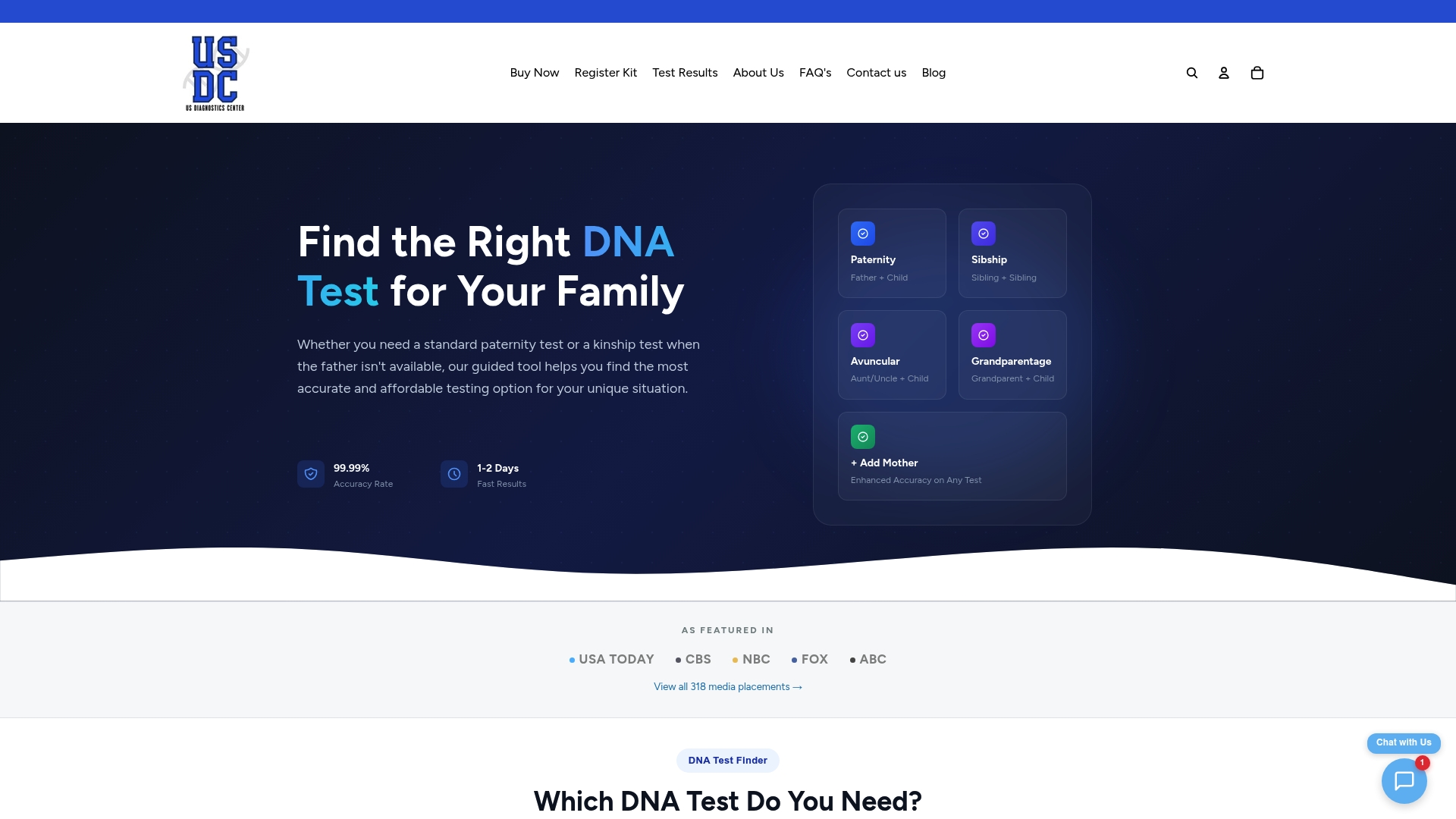
You can see every kit and its price on our home DNA tests page, or answer a few questions in our guided tool to find the right kit for your situation. For a closer look at how our maternity kit works, read how a maternity DNA test works and what to expect.
Our perspective
Families usually reach us in the middle of a stressful process. A letter has arrived, a deadline is running, and the question is simple: is this person my child, or am I theirs? We believe the most useful thing we can do is be clear about which kind of test answers which kind of question.
An immigration filing requires a laboratory and a collection process built for government review, with identification and supervised sample handling at every step. A home test is built for something different: a private, fast, affordable answer for the family itself. We make that second kind of test, and we make it carefully, with a guided selection tool so you buy the right relationship test the first time rather than the wrong one twice.
If you are in an immigration case, follow the instructions in your letter and use the accredited laboratory process it calls for. If you simply need to know, or want clarity before taking the next step, a home maternity test gives you results in days, with a prepaid return envelope and confidential reporting.
Dr. Todd Lewis
Preparing before you book anything
A short checklist saves time and money:
- Reread the letter or consular notice for the exact instruction, the response deadline and the office to contact.
- List the evidence you already hold: birth certificates, hospital and medical records, school records, photographs and affidavits. Submitting additional documents can sometimes address the gap without testing.
- Verify the laboratory’s accreditation before payment, and get an itemized quote.
- Confirm who will be tested, where each person will be collected and what identification each person needs.
- Keep copies of every receipt, appointment confirmation and shipping record.
- Speak with an immigration attorney or accredited representative if your case is complicated.
FAQ
Does USCIS require a maternity DNA test?
No. USCIS cannot require DNA testing, and the test is voluntary. Officers may suggest it when other evidence is insufficient, and a 2026 policy alert says they must suggest it as optional evidence in those circumstances. A positive result does not guarantee approval.
Can I use an at-home maternity test for my immigration case?
No. At-home results do not preserve the government chain of custody, and CLINIC says USCIS will not accept privately obtained results. Immigration testing must go through an AABB-accredited laboratory using the supervised collection process.
Who pays for the test?
The petitioner or beneficiary pays all testing and related expenses, and the laboratory is paid in advance, according to the Department of State. Total price depends on the number of people tested, collection location, shipping and processing speed.
How accurate does the result need to be?
For visa cases, the Foreign Affairs Manual says maternity or paternity results must report at least 99.5 percent certainty to support the biological relationship. The laboratory’s report will state the probability for your case.
What if the mother cannot be tested?
The Department of State says a distant relative may be tested, but more testing or evidence may be requested, and the relationship must still be established with acceptable evidence. An immigration attorney can advise on your specific case.
Sources
- DNA Relationship Testing Procedures, U.S. Department of State
- USCIS genetic testing guidance
- USCIS Policy Alert, August 5, 2026
- Frequently Asked Questions About DNA Testing, CLINIC
- DNA (Relationship) Testing FAQs, AABB
- 9 FAM 601.11, U.S. Department of State
- Information for Parents on U.S. Citizenship and DNA Testing, U.S. Department of State
- How Long Does an Immigration DNA Test Take?, Marble Law


0 comments