


TL;DR:
- DNA paternity testing confirms biological fatherhood with over 99.99% accuracy. Legal tests require witnessed sample collection and chain-of-custody documentation for court admissibility. Starting with a legal test prevents delays and costlier repeats if results are needed for legal proceedings.
Biological father confirmation is the process of using DNA paternity testing to determine with over 99.99% accuracy whether a man is the biological father of a child. The standard industry term for this process is "paternity establishment," and it covers both personal knowledge testing and legally binding court procedures. Courts operating under the Uniform Parentage Act require a probability of paternity above 99% before accepting a result as conclusive proof. Whether you are seeking personal clarity or preparing for a custody hearing, understanding how paternity confirmation works protects your rights and your family's future.
What is biological father confirmation through DNA testing?
DNA paternity testing works by comparing short tandem repeat (STR) markers between a child and an alleged father. STR markers are specific locations on chromosomes where DNA sequences repeat in patterns unique to each person. A child inherits exactly half of these markers from the biological father, so a lab can determine parentage by checking whether the child's paternal markers match those of the man being tested.

Modern labs analyze up to 28 genetic markers per test. Each additional marker comparison raises the Combined Paternity Index, a statistical score that measures the likelihood of biological fatherhood. In conclusive cases, this index can reach into the millions, placing the result well beyond any reasonable doubt.
The lab collects samples using a simple cheek swab. The swab captures buccal cells from the inside of the mouth, which contain sufficient DNA for full analysis. Blood samples are an alternative but are rarely required for standard paternity testing.
Results fall into two categories. An inclusion result means the probability of paternity exceeds 99%, confirming biological fatherhood. An exclusion result means 0% probability, a definitive no-match. Intermediate probabilities typically signal a testing error or a need for additional markers, not an ambiguous biological relationship.
- STR marker analysis compares inherited genetic sequences at multiple chromosome locations.
- Labs test up to 28 markers to build a statistically conclusive Combined Paternity Index.
- Cheek swabs are the standard collection method; blood samples are an alternative.
- Inclusion results require a probability above 99%; exclusion results are absolute at 0%.
- Paternity testing is a statistical analysis, not a medical diagnosis.
Pro Tip: If you receive an intermediate probability result, request that the lab test additional markers before drawing any conclusions. A reputable lab will investigate rather than report an ambiguous finding.
What are the differences between personal DNA tests and legal paternity tests?
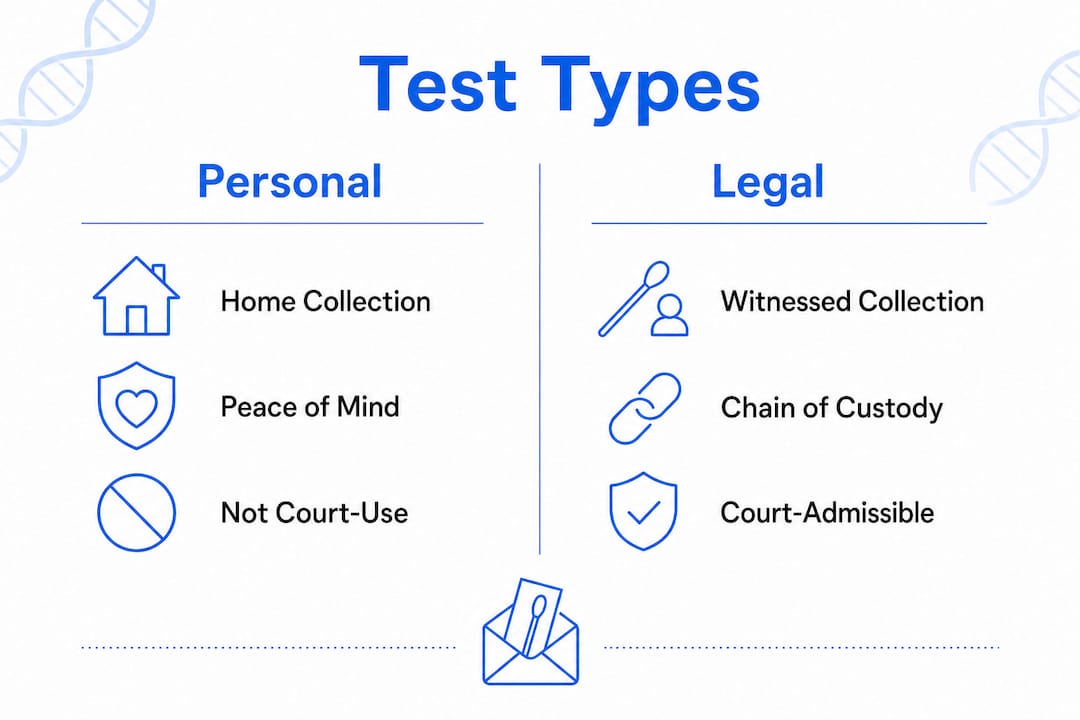
The scientific accuracy of a personal test and a legal test is identical. Both analyze the same STR markers and produce the same probability calculations. The critical difference lies in the procedure surrounding sample collection, not in the laboratory science itself.
A personal or "peace-of-mind" test allows you to collect samples at home and mail them to a lab. These tests start at $79 for a home paternity kit and return results within 2–3 business days of lab receipt. They are appropriate when you need personal clarity and do not anticipate using the results in any legal proceeding.
A legal paternity test requires witnessed sample collection, verified identity, and a documented chain of custody from collection to lab analysis. Chain-of-custody protocols mandate that every person who handles the sample signs a log, the sample is sealed and labeled at the collection site, and the lab receives it with an unbroken seal. This documentation transforms the DNA result into court-admissible evidence.
| Feature | Personal test | Legal test |
|---|---|---|
| Scientific accuracy | Over 99.99% | Over 99.99% |
| Sample collection | Self-collected at home | Witnessed by authorized collector |
| Identity verification | Not required | Two forms of official ID required |
| Chain of custody | Not documented | Fully documented and signed |
| Court admissibility | No | Yes |
| Typical cost | $79 | $250–$500 |
At-home tests cannot be converted into legal tests after the fact. If you collect samples at home and later need the results in court, you must start over with a legally administered test. This is the single most common and costly mistake people make when pursuing paternity confirmation.
Pro Tip: If there is any chance you will need results for child support, custody, or inheritance proceedings, choose a legal test from the start. Redoing the process doubles your cost and delays resolution.
AABB accreditation is the specific certification that qualifies a lab for relationship DNA testing with legal chain-of-custody compliance. Other medical lab certifications such as CLIA or CAP do not meet this standard for legal paternity work. Always verify a lab's accreditation status before submitting samples for a legal test.
How to confirm biological fatherhood through legal channels
Confirming biological fatherhood through the courts follows a defined process. Understanding each step prevents delays and protects your legal standing.
-
File a petition in family court. Either parent, a legal guardian, or a child support agency can file. The petition must include sworn statements establishing a reasonable possibility of paternity. Courts operating under the Uniform Parentage Act accept petitions based on this standard.
-
Obtain a court order for testing. Once the court finds sufficient grounds, it issues an order directing all parties to submit to DNA testing at an approved lab. The court specifies the lab and the collection timeline.
-
Complete witnessed sample collection. All parties, including the child, report to the designated collection site. Adults must present two forms of official ID. Children require a birth certificate or equivalent document. The accompanying parent or guardian must also present identification.
-
Receive and submit results. The lab sends results directly to the court. A probability above 99% constitutes legal confirmation of biological fatherhood. A 0% result excludes paternity entirely.
-
Attend the court hearing. The judge uses the test results to issue orders on child support, custody, visitation, and inheritance rights. Courts focus primarily on the child's best interests when applying these results.
The full process from petition to final order typically takes 2–4 months. Statutes of limitations for paternity actions vary by jurisdiction but commonly fall within an 18–23 year window from the child's birth. Missing this window can permanently bar legal action, so filing promptly matters.
What practical considerations should individuals keep in mind?
Consent is a legal requirement in many states. Unauthorized DNA collection without the subject's permission can carry legal consequences depending on state law. Court-ordered tests resolve consent issues through the legal process, but privately arranged tests require careful attention to applicable state statutes before collecting any sample.
The emotional impact of results deserves serious consideration. A confirmed result changes family dynamics, financial obligations, and legal relationships permanently. An exclusion result can be equally disruptive. Seeking counseling support before and after testing is a practical step, not an optional one.
- Verify that your state permits private DNA collection before proceeding with a personal test.
- Choose a legal test if child support, custody, or inheritance is a current or future concern.
- Confirm that any lab you use for legal testing holds AABB accreditation, the standard required for court-admissible relationship DNA testing.
- Request a copy of the chain-of-custody documentation along with your results.
- Consult a family law attorney before filing any court petition to understand your jurisdiction's specific statutes of limitations.
Pro Tip: Ask the lab directly whether their results are accepted in your state's family courts before paying. Acceptance varies by jurisdiction, and a reputable lab will answer this question clearly.
The importance of biological father confirmation extends beyond personal knowledge. Established paternity affects a child's access to health insurance, Social Security benefits, inheritance rights, and medical history. These practical stakes make accurate, properly documented testing worth the additional cost and procedural steps.
Key takeaways
Biological father confirmation through DNA paternity testing is conclusive, legally binding when properly administered, and irreversible in its impact on family law outcomes.
| Point | Details |
|---|---|
| DNA accuracy | Modern labs analyze up to 28 markers, producing results with over 99.99% probability. |
| Legal vs. personal tests | Legal tests require witnessed collection and chain of custody; personal tests do not qualify for court use. |
| Court process timeline | Filing to final order typically takes 2–4 months under the Uniform Parentage Act. |
| Consent and state law | Unauthorized DNA collection can be unlawful; court-ordered tests handle consent through legal channels. |
| Choose the right test first | Converting a personal test to a legal test is impossible; starting over doubles cost and time. |
Why I always recommend starting with the legal test
People often come to paternity testing hoping for a quick, private answer. That instinct is understandable. What they frequently do not realize is that the decision they make at the collection stage determines whether their results will ever matter in a courtroom.
I have seen situations where someone received a clear exclusion result from a home kit, brought it to a family law attorney, and was told it was inadmissible. They had to repeat the entire process, pay again, and wait again, all while a custody dispute sat unresolved. The science was identical both times. The procedure was not.
The other reality people underestimate is the emotional weight of a conclusive result. Whether the answer is inclusion or exclusion, the result changes relationships, obligations, and identity in ways that are difficult to anticipate. Seeking counseling before testing, not after, gives people a framework for processing whatever the result turns out to be.
My consistent advice: if there is any legal matter connected to the question, even a remote possibility of one, choose a legal test. The cost difference between a $79 home kit and a legal test is far smaller than the cost of redoing the process or losing standing in court because of a procedural error.
— Todd
US Diagnostics Center DNA testing services
Families navigating paternity questions need accurate results and clear guidance on which test type fits their situation.
US Diagnostics Center currently offers home DNA tests starting at $79 for personal knowledge. Every test analyzes up to 28 genetic markers, and lab results are available within 2–3 business days of sample receipt. Each kit ships with a prepaid return envelope. Home DNA tests are for personal knowledge only; court-admissible results require a separate legal test with witnessed sample collection and documented chain of custody. If you are unsure which test type fits your situation, US Diagnostics Center's guided selection tool recommends the right option based on your specific circumstances.
FAQ
What is biological father confirmation?
Biological father confirmation is the use of DNA paternity testing to determine whether a man is the biological father of a child. Modern tests analyze up to 28 STR markers and produce results with over 99.99% accuracy.
Can a home paternity test be used in court?
No. Home paternity tests lack the witnessed collection and documented chain of custody required for court admissibility. A separate legal test must be completed if results will be used in any legal proceeding.
How long does a court-ordered paternity test take?
The full process from filing a petition to a final court order typically takes 2–4 months. Lab results alone are available within 2–3 business days of sample receipt.
What is the difference between a biological father and a legal father?
A biological father is the man whose DNA matches the child's paternal genetic markers. A legal father is the man recognized by law as the father, which may differ from the biological father if paternity has not been formally established or has been legally assigned through adoption or acknowledgment.
What happens if a paternity test excludes the alleged father?
An exclusion result means a 0% probability of biological fatherhood, which is a definitive no-match. Courts treat this result as conclusive evidence that the man is not the biological father, which affects child support, custody, and inheritance determinations accordingly.

0 comments