

Most beliefs families hold about kinship DNA testing are only half true. At-home kits can be accurate, but they are not automatically definitive; DNA can confirm biology, but it cannot define family; and more markers help only when a lab actually needs them for a specific case. The single fact that resolves nearly every misunderstanding is this: a DNA test answers a narrow biological question, and its reliability depends entirely on how well that question was framed before the sample was collected.
Before you order a kit or try to make sense of a confusing result, it helps to know exactly where the common assumptions break down:
- At-home kits are always definitive. They can be highly accurate for straightforward cases, but not for every scenario.
- DNA testing equals family. Biology and family identity are related but not interchangeable concepts.
- More markers always mean more certainty. Marker count only matters relative to the complexity of the case.
- An ancestry test can substitute for a paternity test. These are built for different questions entirely.
- Closely related men will always test differently. Standard panels can struggle here unless the lab is told in advance.
If you're deciding what to order, skip to the section on matching tests to relationships. If you're staring at a confusing result right now, jump to where DNA testing hits its limits.
Key Takeaways
Matching the right test configuration to the actual question, disclosing related candidates, and confirming chain-of-custody options are what separate a reliable kinship result from a misleading one.
| Point | Details |
|---|---|
| Match test to question | A trio beats a duo, and grandparentage or avuncular testing needs the right relatives included. |
| Disclose related candidates | Tell the lab if two potential fathers are related so it can run additional markers. |
| Marker count is contextual | More markers help only in complex cases, not automatically in every test. |
| Prepare for unexpected results | Line up a genetic counselor or legal counsel before testing if the outcome could be significant. |
| US Diagnostics Center pricing | Home paternity costs $79, with turnaround of 2 to 3 business days lab processing (7 to 10 business days order-to-results). |
Table of Contents
- How kinship DNA testing actually works
- The misconceptions that trip up the most families
- Where DNA testing hits a real wall
- What to do before and after you test
- Matching the test to the actual question
- What testing actually costs and how long it takes
- The emotional and legal weight of an unexpected result
- What actually matters when choosing a lab
- A closing perspective on getting this right
- Ready to test? Here's how to get a reliable result
- Sources
- FAQ
How kinship DNA testing actually works
A lab does not "read" a family tree. It compares specific locations on your DNA, called STR markers, between two or more people and calculates how likely it is that they share those markers because of a genetic relationship rather than chance. For parentage tests, the result is expressed as a probability of parentage or Combined Paternity Index (CPI), while kinship tests (sibling, grandparent, avuncular) yield a Combined Relationship Index (CRI): CRI > 10 supports the claimed relationship, CRI 0.1–10 is inconclusive, and CRI < 0.1 does not support it.
The configuration of who gets tested matters as much as the technology itself. A trio test, which includes the alleged father, the mother, and the child, produces a much stronger statistical result than a duo test, where the mother is not available. Without the mother's DNA to rule out which alleles the child inherited from her side, the lab has less information to work with, and the math simply cannot climb as high. According to a technical primer on kinship analysis, trio configurations yield significantly higher CPI values than duo cases, which is why testing labs almost always recommend including the mother when she is available.
A few terms are worth knowing before you order anything:
- STR marker: a specific stretch of DNA that varies enough between people to be useful for comparison.
- Marker count: the number of these locations a lab examines, up to 28 markers on a comprehensive panel.
- CPI (Combined Paternity Index): the statistical strength of a parentage match for paternity/maternity tests, expressed as odds.
- CRI (Combined Relationship Index): the statistical measure for kinship tests (sibling, grandparent, avuncular) — CRI > 10 supports the claimed relationship.
- Chain-of-custody: documented, verified sample collection required for court-admissible results.
The misconceptions that trip up the most families
Here are the beliefs that cause the most confusion, in the order they tend to surface once someone starts researching a test.
-
"At-home kits are always definitive." Consumer kits can be reliable for standard trio cases, but a clinical review found that roughly 40% of positive findings from certain direct-to-consumer genetic tests were not confirmed when retested in clinical-grade laboratories. This happens because consumer kits sometimes analyze fewer markers or lack the clinical oversight that catches sample or interpretation errors.
-
"DNA testing tells you who your family is." A DNA test confirms biological relationships. It says nothing about who raised you, who you're close to, or what family means culturally. Kinship results are best interpreted alongside social and cultural context, not as a replacement for it.
-
"More markers always mean more certainty, no matter what." A panel that reaches the 20-marker industry baseline is plenty for a routine trio case. It is not enough when two potential fathers are related to each other. Marker count only becomes a meaningful variable once the case gets complicated.
-
"An ancestry test can double as a paternity test." Ancestry kits are built to estimate ethnic background and connect you with distant relatives. MedlinePlus notes that direct-to-consumer tests vary by purpose, and some are specific for paternity while others serve entirely different goals like ancestry. Using the wrong tool produces a result that looks authoritative but answers the wrong question.
-
"Closely related men will always show up differently." Brothers, half brothers, and even cousins can share enough alleles that a standard panel struggles to tell them apart. A geneticist explaining paternity testing notes that a standard panel may not distinguish closely related men unless the lab runs additional markers after being told about the relationship.
-
"Identical twins and rare biology don't affect real-world results." Identical twins share essentially the same DNA, so a standard paternity test cannot distinguish which twin fathered a child. Chimerism, where a person carries two genetically distinct cell lines, is rare but can also scramble expected results.
The most common real-world version of this confusion looks something like this: two brothers both had relationships with the same woman around the same time, and only one of them ordered a standard test without mentioning his brother. The result showed a probability of parentage that, on paper, looked conclusive. It wasn't, because the lab never knew there was a second candidate to rule out.
Pro Tip: If more than one man in the family could realistically be the biological father, tell the lab before you submit samples. It's the single fastest way to avoid a misleading result.
For a broader rundown of these errors, US Diagnostics Center's overview of common DNA testing misconceptions covers several more edge cases worth knowing.
Where DNA testing hits a real wall
DNA testing is powerful, but it is not unlimited. A handful of situations exist where even a well-run test cannot deliver a clean answer.
Insufficient or mismatched marker panels. A panel built for routine cases won't necessarily resolve a case involving related candidates or distant relatives. Related alternative fathers, as covered above, remain the most common source of ambiguous results. Degraded or contaminated samples, whether from improper swabbing or an old, poorly stored sample, can weaken or invalidate a result. Missing reference samples, such as no available parent or grandparent for comparison, forces the lab to rely on more distant relatives, which lowers statistical confidence. Consanguinity and population structure, meaning family lines that already share more DNA than average, can inflate or muddy match probabilities. And identical twins or chimerism remain genuine edge cases that standard testing was never designed to fully resolve.

Genetic counselors point out that at-home tests often analyze a limited subset of markers and aren't integrated with a person's broader family or medical history, which is exactly the kind of context that matters most in these edge cases.
Pro Tip: If your result comes back ambiguous or inconclusive, don't assume it's wrong. Ask the lab about testing additional relatives or running an extended marker panel, and consider a conversation with a genetic counselor before drawing conclusions.
What to do before and after you test
Getting a reliable, useful result starts before you ever swab a cheek.
- Define your purpose first. Are you settling a personal question, or do you need a result that holds up in court or for a legal matter?
- Choose legal or consumer accordingly. Court-admissible testing requires documented chain-of-custody collection; a home kit does not meet that standard.
- Collect the right participants. A trio beats a duo every time confidence matters.
- Disclose related candidates. If two potential fathers are related, say so before testing begins.
- Ask about marker count and reporting. Confirm the lab can report a CPI or probability of parentage for paternity/maternity tests, or a Combined Relationship Index (CRI) for kinship tests such as sibling, grandparent, or avuncular — not just a match/no-match answer.
- Plan for support. Line up a genetic counselor or legal counsel in advance if the outcome could be emotionally or legally significant.
When you call a lab, ask directly: How is the sample handled and verified? How many markers does the standard panel include, and can it go up to 28 markers if the case needs it? Does the report include a CPI or probability of parentage for parentage tests, or a Combined Relationship Index (CRI) for kinship tests, not just a binary result? What's the turnaround time, and is there a sample return policy?
Pro Tip: If there's any chance you'll need the result for court, immigration proceedings, or a legal dispute, ask about chain-of-custody collection before you order anything. Retesting after the fact rarely helps once a sample has already been collected informally.
Matching the test to the actual question
The right test depends entirely on which relationship you're trying to confirm, and who's available to test alongside the primary participant.
Paternity is best resolved with a trio (father, mother, child) when possible; a duo works but with less statistical strength. Motherless or duo cases are common when the mother isn't available or willing to test, and they still produce usable results, just with a lower overall confidence level. Grandparentage testing becomes necessary when a parent has died or is unreachable, and results improve when both grandparents on the relevant side are tested together. Sibling testing compares two people's DNA directly to estimate the likelihood of a full or half sibling relationship. Avuncular testing checks an aunt or uncle relationship, often used as a workaround when a parent can't be tested. Zygosity testing determines whether twins are identical or fraternal, a different question entirely from paternity or sibling analysis.
| Test Type | Best For | Relative Evidentiary Strength | Marker Panel Note |
|---|---|---|---|
| Paternity (trio) | Confirming a father when mother is available | Highest | Standard panel usually sufficient |
| Paternity (duo) | Father-child only, no mother | Moderate to high | May need extended panel for edge cases |
| Grandparentage | Parent unavailable or deceased | Moderate, improves with both grandparents | Benefits from larger marker set |
| Sibling analysis | Confirming full or half siblings | Moderate | Often needs a larger marker set than paternity |
| Avuncular | Aunt/uncle relationship, parent unavailable | Lower than direct parent testing | Extended panel recommended |
| Zygosity | Twin identical vs. fraternal status | High for its specific question | Different marker approach than kinship tests |
Adding relatives strengthens weaker configurations. A grandparentage case gets noticeably more reliable when both grandparents are tested rather than just one, and a half-sibling question benefits from including any additional known relative on the shared side. Not every lab offers every configuration, so confirm avuncular, grandparentage, or zygosity testing is actually available before you order. US Diagnostics Center's kinship testing page breaks down which configurations are available and what each one requires.
What testing actually costs and how long it takes
Consumer kinship tests typically run in the low hundreds of dollars, while court-admissible legal testing costs more because of the chain-of-custody collection process. Turnaround also varies with marker panel size, whether you add extra relatives, and whether you pay for expedited processing.
As a concrete reference point, US Diagnostics Center prices home paternity testing at $79, maternity testing at $129, and sibling, grandparent, or aunt/uncle testing at $139, with lab processing completed in 2 to 3 business days and standard order-to-results timing of 7 to 10 business days.
A few things commonly move the price or timeline:
- Additional markers beyond the standard panel for complex or ambiguous cases.
- Extra participants, since testing more relatives increases lab work and cost.
- Legal chain-of-custody forms and documentation for court-admissible cases.
- International shipping delays outside standard domestic timelines.
- Sample quality issues that require a recollection.
For a broader look at pricing structures across different family scenarios, US Diagnostics Center's guide to affordable family DNA testing options is worth a look before you commit to a specific test.
The emotional and legal weight of an unexpected result
A DNA test can confirm biology in a way that conflicts sharply with someone's sense of family. That gap is real, and it's worth preparing for before results arrive, not after.
- Privacy risk: results can reveal information one household member wanted to keep private from another.
- Emotional impact: nonpaternity discoveries and similar surprises can be genuinely destabilizing for everyone involved.
- Cultural context matters: what counts as "family" varies widely, and a biological result doesn't override that.
- Professional support helps: a genetic counselor or legal counsel can help interpret results and next steps.
- Immigration and legal limits exist: DNA can support a case but works best alongside documentary evidence, not as a standalone solution.
A multi-case review of DNA testing in immigration contexts found real utility for documentation, but also multiple pitfalls including sensitive revelations and logistical burdens that can deeply affect families. US Diagnostics Center does not offer immigration paternity testing, and anyone navigating a legal or immigration matter should consult an attorney alongside any testing decision. For background on why families pursue these questions in the first place, US Diagnostics Center's piece on why people question biological origins offers useful context. Family history also matters beyond kinship questions; a physician's guide to family history and its role in assessing health risk is a good reminder that genetic information carries weight well beyond a single test result.
Pro Tip: Before ordering a test that could surface unexpected information, talk with the people involved about how you'll handle a surprising result, and have a genetic counselor's contact information ready in case you need it.
What actually matters when choosing a lab
The strongest signal of a trustworthy lab is not marketing language. It's whether the lab can answer specific technical and procedural questions clearly.
Look for a lab that offers documented chain-of-custody collection when you might need legally admissible results, a marker panel that can extend up to 28 markers for complex cases, transparent reporting that includes a probability of parentage or CPI for parentage tests, and a CRI for kinship tests, rather than a bare match/no-match answer, fast and clearly stated turnaround times, and support that includes referrals to genetic counselors when results are complicated.
US Diagnostics Center offers home DNA test kits for paternity, maternity, sibling, grandparent, avuncular, and twin zygosity testing, backed by a guided test selection tool that helps families choose the right configuration before ordering. US Diagnostics Center does not offer prenatal or non-invasive prenatal paternity testing, ancestry or ethnicity testing, or immigration paternity testing, and anyone working on a court or immigration case should consult legal counsel about which testing pathway fits their situation. Independent guidance from genetic counseling professionals supports this kind of caution, noting that authorized, clinical-grade testing standards offer stronger validity than many unverified consumer products.
A closing perspective on getting this right
Families rarely come to DNA testing out of curiosity. They come because something doesn't add up, and they need an answer that holds up under scrutiny, whether that scrutiny comes from a courtroom or from a difficult conversation at the kitchen table. What strikes me most about the misconceptions covered here is that almost none of them come from bad information. They come from good information applied to the wrong situation: a marker count that would be plenty for one case and inadequate for another, a test built for ancestry pressed into service for paternity. The fix isn't more skepticism about DNA testing. It's more precision about which question you're actually asking, and enough honesty with the lab, and with yourself, about the family circumstances that might complicate the answer. When results are surprising, that's the moment to lean on a genetic counselor or legal professional rather than face it alone.
Ready to test? Here's how to get a reliable result
US Diagnostics Center offers home DNA test kits for paternity, maternity, sibling, grandparentage, avuncular, and twin zygosity testing, with lab processing completed in 2 to 3 business days and a prepaid return envelope included with every kit.
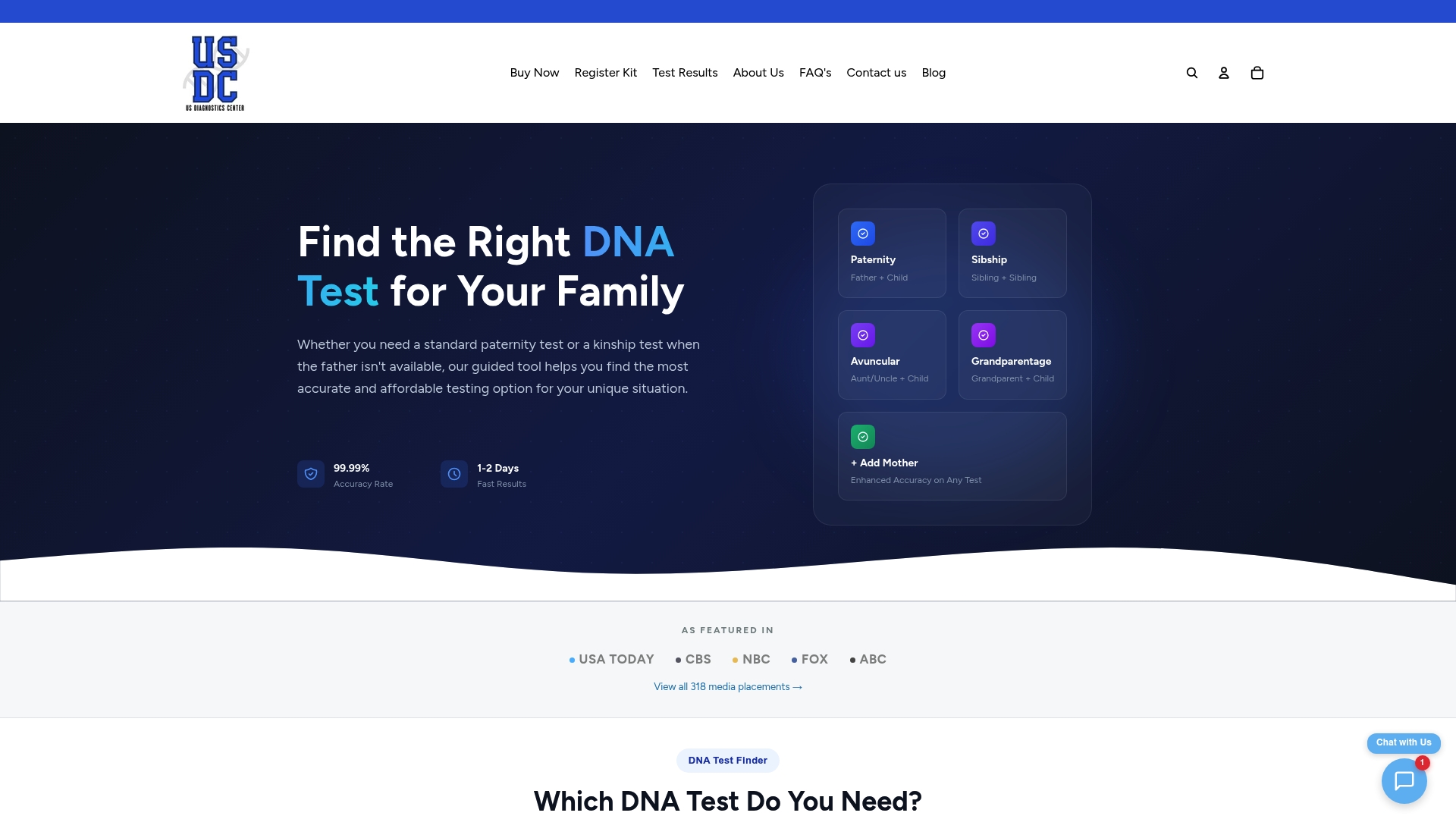
Getting started is straightforward. First, decide what you're actually trying to confirm and whether you need a home kit or a court-admissible legal test with documented chain-of-custody. Next, confirm who needs to test alongside the primary participant, since a trio configuration gives stronger results than a duo whenever the mother is available. If any potential fathers are related to each other, disclose that before ordering so the lab can plan accordingly. From there, choose your kit and check out.
The company does not offer prenatal or non-invasive prenatal paternity testing, ancestry or ethnicity testing, or immigration paternity testing; anyone with a legal or immigration case should consult an attorney about the right testing path. If you're ready to move forward, browse home DNA test kits for consumer options. Legal chain-of-custody test kits are coming soon — visit the legal DNA test kit page to learn more. The paternity testing guide walks through exactly what to expect at each step.
This article is general information, not a substitute for advice from a qualified lawyer. Consult a qualified legal professional about your own circumstances before acting on anything here.
Sources
- How Accurate Are At-Home DNA Tests?
- What is genetic testing? — MedlinePlus Genetics (direct-to-consumer guidance)
- Can a paternity test be wrong if the tested man is related to the real dad? - The Tech Interactive
FAQ
Are at-home DNA kits accurate enough for paternity questions?
They can be highly accurate for standard trio cases, but consumer kits are not automatically definitive, and complex cases like related potential fathers may need extended testing.
Does a higher marker count always mean a more reliable result?
No. Marker count matters most when a case is complicated, such as when potential fathers are related, not for routine trio testing.
Can an ancestry test confirm paternity?
No, ancestry and paternity tests are built for different purposes, and using an ancestry kit to answer a paternity question can produce misleading results.
What should I do if two potential fathers are related?
Tell the lab before testing begins so it can run additional markers or specialized analysis to distinguish between closely related candidates.
Does US Diagnostics Center offer court-admissible testing?
US Diagnostics Center has legal DNA test kit pages available for review as these services come online. For current home-use testing, visit usdiagnosticscenter.com.
Recommended
- Why DNA Tests Beat Blood Tests for Relationship Proof | USDC
- Why People Question Biological Origins: What Families Need to Know | USDC
- Understanding DNA Testing: How It Works and What to Expect | USDC
- What Is a Relationship DNA Test? Your Clear Guide | USDC
This article is part of our Understanding DNA Testing: How It Works and What to Expect guide.


0 comments