

Yes, you can order a DNA test with discreet shipping. Most at-home DNA kits arrive in plain, unmarked packaging with no reference to genetic testing on the exterior, and results are delivered through a secure online account rather than by mail. The practical next step is to confirm that your chosen provider explicitly states a discreet packaging policy, accepts your preferred sample type, and has a clear privacy policy before you place your order. US Diagnostics Center offers at-home paternity and kinship tests with discreet packaging, a prepaid return envelope, and secure online result delivery, starting at $79 for a home paternity test.

Key Takeaways
Discreet shipping is widely available for at-home DNA tests, but privacy protections, legal limits, and sample accuracy vary significantly by provider and state, making it worth verifying each factor before ordering.
| Point | Details |
|---|---|
| Discreet shipping is real but specific | Plain outer packaging, neutral sender name, and secure online results are the core elements to confirm before checkout. |
| Legal limits vary by state | At least 13 states have enacted express-consent rules for DTC genetic testing; collecting another person's sample without consent may carry civil or criminal consequences. |
| Sample type affects accuracy | Cheek swabs yield the most reliable results; alternative samples such as toothbrushes or hair follicles carry higher contamination risk and a greater chance of inconclusive outcomes. |
| At-home kits are not court-admissible | Legal chain-of-custody testing requires ID verification, witnessed collection, and documented handling; order a legal kit from the start if court use is possible. |
| US Diagnostics Center pricing and turnaround | Home paternity $79, maternity $129, sibling/grandparent/aunt/uncle $139; lab processing 2–3 business days; order-to-results 7–10 business days. |
Table of Contents
- What does "discreet shipping" actually mean for a DNA kit?
- Is discreet or "secret" DNA testing legal in the U.S.?
- How does the ordering and return process work, step by step?
- Which sample types work for discreet testing, and how accurate are they?
- What should you check in a provider's privacy policy?
- How do you evaluate and choose a discreet DNA test provider?
- When do you need a legal chain-of-custody test instead?
- Why US Diagnostics Center is a recommended discreet option
- A practitioner's perspective on discreet testing
- Order a discreet DNA kit from US Diagnostics Center
- Sources
- FAQ
What does "discreet shipping" actually mean for a DNA kit?
When a DNA testing provider advertises discreet shipping, the term covers several distinct elements, and not every provider delivers on all of them. Understanding the specifics helps you verify claims before checkout rather than after the kit arrives.
Packaging and labeling are the most visible components:
- The outer box or envelope carries no mention of DNA, genetics, or paternity.
- The return address or sender name is either a generic business name or a neutral abbreviation, with no laboratory branding.
- Any packing slip or invoice inside the box omits the test description or uses a coded product reference.
- The prepaid return envelope for your sample is similarly plain, with no identifying language on the exterior.
Communication and billing add another layer of privacy:
- Order confirmation and result notification emails come from a neutral sender name and subject line.
- Results are accessible through a password-protected online account, not printed and mailed.
- Some providers allow billing under a generic descriptor on credit card statements, though this varies.
Some labs also accept alternative samples, such as used toothbrushes or hair with a root, which can be collected without the other party's knowledge. These samples carry their own accuracy and legal considerations, covered in detail below.
Pro Tip: Before placing your order, search the provider's website for the phrase "discreet packaging" and look for a sample image of the shipping box. If neither appears, contact customer support and ask for the exact wording that will appear on the outer package and the billing statement.
Is discreet or "secret" DNA testing legal in the U.S.?
Private at-home DNA testing is generally legal in the United States when you provide your own biological sample or when you have legal authority over the person whose sample you are collecting, such as a parent collecting a cheek swab from a minor child. The legal complexity arises when you collect a sample from another adult without their knowledge or consent.
Using someone else's discarded biological material, such as a cigarette butt or used cup, without their consent may expose you to civil liability or, in some states, criminal penalties. The law varies considerably by state, and the trend is clearly toward stronger consumer protections.
Key legal principle: Collecting and testing another person's genetic material without their consent may violate state genetic privacy statutes, even when the material was discarded. The fact that a sample was abandoned does not automatically make its genetic analysis lawful in every jurisdiction.
As of late 2024, at least 13 states had enacted laws specifically regulating direct-to-consumer genetic testing, requiring express consumer consent and privacy disclosures around collection, use, sharing, and retention of genetic data.
At the federal level, CLIA, HIPAA, GINA, and FDA oversight all touch genetic testing in different ways, but many DTC providers fall outside HIPAA's scope entirely. GINA protects against genetic discrimination in employment and health insurance, but it does not regulate how a private lab handles your sample. CLIA governs laboratory quality standards, not privacy.
Two state examples illustrate how specific these statutes can become. Virginia's § 59.1-596 requires express consent for the collection, storage, use, and disclosure of genetic data and gives individuals the right to revoke that consent, with biological samples destroyed within 30 days of revocation. Maryland's HB0866 goes further, placing limits on forensic genetic genealogy searches and requiring judicial authorization for certain law-enforcement uses of genetic databases.
Pro Tip: Before ordering a test using someone else's sample, check your state's current genetic privacy statute. State laws are the fastest-moving part of this regulatory area, and a rule that did not exist two years ago may now carry civil or criminal consequences.
This article provides general legal information, not legal advice. If you are uncertain about the legality of collecting a specific sample in your state, consult a licensed attorney before proceeding.
How does the ordering and return process work, step by step?
The process for a discreet at-home DNA test follows a consistent sequence across most reputable providers, though the privacy controls at each step vary.
- Place your order online. Select the test type (paternity, maternity, sibling, etc.) and confirm the provider's discreet packaging option at checkout. Create a secure account with a password you control; this is where results will be delivered.
- Receive the kit. The package arrives in plain outer packaging with no reference to DNA testing. Inside, you will find collection swabs, labeled sample envelopes, an instruction sheet, and a prepaid return envelope.
- Collect the samples. For a standard cheek-swab test, rub the swab firmly inside the cheek for 30–60 seconds per swab, allow it to air-dry briefly, and seal it in the labeled envelope. If you are using an alternative sample type, follow the specific handling instructions included with the kit.
- Seal and return. Place the sealed sample envelopes inside the prepaid return envelope and drop it in any USPS mailbox. The return envelope carries no external indication of its contents.
- Lab processes your sample. The laboratory extracts DNA, analyzes the genetic markers, and generates the report.
- Receive results securely. You receive a notification by email, and results are available through your password-protected account. No printed report is mailed unless you specifically request one.
On turnaround time: Lab processing typically takes 2–3 business days once the sample arrives at the laboratory. From the moment you place your order to the moment results appear in your account, the standard window is 7–10 business days. Expedited processing options can shorten the lab portion of that timeline when time is a factor.
The Cleveland Clinic notes that at-home paternity tests are generally less expensive and faster than clinic-based tests, though they may not meet the chain-of-custody requirements needed for court proceedings.
Which sample types work for discreet testing, and how accurate are they?
The standard sample for any DNA relationship test is a buccal (cheek) swab, collected directly from the person being tested. It yields the highest DNA concentration, the lowest contamination risk, and the most reliable result. When direct swab collection is not possible, some laboratories accept alternative sample types, each with meaningful trade-offs.
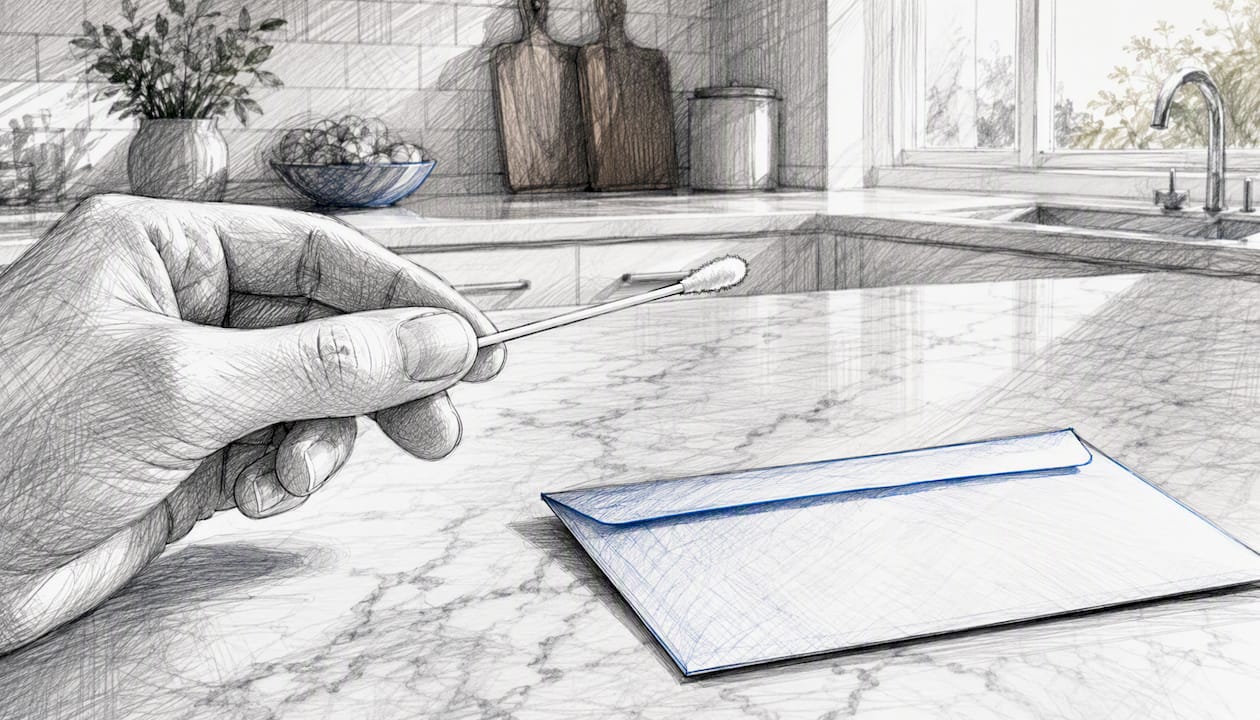
Pro Tip: If you need the highest accuracy or any possibility of court admissibility, a cheek swab collected with documented chain-of-custody is the only sample type that meets both standards. Alternative samples are appropriate for personal-knowledge purposes only.
| Sample Type | Relative Reliability | Key Consideration |
|---|---|---|
| Cheek swab (buccal) | Highest | Standard for all relationship tests; required for legal/court use |
| Used toothbrush | Moderate | Saliva cells on bristles; contamination from toothpaste or shared use is a risk |
| Hair with root follicle | Moderate | Root must be intact; shed hair without a follicle yields little usable DNA |
| Cigarette butt | Moderate | Saliva-based; degradation risk if stored in heat or moisture |
| Earwax swab | Lower | Smaller cell yield; higher chance of inconclusive result |
| Nail clippings | Lower | Requires specialized extraction; higher lab processing cost |
| Used tissue or napkin | Lower | Highly variable DNA yield; contamination from mucus or environmental exposure |
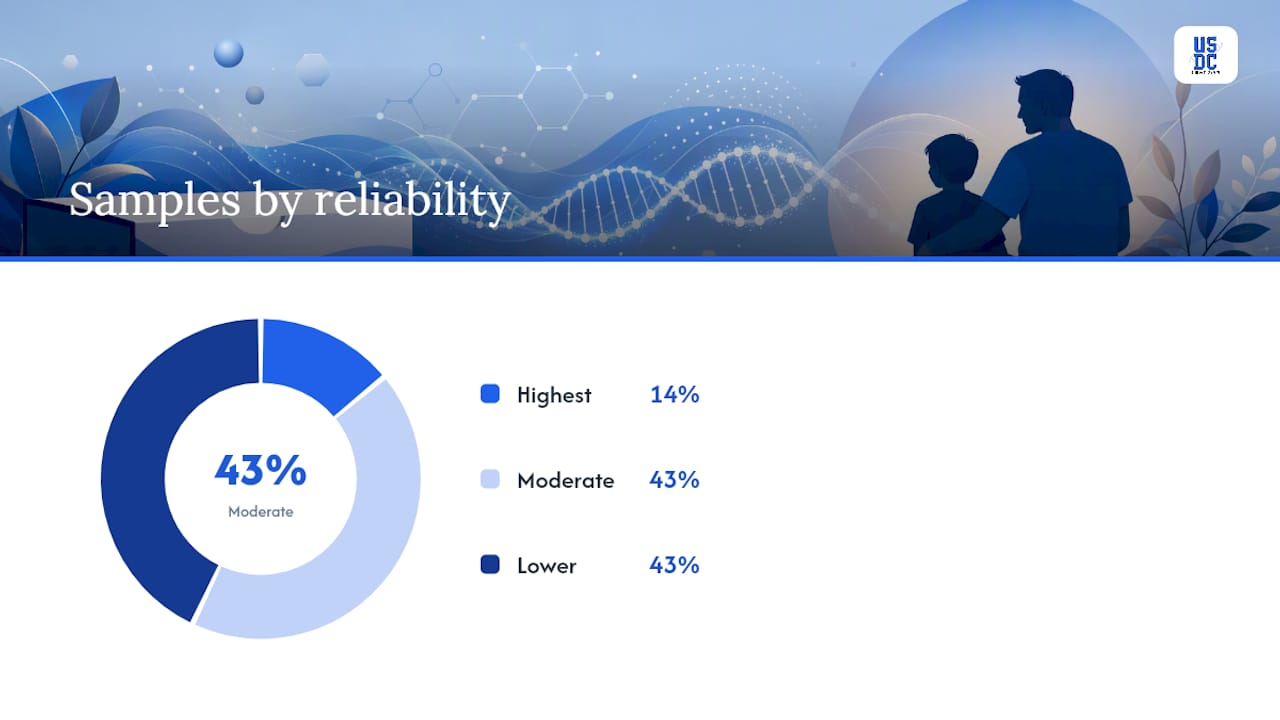
When providers accept alternative samples, labs often need additional extraction steps. That extra processing can increase cost, introduce contamination risk, and raise the probability of an inconclusive result. Some labs charge a surcharge for non-standard samples precisely because of those added requirements.
What should you check in a provider's privacy policy?
Many DTC genetic testing companies are not HIPAA-covered entities, which means the federal health-privacy framework that applies to hospitals and insurers does not automatically apply to them. CLIA certification speaks to laboratory quality and accuracy standards, not to how your genetic data is stored or shared. Privacy protection for your sample and data depends almost entirely on the provider's own policy and any applicable state law.

California Civil Code §56.18 defines "biological sample" and "direct-to-consumer genetic testing company" and requires contractual limits on service providers, prohibiting them from retaining or making unauthorized disclosures of biological samples and genetic data. That statutory model is instructive even if you do not live in California, because it shows what a strong provider contract should contain.
The FTC has taken enforcement action against DTC genetics companies for inadequate data security and misleading privacy claims, a signal that regulatory scrutiny of weak privacy practices is increasing.
Before ordering, verify these specific items in the provider's privacy policy:
- Express consent controls: You should be able to see exactly what you are consenting to before submitting a sample.
- Sample retention policy: How long does the lab keep your physical sample after testing? Is destruction available on request?
- Third-party data sharing: Does the provider share genetic data with research partners, insurers, or law enforcement without a court order?
- Encryption and account security: Are results stored in an encrypted account with multi-factor authentication available?
- Data deletion mechanism: Can you request deletion of your genetic profile and destruction of your sample, and what is the timeline?
- Service-provider contract terms: Does the privacy policy explicitly bind third-party processors from retaining or reusing your sample?
Red flags include vague language like "we may share data with trusted partners," no stated sample-retention period, and no mechanism to revoke consent after testing.
How do you evaluate and choose a discreet DNA test provider?
A structured checklist prevents the most common purchasing mistakes, particularly when providers use similar marketing language but differ substantially in what they actually deliver.
- Confirm the discreet packaging policy in writing. Look for explicit language on the provider's site, not just a marketing claim.
- Verify accepted sample types. If you need an alternative sample, confirm the lab accepts it before ordering and ask about any additional fees.
- Check the marker count. More markers mean greater statistical certainty. Look for providers that analyze 20 or more markers for relationship testing.
- Review lab processing turnaround. Standard lab processing of 2–3 business days is reasonable; confirm whether expedited options are available.
- Determine whether legal/chain-of-custody testing is available. If there is any chance you will need results in court, confirm the provider offers a legal testing pathway.
- Read the full privacy and data-retention policy. Apply the checklist from the previous section.
- Confirm cost transparency. The listed price should include lab fees and the prepaid return envelope, with no hidden charges at checkout.
- Test customer support. Send a pre-purchase question about discreet packaging or privacy. The quality and speed of the response tells you a great deal about post-purchase support.
Additional verification steps worth taking:
- Look for sample images of the shipping box on the provider's website or in customer reviews.
- Check whether the lab is pursuing or holds any recognized accreditation standard (AABB, CAP, or ISO 17025).
- Review the provider's pre-purchase questions checklist if one is available.
When do you need a legal chain-of-custody test instead?
A discreet at-home kit is appropriate when you need a private answer for personal knowledge. It is not appropriate, and the results will likely be inadmissible, in any of the following situations:
- Court proceedings involving paternity or child support. Judges require results produced under documented chain-of-custody protocols, with verified participant identities.
- Formal custody determinations. Family courts in most states will not accept at-home test results as evidence.
- Child support enforcement actions. State agencies and courts require legally collected samples with proper documentation.
- Any proceeding where the opposing party can challenge the evidence. Without chain-of-custody documentation, the integrity of the sample cannot be verified.
A legal chain-of-custody test differs from an at-home kit in three concrete ways: participant identities are verified with government-issued ID at the time of collection, sample collection is witnessed by a neutral third party, and the sample is sealed and shipped under documented handling procedures. Those controls are what make results defensible in court.
If you suspect you may eventually need results in a legal proceeding, order a legal kit from the start. Converting an at-home result into admissible evidence is generally not possible; you would need to repeat the test under proper chain-of-custody conditions. US Diagnostics Center's legal DNA test collection covers court-admissible options for paternity and kinship testing.
The role of DNA evidence in legal contexts illustrates why chain-of-custody documentation is treated as non-negotiable in formal proceedings, whether in criminal cases or civil family law matters.
Why US Diagnostics Center is a recommended discreet option
US Diagnostics Center offers at-home DNA tests for paternity, maternity, sibling, grandparent, and aunt/uncle relationship verification, with discreet packaging and a prepaid return envelope included with every kit. Results are delivered through a secure online account, not by mail, and the company provides guided test selection tools to help you identify the right test for your specific situation before you order.
Pricing and turnaround:
- Home paternity test: $79
- Maternity test: $129
- Sibling, grandparent, or aunt/uncle test: $139
- Lab processing: 2–3 business days after sample receipt
- Order-to-results: 7–10 business days standard
Every test analyzes up to 28 genetic markers, which supports the statistical confidence level needed for relationship determination. For a full explanation of what AABB accreditation involves and why it matters for DNA testing, see the AABB accreditation overview.
Pro Tip: Use the guided test selection tool on the US Diagnostics Center website before ordering. If you are unsure whether you need a paternity test, a grandparentage test, or a sibling test, the tool walks through your specific situation and recommends the most accurate and cost-effective option.
Pro Tip: For discreet paternity testing specifically, review the privacy policy at checkout and confirm the billing descriptor before submitting payment, particularly if you share financial accounts with another party.
Pro Tip: If your situation involves kinship testing beyond paternity, such as grandparentage or sibling verification, review the kinship DNA testing options page for pricing and which participants are required for each test type.
A practitioner's perspective on discreet testing
The most common mistake people make when ordering a discreet DNA test is conflating privacy with anonymity. A discreet kit protects your packaging and your results from casual observation. It does not make the test anonymous in any legal sense, and it does not protect you from the consequences of collecting a sample without the other party's consent.
The second mistake is relying on alternative samples without understanding the accuracy trade-off. A used toothbrush or a hair follicle can yield a valid result, but the probability of an inconclusive result is meaningfully higher than with a direct cheek swab. If you are going to act on the result, an inconclusive outcome is not just frustrating; it may require a second test at additional cost.
The practical framework is straightforward: decide whether you need a legally admissible result before you order anything. If you do, a discreet at-home kit is the wrong product, regardless of how private the packaging is. If you need a private answer for personal knowledge and you are collecting samples with proper consent or your own legal authority, a discreet at-home kit ordered from a reputable provider with a clear privacy policy is a fast, affordable, and genuinely private option. The paternity test confidentiality guide covers the regulatory and privacy dimensions in greater depth for readers who want more detail before ordering.
Order a discreet DNA kit from US Diagnostics Center
US Diagnostics Center's at-home DNA test kits ship in plain, unmarked packaging with no reference to genetic testing on the exterior. Every order includes a prepaid return envelope, and results are accessible through a secure online account within 7–10 business days of ordering, with lab processing completed in 2–3 business days after your sample arrives.
Pricing is straightforward: home paternity at $79, maternity at $129, and sibling, grandparent, or aunt/uncle tests at $139. Every test analyzes up to 28 markers. At checkout, you will find a link to the privacy policy, a secure account creation step, and the discreet packaging confirmation. To get started, visit the home DNA tests page and select the test that fits your situation.
Sources
The following authoritative sources provide independent verification of the legal and regulatory context covered in this article:
- Locke Lord QuickStudy: Trends in State and Federal Regulation of Consumer Genetic Testing - Troutman Pepper
- Current Legislative and Regulatory Framework in the United States - Direct-To-Consumer Genetic Testing - NCBI Bookshelf
- § 59.1-596. Express consent required; revocation of express consent. (Virginia Code)
- 2022 Regular Session - House Bill 866 Chapter (Maryland)
- California Civil Code §56.18
This article is general information, not a substitute for advice from a qualified lawyer. Consult a qualified legal professional about your own circumstances before acting on anything here.
FAQ
Can you discreetly get a DNA test?
Yes. Most at-home DNA test providers ship kits in plain, unmarked packaging with no reference to genetic testing on the exterior, and deliver results through a password-protected online account. US Diagnostics Center offers this type of discreet delivery for its at-home paternity and kinship tests.
Can I send a DNA test sample in the mail?
Yes. At-home DNA kits include a prepaid return envelope for mailing your collected sample back to the laboratory. The envelope carries no external indication of its contents, and the sample is processed once it arrives at the lab.
How do you collect a DNA sample without the other person knowing?
Alternative samples such as a used toothbrush, hair with an intact root follicle, or a cigarette butt can be collected without the other person's direct participation. However, collecting and testing another adult's genetic material without their consent may violate state genetic privacy laws in some jurisdictions, so you should verify your state's rules before proceeding.
Can I get a paternity test without the other party knowing?
You can order and receive a discreet at-home paternity test without the other party's knowledge, but using a sample collected from that person without their consent may carry legal risk depending on your state. If the result will be used in any court proceeding, a legal chain-of-custody test with verified participant identities is required regardless of how the at-home test was conducted.
Recommended
- Discreet Paternity Test: Private, At-Home, From $79 | USDC
- Paternity Test Confidentiality Explained: 2026 Guide | USDC
- Paternity Test Without Father Present: Your Full Guide | USDC
- The Role of DNA in Paternity Proof: A Legal Guide | USDC
This article is part of our Paternity Testing: The Complete Guide guide.


0 comments