

Don’t eat, drink, smoke, chew gum, or brush your teeth for 30 minutes before giving a saliva sample. Food and drink dilute the sample and can introduce bacteria or particles that interfere with lab analysis, raising the odds of an inconclusive result. If you already ate, spit out any residue, rinse with plain water, and wait at least 10 minutes before collecting (more on timing below).
TL;DR:
- Do not eat, drink, smoke, chew gum, or rinse with mouthwash for 30 minutes before collecting saliva to prevent sample dilution and contamination.
- Brushing teeth or using mouthwash can significantly reduce DNA yield and should be followed by a 30-minute wait; rinsing with water only requires at least 10 minutes.
- If you accidentally ate or drank within 30 minutes before collection, spit out any residue, rinse with water, and wait at least 10 minutes, or 30 minutes if you brushed or used mouthwash.
- Labs verify sample quality using DNA yield and purity checks, flagging samples with low DNA amounts or contamination for potential re-collection.
- Morning collection before eating and gentle cheek massage can improve saliva production, especially if you’re short on saliva or anxious about producing enough for testing.
Table of Contents
- Can You Eat Before a DNA Test? Quick Pre-Collection Checklist
- Why Eating or Drinking Can Ruin a Saliva Sample
- What About Brushing, Mouthwash, and Water Before You Collect?
- What to Do If You Already Ate Before Collecting
- How Do Labs Detect a Bad Saliva Sample?
- Practical Tips for Producing Enough Saliva
- A Practitioner’s Note on Getting It Right
- Ordering a Home Kit With Clear Collection Instructions
- Sources
- FAQ
Can You Eat Before a DNA Test? Quick Pre-Collection Checklist
Here’s the short version to follow in the half hour before you collect: no food, no drinks, no smoking, no chewing gum, and no kissing. Your saliva needs to be as close to its natural, undiluted state as possible when it hits the collection tube.
Manufacturer collection instructions from companies like DNA Genotek consistently tell users to avoid eating, drinking, smoking, or chewing gum for 30 minutes before giving a saliva sample. That window isn’t arbitrary. It’s roughly how long it takes your mouth to return to its normal chemical baseline after you’ve introduced something foreign.
- Skip food, drinks (including alcohol), smoking, vaping, and gum for 30 minutes.
- Skip brushing and mouthwash for 30 minutes; if you only rinsed with water, wait at least 10 minutes.
- Check your specific kit’s instructions first. Manufacturer guidance always overrides general advice like this article.
Pro Tip: Set a timer the moment you finish eating or drinking. Thirty minutes goes by faster than you think, and a timer beats trying to estimate it after the fact.
Why Eating or Drinking Can Ruin a Saliva Sample
Saliva DNA testing depends on getting enough intact human cellular material into the tube, and food or drink work against that in two separate ways.
Dilution is the first problem. Liquids and food residue thin out the concentration of cells in your saliva, which lowers the total DNA yield a lab can extract. Labs set minimum yield thresholds before they’ll even attempt analysis, and a diluted sample can fall short of that bar.
Contamination is the second problem. Food particles and the bacteria that come with them introduce non-human genetic material and chemical inhibitors that interfere with the purification process. This rarely produces a wrong result. It’s far more likely to produce an inconclusive one that requires a fresh sample, which costs you time.
| Behavior | Main effect on sample | Typical consequence |
|---|---|---|
| Eating or drinking | Dilutes DNA concentration | Lower yield, possible retest |
| Smoking or vaping | Introduces chemical residue | Reduced purity |
| Chewing gum | Coats mouth in sugar/flavoring | Contamination risk |
| Brushing teeth | Physically removes cells | Lower total yield |
What About Brushing, Mouthwash, and Water Before You Collect?
Not every pre-collection behavior carries equal risk, and knowing which ones matter most saves you from unnecessary paranoia.
Toothbrushing deserves the most caution. A single-donor pilot study on pre-sampling behaviors and salivary DNA found that brushing accounted for 62.9% of the observed variation in DNA yield among the conditions tested, making it the single biggest factor in reduced yield. Interestingly, brushing sometimes increased the fraction of human DNA relative to bacterial DNA, but the total amount of usable material still dropped. Wait a full 30 minutes after brushing whenever possible.
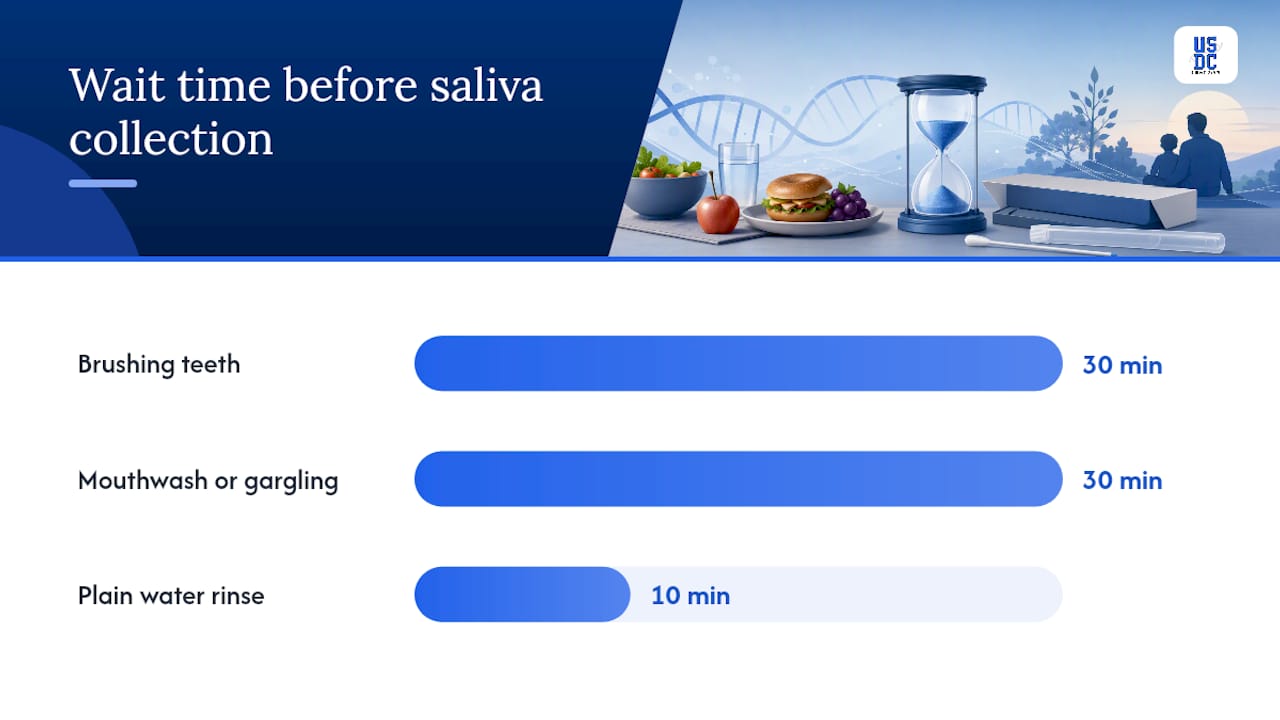
Mouthwash and vigorous gargling introduce stronger chemical residue than brushing alone, so the same 30-minute wait applies. If you only rinse with plain water, the bar is lower. Salimetrics recommends waiting at least 10 minutes after a water rinse before spitting into the tube, since even water can dilute the sample if you collect too soon after.
Plain drinking water is the mildest offender on this list, but it still counts. Give it 10 minutes minimum.
- Brushed your teeth? Wait 30 minutes.
- Used mouthwash or gargled? Wait 30 minutes.
- Rinsed with plain water only? Wait 10 minutes.
- Took medication with a liquid? Contact your kit’s support line if you’re unsure. Medication won’t change your genetic identity, but it can alter saliva composition temporarily.
Pro Tip: When in doubt, always default to the longer wait time. Thirty extra minutes costs you nothing. A rejected sample costs you a second collection kit and another week of waiting.
What to Do If You Already Ate Before Collecting
Slipping up happens, and most slips are fixable without needing a whole new kit shipped to your door.
- If it’s been less than 30 minutes since you ate or drank, spit out any remaining food, rinse your mouth thoroughly with plain water, and wait at least 10 minutes before collecting. Waiting the full 30 minutes is safer if your schedule allows it.
- If you brushed your teeth or used mouthwash within that window, wait the full 30 minutes rather than the shorter 10-minute rinse rule. Toothbrushing has a measurably larger effect on total DNA yield, so it needs the longer buffer.
- If you notice visible food particles, a sticky residue, or an unusual taste in your mouth right before collecting, don’t proceed. Contact your test provider for a replacement kit rather than submitting a sample you suspect is compromised.
How Do Labs Detect a Bad Saliva Sample?
Labs don’t just guess whether a sample is usable. They run it through specific checks before analysis even begins.
The first check is total DNA yield combined with spectrophotometric purity, usually expressed as an A260/280 absorbance ratio. A sample below the lab’s minimum yield threshold, or outside the acceptable purity range, gets flagged as insufficient before anyone looks at genetic markers.
Some lab workflows go further, using qPCR assays that target a human-specific marker alongside a bacterial marker to calculate a human-to-bacterial DNA ratio. A sample with too small a human fraction can prompt a request for re-collection, since bacterial overgrowth from food residue or poor oral hygiene crowds out the material labs actually need.
- Insufficient sample volume in the tube
- DNA yield below the lab’s minimum threshold
- Visible contamination, such as food particles or discoloration
- Overly viscous samples with excess mucus or bubbles instead of saliva
Practical Tips for Producing Enough Saliva
Some people simply struggle to produce saliva on demand, especially first thing in the morning or under the mild stress of “doing it right.” A few low-tech tricks solve this without touching the science.
Massaging your cheeks in a circular motion for a minute or two stimulates flow, and thinking about sour foods (lemons work well for most people) triggers the same response your salivary glands use naturally. If you’re still coming up short, placing a quarter teaspoon of plain white table sugar on your tongue is an accepted manufacturer trick for boosting flow when nothing else is working.
Timing matters too. Collecting first thing in the morning, before you’ve eaten anything, is commonly recommended because your mouth is least likely to hold food residue and saliva flow tends to be strongest.
- Massage your cheeks gently before you start.
- Think about something sour to trigger natural saliva flow.
- Use a small pinch of sugar on your tongue if you’re struggling.
- Fill to the kit’s indicated line with actual saliva, not bubbles, and avoid deep throat clearing since it makes saliva too thick to use.
Pro Tip: Morning collection solves two problems at once: you’re less likely to have eaten recently, and saliva flow is naturally higher after a night without food or drink.
A Practitioner’s Note on Getting It Right
Small slips are common, and most are fixable. If you ate a cracker twenty minutes ago, you haven’t ruined anything. Rinse, wait, and follow your kit’s specific instructions rather than guessing. When something feels off about your sample, a quick call to support beats submitting a tube you’re unsure about and waiting days to find out it failed.
— Dr. Todd Lewis
Ordering a Home Kit With Clear Collection Instructions
If you’re about to order a kit, the instructions that come with it matter as much as the kit itself. US Diagnostics Center’s home DNA test kits ship with step-by-step collection guidance and prepaid return shipping, so you’re not left guessing about timing once your kit arrives. Every kit analyzes up to 28 markers, and lab processing runs 2 to 3 business days once your sample reaches the lab, with standard order-to-results turnaround of 7 to 10 business days.
If you’re not sure which kit fits your situation, whether that’s paternity, maternity, sibling, or grandparent testing, the test-finder tool walks you through a few quick questions and points you to the right option, with next-day results available as an add-on for an extra $100. Browse the full kit lineup and start your order today.
Sources
- DNA Genotek — collection precautions (package insert)
- Salimetrics — Collecting and handling saliva for DNA analysis
- Saliva as a source of DNA (2019 review) — PMC
FAQ
What Should I Avoid Doing Before a DNA Test?
Avoid eating, drinking, smoking, vaping, chewing gum, kissing, brushing your teeth, or using mouthwash for 30 minutes before collecting your saliva sample. If you only rinsed with plain water, a 10-minute wait is usually enough.
What Can Throw Off a DNA Test?
Dilution from food or drink, and contamination from food particles or bacteria, are the main culprits behind an inconclusive saliva DNA test. These issues typically cause a low DNA yield or purity problem rather than a wrong result, which means a re-collection rather than a false match.
Should I Brush My Teeth Before a DNA Test?
No. A pilot study on pre-sampling behaviors found that toothbrushing had the largest effect on DNA yield of any behavior tested, reducing the total amount of usable DNA even though it sometimes raised the human DNA fraction. Wait 30 minutes after brushing before you collect.
Is It Okay to Drink Water Before a DNA Test?
Plain water is the least risky option on this list, but it can still dilute your sample if you collect too soon afterward. Salimetrics recommends waiting at least 10 minutes after drinking water before you spit into the collection tube.
How Much Does a Home DNA Test Cost?
US Diagnostics Center’s Home Paternity Test Kit is $79, the Home Maternity Test Kit is $129, and sibling, grandparent, and aunt/uncle kits are $139 each. Every kit includes prepaid return shipping and results in 7 to 10 business days from order to result.
Recommended
- Home DNA Test Preparation Checklist: 10 Steps
- 9 Cheek Swab Mistakes That Ruin Home DNA Tests
- How to Do a DNA Test: A Complete Step-by-Step Guide
This article is part of our Understanding DNA Testing: How It Works and What to Expect guide.


0 comments