

TL;DR:
- At-home paternity tests using STR marker analysis are scientifically reliable for personal knowledge, often showing 99.9% inclusion probability. However, without chain-of-custody documentation, home kits are not legally admissible in court, requiring separate legal testing for official proceedings. Including the mother's DNA and testing more markers can improve accuracy and reduce ambiguous results.
When done correctly by a reputable lab, at-home paternity tests use the same short tandem repeat (STR) marker analysis as clinical laboratories and commonly report inclusion probabilities of 99.9% or higher. The science is sound. The limitation is procedural: because home kits do not include ID verification or a documented chain of custody, their results are generally not admissible in court.
Two facts anchor everything else in this article:
- Inclusion probability: A reputable lab typically reports a very high probability when samples are collected correctly and the marker panel is sufficient.
- Exclusion: When a tested man is not the biological father, a properly run STR test returns a zero probability, a definitive exclusion with no ambiguity.
- Legal admissibility: Home kits are for personal knowledge only. Court proceedings, child support, custody, and immigration cases require a separate legal test with chain-of-custody documentation.
Table of Contents
- How do at-home paternity tests actually work?
- What do the reported percentages actually mean?
- What causes wrong or ambiguous results?
- Why do lab accreditations like AABB and ISO 17025 matter?
- Home test vs. legal test: which one do you actually need?
- How to choose a reputable provider and what to do after you get results
- What US Diagnostics Center offers and what you should verify before ordering
- Key Takeaways
- The gap between what the percentage says and what it proves
- US Diagnostics Center home paternity testing: a straightforward option
- Useful sources
- FAQ
How do at-home paternity tests actually work?
The process has three stages: collection, laboratory analysis, and reporting. Understanding each stage helps clarify where accuracy is won or lost.
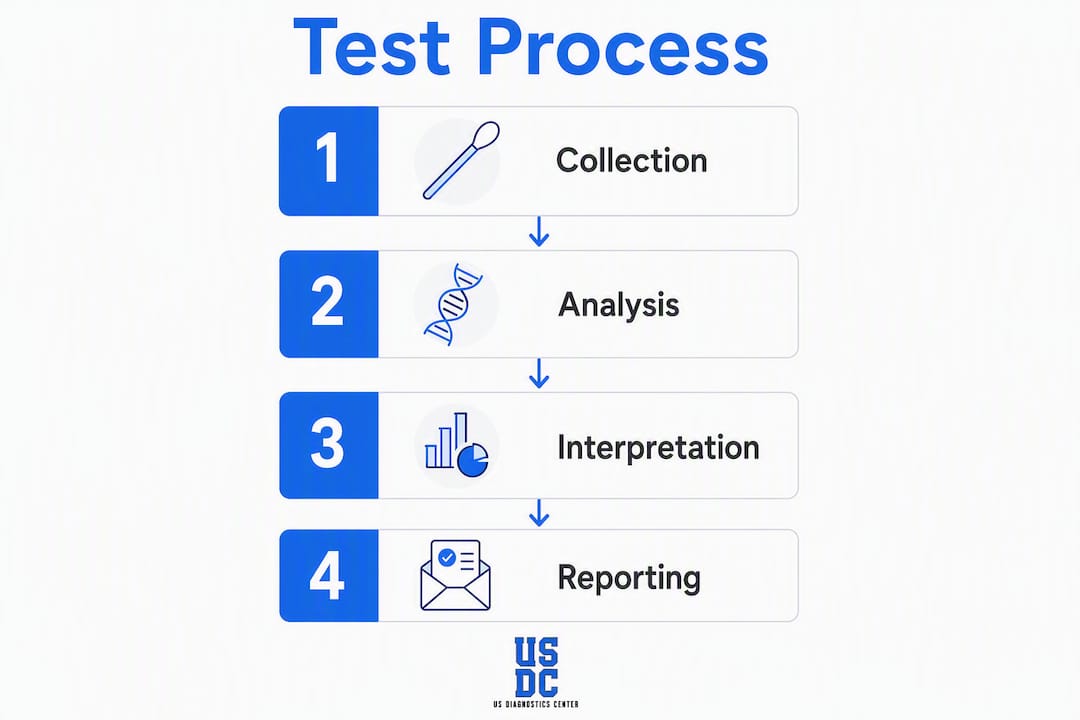
Collection relies on a buccal (cheek) swab. The person being tested rubs a cotton or nylon swab firmly against the inside of the cheek for 30–60 seconds to collect epithelial cells. The quantity and quality of those cells directly affect whether the lab can extract enough DNA to run a full analysis.

Laboratory analysis begins with DNA extraction from the swab material. The lab then amplifies specific regions of the genome called STR loci using polymerase chain reaction (PCR). Each STR locus has two alleles, one inherited from each parent. The lab compares the child's allele pattern against the alleged father's at every locus tested. A likelihood ratio is calculated across all loci, and that ratio is converted into a probability of paternity. The analytic method is identical whether the kit was purchased online or ordered through a clinic; what differs is the procedural documentation surrounding the sample.
Reporting translates the likelihood ratio into plain language. An inclusion result states a probability of paternity, typically expressed as a percentage. An exclusion result states that the tested man cannot be the biological father. For a deeper look at how STR analysis compares to older relationship-proof methods, the underlying science is worth reviewing.
Pro Tip: Swab firmly and rotate the swab against the cheek wall for the full recommended time. A gentle dab collects too few cells and is one of the most common reasons a lab requests a recollection.
What do the reported percentages actually mean?
The probability of paternity is a statistical statement, not a simple pass/fail. Knowing what drives that number helps you interpret your result correctly.
| Reported probability | Interpretation | Typical next step |
|---|---|---|
| Zero probability | Definitive exclusion — the tested man is not the biological father | No further testing needed unless sample quality is in doubt |
| High probability range | Statistical inclusion, but lower confidence — often reflects a small marker panel or missing maternal data | Add mother's sample or retest with a higher-marker panel |
| Very high probability | Strong inclusion — standard for most reputable home kits | Sufficient for personal knowledge; get a legal test for official use |
| Highest probability | Very strong inclusion — typical when marker count is high and maternal profile is available | Sufficient for personal knowledge; legal test required for court |
Two variables most directly raise or lower that percentage. First, marker count: the industry baseline for STR testing has historically been 16 loci, but many labs now test more. A larger panel means more data points, which raises the likelihood ratio and pushes the probability closer to 99.9% or above. Second, the mother's sample: including the mother's DNA allows the lab to isolate which alleles the child inherited paternally, removing ambiguity at loci where the child and alleged father happen to share common alleles by chance.
A result around 97% is not a failure. It usually signals one of three things: a smaller marker panel, the absence of maternal data, or a locus where the child and alleged father share a common allele in the general population. Adding the mother's sample or requesting a higher-marker retest typically resolves the ambiguity.
What causes wrong or ambiguous results?
The laboratory chemistry itself rarely fails. The overwhelming majority of compromised results trace back to pre-analytical errors, meaning mistakes that happen before the sample ever reaches the lab.
Common collection errors:
- Sealing a damp swab in its envelope, which promotes mold growth and degrades DNA
- Eating, drinking, or smoking within 30 minutes of collection, which introduces foreign organic material
- Swabbing too gently and collecting too few epithelial cells
- Touching the swab tip with fingers, which introduces a second person's DNA
Biological edge cases can also complicate results. If the alleged father has a close biological relative (a brother, uncle, or half-sibling) who could also be the father, the STR profiles may be similar enough to reduce statistical discrimination. Spontaneous mutations at a single locus can cause a mismatch that looks like an exclusion at that marker; reputable labs account for this by requiring mismatches at multiple loci before declaring exclusion. Low-DNA samples from infants or individuals with certain medical conditions may also yield partial profiles.
Reputable labs with strong quality-control protocols detect degraded or contaminated samples and request recollection rather than report a speculative result. An inconclusive result, therefore, is a sign of a lab doing its job correctly, not a sign that the test failed.
Pro Tip: After swabbing, hold the swab in open air for 60 seconds before placing it in the envelope. Air-drying is the single most effective step to prevent mold-related DNA degradation.
Why do lab accreditations like AABB and ISO 17025 matter?
Accreditation is not a marketing label. It is a third-party audit of a laboratory's processes, equipment calibration, staff qualifications, and quality-control procedures.
AABB (formerly the American Association of Blood Banks) sets specific standards for relationship testing laboratories, covering everything from how samples are logged and stored to how results are reviewed before release. An AABB-accredited lab must demonstrate that its chain-of-custody procedures, analyst training, and reporting formats meet defined benchmarks.
ISO 17025 is the international standard for testing and calibration laboratories. It governs technical competence and management systems, including how labs handle nonconforming results, how equipment is maintained, and how measurement uncertainty is calculated and reported.
Why this matters in practice:
- Accredited labs are required to have documented procedures for flagging degraded or contaminated samples.
- They maintain proficiency testing records, meaning external reviewers periodically send blind samples to verify the lab's results are correct.
- The FDA maintains oversight of direct-to-consumer in vitro diagnostics, and accreditation signals that a lab operates within recognized quality frameworks.
When evaluating a home paternity kit provider, confirm whether the processing laboratory holds AABB accreditation, ISO 17025 certification, or both. A lab that publishes its accreditation status and lists the specific certifying body is demonstrating a level of transparency that unaccredited labs cannot match.
Home test vs. legal test: which one do you actually need?
The chemistry is the same. The difference is documentation.
A home (personal-use) test involves a self-collected sample mailed to a lab. There is no identity verification, no neutral third-party collector, and no sealed chain-of-custody documentation. The result is valid for personal knowledge but cannot be used as legal evidence because it lacks the verified chain of custody courts require. For more detail on the procedural distinctions, the comparison between home and legal paternity tests covers the key differences clearly.
A legal (court-admissible) test requires all parties to appear at a collection site, present government-issued ID, and have samples collected by a trained, neutral collector. The samples are sealed, labeled, and shipped under documented chain of custody. That documentation is what makes the result admissible in family court, child support proceedings, custody determinations, probate cases, and certain immigration matters.
A practical decision framework:
- You want personal clarity about a biological relationship, with no legal proceedings involved: a home kit is appropriate.
- You are involved in or anticipate child support, custody, or probate proceedings: a legal test is required.
- An attorney or court has ordered a paternity test: a legal test with chain-of-custody documentation is mandatory.
- You want to confirm a home result before taking legal action: get a legal test; the home result cannot substitute for it.
Home kits typically cost a moderate amount depending on the relationship type, with standard order-to-results turnaround of 7–10 business days. Legal tests carry additional collection fees and may take longer depending on scheduling.
How to choose a reputable provider and what to do after you get results
Not all home paternity kits are processed by the same quality of laboratory. These are the signals that distinguish a reliable provider from one that is not.
Provider evaluation checklist:
- Publishes the specific number of STR markers tested (a transparent lab will state this clearly)
- Lists the accreditation status of its processing laboratory (AABB, ISO 17025, or both)
- Explains its sample-handling and quality-control policies
- Reports both the likelihood ratio and the probability of paternity, not just a percentage
- Provides accessible customer support for questions about results or recollection requests
Step-by-step collection to minimize errors:
- Do not eat, drink, or smoke for at least 30 minutes before swabbing.
- Swab firmly against the inner cheek wall, rotating the swab for the full recommended duration.
- Air-dry the swab for 60 seconds before sealing it.
- Label each swab envelope clearly with the correct person's name.
- Never handle another participant's swab with the same ungloved hand.
If results are unexpected or inconclusive:
- An inconclusive result most often reflects a collection error. Request a recollection kit and follow the collection steps above precisely.
- A result near 97% with no maternal sample included: add the mother's DNA to the retest.
- A result you intend to use in any legal context: obtain a separate legal test regardless of what the home result shows.
- A result involving close biological relatives or a complex family situation: consult a genetic counselor who can interpret the likelihood ratios in context.
Pro Tip: If you are uncertain whether the result will eventually need to be used in court, order a legal test from the start. Retesting later adds cost and time; a legal test done once is always sufficient for both personal knowledge and official use.
What US Diagnostics Center offers and what you should verify before ordering
US Diagnostics Center processes home paternity tests using STR marker analysis with a marker count above the historical industry baseline. The home paternity kit is priced moderately and includes a prepaid return shipping envelope. Standard order-to-results turnaround is 7–10 business days, with lab processing typically completed in 2–3 business days. Other relationship tests are also offered at higher prices.
Readers who require a result for a proceeding that specifies AABB-accredited testing should confirm that requirement and verify lab accreditation status directly before ordering.
Key facts to verify before purchasing:
- Confirm whether you need a personal-use result or a court-admissible result. US Diagnostics Center's home kits are for personal use.
- If a legal test is required, review the legal DNA testing options separately.
- Expedited processing is available for time-sensitive situations.
- Results are reported with probability of paternity and likelihood ratio, giving you the full statistical picture rather than a simplified pass/fail.
The home DNA test collection covers all available personal-use relationship tests, with guided selection tools to help identify the right test for your specific situation.
Key Takeaways
Home paternity tests using STR marker analysis are scientifically reliable for personal use with very high inclusion probabilities, but they are not court-admissible without a separate legal chain-of-custody test.
| Point | Details |
|---|---|
| Typical inclusion probability | Reputable labs commonly report 99.9% or higher when samples are collected correctly and the marker panel is sufficient. |
| Main source of error | Pre-analytical collection mistakes (damp swabs, eating before swabbing, cross-contamination) cause most compromised results, not lab chemistry. |
| Legal admissibility | Home kits lack chain-of-custody documentation and are not admissible in court; a separate legal test is required for official proceedings. |
| Improving accuracy | Adding the mother's sample and choosing a lab that tests more STR loci both raise statistical power and reduce ambiguous results. |
| US Diagnostics Center | Offers home paternity testing at $79 with up to 28 markers and 7–10 business day turnaround. |
The gap between what the percentage says and what it proves
The number on a paternity report is a probability statement, not a legal verdict. That distinction gets lost more often than it should.
A result showing 99.9% probability of paternity is statistically very strong. It means the data are consistent with biological paternity and that the likelihood of a random unrelated man matching the child's profile at all tested loci is extremely low. What it does not mean is that the result is legally binding, that the sample was collected under verified conditions, or that the identity of the person who swabbed was confirmed by anyone other than the person themselves.
This is not a flaw in the science. It is a feature of how the legal system evaluates evidence. Courts require documented chain of custody because the evidentiary standard is different from the scientific one. A home test answers the biological question with high confidence. A legal test answers the same biological question while also satisfying the procedural requirements that make the answer usable in court.
The practical advice that follows from this is straightforward: if you are testing for personal clarity and no legal proceeding is involved or anticipated, a home kit from a reputable lab is a reasonable and cost-effective choice. If there is any possibility the result will be needed in court, skip the home kit entirely and order a legal test. The cost difference is modest compared to the cost of retesting later under legal requirements.
Confidentiality is also worth noting. Home kits are processed privately, and reputable providers maintain strict data-handling policies. For readers who want more detail on how paternity test confidentiality works in practice, that is a reasonable next step before ordering.
US Diagnostics Center home paternity testing: a straightforward option
For readers who have confirmed they need a personal-use result rather than a court-admissible one, US Diagnostics Center's home paternity kit at $79 offers STR analysis with up to 28 markers, a prepaid return shipping envelope, and standard results in 7–10 business days. The kit covers the child and alleged father; adding the mother's sample is available and recommended when the initial result is near a borderline probability.
If your situation involves child support, custody, or any official proceeding, the legal DNA testing options are the appropriate starting point. For personal peace of mind, the home DNA test collection includes a guided selection tool to match you with the right test for your specific family scenario. Results are reported with both the probability of paternity and the underlying likelihood ratio, so you receive the full statistical picture rather than a simplified label.
Useful sources
- DNA Paternity Test: Procedure, Accuracy & Results — Cleveland Clinic
- How Accurate Are Home DNA Paternity Tests? — LegalClarity
- Direct-to-Consumer Tests — FDA
- Clinical Laboratory Quality and Molecular Testing — PMC
- At-Home DNA Testing Kits: 3 Things to Know — Kaiser Permanente
FAQ
Can home paternity tests give a wrong result?
A definitive exclusion is extremely reliable when the sample is adequate. An inclusion result can be affected by pre-analytical collection errors or a small marker panel, but reputable labs flag compromised samples as inconclusive rather than report a false positive.
Are at-home paternity tests reliable for personal use?
Yes, when processed by a reputable lab using STR marker analysis, home paternity tests are scientifically reliable for personal knowledge, commonly reporting inclusion probabilities of 99.9% or higher with correct sample collection.
What does 99.9% mean on a paternity test?
It means the statistical probability that the tested man is the biological father is 99.9%, based on comparing STR marker profiles across all tested loci. It is not a legal determination, but it is a very strong scientific inclusion.
Why are home paternity tests not admissible in court?
Home kits do not include identity verification or a documented chain of custody, both of which courts require to confirm that the sample came from the person named in the report. A legal test collected by a neutral third party under documented chain-of-custody procedures is required for court use.
Does including the mother's sample improve accuracy?
Yes. The mother's DNA profile allows the lab to identify which alleles the child inherited maternally, isolating the paternal contribution and reducing ambiguity at loci where common alleles might otherwise lower the probability of paternity.
Recommended
- Are Home Paternity Tests Accurate? The Real Answer | USDC
- At-Home Paternity Test: Cost & Accuracy | USDC
- Why Paternity Test Results Matter for Families | USDC
- Why Probability of Paternity Never Reaches 100% (2026) | USDC
This article is part of our Paternity Testing: The Complete Guide guide.


0 comments