

Humans normally have 23 pairs of chromosomes in nearly every cell, for a total of 46. This figure comes from decades of genetic research and is confirmed by MedlinePlus and the National Human Genome Research Institute.
- Source quality: Government genetics agencies and major medical centers all report the same number, 46.
- Pairs vs. total: "23 pairs" means two matching sets of 23, one from each parent, adding up to 46 individual chromosomes.
- Exceptions exist: Some people have a different count due to natural variation, and a genetics professional can explain what any specific result means.
Key Takeaways
Humans have 46 chromosomes arranged as 23 pairs, one full set inherited from each biological parent, and departures from that number explain a range of well-documented genetic conditions.
| Point | Details |
|---|---|
| Standard human count | 23 pairs of chromosomes, 46 total, confirmed by MedlinePlus and Genome.gov. |
| Two chromosome categories | 22 autosome pairs plus one sex-chromosome pair (XX or XY typically). |
| Inheritance is 50/50 | Each parent contributes one full set of 23 chromosomes at conception. |
| Variations are documented | Trisomy 21, Turner syndrome, and Klinefelter syndrome all involve atypical chromosome counts. |
| Karyotyping is the standard | Labs stain and photograph chromosomes to count them, with microarray and sequencing catching smaller changes. |
Table of Contents
- What Is a Chromosome, Exactly?
- Breaking Down the 23 Pairs
- How Inheritance Delivers Your 23 Chromosomes
- When the Chromosome Count Differs: Aneuploidy Explained
- How Scientists Actually Count Chromosomes
- Why Chromosome Number Actually Matters
- Get Clarity on Your Family's Genetic Questions
- An Editorial Take on Why This Fact Gets Oversimplified
- Sources
- FAQ
What Is a Chromosome, Exactly?
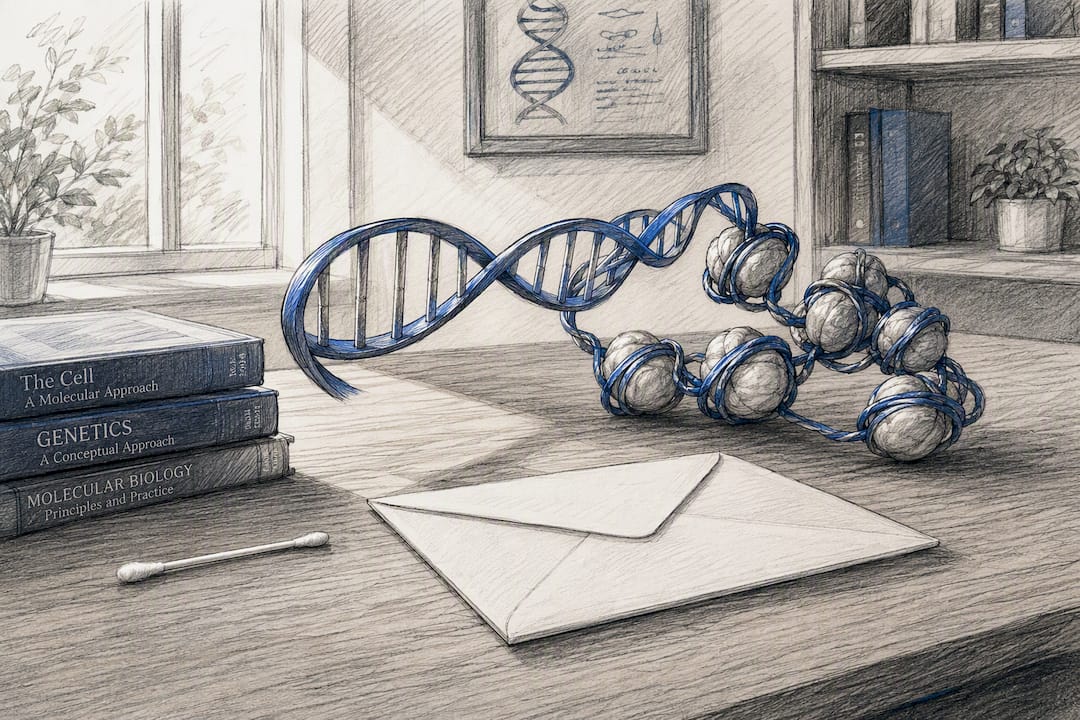
A chromosome is a tightly wound bundle of DNA and proteins that carry genetic instructions for building and running your body. The DNA itself doesn't float around loose in a cell. It wraps around proteins called histones, then coils and folds until it's compact enough to fit inside a cell's nucleus, according to the Cleveland Clinic.
Think of it like a library. Your DNA is the full text of every book ever written, and chromosomes are the shelving system that keeps everything organized and retrievable. Each chromosome has a pinched middle section called a centromere and two arms extending from it, a structure that lets cells copy and divide DNA accurately every time a new cell forms.
That packaging matters more than it sounds. If you stretched out all the DNA in a single human cell, it would measure roughly six feet end to end. Chromosomes are the reason that much genetic material fits inside a nucleus too small to see without a microscope.
Pro Tip: If you ever see a lab report listing "46,XX" or "46,XY," that's a shorthand karyotype notation, total chromosome count followed by the sex chromosomes present.
Breaking Down the 23 Pairs
The full human chromosome count splits into two categories, and understanding that split explains a lot about how traits and conditions get passed down.
- 46 total chromosomes arranged as 23 pairs in nearly every cell in your body.
- 22 autosome pairs (44 chromosomes) that are identical in structure between males and females and carry most of your genetic information.
- 1 sex-chromosome pair (2 chromosomes) that determines biological sex and differs between males and females.
Biologically female individuals typically carry two X chromosomes (XX), while biologically male individuals typically carry one X and one Y (XY), per MedlinePlus. Chromosomes are numbered roughly by size, with chromosome 1 the largest, carrying close to 2,800 genes, while chromosome 22 holds around 750, according to the Genome.gov glossary. Oddly, chromosome 21 is actually smaller than chromosome 22, a naming quirk left over from early microscope-based counting.
How Inheritance Delivers Your 23 Chromosomes

Every person receives one full set of 23 chromosomes from their biological mother and one full set of 23 from their biological father. Sperm and egg cells each carry half the standard number, 23 single chromosomes apiece, so when they combine at conception, the resulting cell has the complete 46, according to MedlinePlus. That's the entire mechanism behind why children resemble both parents genetically.
Sex-chromosome combinations follow a fairly predictable pattern, though not without exceptions:
- XX — typical female pattern, one X from each parent.
- XY — typical male pattern, an X from the mother and a Y from the father.
- Less common patterns, such as XXY or a single X (XO), occur when chromosome separation doesn't go exactly as expected during egg or sperm formation.
These variations aren't rare curiosities to panic over. They're documented, well-studied patterns, and a genetic counselor can walk a person through what a specific result actually means for their health and family planning.
Pro Tip: A DNA test result showing chromosome details isn't the same as a paternity or kinship test. If you're trying to confirm a family relationship rather than analyze chromosome structure, kinship DNA testing uses a different set of genetic markers entirely.
When the Chromosome Count Differs: Aneuploidy Explained
Aneuploidy simply means having more or fewer than the usual 46 chromosomes. It usually happens because of nondisjunction, a hiccup during cell division where chromosomes fail to separate correctly, according to research on aneuploidy. The result is a cell with an extra copy of a chromosome or one missing entirely.
Some of the better-known examples include:
- Trisomy 21 (47 chromosomes): an extra copy of chromosome 21, causing Down syndrome.
- Turner syndrome (45,X): a missing or incomplete second sex chromosome in females, affecting growth and development.
- Klinefelter syndrome (47,XXY): an extra X chromosome in males, which can affect hormone levels and fertility.
- Mosaicism: a condition where some cells in the body have a different chromosome count than others, because the error occurred after conception rather than at it.
None of these conditions are something to self-diagnose from a symptom checklist. If a chromosome-related concern comes up, whether from a prenatal screening, a developmental evaluation, or unexplained symptoms, a genetics professional can order the right test and interpret it accurately. Reviewing how genetic testing works is a reasonable first step before that conversation.
How Scientists Actually Count Chromosomes

Labs still rely on a technique called karyotyping to physically count chromosomes. A technician grows a small sample of cells, usually from blood, stops them mid-division when chromosomes are most visible, stains them, and photographs the results under a microscope. Those images get arranged into pairs by size and shape, producing the classic karyotype chart you may have seen in a biology textbook.
Karyotyping remains the standard for spotting whole extra or missing chromosomes, while newer tools like chromosomal microarray analysis and DNA sequencing detect smaller structural changes, missing or duplicated segments too small to see under a microscope, according to Genome.gov.
Mosaicism can complicate a straightforward count. Because the chromosome error happens after the embryo has already started dividing, one tissue sample (say, blood) might show a typical 46, while another tissue shows a different number. That's part of why doctors sometimes test more than one tissue type before drawing conclusions.
Pro Tip: A karyotype test looks at chromosome structure and number. It's a completely different test from the DNA relationship testing used to confirm paternity or sibling relationships, so don't expect one to substitute for the other.
Why Chromosome Number Actually Matters
Chromosome count isn't just trivia for a biology quiz. It has real, practical weight in medicine and family life:
- Development: an atypical chromosome count often explains delayed growth or developmental differences in children.
- Diagnosis: identifying an extra or missing chromosome gives doctors a starting point for treatment and support planning.
- Family risk: some chromosome patterns run in families and affect future pregnancies, which is why relatives sometimes get tested too.
- Genetic counseling: understanding a specific result helps families make informed decisions about next steps.
Clinicians typically order chromosome testing after unexplained developmental delays, as follow-up to a prenatal screening result, or during a fertility workup. In each case, the chromosome count becomes one piece of a larger diagnostic picture, not the whole story.
Get Clarity on Your Family's Genetic Questions
Chromosome science explains a lot about inherited traits, but it doesn't answer the question families most often bring to us: who is biologically related to whom. That's where US Diagnostics Center comes in. Our guided test selection tool asks a few questions about your situation, paternity, maternity, sibling, grandparent, or aunt/uncle testing, and recommends the option that fits.
Testing starts at $79 for a home paternity test, $129 for maternity, and $139 for sibling, grandparent, or aunt/uncle testing. Every kit ships with a prepaid return envelope, and results come back in 2 to 3 business days once your sample reaches the lab, with 7 to 10 business days typical from order to results. US Diagnostics Center analyzes up to 28 genetic markers per test.
If your situation calls for a court-admissible result, browse our legal DNA testing options. For most families confirming a relationship at home, our at-home DNA test kits are the faster, more affordable place to start.
An Editorial Take on Why This Fact Gets Oversimplified
Most explainers stop at "23 pairs, 46 total" and treat that as the whole story. It isn't wrong, but it flattens a more interesting reality: chromosome number is a starting point for a diagnostic conversation, not an endpoint. The conventional advice, memorize the number, move on, undersells how often variation shows up in ordinary medical life, from prenatal screening follow-ups to fertility workups.
What gets underestimated is mosaicism. People assume a chromosome count is one fixed number for their entire body, when in fact different tissues can show different results depending on when a cell-division error occurred. That single detail changes how a lot of test results should be interpreted.
If there's one priority for readers, it's this: don't treat a chromosome number as a verdict. Treat it as a data point that means something specific only in context, alongside family history, symptoms, and a genetics professional's interpretation.
Sources
- How many chromosomes do people have? - Genetics (MedlinePlus)
- Genome
- Chromosomes: Definition, Structure & Function (Cleveland Clinic)
- What are Chromosomes? (Learn.Genetics, University of Utah)
FAQ
How Many Chromosomes Does a Female Have?
Biologically female individuals typically have 46 chromosomes total, including two X chromosomes (46,XX), matching the standard human count of 23 pairs.
What Happens if a Human Has 24 Pairs of Chromosomes?
Having more than the typical 23 pairs would be a significant chromosomal abnormality; documented human conditions generally involve one extra or missing chromosome, such as trisomy 21, rather than a full extra pair, and any such finding would require evaluation by a genetics professional.
What Is the Largest Number of Chromosomes Ever Recorded in a Human?
Extreme chromosome counts are exceptionally rare and specific case reports vary; the reliably documented human baseline remains 46, with named variations like trisomy conditions adding one extra chromosome rather than large multiples.
What Are the 23 Chromosomes Responsible For?
The 23 chromosome pairs carry the roughly 21,000 genes that direct nearly every trait and function in the body, from eye color to organ development, according to Learn.Genetics.
Recommended
- Facts About DNA: What to Know Before a DNA Test | USDC
- How Much DNA Do Siblings Share? Percentages Explained (2026) | USDC
- Combined Paternity Index (CPI) Explained (2026) | USDC
- Y-STR DNA Testing: Confirming Paternal Line (2026) | USDC
This article is part of our Understanding DNA Testing: How It Works and What to Expect guide.


0 comments