

Personal DNA profiles most reliably answer parent/child and full-sibling questions, and with the right strategy, they can also resolve grandparent, aunt/uncle, and other kinship questions. If your results need to hold up in court or on official paperwork, you need chain-of-custody legal testing, not an at-home kit. If you only need personal clarity, an at-home kit is usually the faster, cheaper path.
TL;DR:
- Personal DNA testing confidently establishes parent/child and full-sibling relationships, but accuracy diminishes for more distant kinship links like grandparents or aunts and uncles.
- Autosomal STR panels are standard for most kinship testing, with additional markers or different marker types used for complex or distant relationships.
- Legal tests require chain-of-custody procedures with witnessed sample collection, unlike at-home kits, to ensure results are legally admissible.
- Turnaround time for lab processing is typically 2 to 3 days, with a total result delivery of 7 to 10 days, and costs vary from $79 for paternity to $139 for more complex tests.
Table of Contents
- Which Kinship Questions Can a Personal DNA Profile Answer?
- What Types of DNA Markers Do Labs Actually Use?
- Do I Need an At-Home Kit or a Legal DNA Test?
- How Do Labs Report and Interpret DNA Kinship Results?
- What Happens if Your DNA Test Comes Back Inconclusive?
- What Should You Know About Privacy, Timelines, and Cost?
- Expert Guidance From Dr. Todd Lewis
- Get the Right DNA Test for Your Situation
- Primary Sources and Further Reading
- Sources
- FAQ
Which Kinship Questions Can a Personal DNA Profile Answer?
Most people asking about personal DNA profiles want one of a handful of specific answers, and the technology handles some of them with far more confidence than others.
- Paternity or maternity: Confirms or excludes a biological parent-child relationship, typically with very high statistical confidence.
- Full or half siblings: Determines whether two people share both parents, one parent, or neither.
- Grandparentage: Used when a parent is unavailable and grandparents need to establish a biological link to a grandchild.
- Avuncular (aunt/uncle) testing: Checks a biological relationship between a child and an alleged aunt or uncle, often when the potential father is deceased or unreachable.
- Twin zygosity: Confirms whether twins are identical (monozygotic) or fraternal (dizygotic).
- Post-mortem or identity confirmation: Establishes a biological connection to a deceased individual using stored or archived samples.
The statistical power behind these answers drops as the biological relationship gets more distant. Parent/child and full-sibling comparisons share roughly 50 percent of DNA, which gives labs a strong signal to work with. Grandparent and avuncular relationships share about 25 percent, so the testing overview from SimplyForensic notes these cases often need extra relatives or supplementary techniques to reach a firm conclusion. Expect one of three outcomes: a conclusive inclusion, a conclusive exclusion, or an inconclusive result that points toward more testing.
What Types of DNA Markers Do Labs Actually Use?
Every relationship test starts with the same building block: a marker panel. Knowing which one applies to your situation helps you ask the lab the right questions before you swab anyone's cheek.
Autosomal short tandem repeat (STR) testing is the standard for parentage and most kinship comparisons, and it's what personal DNA profiling has relied on for decades because it reads consistently across generations. Many labs test up to 28 markers to strengthen the statistical weight behind a result, since more loci mean more independent points of comparison.
- Autosomal STR panels: The default choice for paternity, maternity, and sibling testing.
- Y-STR markers: Trace the paternal line only, useful when the alleged father is unavailable but a brother or paternal uncle can stand in.
- Mitochondrial DNA (mtDNA): Traces maternal lineage and works well on degraded or older samples.
- X-STR markers: Add value in specific female-line scenarios, such as certain half-sibling comparisons.
- SNP panels or extended STR loci: Brought in for distant relationships where standard autosomal testing alone won't separate the possibilities.
A real-world example: if the alleged father has died, testing his brother with Y-STR markers alongside standard autosomal comparisons can often answer the question without exhuming a body or waiting on estate paperwork. Complex situations, like distinguishing between two related possible fathers, sometimes require more loci than a standard panel provides.
Do I Need an At-Home Kit or a Legal DNA Test?
This decision comes down to one question: will anyone outside your household ever need to see or challenge the result? If the answer is yes, chain of custody matters.
Chain of custody means every step, from sample collection to lab receipt, is documented and witnessed by a neutral third party, so no court can question whether the sample was swapped or tampered with. The PMC review on DNA profiling for legal and social parentage points out that at-home kits generally lack this documentation, which is exactly why they aren't accepted for court, custody, or government paperwork.
- Choose legal testing if you need results for a custody dispute, child support case, Social Security benefits, birth certificate amendment, or estate matter.
- Choose an at-home kit if you only want a private, personal answer and have no plans to use it officially.
- Schedule a witnessed collection at an approved facility, bring a government-issued photo ID, and let a neutral collector observe the swab process.
- Expect a legal report that documents the chain of custody alongside the statistical findings, so it can be submitted as evidence if needed.
How Do Labs Report and Interpret DNA Kinship Results?
Lab reports don't just say "yes" or "no." They express confidence using statistical language that's worth understanding before your results arrive.
The likelihood ratio (LR) compares the probability of the observed DNA pattern under two competing scenarios: that the tested individuals are related as claimed, versus that they are unrelated. For paternity cases, this number becomes the combined paternity index (CPI). For other kinship comparisons, it's called the kinship index (KI) or combined kinship index (CKI).
A CPI of 2,000 or higher is treated as strong support for paternity, corresponding to a probability of paternity above 99.9 percent under standard assumptions, according to the forensic biology technical manual from the New York City Office of Chief Medical Examiner.
For relationships other than direct parentage, the same OCME manual describes calculating the CKI across several population reference groups and reporting the most conservative figure, which avoids overstating confidence for any single group. An exclusion means the DNA rules out the relationship entirely. Inconclusive means the numbers fell into a gray zone, usually because too few markers or too few tested relatives were available. Adding relatives or markers raises the likelihood ratio and can convert an inconclusive case into a conclusive one.
What Happens if Your DNA Test Comes Back Inconclusive?
An inconclusive result isn't a dead end. It's a signal that the lab needs more information to reach statistical confidence.
Ask whether adding the mother, another sibling, or a paternal relative would help. The autosomal DNA relationship testing guidance confirms that testing additional family members raises statistical power significantly, especially for grandparent and avuncular cases. You can also ask the lab about extending the Y-STR panel, adding mtDNA, or switching to a SNP-based panel for distant relationships. If the case is headed to court, get a legal collection scheduled and talk to an attorney before submitting anything.
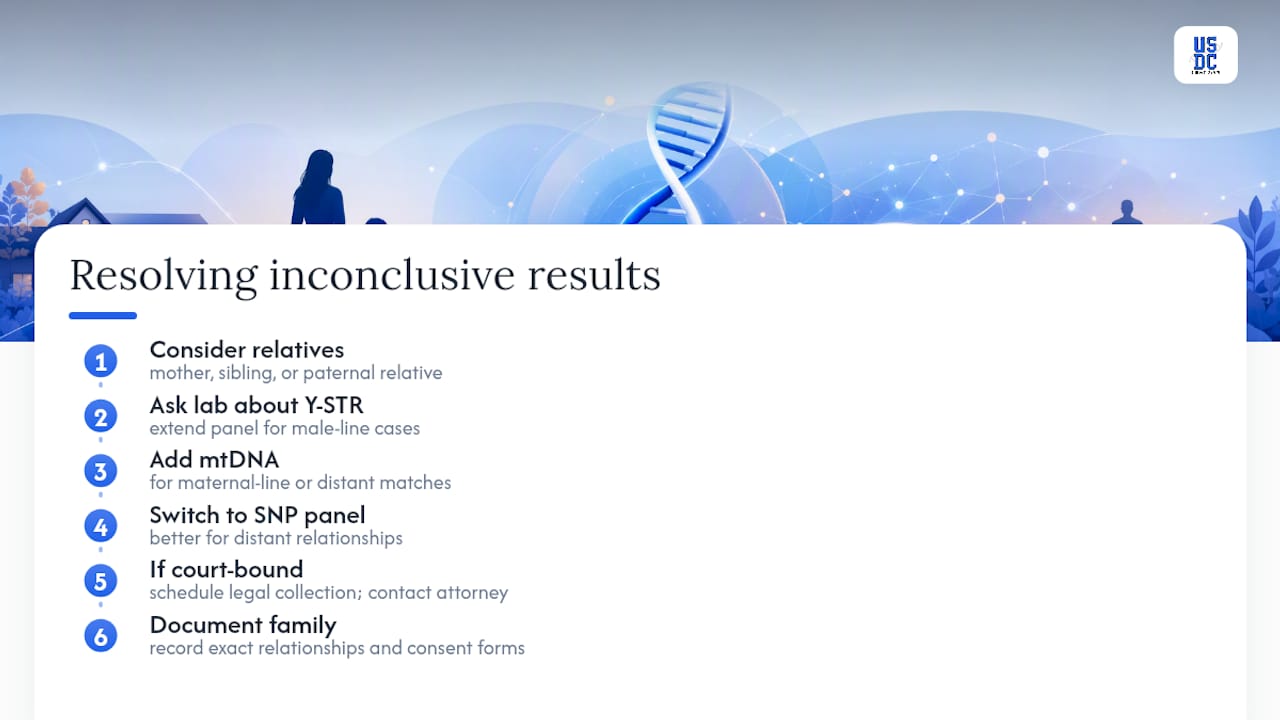
Pro Tip: Write down every tested person's exact relationship to the others before you order, and keep copies of consent forms and collection dates. Labs move faster when they don't have to untangle your family tree from scratch.
What Should You Know About Privacy, Timelines, and Cost?
Before you order, get clear on three practical things: who sees your data, how long results take, and what you'll actually pay.
- Privacy: Ask the lab in writing about data retention, who has access to raw genetic profiles, and whether samples are destroyed after testing.
- Timelines: Lab processing typically takes 2 to 3 business days once your sample arrives, with standard order-to-results turnaround running 7 to 10 business days; expedited options are usually available for urgent cases.
- Pricing: Home paternity testing runs $79, maternity testing is $129, and sibling, grandparent, or aunt/uncle testing is $139.
- Shipping: Kits include a prepaid return envelope, so you're not scrambling to find packaging or pay for postage separately.
These figures apply to consumer-grade personal testing. Legal, chain-of-custody cases involve additional collection fees tied to the witnessed appointment itself.
Expert Guidance From Dr. Todd Lewis
If there's official paperwork, custody, or a court date attached to your question, don't gamble on an at-home kit. Legal testing exists precisely because judges and agencies need documented chain of custody, not just a lab result. Consent and family dynamics matter too. Testing a relative without their knowledge can create lasting damage even when the science is sound. For anything beyond a straightforward parent/child question, use a guided test selection tool or call lab support before you order.
— Dr. Todd Lewis
Get the Right DNA Test for Your Situation
US Diagnostics Center solves the exact problem this article just walked through: figuring out which test actually fits your family's situation before you spend money on the wrong one. Its guided test selection tool asks about your relationships and recommends the right at-home panel for your needs.
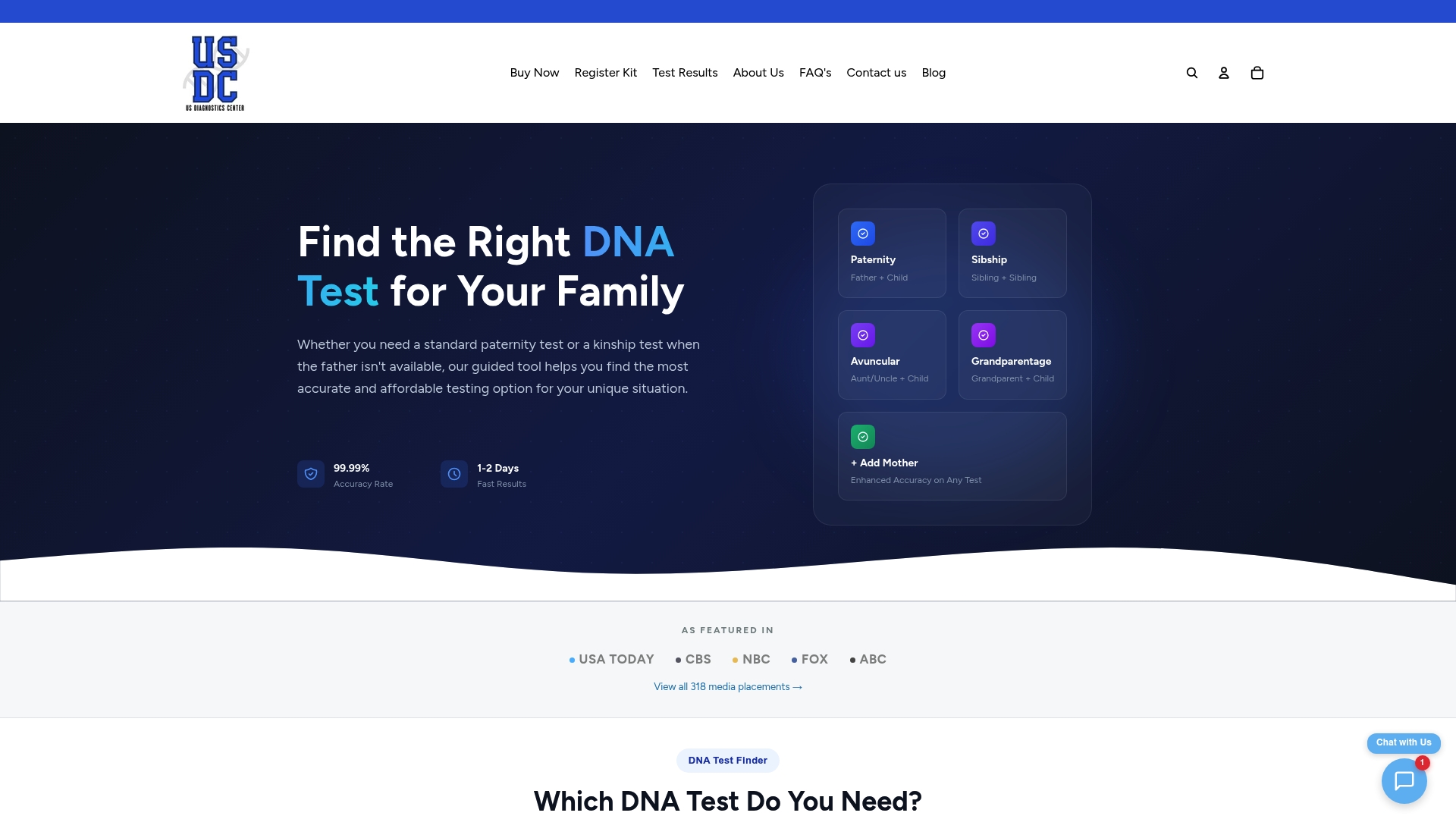
US Diagnostics Center currently offers home DNA test kits for personal knowledge, covering paternity, maternity, sibling, grandparentage, avuncular, and twin zygosity testing. Lab processing typically runs 2 to 3 business days, with standard order-to-results turnaround of 7 to 10 business days, and expedited processing is available. Pricing details vary; please refer to the provider's website for current information about home paternity, maternity, sibling, grandparent, and avuncular tests. For personal peace of mind without the paperwork, browse the at-home DNA test kits. If your situation involves court or custody paperwork, a legal DNA test with witnessed sample collection and documented chain of custody is required — contact a qualified legal professional to identify the right provider for that need.
Primary Sources and Further Reading
For readers who want the underlying technical detail behind the statistics and standards discussed above:
- Kinship and Paternity Analysis Technical Manual, New York City Office of Chief Medical Examiner
- DNA Profiling: Social, Legal, or Biological Parentage, PMC review article
- Guidance on Autosomal DNA Relationship Testing, forensic guidance document
- Forensic Paternity and Kinship Testing Overview, SimplyForensic
- Kinship DNA Testing Examples, US Diagnostics Center
This article is general information, not a substitute for advice from a qualified lawyer. Consult a qualified legal professional about your own circumstances before acting on anything here.
Sources
- Kinship and paternity analysis — Forensic Biology technical manual (OCME)
- DNA profiling: Social, legal, or biological parentage (PMC)
- Guidance: Autosomal DNA relationship testing
- Forensic paternity and kinship testing overview (SimplyForensic)
FAQ
What Can a Personal DNA Profile Actually Prove?
It can confirm or rule out parent/child, sibling, grandparent, avuncular, and twin zygosity relationships, with parent/child and full-sibling comparisons carrying the strongest statistical confidence.
Is an At-Home DNA Kit Accepted in Court?
No. Courts require chain-of-custody documentation and witnessed sample collection, which standard at-home kits do not provide.
What Does a CPI of 2,000 Mean?
According to the OCME technical manual, a combined paternity index of 2,000 or higher indicates strong statistical support for paternity, corresponding to a probability above 99.9 percent.
Why Would a Grandparent or Aunt/Uncle Test Come Back Inconclusive?
These relationships share less DNA than a parent/child pair, so labs sometimes need additional relatives or extra markers to reach a conclusive statistical result.
How Long Does a Personal DNA Profile Test Take?
Lab processing typically takes 2 to 3 business days, with standard order-to-results turnaround of 7 to 10 business days; expedited options are usually available.
How Much Does Kinship DNA Testing Cost?
Home paternity testing costs $79, maternity testing is $129, and sibling, grandparent, or aunt/uncle testing is $139, with kits shipped in a prepaid return envelope.
Recommended
- Expedited DNA Testing in the U.S.: What 1–3 Business Days Really Means
- Court-Admissible DNA Testing Benefits for U.S. Families
- Why Court DNA Differs from Private Tests: A Clear Guide
- Home DNA Test vs Legal DNA Test: How to Choose (Framework)
This article is part of our Understanding DNA Testing: How It Works and What to Expect guide.


0 comments