

TL;DR:
- A combination family DNA test verifies multiple biological relationships simultaneously. At-home versions are for personal knowledge only. Court-admissible results require a separate legal test with witnessed sample collection and documented chain of custody. Results are highly accurate, typically delivered within 7 to 10 days by certified laboratories.
A combination family DNA test is a DNA analysis designed to verify multiple biological relationships within a single testing process. Rather than testing one relationship in isolation, it analyzes samples from several family members simultaneously, using multiple genetic markers to establish or exclude biological connections with a high degree of certainty. Common relationships examined include paternity, siblingship, grandparentage, and aunt/uncle ties. For results to be legally admissible in US courts, immigration proceedings, or inheritance disputes, the test must follow a formal chain-of-custody procedure from sample collection through laboratory analysis to result delivery, conducted by an AABB-accredited laboratory — which is what distinguishes a legal test from a standard at-home kit.
Typical uses include:
- Confirming paternity when the alleged father is unavailable and extended relatives must substitute
- Establishing siblingship for inheritance or immigration petitions
- Verifying grandparent-grandchild relationships when both parents are deceased or inaccessible
- Supporting USCIS family-based visa petitions where documentary evidence is insufficient
- Resolving custody and child support disputes requiring court-recognized biological proof
Table of Contents
- What legal requirements apply to family DNA testing in the US?
- How does combination family DNA testing actually work?
- How do combination tests handle complex family situations?
- How to choose a reliable provider for combination family DNA tests
- US Diagnostics Center offers clear, affordable family DNA testing
- FAQ
- Key Takeaways
What legal requirements apply to family DNA testing in the US?
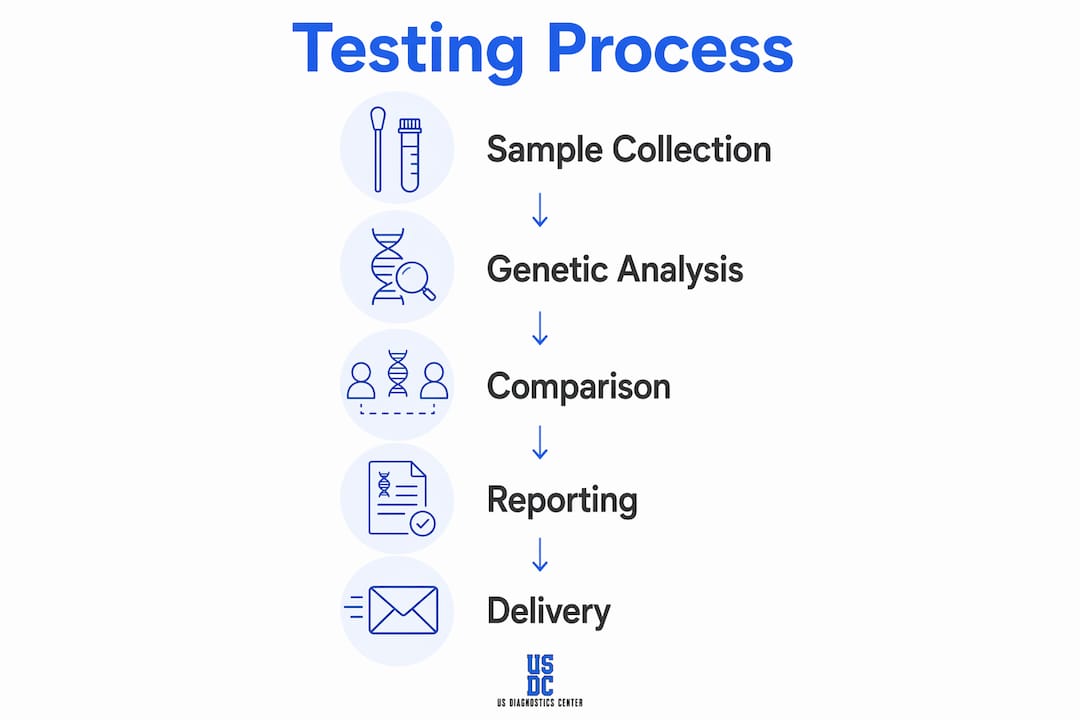
US courts and federal immigration agencies do not accept DNA results from just any laboratory. The chain-of-custody requirement mandates that sample collection be witnessed and documented, that samples be sealed and labeled at the collection site, and that the laboratory receive them through a verifiable, unbroken chain of handling. Skipping any step in that process invalidates the sample for legal use, and chain-of-custody cannot be established retroactively.
AABB accreditation is the governing standard. The AABB accreditation requirement means USCIS requires that any laboratory submitting DNA results for immigration purposes hold current AABB accreditation. Many state courts apply the same standard for custody and inheritance cases. AABB itself is the accrediting body, not a testing lab.
Key procedural distinctions between legal tests and at-home kits:
- Witnessed collection: A neutral third party observes and documents sample collection for legal tests; at-home kits have no such oversight.
- Sealed documentation: Legal samples are sealed, labeled with photo ID verification, and shipped directly to the lab; at-home samples are self-handled.
- Direct result delivery: For legal purposes, labs send results directly to the court or agency; clients cannot submit results themselves.
- Accredited facility: Only AABB-accredited labs are accepted for immigration and many court proceedings.
Pro Tip: If you are unsure whether your situation requires a legal test or a personal peace-of-mind test, read the differences between home and legal DNA tests before ordering — choosing the wrong test type means starting over.
How does combination family DNA testing actually work?
Sample collection relies on buccal swabs, which collect cheek cells using a cotton swab. Cheek swabs are as accurate as blood tests and are preferred because they are non-invasive, painless, and straightforward to ship. Each participant swabs the inside of their cheek, and the sealed samples from all family members travel to the laboratory together.
In the lab, analysts compare genetic profiles across all submitted samples simultaneously. The process examines up to 28 genetic markers, which are specific locations on the DNA strand where inherited patterns can be matched or excluded. The greater the number of markers analyzed, the stronger the discrimination power between related and unrelated individuals.

| Parameter | Standard |
|---|---|
| Genetic markers analyzed | Multiple markers |
| Parentage accuracy threshold | 99.5% probability or greater for a conclusive biological relationship determination |
| Lab processing time | Typically a few business days |
| Standard order-to-results | About one to two weeks |
| Sample method | Buccal (cheek) swab |
Results report a probability of relationship. Industry-accepted parentage accuracy meets a high threshold regarded as conclusive for inclusion, and a zero probability for a conclusive exclusion. Labs issue a written report stating whether the biological relationship is confirmed or excluded, along with the statistical basis for that conclusion.
How do combination tests handle complex family situations?
Not every family can produce samples from both biological parents. When a direct parent is unavailable, labs use extended family members to reconstruct the genetic picture. Including additional relatives such as siblings, grandparents, or aunts and uncles strengthens the statistical certainty of the result when direct parent samples cannot be collected.
Common complex scenarios and how they are addressed:
- Absent alleged father: Paternal grandparents or full siblings of the alleged father can substitute, providing overlapping genetic data.
- Half-sibling determination: Analyzing shared DNA segments distinguishes full siblings from half-siblings, though certainty is lower than in parent-child testing.
- Multiple possible fathers: Combination testing can evaluate two or more alleged fathers against the child's profile in a single process.
- Deceased parent: Stored biological material, if available, or testing of the deceased's parents or siblings can substitute.
USCIS recognizes sibling DNA testing under specific conditions, treating a high probability as probative evidence, though additional supporting documentation is generally required for a conclusive determination. DNA results alone do not guarantee legal outcomes. Results must be evaluated alongside other evidence, particularly in complex kinship cases where the biological distance between parties is greater than a first-degree relationship.
How to choose a reliable provider for combination family DNA tests
The most consequential factor in provider selection is the type of test you need. For court-admissible results, a legal DNA test with witnessed sample collection, documented chain of custody, and processing by an AABB-accredited laboratory is required. For personal knowledge, a home DNA test from a reputable provider is appropriate. Reviewing what AABB accreditation means for DNA testing labs before ordering is a straightforward step that prevents wasted time and expense.
Additional criteria worth evaluating:
- Marker count: Providers analyzing up to 28 markers offer stronger discrimination than those using fewer loci, particularly for second-degree relationships.
- Turnaround transparency: Confirm whether the quoted timeframe is lab processing only or the full order-to-results cycle.
- Sample collection logistics: Prepaid return shipping envelopes simplify the process and reduce handling errors.
- Pricing clarity: Expect published pricing for each test type; combination tests covering siblings, grandparents, or aunts and uncles typically run around $139 per test at reputable providers.
- Expert support: Complex family scenarios benefit from pre-test consultation to confirm which combination of samples will yield the most statistically meaningful result.
Pro Tip: Before scheduling sample collection, confirm in writing that the provider's chain-of-custody documentation meets the specific requirements of the court or agency receiving the results. Requirements vary between state family courts and federal immigration agencies.
US Diagnostics Center offers clear, affordable family DNA testing
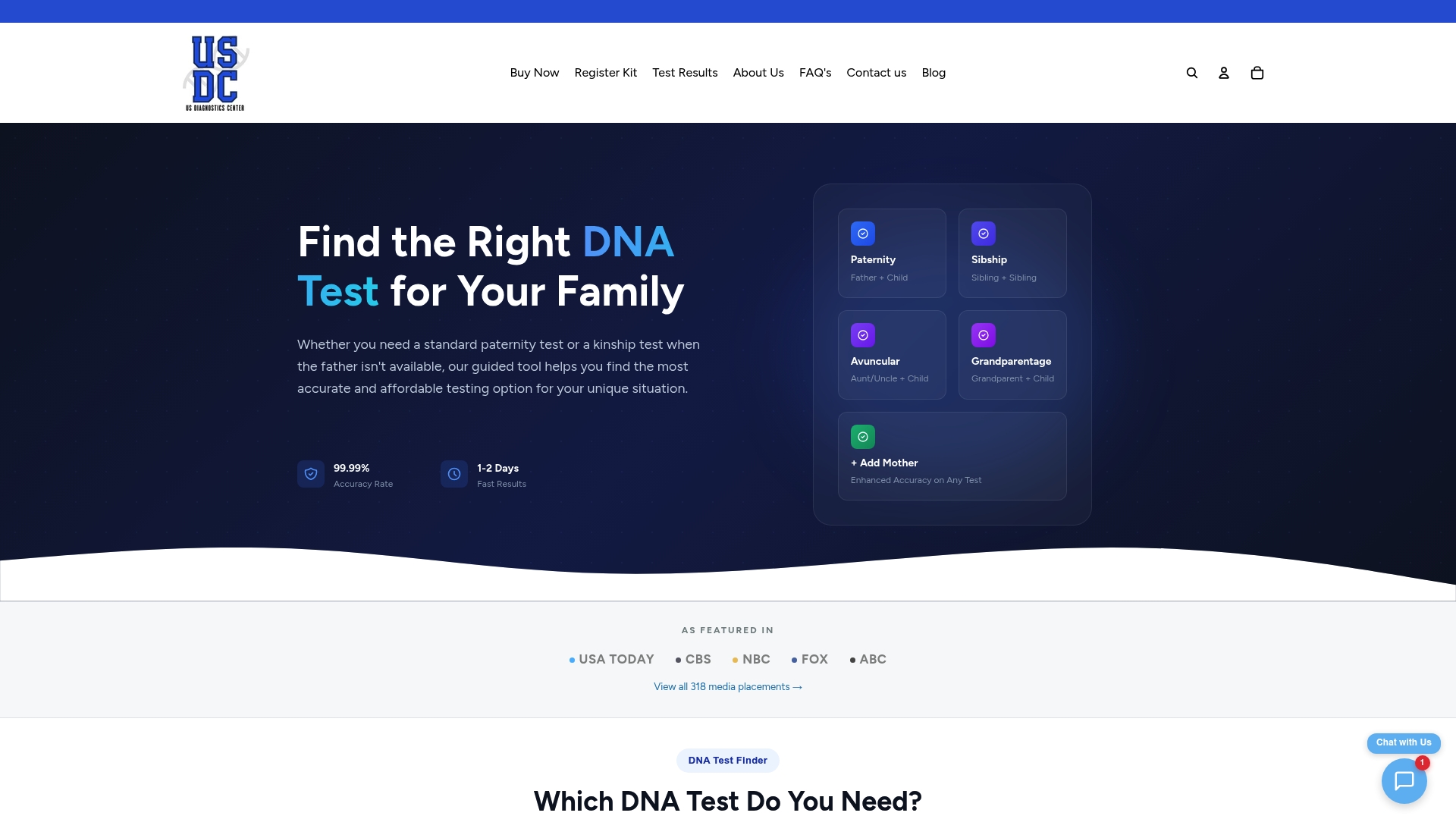
Families seeking personal knowledge about paternity, maternity, or kinship want results they can rely on. US Diagnostics Center currently offers home DNA tests for personal knowledge covering paternity, maternity, sibling, grandparent, and aunt/uncle relationships, with a guided tool that identifies the most accurate and affordable option for each family's specific situation. These tests are for personal knowledge. For court-admissible results, a legal DNA test with witnessed collection and documented chain of custody is required.
Testing uses up to 28 genetic markers, samples are collected via cheek swab with a prepaid return shipping envelope included, and standard results arrive within 7–10 business days. USDC maintains confidentiality and expert support throughout the process. Pricing is published and straightforward: paternity testing starts at $79, maternity at $129, and sibling, grandparent, or aunt/uncle tests at $139. To find the right test for your situation, visit the kinship testing options page and use the guided selector.
FAQ
What does a combination family DNA test include?
A combination family DNA test analyzes samples from multiple family members simultaneously to verify more than one biological relationship, such as paternity and siblingship, within a single testing process using up to 28 genetic markers.
Is a combination DNA test legally admissible in US courts?
Only tests conducted with a formal chain-of-custody process by an AABB-accredited laboratory are accepted by US courts and federal agencies such as USCIS; at-home kits without witnessed collection do not meet this standard.
What if the biological parent cannot provide a sample?
When a direct parent is unavailable, labs can include grandparents, siblings, or aunts and uncles to strengthen the genetic analysis, though results for second-degree relationships carry somewhat lower statistical certainty than parent-child tests.
How accurate are combination family DNA tests?
The industry-accepted standard for parentage testing is 99.5% probability or greater for a conclusine inclusion, with a zero probability indicating a conclusive exclusion.
How long does it take to receive results from US Diagnostics Center?
US Diagnostics Center completes laboratory processing typically in a few business days, with the full order-to-results cycle usually taking 7–10 business days from sample receipt.
Key Takeaways
A combination family DNA test verifies multiple biological relationships at once. Court-admissible results require chain-of-custody documentation and processing by an AABB-accredited laboratory. At-home tests are for personal knowledge only.
| Point | Details |
|---|---|
| Legal admissibility requires chain-of-custody | Witnessed sample collection and unbroken documentation are mandatory; retroactive establishment is not possible. |
| AABB accreditation is the governing standard | USCIS and many state courts accept results only from AABB-accredited laboratories. |
| Accuracy threshold for parentage | 99.5% probability or greater for a conclusive biological relationship determination. |
| Extended family strengthens complex cases | Grandparents, siblings, or aunts and uncles can substitute when a direct parent is unavailable, improving statistical certainty. |
| US Diagnostics Center for family relationship testing | Offers home paternity, sibling, grandparent, and aunt/uncle tests from $79–$139, with up to 28 markers and 7–10 business day results, for personal knowledge. |
Recommended
- Kinship DNA Testing Examples: A Clear Guide | USDC
- USDCTest | DNA Paternity Testing for Peace of Mind
- What Is Biological Kinship Testing: A Family Guide | USDC
This article is part of our Understanding DNA Testing: How It Works and What to Expect guide.


0 comments